Barrel Finishing Machines: Polishing, Deburring and Burnishing
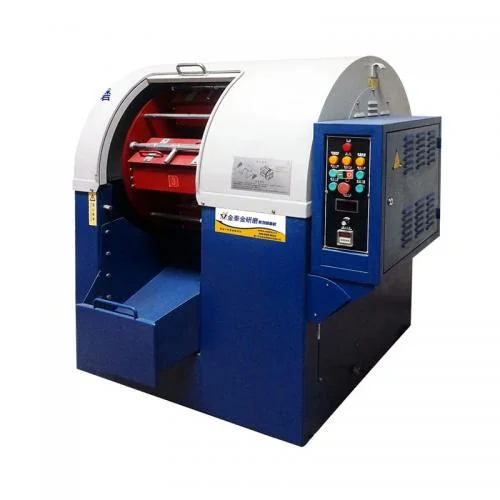
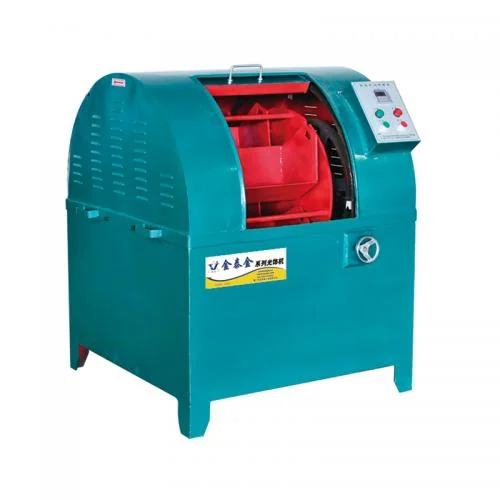
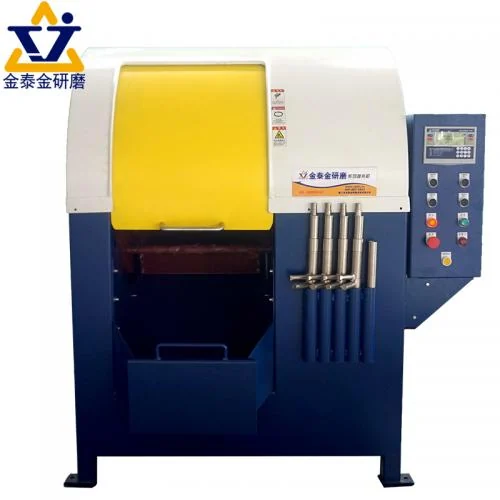
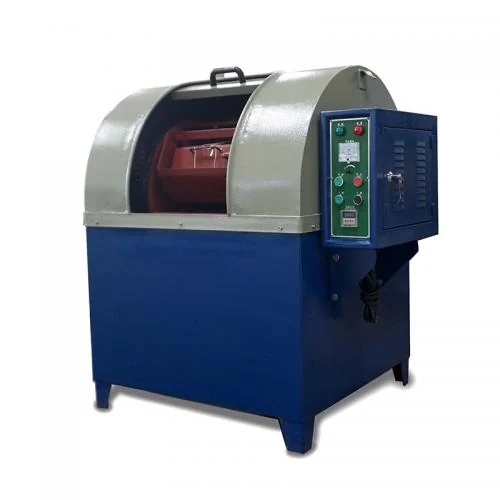
A barrel finishing machine is the oldest form of mass finishing: parts, media and compound are loaded into a barrel, the barrel turns, and the load slides against itself. It is slow by comparison with high-energy processes, but it is also the most forgiving — and that is why it is still the right choice for a large class of work.
How barrel finishing works
The barrel rotates and the media charge climbs the rising wall until the angle of repose is exceeded, then the top layer slides down over the rest. Parts are caught in that sliding layer and are worked by the media as it moves. Three things follow from that mechanism:
- Action is gentle and distributed — nothing is driven hard against the part, so thin sections and soft metals survive.
- Cycle times are long — hours rather than minutes for a comparable result, because the cutting energy per unit time is low.
- Part geometry matters less — the load tumbles as a mass, so parts do not need to circulate individually the way they must in a disc machine.
Wet or dry: the first decision
Barrel finishing runs either wet (water plus compound, sometimes with abrasive media) or dry (media only, or media with a dry polishing compound). The choice changes the whole process:
| Wet barrel finishing | Dry barrel finishing |
|---|
| Media | Ceramic or plastic abrasive media | Walnut shell, corn cob, wood media, or dry compound |
| What it does | Deburring, radiusing, surface refinement | Drying, polishing, absorbing residue, brightening |
| Compound | Cutting or burnishing compound in water | Dry polishing compound or none |
| Best for | Metal parts needing material removal | Delicate surfaces, wood, jewellery, final gloss |
Many production routes use both in sequence: a wet stage to cut and refine, then a dry stage to dry and brighten. The two are not alternatives so much as different stages.
What barrel finishing is good at
| Application | Why the barrel suits it |
|---|
| Deburring batches where the burr is small | Low energy means no risk of edge damage while the burr is removed |
| Burnishing to a bright finish | Steel media and burnishing compound work the surface without cutting it |
| Delicate or thin-walled parts | The distributed action is the gentlest of the mass finishing processes |
| Parts that will not fit a disc or vibratory bowl | The barrel accepts the load as a mass rather than requiring part circulation |
| Drying and polishing after a wet stage | Dry barrel finishing with organic media absorbs moisture and brightens |
Where barrel finishing does not fit
- Heavy burrs or a large radius requirement — the energy is too low. A disc or centrifugal barrel machine will do in minutes what a barrel would need hours to attempt.
- Production throughput targets — long cycles mean low hourly output per barrel. Multiple barrels or a different process are usually the answer.
- Parts that must be inspected individually mid-cycle — a barrel load is processed as a batch, so stopping to inspect one part means stopping the batch.
Choosing a barrel machine
| Variable | What it controls |
|---|
| Barrel volume | The batch mass and the largest part that can tumble freely |
| Barrel geometry | Whether the load slides properly — hexagonal and octagonal barrels tumble differently from round ones |
| Rotation speed | The energy available and whether the load slides or cataracts |
| Barrel material and lining | Whether the barrel itself contaminates the process, and how long it lasts |
| Media and compound | Whether the process cuts, burnishes, or polishes |
The most common specification mistake is sizing the barrel on part dimensions alone. A part that fits inside the barrel may still not tumble — if it cannot be surrounded by media and carried in the sliding layer, the barrel is not processing it.
Barrel versus vibratory versus disc: picking the process
| Process | Energy | Best for | Main limitation |
|---|
| Barrel | Lowest | Gentle deburring, burnishing, delicate parts | Long cycles, low throughput |
| Vibratory | Moderate | General deburring and finishing at production scale | Larger footprint, needs media separation |
| Disc | Highest | Fast deburring of small-to-medium parts | Part size ceiling, risk to fine surfaces |
Specifying a barrel machine for a part
Four inputs decide the machine, and three are about the part:
- Part geometry — largest dimension, whether the part can tumble freely, and any feature that must not be reached by media.
- Incoming condition — burr size, surface condition, and features to preserve.
- Finish target — cutting, burnishing or polishing, and how the result will be inspected.
- Batch quantity — the load mass per cycle and how many cycles are needed.
Frequently asked questions
What is the difference between barrel finishing and tumbling?
They are the same process. "Tumbling" is the general term; "barrel finishing" specifies that the vessel is a barrel. Rotary barrel tumbling is the classic form.
How long does barrel finishing take?
Hours rather than minutes for a comparable result. The exact cycle depends on the burr, the media and the finish target — it is set by a trial, not a table.
Can barrel finishing produce a mirror finish?
Not by cutting alone. A barrel can refine a surface and a burnishing stage can brighten it, but a true mirror on hard metal usually needs a subsequent polishing stage with a finer medium.
What is the difference between wet and dry barrel finishing?
Wet uses water and compound with abrasive media to cut and refine. Dry uses organic media (walnut shell, corn cob, wood) with or without dry compound to dry, absorb residue and brighten. Production routes often use both in sequence.
Can I barrel-finish delicate parts?
Yes — this is the process's strength. A barrel is the gentlest mass finishing method, which is why it is used for thin-walled parts, soft metals and jewellery.
What should be sent for a barrel machine recommendation?
Part material, largest dimension, whether the part can tumble freely, the incoming burr or surface condition, the finish target, and the batch mass. A model recommendation without the part geometry is a guess.
Discuss your workpiece
Send the part details and the finish requirement. The useful inputs are the geometry with features to protect, the starting condition, the finish the part is allowed to have, and how the result will be inspected. The machine and the wet/dry route follow from those.
We manufacture barrel finishing machines and the media and compounds for them. Specifications describe the listed range; confirm the exact configuration and cycle for your part with a trial on representative parts.


 IPv6 network supported



 +86-592-2381506
