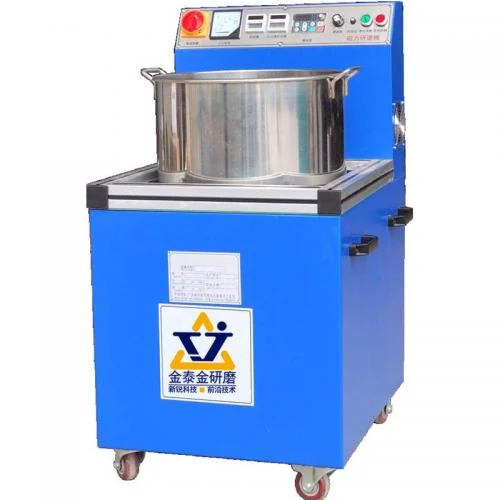
Magnetic finishing machines use magnetic fields to generate a polishing force on small metallic parts. These machines are ideal for small parts that are difficult to polish manually. They use a magnetic field to create a rotating motion that causes the parts to move and rub against each other, as well as abrasive media, inside a container. This motion polishes the surface of the parts and removes any burrs, scratches or other imperfections. Magnetic finishing machines are versatile, efficient, and ideal for small precision parts. They are commonly used in industries such as electronics, jewelry, and medical devices. These machines can polish parts made of a wide range of metals, including steel, brass, and aluminum.
A total of 1 pages
Email : info@surface-polish.com


A magnetic finishing machine processes parts with stainless steel needles driven by a rotating magnetic field. The needles are not media in the usual sense — they are hundreds of small pins that align with the field and move as a flexible brush across the part surface. That is what lets the process reach features that loose media cannot enter.
A set of magnets rotates beneath the working bowl, and the stainless steel needles inside the bowl follow the field as it turns. The needles form a moving bristle-like mass that presses against the part from every direction the field reaches. Three consequences follow:
| Application | Why the magnetic process suits it |
|---|---|
| Deburring cross-holes, slots and thread roots | The needles enter features that media cannot reach |
| Polishing small precision parts | The flexible needle mass follows complex geometry |
| Parts that cannot tumble | Holding the part in the field is enough; it does not need to circulate |
| Medical, jewellery and instrument components | Fine features plus a finish target that needs the needles, not bulk media |
| Surface refinement after machining | The needles work the surface without a heavy cutting action |
| Variable | What it controls |
|---|---|
| Bowl size and field depth | The largest part that can be worked, and how deep the needles can reach |
| Magnetic field strength and rotation speed | The energy available — and therefore how quickly the needles cut |
| Needle size and material | Whether the needles can enter the feature, and whether they mark the surface |
| Compound and dosing | Cleaning, cooling and the final brightness |
| Part holding arrangement | Whether the part is fixtured, held by hand, or free in the bowl |
| Process | Reach | Best for | Main limitation |
|---|---|---|---|
| Magnetic | Into slots, cross-holes, thread roots | Small precision parts with fine features | Slow cutting, part size and material limits |
| Disc | External surfaces of small parts | Fast deburring in volume | Cannot enter fine features |
| Vibratory | General external surfaces | Production-scale general finishing | Media cannot enter small features |
| Barrel | General external surfaces | Gentle deburring and burnishing | Lowest energy, longest cycles |
Stainless steel. Stainless is used because the needles must respond to the magnetic field while resisting corrosion from the compound. Needle size is chosen to suit the feature being worked.
No. The needles cut slowly and are best suited to fine burr and surface refinement. A heavy burr is removed with a higher-energy process first, and the magnetic stage then refines the result.
Yes, up to the depth the field and needle length can reach. This is the process's main advantage over media-based finishing, which cannot enter a small hole at all.
Ferrous parts need assessment because the part itself interacts with the field. Non-magnetic metals are generally straightforward. The needle material and compound must also suit the part material.
No — they solve different problems. Vibratory finishing works external surfaces at production scale; magnetic finishing reaches features that media cannot. Many production routes use both.
Part material (including magnetic properties), the feature to be worked with its dimension, the incoming burr or surface condition, the finish target and how it will be inspected.
Send the part details, the feature that needs work, and the finish requirement. The needle size and machine follow from those. A recommendation without the feature dimension is a guess.
We manufacture magnetic finishing machines and the needles and compounds for them. Specifications describe the listed range; confirm the exact configuration and cycle for your part with a trial on representative parts.
 IPv6 network supported






 +86-592-2381506
