Email : info@surface-polish.com


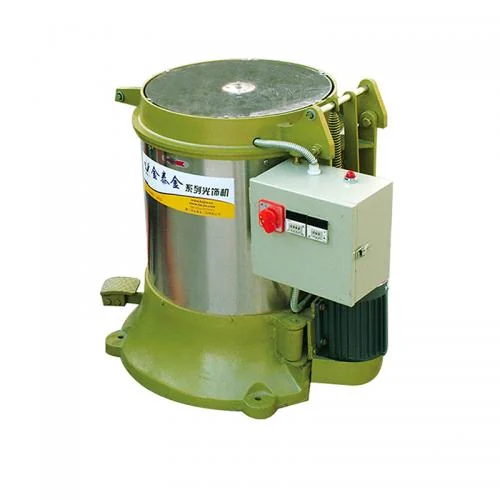
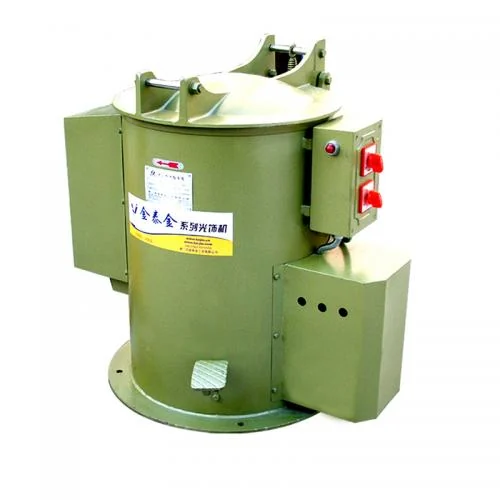
A centrifugal spin dryer removes water and compound residue from parts after a wet finishing stage. It does two things at once: spinning throws bulk water off the part, and hot air drives off the film that remains. Skipping it — or doing it badly — is one of the most common causes of water spots and re-contamination.
After a wet finishing cycle the part leaves the bowl wet, carrying a film of water plus the compound and fines that were in it. If that film is allowed to dry in air, three things happen:
A spin dryer addresses all three by removing the liquid before it can evaporate in place.
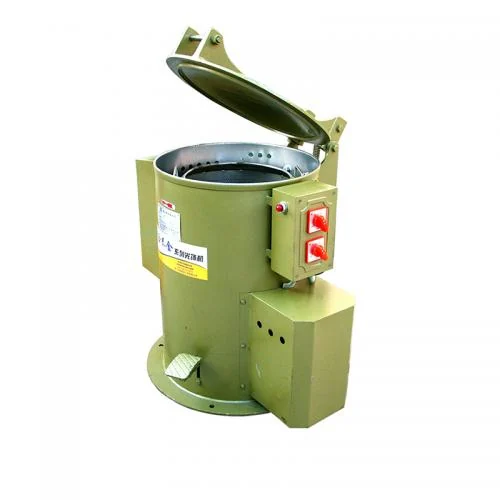
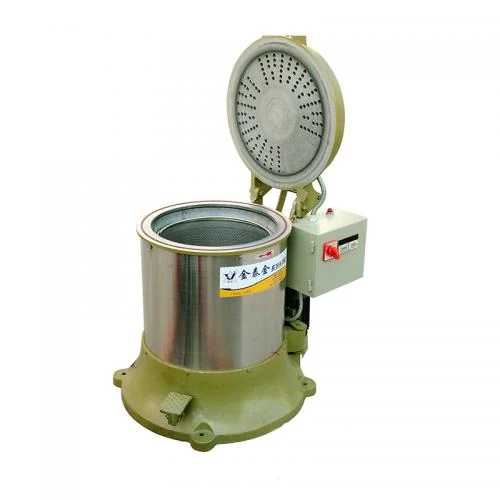
Parts are loaded into a basket which spins at high speed. Centrifugal force throws the bulk liquid off the part and out through the basket wall. Hot air is passed through the spinning load, which removes the residual film. Two mechanisms, one cycle:
| Mechanism | What it removes | What it cannot remove |
|---|---|---|
| Centrifugal force | Bulk water on external surfaces | Liquid held in blind holes, slots and between closely stacked parts |
| Hot-air flow | The residual film, including moisture in features | Compound that has already dried onto the surface |
That division is why the two are combined. Spinning alone leaves a film that spots; hot air alone is slow and consumes more energy. Together the cycle is short and the result is dry.
| Application | Why the spin dryer suits it |
|---|---|
| Batch drying after vibratory or barrel finishing | Short cycle, matches the batch size of the finishing machine |
| Parts with complex geometry | Hot air reaches features that spinning alone cannot clear |
| Removing compound residue before inspection or packing | Leaves the part dry and free of visible film |
| Preventing water spots on polished surfaces | Removes the liquid before it can evaporate in place |
| Variable | What it controls |
|---|---|
| Basket diameter and volume | The batch mass and the largest part that fits |
| Spin speed | The centrifugal force available to throw off bulk liquid |
| Heat source and air temperature | How quickly the residual film is driven off |
| Air flow path | Whether hot air actually passes through the load or only around it |
| Cycle control | Whether spin and heat can be staged separately for the part |
The most common specification mistake is sizing on part dimensions alone. A basket that holds the part may still not clear the liquid if the air flow does not pass through the load — and a dryer that leaves moisture in features has not done its job.
| Method | Speed | Best for | Main limitation |
|---|---|---|---|
| Centrifugal + hot air | Fast | Batch drying after wet finishing | Basket size; trapped liquid in blind cavities |
| Hot air only | Slower | Parts that cannot be spun | Energy cost; long cycle |
| Dry media tumbling | Medium | Drying plus brightening in one stage | Media must suit the part; adds a media handling step |
| Air knife / blow-off | Very fast | Simple external surfaces, in-line | Does not reach features or complex geometry |
If the parts have complex geometry or the finish is visible, yes. Hot air alone is slow and can leave a concentrated film in features. Spinning first removes the bulk liquid and shortens the thermal stage.
Water spots come from liquid evaporating in place, leaving dissolved minerals and compound behind. Either the spin stage is not removing enough bulk liquid, the air temperature is too low, or the rinse water itself is hard.
Partly. It will remove most of the liquid but a blind cavity can hold a plug that only a longer hot-air stage or a change in part orientation will clear. This has to be assessed on the part.
A spin dryer removes liquid. A dry finishing machine (walnut shell, corn cob, wood media) dries and brightens in one stage using media. Some production routes use the spin dryer first, then a dry media stage for gloss.
The risk is handling, not heat. Parts in a basket contact each other, and freshly polished surfaces are vulnerable to that contact. Very fine work may need individual handling rather than a basket load.
Part geometry (especially any feature that holds liquid), batch mass, the surface requirement, and the compound used in the preceding wet stage.
Send the part details and the drying requirement. The useful inputs are the geometry with any liquid-trapping features, the batch mass, and what happens to the part after drying. The machine follows from those.
We manufacture centrifugal spin dryers and the media and compounds for the finishing stages around them. Specifications describe the listed range; confirm the exact configuration and cycle for your part with a trial on representative parts.
 IPv6 network supported



 +86-592-2381506
