Machined 7075-T6 for medical devices in Birmingham, United Kingdom is hard enough to resist cutting but still soft enough to gall, so a handle with a knurled band and a cosmetic shank rarely finishes evenly on a first attempt. SurfacePolish is a cross-border supplier of finishing machines, media and compounds, with a free sample trial on representative parts. This brief is written for a buyer in Birmingham working on medical devices; it describes equipment, media and a scoped sample review, not a local polishing service.
Who defines and verifies the cleanliness, residue and any regulatory requirement, and by what method and limit?
What is the minimum wall thickness and unsupported span, and which internal features could trap media?
What edge radius or chamfer is allowed at each mating, sealing and press-fit feature, and how will it be measured?
Thin aluminium walls are the most common source of trouble in a vibratory or barrel route. Below roughly two millimetres of wall, part-on-part contact and media impact bend a rib, peen a flange or drive small media into a pocket where it wedges and stays. Blind holes, cross-drillings, undercuts, fine threads and knurled bands all trap media, and a lodged piece of ceramic later shows up as a rattle, a scored bore or a rejected assembly. Count the features that cannot be inspected easily from outside, then decide whether they need masking, a plug, a fixture that shields them or a different route entirely. A thin-wall housing that survives one cycle may not survive a hundred, so ask for wall thickness and unsupported span rather than assuming them.
Aluminium reacts to both strong acid and strong alkali, so compound chemistry deserves more care here than on steel. A mildly alkaline or near-neutral cleaning and burnishing compound with a suitable inhibitor is the usual starting point for aluminium, because a strongly alkaline product etches the surface, darkens it and attacks exposed edges, while a strongly acidic one can pit it and leave smut. The compound also carries debris and controls foam, lubricity and rinsing, so concentration and flow rate matter as much as family. Water quality is part of the chemistry: hard water leaves mineral spotting and deposits, chloride content in the supply raises a corrosion concern on aluminium, and a recirculated system concentrates fines and dissolved metal over time. Set a working range for concentration, pH and flow, then monitor and correct it during the shift.
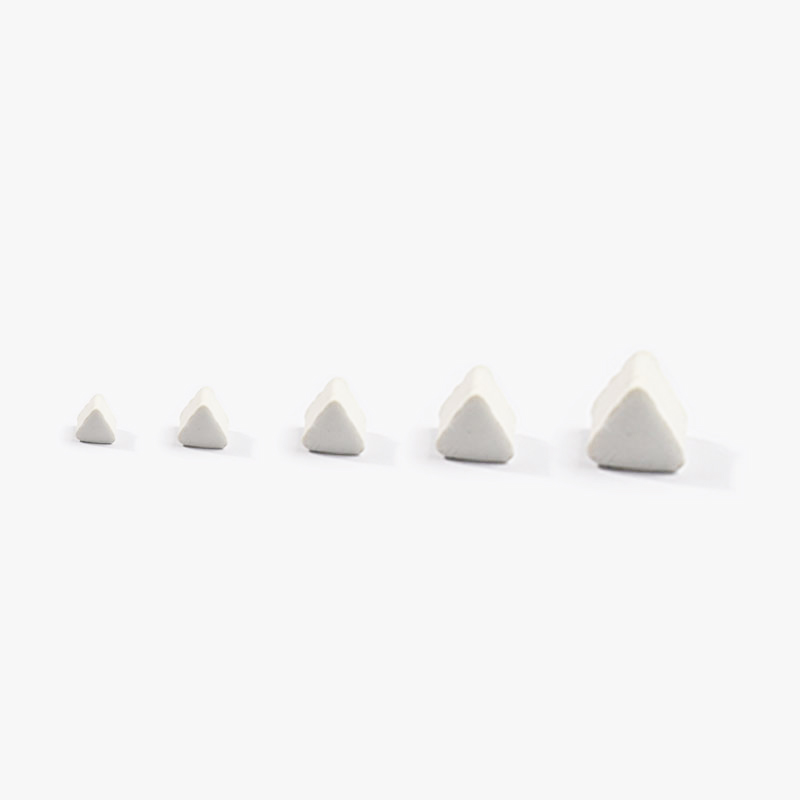
| Media | Best fit | Watch out for |
|---|---|---|
| Alumina-based ceramic media, low-density, cylindrical and pin shapes | Internal bores, slots and cross-holes on small aluminium components that a rounded tumbling body cannot reach | Pin and cylinder shapes can wedge in a bore or a slot; confirm retrieval and inspection before running a production batch |
| Ceramic media, angle-cut triangles, medium size class | Heavy-cut deburring on cast or robust aluminium parts where the machined surface will be finished again or is not appearance graded | Rounds functional edges quickly and can chip or peen thin walls; not suitable where a sealing land or press fit is exposed |
| Dry media, walnut shell, fine grade | Dry polishing, light surface cleaning and preparation before anodising or laser marking on aluminium parts | Shell dust must be extracted and the part cleaned, or the residue interferes with marking, bonding or a later coating step |
| Plastic-bonded media, light to medium abrasive grade, cone and triangle shapes | General deburring and satin finishing on 6061 and 7075 where galling risk rules out dense ceramic | Wears quickly and loses edge definition; cut rate drops as the charge ages and the cosmetic result drifts unless media is screened and topped up |
A round bowl vibrator suits small to medium aluminium components that tumble freely and pass a media gate: instrument handles, ferrules, cover plates, brackets. It gives good part-to-part uniformity because the whole load circulates through the same energy field, and it is easy to automate with compound flow and a discharge gate. The limit is size and shape. A long extruded frame, a tall manifold or a part with a protruding boss will not circulate well in a bowl and will shadow itself, leaving the sheltered side unfinished. Tub vibrators handle long and large parts because the working channel is linear and the part can be oriented; the trade-off is slower uniform coverage and a greater tendency for parts to settle in one attitude. Match machine to part envelope first, then to finish.
| Machine route | Where it fits | What it will not do |
|---|---|---|
| Tub vibrator | Long and large aluminium parts such as extruded frames and housings that can be oriented in a linear working channel | Slower uniform coverage, a tendency for parts to settle in one attitude, and greater floor space and media volume than a bowl |
| Rotary barrel finishing machine | Gentle, low-energy deburring of small precise aluminium parts in high volume, including thin and light components | Longer cycles for the same result; flat or light parts may slide rather than tumble, and an overloaded barrel stops working the load |
| Dry polishing machine and dryer | Post-wet drying and dry polishing of aluminium parts before anodising, laser marking, bonding or packaging | Does not remove a burr or refine a surface on its own; residual media dust and incomplete drying still cause marking and coating defects |
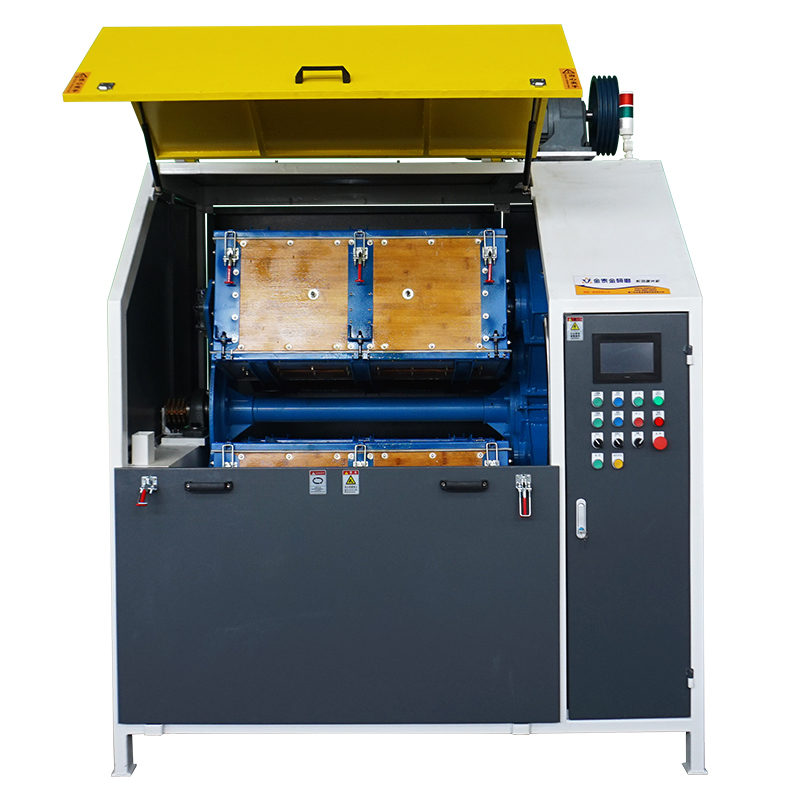
| Centrifugal barrel finishing machine | Short, controlled cycles producing a fine satin finish and a defined edge on small to medium aluminium device parts | High energy bends thin walls and distorts light sections; barrel geometry limits part length and pieces per run |
Galling is the characteristic failure of a mechanical cycle on soft aluminium. Under pressure and without adequate lubrication, aluminium transfers to the media and to neighbouring parts, producing a torn, smeared or picked surface that looks worse than the starting condition. It shows first on edges, on high spots left by machining, and on any face where two aluminium parts rub. Temperature, compound lubricity, load ratio and media weight all push toward it, and a hot, heavy, under-lubricated charge will gall a batch that ran cleanly the day before. Check with low-angle lighting across the surface to reveal smears and cold welds, and confirm with a white cloth for transferred metal. Prevention is mostly charge discipline: lighter media on cosmetic faces, adequate compound flow, a controlled load, and segregation.
| Failure mode | Likely cause | How to catch it |
|---|---|---|
| Etched, darkened or chalky surface after wet finishing | Compound pH or concentration outside the aluminium working range, over-alkaline product, long dwell in a hot solution, exhausted compound | Compare a dried part against a retained reference under the customer's lighting, and log compound pH, concentration and temperature for the batch |
| Damaged thread or media wedged in a thread root | Threads left exposed to the media field, sharp media entering the crest, insufficient plugging or masking of ports before the cycle | Run a go and no-go gauge through every sampled thread and inspect the root with a borescope or a thread impression |
| Dents, peening marks or a hammered texture from part-on-part contact | Excessive energy for the part mass, under- or over-loaded charge, no fixture to control part attitude, hard or oversized media | Inspect a full-face view under low-angle light and a cross-section of a dent under a toolmaker's microscope to confirm plastic deformation |
| Water spotting, rings or mineral staining after drying | Hard rinse water, slow or incomplete dry, droplets trapped in blind holes or under a flange, no final deionised rinse | Inspect the dried part in raking light against a reference, and check rinse-water hardness and conductivity records for the shift |
Birmingham sits inside the West Midlands production region whose robotics and autonomous systems adoption Make UK studied jointly with the West Midlands Combined Authority and the West Midlands RAS Cluster, based on survey responses from over 100 manufacturers of all sizes. The West Midlands Combined Authority is the region's statutory economic body, and the city is the base of the Greater Birmingham Chambers of Commerce. Freight is anchored by ABP's Hams Hall Rail Freight Terminal, 13 km from Birmingham, which handles deep-sea and short-sea traffic to and from Southampton, Tilbury and Felixstowe as well as Channel Tunnel traffic. Make UK's regional outlook records that all English regions have now exceeded their 2019 manufacturing output levels, with aerospace and defence investment fuelling growth in the strongest-performing areas.
The nearest part of that base to this brief is automotive: The West Midlands production base that Make UK studied jointly with the West Midlands Combined Authority covers the region's vehicle-building supply chain, and ABP links Birmingham to deep-sea and short-sea container traffic through the Hams Hall rail terminal.
Deburring and edge control sit between machining and assembly in a production base that is being pushed towards automation: Make UK and WMCA commissioned the West Midlands RAS study specifically because adoption is uneven across the region's manufacturers. Because incoming machines and media move through an inland rail terminal rather than a local seaport, the practical issues for a Birmingham plant are inland container booking, offloading and media handling rather than port-side clearance.
Before choosing a machine or media, the Birmingham buyer should define which edge or surface condition is actually acceptance-critical on the part, and confirm who will hold the UKCA/CE technical file and Declaration of Conformity once the equipment is installed in the West Midlands.
Freight context: Hams Hall Rail Freight Terminal (ABP-owned, Edison Road, Coleshill, Birmingham; operated by Maritime Transport), Birmingham Airport. ABP describes Hams Hall as 'one of the country's busiest inland rail freight terminal' and states that the 11ha site handles deep-sea and short-sea traffic to and from ports such as Southampton, Tilbury and Felixstowe, plus traffic via the Channel Tunnel and domestic traffic from Scotland. Machines or sample parts consigned to Birmingham can therefore be cleared through a southern container port and moved inland by rail.
Importers need a GB-prefixed Economic Operators Registration and Identification (EORI) number, an import declaration carrying the correct commodity code, and retained commercial invoices plus the Import VAT Certificate (C79) so import VAT can be reclaimed. Machinery placed on the Great Britain market must be marked UKCA or CE: the manufacturer must draw up and retain technical documentation including a Declaration of Conformity, apply the correct marking with identification details, and cooperate with market surveillance; an authorised representative must be established in the UK. Under the Product Safety and Metrology (Amendment) Regulations 2024 the UK continues to recognise CE marking alongside or in place of UKCA for the Great Britain market, so either route can be used for most product types. Duty and import VAT are calculated from the customs value declared, and the commodity code also determines whether an import licence is needed.
China does not appear in the alphabetical list of trade agreements in effect published by the Department for Business and Trade, so Chinese-origin machinery imported into the UK cannot claim a preferential agreement rate. Duty is instead determined by the commodity code declared on the import declaration, and the UK's customs authority is HM Revenue and Customs (HMRC), which ONS also names as the largest single data source behind UK trade-in-goods statistics. Because a GB-prefixed EORI number is a precondition for importing into England, Scotland or Wales, a Chinese seller's UK buyer must already hold that registration before any machine ships.
SurfacePolish supplies from Xiamen, China. The buyer's own destination rules, conformity marking, tariff classification and documentation responsibilities stay with the buyer; confirm them against the authorities named above before ordering.
A roughness number without a location and a cut-off is not a specification. On an aluminium device component, name each surface that carries a roughness requirement, the direction of measurement relative to the machining or polishing marks, and the cut-off and evaluation length to be used, since a profile measured over a short length with a short cut-off reads differently from one measured across the full face. ISO 4287 and ISO 4288 describe profile parameters and the rules for selecting cut-off, ISO 25178 covers areal texture if a three-dimensional description is needed, and ASME B46.1 is the equivalent North American reference. Aluminium is soft, so stylus force and tip radius can mark the surface being measured; agree the instrument and the force, or use an optical method, and retain the measured part as the physical reference.
The first good batch is not the hard part; holding the finish over weeks is. Media wear, the charge volume falls, fines accumulate in the compound, screens clog and the rinse water changes, so the same timer produces a different result as the charge ages. Drift shows first as a slightly duller surface, a burr that reappears at a bore exit, or a finish that no longer matches the retained reference. Control it with a media top-up and replacement rule based on screening rather than the calendar, a compound concentration and pH check each shift, a rinse-water quality check, and a first-article comparison against the retained reference at the start of every batch. Any change of media supplier, compound, water supply or machine setting invalidates the previous baseline and should be treated as a new first-article event.

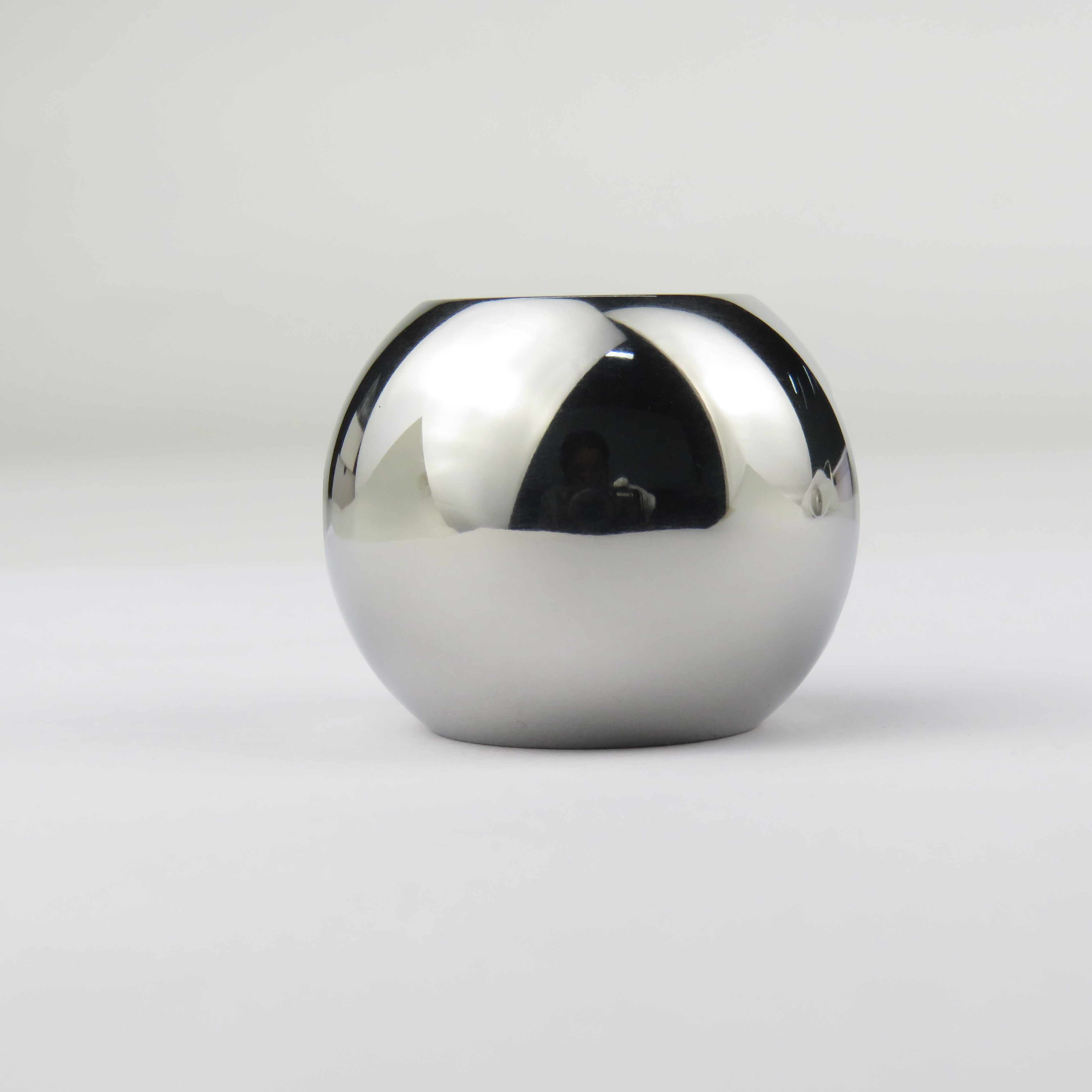
Laser marking interacts with surface texture, so contrast depends on whether the surface is directional, random satin or bright. A strong directional finish from a tub or a linishing step can produce a marking that reads differently when the part is turned, while a uniform random texture marks more consistently. Residue and embedded media also interfere, because the marking energy meets a contaminated surface. For a marked cover plate in United Kingdom, the practical sequence is to fix the finish first, then qualify the marking programme on finished parts, and to check the mark under the lighting the end user will use rather than a bench lamp.
The buyer defines the requirement and the check. Methods include visual inspection of internal features under magnification or with a borescope, a wipe test with a defined solvent and a white substrate, gravimetric non-volatile residue on a rinse sample, and rinse-water conductivity where the assembly is sensitive. Blind holes, threads and press fits retain residue and should be sampled specifically. A residue limit, a validated cleaning process, biocompatibility data or a sterility claim is the buyer's to set and verify against their own specification. Equipment supply and a sample trial do not establish any of those, and no finishing route substitutes for the buyer's own quality system.
Start with media that are softer or lighter than the workpiece is likely to tolerate: plastic-bonded media in a light or medium abrasive grade, or a low-density ceramic. Dense ceramic and steel media that cut steel efficiently will embed, smear or gall aluminium and can implant iron that later shows as staining. Media weight, compound lubricity and load ratio matter as much as family, because a heavy, hot, under-lubricated charge will gall parts even with the right media. A buyer in United Kingdom should treat media selection as a two-stage question: what removes the burr, and what produces the final cosmetic surface without transfer.
Use Birmingham, United Kingdom as the destination on the enquiry and state whether the deliverable is equipment, media and compound, a representative sample review or a line concept. A destination does not imply local stock, a local service point or a local delivery time.
Equipment placed on the Great Britain market must carry UKCA or CE marking with a Declaration of Conformity held by the manufacturer or a UK-established authorised representative, and HSE's work equipment and machinery regime governs guarding and safe operation on site. COSHH applies to ceramic, plastic or steel media, to finishing compounds and to the dust and effluent the process produces.
Sources were retrieved on 2026-09-29 and describe the local industrial and trade context only. They do not evidence any SurfacePolish project, shipment, installation or service in Birmingham.
The buyer finds that aggressive media tears the 7075 surface and closes the pivot bore edge, and needs a gentler direction that still removes machining marks.
Send the material, dimensions, approximate weight, batch quantity, the incoming condition and photographs of the difficult features. Mark which features must not be contacted by media and state how the result will be inspected. This form carries source reference PSEO-0203; quote it if you prefer an additional manual reference.
Open the SurfacePolish enquiry form Email a prepared enquiry
No price, lead time, certification or result is promised here. Confirm whether a sample trial is available for the specific part and what the trial can and cannot show.
Page PSEO-0203 · revised 2026-09-29 · cross-border equipment, media and scoped sample review. City context is sourced and cited above.
Use this local checker to identify missing part and inspection information. It prepares a technical-review brief; it does not approve a machine, process recipe or production result.
Complete the part details to prepare a review brief.
Email : info@surface-polish.com


 IPv6 network supported


 +86-592-2381506