A die-cast aluminium manifold for medical devices carries porosity that holds liquid and releases it later, so a buyer in Detroit, United States often sees bloom or staining days after the parts were finished. SurfacePolish supplies finishing machines, media and compounds across borders and discusses a scoped line concept with a free sample trial on the buyer's castings. This brief is written for a buyer in Detroit working on medical devices; it describes equipment, media and a scoped sample review, not a local polishing service.
What are the alloy and temper, and has machining, casting, welding or heat treatment already changed the surface hardness and porosity?
What edge radius or chamfer is allowed at each mating, sealing and press-fit feature, and how will it be measured?
What is the minimum wall thickness and unsupported span, and which internal features could trap media?
Aluminium is a family, and the finishing window moves with alloy and temper. Wrought 6061 in T6 cuts and polishes predictably and holds a uniform finish, which is why it dominates machined device hardware. Wrought 7075 is stronger but harder, more prone to tearing and to differential finishing around machining marks, and it needs gentler media and shorter high-energy contact. Cast aluminium behaves differently again: surface porosity, cold shuts and a hard as-cast skin mean a casting can absorb compound into pores and bleed it out later, and an energetic cycle opens pores that machining had closed. Annealed or solution-treated stock smears under media where the same alloy in T6 would cut cleanly. Record alloy, temper and heat-treatment state before media is chosen rather than after the first batch disappoints.
Magnetic finishing works on small aluminium parts with fine internal features, using a magnetic field to drive small pins or abrasive media through holes, slots and recesses that a tumbling load cannot reach. It is useful on small fittings, valve spools, connector components and parts with internal cross-holes, and it can be gentle enough for thin sections if field strength and cycle are controlled. Its limits are size and throughput: the working envelope is small and the process suits a narrow part family rather than a mixed batch, and fine media or pins lodge in blind features just as tumbling media do, so retrieval and inspection matter. Dry polishing machines and dryers handle the post-wet step, removing water from blind holes before anodising or laser marking, where a trapped droplet becomes a stain or a marking defect.
| Machine route | Where it fits | What it will not do |
|---|---|---|
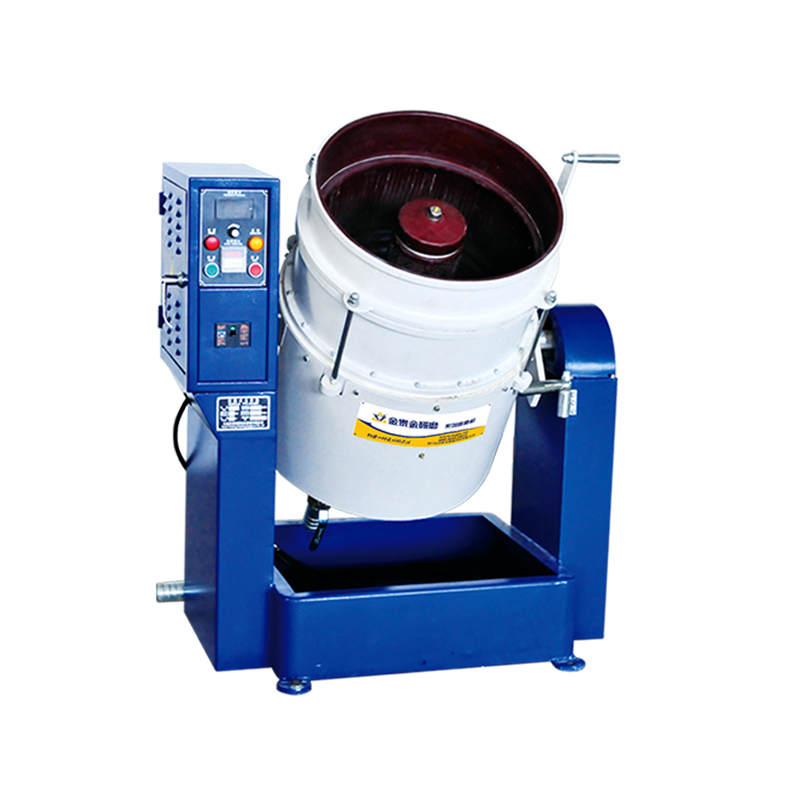
| Disc finishing machine | Fast burr removal and edge radiusing on robust aluminium parts where a short cycle and high material removal matter most | High part-on-part contact and impingement risk; smears soft 6061, is hard to localise, and adds fixturing labour to every cycle |
| Vibratory bowl finishing machine | Small to medium aluminium components that tumble freely: ferrules, handles, brackets and cover plates needing uniform deburring or satin finishing | Long, tall or heavily recessed parts shadow themselves and finish unevenly; part envelope must fit free circulation in the bowl |
| Dry polishing machine and dryer | Post-wet drying and dry polishing of aluminium parts before anodising, laser marking, bonding or packaging | Does not remove a burr or refine a surface on its own; residual media dust and incomplete drying still cause marking and coating defects |
| Grinding finishing machine | Higher material removal on aluminium parts that need a heavy burr or a pronounced chamfer removed before a gentler finishing step | Aggressive on soft aluminium, difficult to control on cosmetic faces and functional edges, and not a finishing step on its own |
Aluminium reacts to both strong acid and strong alkali, so compound chemistry deserves more care here than on steel. A mildly alkaline or near-neutral cleaning and burnishing compound with a suitable inhibitor is the usual starting point for aluminium, because a strongly alkaline product etches the surface, darkens it and attacks exposed edges, while a strongly acidic one can pit it and leave smut. The compound also carries debris and controls foam, lubricity and rinsing, so concentration and flow rate matter as much as family. Water quality is part of the chemistry: hard water leaves mineral spotting and deposits, chloride content in the supply raises a corrosion concern on aluminium, and a recirculated system concentrates fines and dissolved metal over time. Set a working range for concentration, pH and flow, then monitor and correct it during the shift.
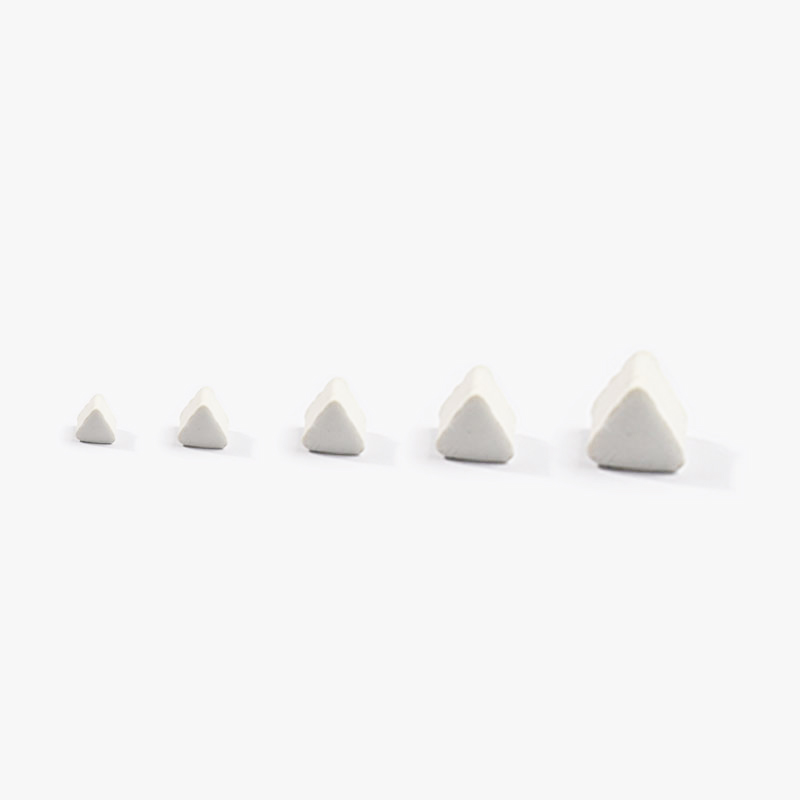
| Media | Best fit | Watch out for |
|---|---|---|
| Ceramic media, spheres and low-density ceramic, fine size class | Bright surface development and light edge work on small aluminium components with mixed cosmetic and internal features | Fine media lodges in blind holes, cross-drillings and thin-wall pockets and is harder to screen out of the load |
| Ceramic media, angle-cut triangles, medium size class | Heavy-cut deburring on cast or robust aluminium parts where the machined surface will be finished again or is not appearance graded | Rounds functional edges quickly and can chip or peen thin walls; not suitable where a sealing land or press fit is exposed |
| Dry media, corn cob with a polishing compound charge | Final dry polish and drying assistance on small aluminium parts where a wet rinse and dry would leave spotting | Compound loading saturates with use and the media cakes; the charge needs regular replacement, and soft aluminium can still smear |
| Plastic-bonded media, light to medium abrasive grade, cone and triangle shapes | General deburring and satin finishing on 6061 and 7075 where galling risk rules out dense ceramic | Wears quickly and loses edge definition; cut rate drops as the charge ages and the cosmetic result drifts unless media is screened and topped up |
Media cannot tell a cosmetic edge from a sealing edge, so a cycle that breaks a burr nicely on the outside of a housing can round a seal land, a dowel bore or a press-fit shoulder until it no longer functions. The drift is gradual and cumulative: each pass removes a little more material, and a batch that was within tolerance at the start of a media charge may be outside it by the end. Watch for a seal face that has lost its flat land, a bore edge closed to a radius, or a chamfer grown past the drawing. Detect it with an optical comparator or radius gauge on a cross-section, or by measuring the feature with a CMM before and after. Protection comes from shielding the functional edge, rounder and lighter media, and a first-article check.
| Failure mode | Likely cause | How to catch it |
|---|---|---|
| Galled, smeared or picked surface with transferred aluminium | Media too heavy or too dense for the alloy, insufficient compound lubricity, hot or overloaded charge, aluminium parts rubbing against each other | Inspect under low-angle directional light for smears and cold welds, then wipe with a white lint-free cloth to reveal transferred metal |
| Dents, peening marks or a hammered texture from part-on-part contact | Excessive energy for the part mass, under- or over-loaded charge, no fixture to control part attitude, hard or oversized media | Inspect a full-face view under low-angle light and a cross-section of a dent under a toolmaker's microscope to confirm plastic deformation |
| Etched, darkened or chalky surface after wet finishing | Compound pH or concentration outside the aluminium working range, over-alkaline product, long dwell in a hot solution, exhausted compound | Compare a dried part against a retained reference under the customer's lighting, and log compound pH, concentration and temperature for the batch |
| Finish bloom or speckle, or poor laser mark contrast, revealed after anodising or marking | Embedded media, a silicate or residue film, a directional texture that marks unevenly, or an oxide layer from a slow dry | Evaluate the appearance on a coated or marked sample rather than bare metal, and compare marking contrast on parts from different positions in the load |
Detroit's current industrial policy is explicitly a reindustrialisation programme built on automotive manufacturing: the city received two U.S. Economic Development Administration grants totalling about $4.1 million, of which a $3,197,160 EDA investment supports the Georgia Street redevelopment and expansion as part of the I-94 Industrial Corridor Redevelopment Project, which the city expects to yield more than 600 new jobs and $120 million in private investment. The stated city goal is 5,000 new jobs for Detroiters over five years, with industrial and logistics business attraction and the identification and preparation of industrial sites and districts as the primary elements of the work. The state economic-development agency frames Michigan as competing for and winning projects in next-generation industries such as data analytics and manufacturing, and in September 2026 announced expansions in Oakland County, part of metro Detroit, including a new Geotab facility in Madison Heights for vehicle data and sustainable mobility. Automation Alley, based in the metro, positions itself as Michigan's digital-transformation insight centre supporting the state's technology and manufacturing businesses.
The nearest part of that base to this brief is automation: Automation Alley, based in metro Detroit, describes itself as Michigan's Digital Transformation Insight Center and supports the technology and manufacturing businesses in the state, with an Industry 4.0 focus.
Automotive and supplier work is where deburring and edge control are hardest to avoid: transmission, engine and machined-housing parts, stamped brackets, and electrified-drivetrain and battery-enclosure components all carry burr, sharp-edge and Ra requirements that are checked before assembly. Because the supplier base runs both high-volume and low-volume programmes, media and compound selection turns on whether the part is aluminium, hardened steel or stainless, and on whether the burr is a machining burr or a stamping/blanking burr with a rolled edge.
The decision to settle first is which burr type dominates the part family - a machining burr on a turned or milled part, or a stamping/blanking burr with a rolled edge - and whether the print controls burr height, edge radius or Ra, because those three answers select different media shapes and compound chemistry.
Freight context: I-94 Industrial Corridor, Detroit, Oakland County International Airport (Waterford, Oakland County). Detroit's reindustrialisation programme is organised around industrial and logistics business attraction and the preparation of industrial sites and districts, with the I-94 Industrial Corridor as the named cluster. Metro Detroit is a US-Canada road, rail and Great Lakes crossing point, and Oakland County - the northern half of the metro - operates its own general-aviation airports. Imported machinery and sample parts would be entered through a US port of entry under CBP entry procedures.
The customs authority is U.S. Customs and Border Protection (CBP), part of the Department of Homeland Security. The importer of record files an entry and then an entry summary (CBP Form 7501): '"Entry Summary" refers to the documentation necessary to enable U.S. Customs and Border Protection to assess duties, collect statistics, and determine whether other requirements of law have been met.' Classification is made in the Harmonized Tariff Schedule of the United States, and an importer may request a written CBP ruling on the correct HTSUS classification and rate of duty, which is the practical way to confirm the treatment of a finishing machine before shipment. Every article of foreign origin must be marked with the English name of its country of origin 'in a conspicuous place as legibly, indelibly, and permanently as the nature of the article (or container) will permit' under 19 U.S.C. 1304 and 19 CFR 134.11. The $800 de minimis (Section 321) exemption is no longer available for ordinary freight: CBP suspended it indefinitely for all modes other than the international postal network effective 24 June 2026, so even low-value sample parts and media must go through formal or informal entry and pay applicable duty. General US industry practice is that there is no single machinery conformity mark comparable to the EU's CE marking; buyers instead verify electrical components and control panels, machine guarding against workplace-safety requirements, and any customer-specific qualification.
Business is conducted in US English. Units matter: US drawings and purchase orders frequently use inches, microinch Ra and US gallons, and a supplier that quotes only metric can be asked to reissue documentation. Buyers are US legal entities with an EIN and expect an identifiable contracting entity, a correct HTSUS classification, a commercial invoice, packing list and bill of lading, country-of-origin marking, and an importer of record for customs. Procurement is normally evidence-driven: process selection is expected to be justified by a trial run on the buyer's own sample parts with measured results (burr height, edge radius, Ra, cleanliness) and by media and compound data sheets, rather than by a capability claim. Payment terms in general US industrial practice are open account with net-30 to net-60 terms for established buyers, with letters of credit or advance payment more common for a first order from a new overseas supplier; no US buyer assumes Incoterms, warranty terms or spare-parts lead times unless they are stated in the quotation.
SurfacePolish supplies from Xiamen, China. The buyer's own destination rules, conformity marking, tariff classification and documentation responsibilities stay with the buyer; confirm them against the authorities named above before ordering.
Residue requirements on a device component come from the buyer's own specification, not from a finishing route, and they should be stated as a measurable limit before parts are accepted. Practical checks include visual inspection of internal features under magnification or with a borescope, a wipe test with a defined solvent and a white substrate, a gravimetric non-volatile residue determination on a rinse sample, and a rinse-water conductivity or particulate count where the assembly is sensitive. Blind holes, threads and press fits are the features that retain residue, so sample them specifically rather than only a flat exterior face. If a validated cleaning process, biocompatibility data or a sterility claim is needed, that work belongs to the buyer's own quality system.
A sample trial produces observations on the parts that were tested, under the settings that were used, on the equipment that ran them. It does not guarantee a roughness value, an appearance grade, an edge radius, a dimensional result, a cycle time, a capacity or a production cost, and it does not qualify, approve or validate a process for a medical device or any regulated application. It cannot prove biocompatibility, cleanability, sterility, corrosion life or a cleaning validation, and it does not create a specification the buyer can rely on for regulatory purposes. Those determinations belong to the buyer's own engineering and quality functions, working to their own requirements. What a trial can do is show whether a mechanical route is plausible for a part and which media and compound direction is worth pursuing.
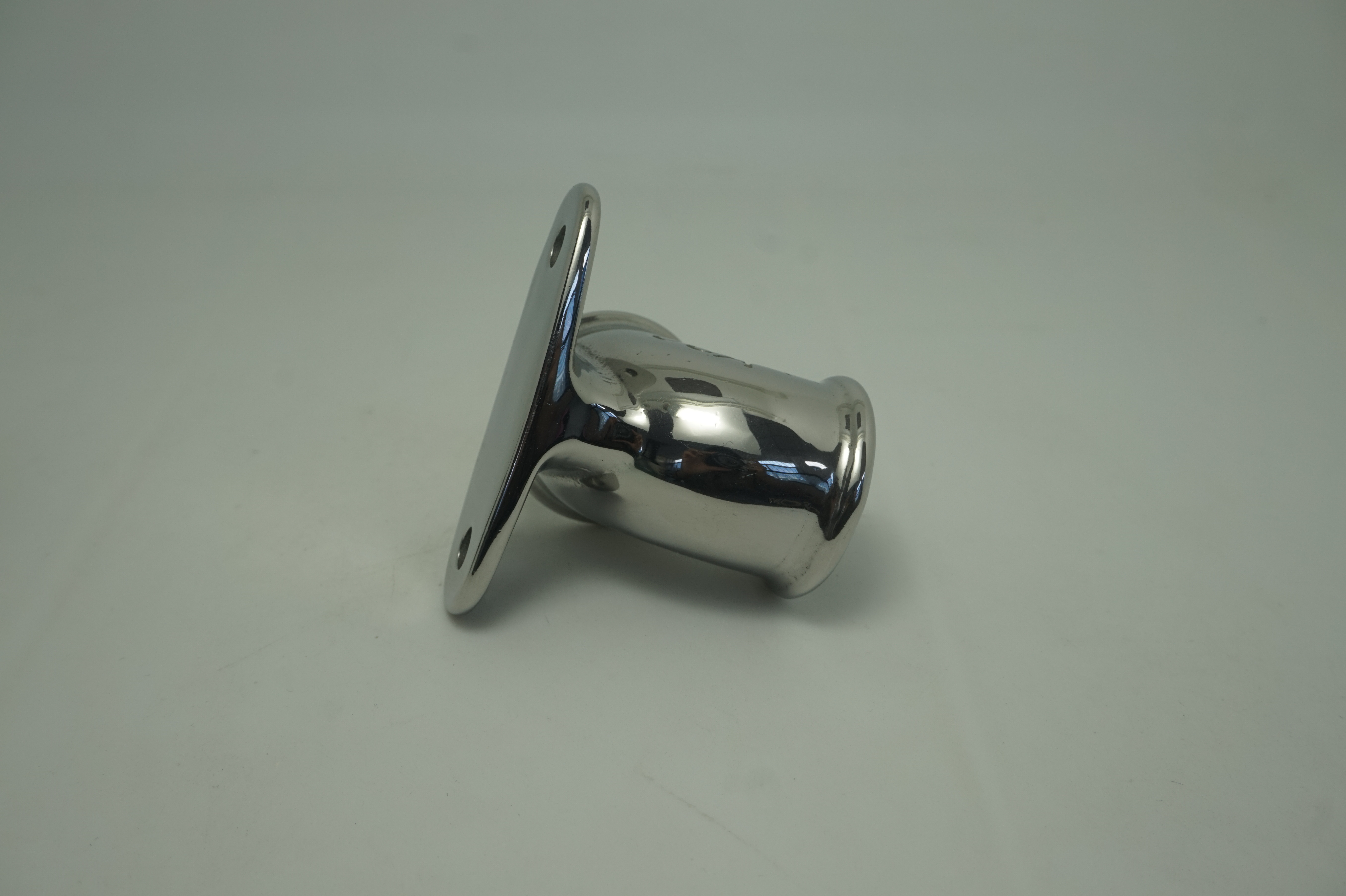
It will if the edge is exposed to the media for long enough. Media cannot distinguish a cosmetic edge from a seal land, a dowel bore or a press-fit shoulder, and rounding accumulates gradually, so a batch inside tolerance at the start of a media charge can be outside it later. Protection comes from shielding or masking the functional edge, using rounder and lighter media, shortening the cycle, and checking the feature with an optical comparator, radius gauge or CMM rather than by eye. A buyer in United States should state the allowed edge radius per feature on the drawing, because a blanket edge-break note will be read literally.
Laser marking interacts with surface texture, so contrast depends on whether the surface is directional, random satin or bright. A strong directional finish from a tub or a linishing step can produce a marking that reads differently when the part is turned, while a uniform random texture marks more consistently. Residue and embedded media also interfere, because the marking energy meets a contaminated surface. For a marked cover plate in United States, the practical sequence is to fix the finish first, then qualify the marking programme on finished parts, and to check the mark under the lighting the end user will use rather than a bench lamp.
Keep the aluminium loop physically separate. Steel media, steel barrels, worn machine parts and shared screening equipment all transfer iron to a soft aluminium surface, and the result shows as black smut, dark specks or a galvanic couple that becomes visible under a coating or after anodising. Dedicated media, a dedicated barrel or bowl liner, separate screens and separate storage are the practical controls, along with a check of the finished surface under directional light. For a plant in United States running both steel and aluminium work, the segregation rule needs to cover media storage and top-up stocks, not only the machine, because a shared media bin reintroduces the contamination.
Use Detroit, United States as the destination on the enquiry and state whether the deliverable is equipment, media and compound, a representative sample review or a line concept. A destination does not imply local stock, a local service point or a local delivery time.
A Detroit buyer works in the US voluntary-consensus system coordinated by ANSI, and in automotive work the binding requirements are normally the vehicle manufacturer's own supplier and part-approval requirements rather than a single national finishing standard. Burr height, edge radius and Ra are set on the drawing or in the customer specification, so the finishing process has to be documented against the customer's acceptance criteria.
Sources were retrieved on 2026-09-29 and describe the local industrial and trade context only. They do not evidence any SurfacePolish project, shipment, installation or service in Detroit.
The buyer is getting compound bleed-out and dark bloom from the casting pores after finishing, and media is wedging in the blind bosses.
Send the material, dimensions, approximate weight, batch quantity, the incoming condition and photographs of the difficult features. Mark which features must not be contacted by media and state how the result will be inspected. This form carries source reference PSEO-0013; quote it if you prefer an additional manual reference.
Open the SurfacePolish enquiry form Email a prepared enquiry
No price, lead time, certification or result is promised here. Confirm whether a sample trial is available for the specific part and what the trial can and cannot show.
Page PSEO-0013 · revised 2026-09-29 · cross-border equipment, media and scoped sample review. City context is sourced and cited above.
Use this local checker to identify missing part and inspection information. It prepares a technical-review brief; it does not approve a machine, process recipe or production result.
Complete the part details to prepare a review brief.
Email : info@surface-polish.com


 IPv6 network supported


 +86-592-2381506