Laser marking on aluminium reads differently on a directional brushed surface than on a random satin one, and inconsistent texture across a marking window produces inconsistent contrast. A buyer in Nantes, France marking cover plates for medical devices can send parts to SurfacePolish, a cross-border supplier of finishing machines, media and compounds, for a free sample trial. This brief is written for a buyer in Nantes working on medical devices; it describes equipment, media and a scoped sample review, not a local polishing service.
Who defines and verifies the cleanliness, residue and any regulatory requirement, and by what method and limit?
Which surfaces on this aluminium part carry a cosmetic grade, which are functional seating or sealing faces, and which are indifferent?
What edge radius or chamfer is allowed at each mating, sealing and press-fit feature, and how will it be measured?
Thin aluminium walls are the most common source of trouble in a vibratory or barrel route. Below roughly two millimetres of wall, part-on-part contact and media impact bend a rib, peen a flange or drive small media into a pocket where it wedges and stays. Blind holes, cross-drillings, undercuts, fine threads and knurled bands all trap media, and a lodged piece of ceramic later shows up as a rattle, a scored bore or a rejected assembly. Count the features that cannot be inspected easily from outside, then decide whether they need masking, a plug, a fixture that shields them or a different route entirely. A thin-wall housing that survives one cycle may not survive a hundred, so ask for wall thickness and unsupported span rather than assuming them.
After a wet cycle an aluminium part carries compound residue, suspended fines, media dust and water. Some of it sits in a blind hole, under a flange or in a thread and is not removed by a plain rinse. A dried residue film or a silicate deposit can interfere with later operations: it can show as a bloom under anodising, uneven laser marking, a poor bond or a stained appearance after assembly. Define what the downstream operation needs and state it, because the buyer owns that requirement; the realistic levers are rinse stages, water quality, a controlled dry, and verification by the buyer on the parts they receive. Nothing about equipment supply or a sample trial establishes biocompatibility, sterility or a validated cleaning process, and residue limits for a device must be set and verified by the buyer against their own specification.
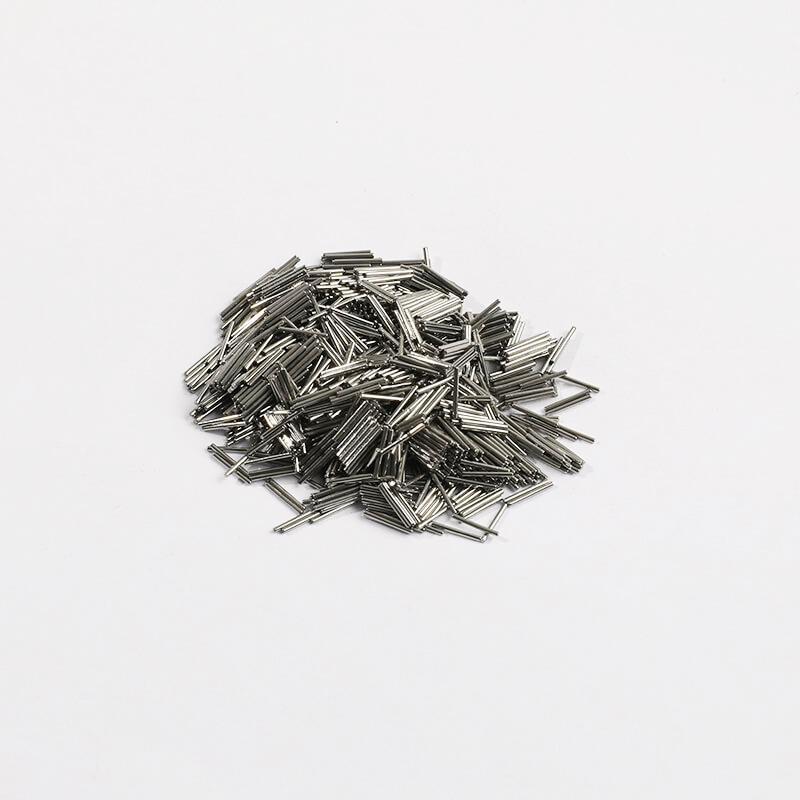
| Media | Best fit | Watch out for |
|---|---|---|
| Alumina-based ceramic media, low-density, cylindrical and pin shapes | Internal bores, slots and cross-holes on small aluminium components that a rounded tumbling body cannot reach | Pin and cylinder shapes can wedge in a bore or a slot; confirm retrieval and inspection before running a production batch |
| Dry media, corn cob with a polishing compound charge | Final dry polish and drying assistance on small aluminium parts where a wet rinse and dry would leave spotting | Compound loading saturates with use and the media cakes; the charge needs regular replacement, and soft aluminium can still smear |
| Plastic-bonded media, light to medium abrasive grade, cone and triangle shapes | General deburring and satin finishing on 6061 and 7075 where galling risk rules out dense ceramic | Wears quickly and loses edge definition; cut rate drops as the charge ages and the cosmetic result drifts unless media is screened and topped up |
| Dry media, walnut shell, fine grade | Dry polishing, light surface cleaning and preparation before anodising or laser marking on aluminium parts | Shell dust must be extracted and the part cleaned, or the residue interferes with marking, bonding or a later coating step |
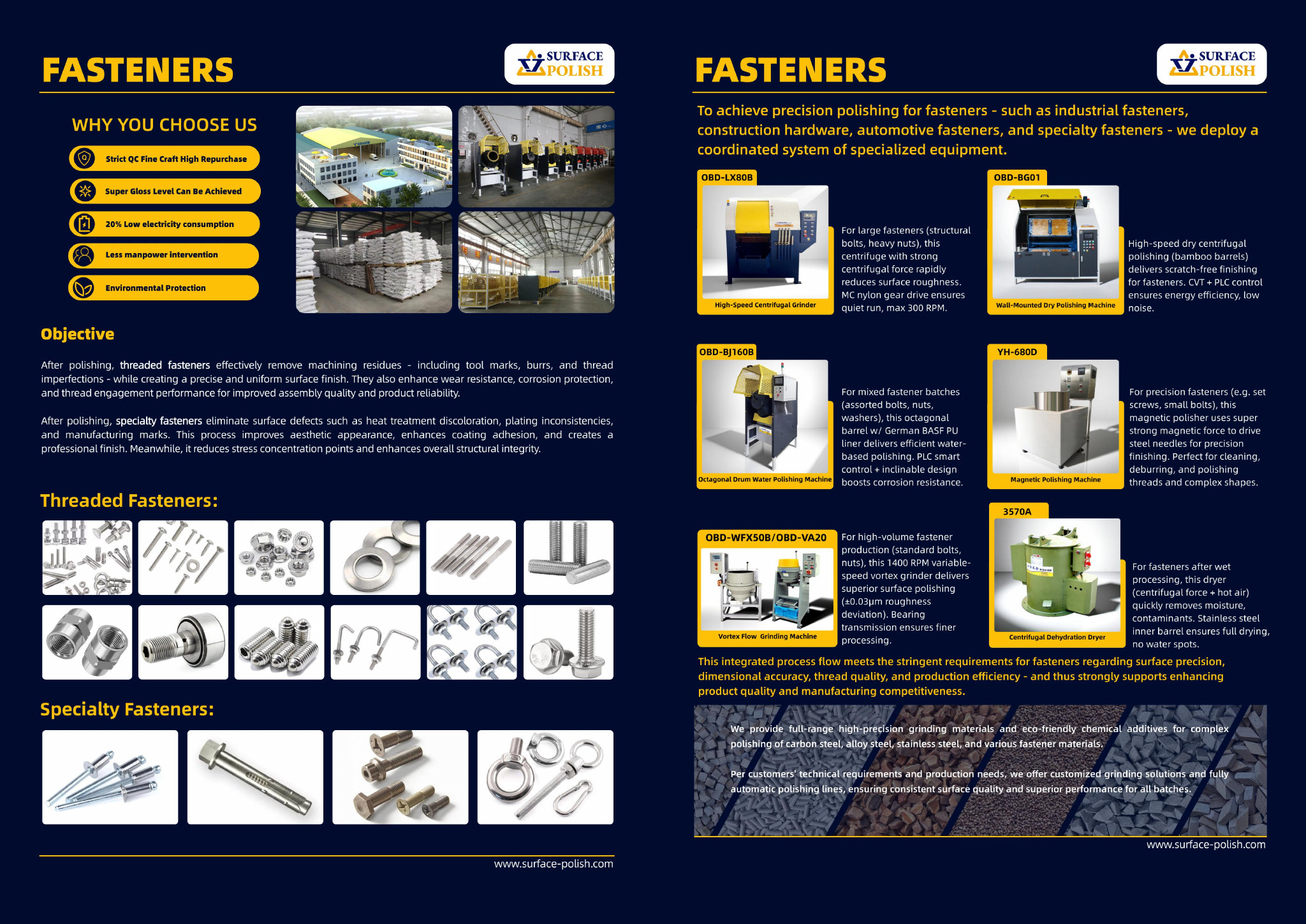
Magnetic finishing works on small aluminium parts with fine internal features, using a magnetic field to drive small pins or abrasive media through holes, slots and recesses that a tumbling load cannot reach. It is useful on small fittings, valve spools, connector components and parts with internal cross-holes, and it can be gentle enough for thin sections if field strength and cycle are controlled. Its limits are size and throughput: the working envelope is small and the process suits a narrow part family rather than a mixed batch, and fine media or pins lodge in blind features just as tumbling media do, so retrieval and inspection matter. Dry polishing machines and dryers handle the post-wet step, removing water from blind holes before anodising or laser marking, where a trapped droplet becomes a stain or a marking defect.
| Machine route | Where it fits | What it will not do |
|---|---|---|
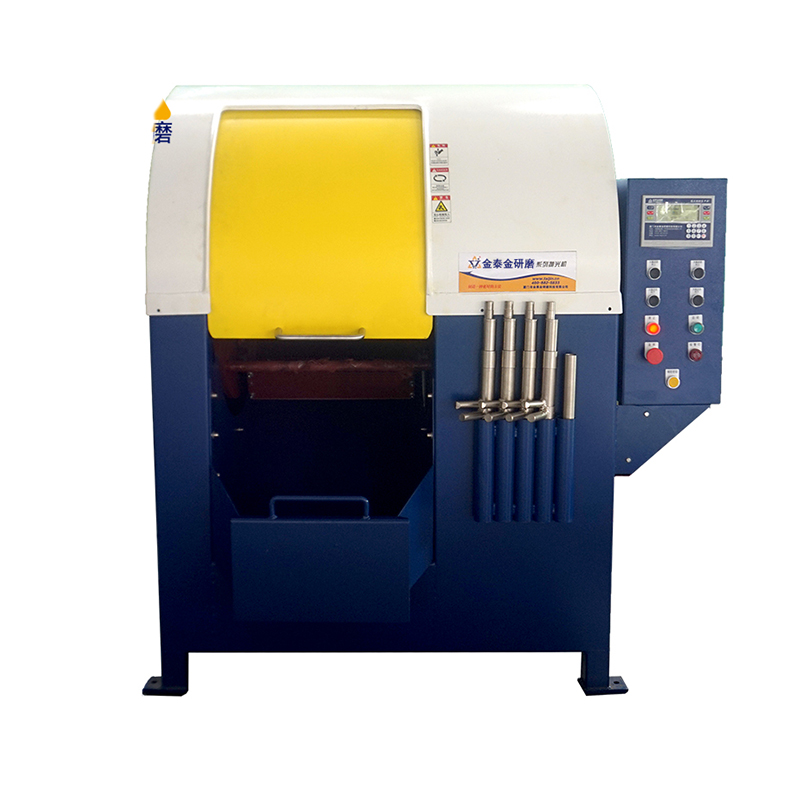
| Vibratory bowl finishing machine | Small to medium aluminium components that tumble freely: ferrules, handles, brackets and cover plates needing uniform deburring or satin finishing | Long, tall or heavily recessed parts shadow themselves and finish unevenly; part envelope must fit free circulation in the bowl |
| Tub vibrator | Long and large aluminium parts such as extruded frames and housings that can be oriented in a linear working channel | Slower uniform coverage, a tendency for parts to settle in one attitude, and greater floor space and media volume than a bowl |
| Disc finishing machine | Fast burr removal and edge radiusing on robust aluminium parts where a short cycle and high material removal matter most | High part-on-part contact and impingement risk; smears soft 6061, is hard to localise, and adds fixturing labour to every cycle |
| Dry polishing machine and dryer | Post-wet drying and dry polishing of aluminium parts before anodising, laser marking, bonding or packaging | Does not remove a burr or refine a surface on its own; residual media dust and incomplete drying still cause marking and coating defects |
Parts that do not circulate freely receive uneven work. In a bowl or barrel a long part, a heavy part or a part with a deep recess can sit in one attitude, shelter its own face, or trap a neighbour against the wall, leaving a bright band beside a dull one. Impingement is the more visible version: two parts strike each other repeatedly and produce dents, peened patches, scratches or a hammered texture that will not polish out without further material removal. The cause is usually charge geometry rather than media: wrong load ratio, media too large to flow around the part, insufficient compound lubricity, or a fixture that holds parts where the media field is weak. Check under directional light and compare several parts from different positions in the load, not one sample from the discharge gate.
| Failure mode | Likely cause | How to catch it |
|---|---|---|
| Uneven finish with bright and dull bands on the same face | Part settling in one attitude, self-shadowing on a long or recessed part, wrong load ratio, media too large to flow around the geometry | Compare several parts taken from different positions in the load under directional light rather than sampling only the discharge gate |
| Etched, darkened or chalky surface after wet finishing | Compound pH or concentration outside the aluminium working range, over-alkaline product, long dwell in a hot solution, exhausted compound | Compare a dried part against a retained reference under the customer's lighting, and log compound pH, concentration and temperature for the batch |
| Dents, peening marks or a hammered texture from part-on-part contact | Excessive energy for the part mass, under- or over-loaded charge, no fixture to control part attitude, hard or oversized media | Inspect a full-face view under low-angle light and a cross-section of a dent under a toolmaker's microscope to confirm plastic deformation |
| Black smut or scattered dark specks on the finished surface | Iron transferred from steel media, a shared barrel, worn machine parts or a shared media store; galvanic reaction on the soft aluminium surface | Examine under magnification and with a light acidified wipe, and audit media storage, barrel liners and screening equipment for steel contact |
Nantes sits on the Loire estuary industrial axis, whose port authority - Nantes Saint-Nazaire Port, the fourth largest French seaport, handling about 30 million tonnes of traffic a year - describes itself as a logistics and industrial platform connected by sea, river, rail, road and air, with 1 460 ha of industrial-port land and more than 600 companies in the industrial-port complex. INSEE counted 11 718 establishments in the commune at the end of 2024 with 3,3 % in industry and 215 178 jobs at the place of work in 2023. The estuary economy combines shipbuilding and offshore-wind fabrication at Saint-Nazaire, aerostructures and composites, agri-food and agricultural machinery in the wider Loire region, and naval/aeronautical engineering in Nantes itself.
The nearest part of that base to this brief is aerospace: The Nantes and Nouvelle-Aquitaine aerospace industry forms part of Aerospace Valley, the leading European aerospace competitiveness cluster whose coverage includes Nouvelle-Aquitaine alongside Occitanie.
The Loire estuary combines two finishing problems: large welded and fabricated steelwork for shipbuilding, offshore wind and heavy industry, where weld dressing, edge preparation and surface cleanliness govern coating performance and fatigue life; and smaller precision components in aerostructures and mechanical equipment where deburring and surface finish are tolerance-driven. Agri-food equipment in the region adds stainless fabrication where surface smoothness and residue-free cleaning are hygiene requirements rather than cosmetic preferences. Both cases reward a process that can be documented and repeated, because the customers here are audited industrial buyers.
A Nantes buyer should settle whether the target is surface preparation before coating on large fabricated assemblies or deburring and finish on machined components, and then check that the proposed process can handle the part mix without cross-contamination between ferrous and stainless work.
Freight context: Nantes Saint-Nazaire Port (Nantes, Montoir-de-Bretagne, Saint-Nazaire, Donges), Nantes Atlantique Airport, Montoir container and ro-ro terminals. The port states it connects to five continents through regular maritime services linked to the main European transhipment hubs, with 209 container ship calls and 198 ro-ro calls in 2025, plus 800 freight trains and river barge convoys; 25 ha of industrial-port land reserve is available. That makes it practical to receive containerised finishing machines and bulk media through Montoir and to ship sample parts by air from Nantes Atlantique or by courier.
The working language of French industrial procurement is French: tenders, drawings, inspection plans and technical dossiers are normally issued and answered in French, and quotations that omit French documentation slow down qualification. Buyers qualify a machine against a written specification and expect traceable material certificates, machine safety documentation and, where applicable, a CE declaration of conformity and a risk assessment; acceptance is often staged (documentary review, factory acceptance test, then commissioning). Payment and documentation norms are conventional EU practice: euro invoicing, SEPA or SWIFT bank transfer, Incoterms agreed in writing, and customs paperwork (commercial invoice, packing list, transport document, proof of origin where a preference is claimed) prepared for the declarant or customs representative. Because customs and tax authorisations are handled jointly through SOPRANO, non-EU sellers are normally advised to sell to an established French/EU importing entity rather than to act as importer of record themselves.
France applies the EU common commercial policy, so industrial machinery arriving from China enters under the Union Customs Code and the Common Customs Tariff rather than under any bilateral French regime; the EU has no free-trade agreement with China, so no preferential duty rate applies and normal third-country duties are due on the customs value. Importers classify the machine in the tariff nomenclature and lodge a customs declaration; French Customs publishes the common and national tariff through its RITA online service and states that three notions are fundamental: the tariff classification of the product, its origin or destination, and the value of the goods.
SurfacePolish supplies from Xiamen, China. The buyer's own destination rules, conformity marking, tariff classification and documentation responsibilities stay with the buyer; confirm them against the authorities named above before ordering.
Residue requirements on a device component come from the buyer's own specification, not from a finishing route, and they should be stated as a measurable limit before parts are accepted. Practical checks include visual inspection of internal features under magnification or with a borescope, a wipe test with a defined solvent and a white substrate, a gravimetric non-volatile residue determination on a rinse sample, and a rinse-water conductivity or particulate count where the assembly is sensitive. Blind holes, threads and press fits are the features that retain residue, so sample them specifically rather than only a flat exterior face. If a validated cleaning process, biocompatibility data or a sterility claim is needed, that work belongs to the buyer's own quality system.
The first good batch is not the hard part; holding the finish over weeks is. Media wear, the charge volume falls, fines accumulate in the compound, screens clog and the rinse water changes, so the same timer produces a different result as the charge ages. Drift shows first as a slightly duller surface, a burr that reappears at a bore exit, or a finish that no longer matches the retained reference. Control it with a media top-up and replacement rule based on screening rather than the calendar, a compound concentration and pH check each shift, a rinse-water quality check, and a first-article comparison against the retained reference at the start of every batch. Any change of media supplier, compound, water supply or machine setting invalidates the previous baseline and should be treated as a new first-article event.
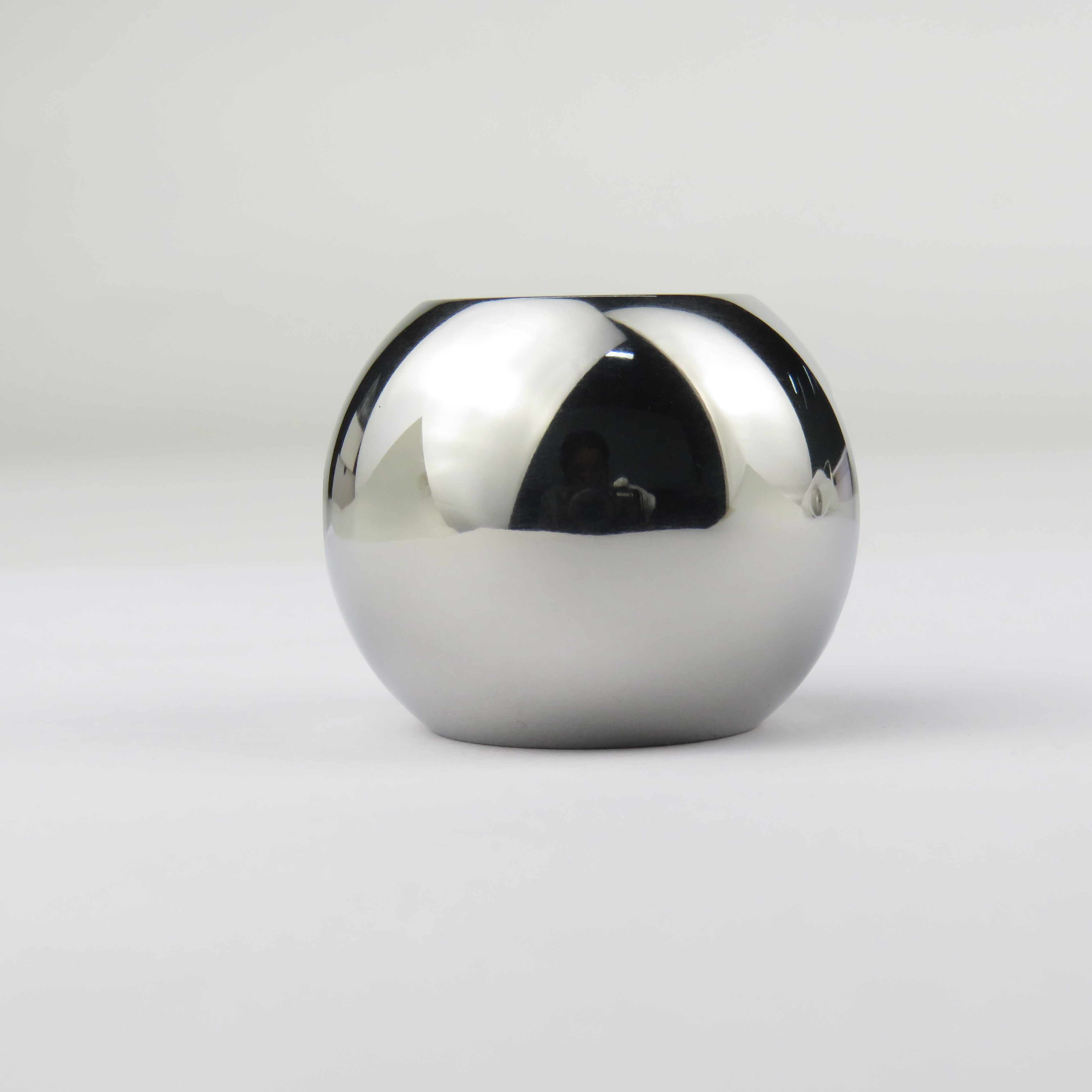
Keep the aluminium loop physically separate. Steel media, steel barrels, worn machine parts and shared screening equipment all transfer iron to a soft aluminium surface, and the result shows as black smut, dark specks or a galvanic couple that becomes visible under a coating or after anodising. Dedicated media, a dedicated barrel or bowl liner, separate screens and separate storage are the practical controls, along with a check of the finished surface under directional light. For a plant in France running both steel and aluminium work, the segregation rule needs to cover media storage and top-up stocks, not only the machine, because a shared media bin reintroduces the contamination.
A bowl vibrator circulates a load through a media field at moderate energy, with good uniformity on small parts that tumble freely and easy discharge. A centrifugal barrel presses media and parts together at high force in a much shorter cycle, producing a fine finish and controlled edge quickly, but bending thin walls, distorting light sections and rounding edges faster. Bowl routes suit mixed small parts and gentle work; centrifugal routes suit a narrow part family that fits the barrel and accepts the energy. Parts made in France should be trialled in the specific geometry before a machine size is fixed, because barrel dimensions limit part length and load size.
Send representative parts, including the worst case: the thinnest wall, the tightest sealing edge, the deepest tool mark, a casting with visible porosity, the smallest hole and the feature most likely to trap media. Include two or three pieces of each condition, an untreated reference part, and a note of the alloy and temper, the part number, which surfaces are cosmetic and which are functional, and the edge radius or chamfer allowed at each critical feature. State the current process, the defect that prompted the enquiry and the downstream operation, whether anodising, laser marking, bonding or assembly. The clearer the part definition, the more useful the observations returned.
Use Nantes, France as the destination on the enquiry and state whether the deliverable is equipment, media and compound, a representative sample review or a line concept. A destination does not imply local stock, a local service point or a local delivery time.
A Nantes buyer would reference ISO/NF EN surface-texture standards for finish and roughness, EN 1090 and the classification-society rules for welded steel and marine structures, and hygiene-related surface requirements for food-contact equipment; ISO 9001 is the common baseline, with EN 9100 where aerospace work is involved. Coating and surface-preparation specifications for offshore and marine fabrication are usually set by the client or the classification society on top of those standards.
Sources were retrieved on 2026-09-29 and describe the local industrial and trade context only. They do not evidence any SurfacePolish project, shipment, installation or service in Nantes.
The buyer's laser marking reads inconsistently because the media direction and surface texture vary across the marking area.
Send the material, dimensions, approximate weight, batch quantity, the incoming condition and photographs of the difficult features. Mark which features must not be contacted by media and state how the result will be inspected. This form carries source reference PSEO-0553; quote it if you prefer an additional manual reference.
Open the SurfacePolish enquiry form Email a prepared enquiry
No price, lead time, certification or result is promised here. Confirm whether a sample trial is available for the specific part and what the trial can and cannot show.
Page PSEO-0553 · revised 2026-09-29 · cross-border equipment, media and scoped sample review. City context is sourced and cited above.
Use this local checker to identify missing part and inspection information. It prepares a technical-review brief; it does not approve a machine, process recipe or production result.
Complete the part details to prepare a review brief.
Email : info@surface-polish.com


 IPv6 network supported


 +86-592-2381506