High-volume small aluminium components for medical devices live or die on part-to-part consistency, and a batch of several thousand ferrules in Strasbourg, France will show any weakness in media size class, screening or load control. SurfacePolish supplies finishing machines, media and compounds across borders and runs a free sample trial on the buyer's parts. This brief is written for a buyer in Strasbourg working on medical devices; it describes equipment, media and a scoped sample review, not a local polishing service.
What are the alloy and temper, and has machining, casting, welding or heat treatment already changed the surface hardness and porosity?
Which surfaces on this aluminium part carry a cosmetic grade, which are functional seating or sealing faces, and which are indifferent?
What edge radius or chamfer is allowed at each mating, sealing and press-fit feature, and how will it be measured?
Thin aluminium walls are the most common source of trouble in a vibratory or barrel route. Below roughly two millimetres of wall, part-on-part contact and media impact bend a rib, peen a flange or drive small media into a pocket where it wedges and stays. Blind holes, cross-drillings, undercuts, fine threads and knurled bands all trap media, and a lodged piece of ceramic later shows up as a rattle, a scored bore or a rejected assembly. Count the features that cannot be inspected easily from outside, then decide whether they need masking, a plug, a fixture that shields them or a different route entirely. A thin-wall housing that survives one cycle may not survive a hundred, so ask for wall thickness and unsupported span rather than assuming them.
Media shape decides which features receive work. Angle-cut triangles, stars and wedges reach into corners and produce an edge break; spheres and ellipsoids blend surface and remove very little edge material; cylinders and pins work inside bores and slots; flattened or lens shapes reach recesses a rounded body cannot. On aluminium components with mixed features this distinction is the whole decision: a sphere-heavy charge protects a sealing edge but leaves a burr at a bore exit, while a sharp-edged charge removes the burr and rounds the very edge that has to stay accurate. Size matters just as much. Large media cannot enter a small slot but produce a more open, less clogged charge; small media follow tighter geometry but lodge in pockets, pack blind holes and are harder to screen out of the load. Define the smallest feature to be worked before specifying size class.
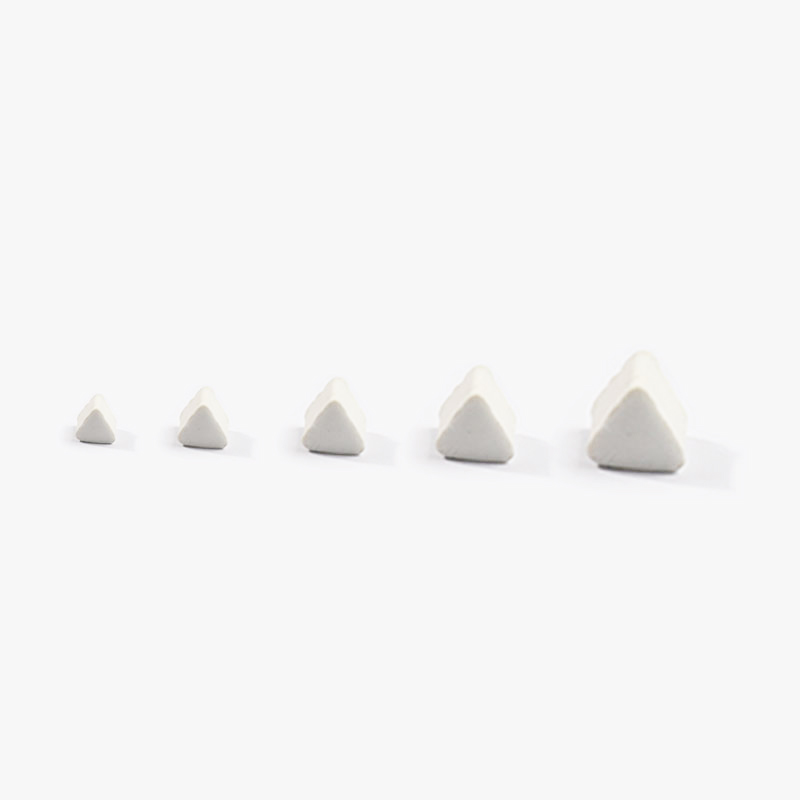
| Media | Best fit | Watch out for |
|---|---|---|
| Ceramic media, angle-cut triangles, medium size class | Heavy-cut deburring on cast or robust aluminium parts where the machined surface will be finished again or is not appearance graded | Rounds functional edges quickly and can chip or peen thin walls; not suitable where a sealing land or press fit is exposed |
| Alumina-based ceramic media, low-density, cylindrical and pin shapes | Internal bores, slots and cross-holes on small aluminium components that a rounded tumbling body cannot reach | Pin and cylinder shapes can wedge in a bore or a slot; confirm retrieval and inspection before running a production batch |
| Ceramic media, spheres and low-density ceramic, fine size class | Bright surface development and light edge work on small aluminium components with mixed cosmetic and internal features | Fine media lodges in blind holes, cross-drillings and thin-wall pockets and is harder to screen out of the load |
| Plastic-bonded media, light to medium abrasive grade, cone and triangle shapes | General deburring and satin finishing on 6061 and 7075 where galling risk rules out dense ceramic | Wears quickly and loses edge definition; cut rate drops as the charge ages and the cosmetic result drifts unless media is screened and topped up |
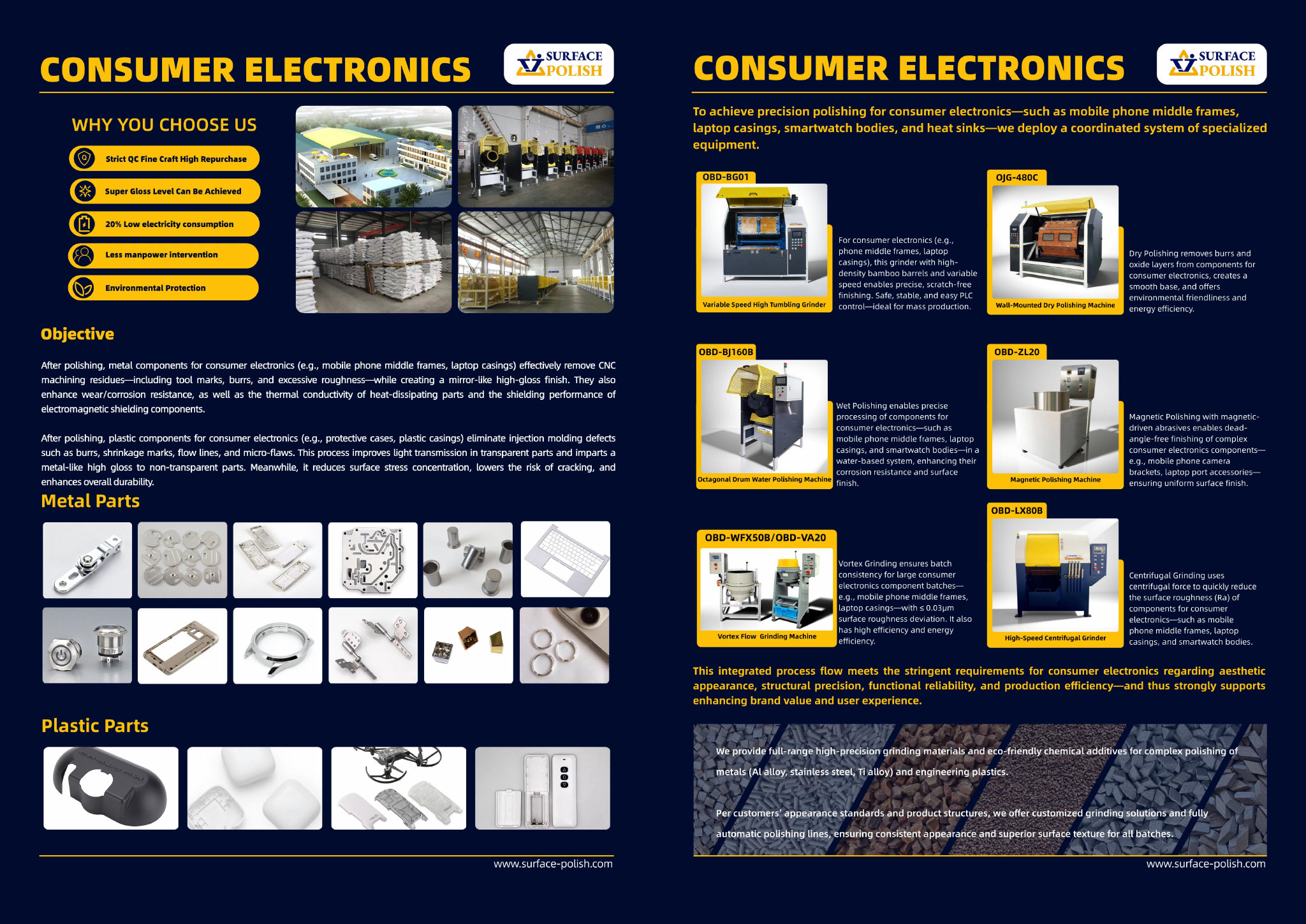
Magnetic finishing works on small aluminium parts with fine internal features, using a magnetic field to drive small pins or abrasive media through holes, slots and recesses that a tumbling load cannot reach. It is useful on small fittings, valve spools, connector components and parts with internal cross-holes, and it can be gentle enough for thin sections if field strength and cycle are controlled. Its limits are size and throughput: the working envelope is small and the process suits a narrow part family rather than a mixed batch, and fine media or pins lodge in blind features just as tumbling media do, so retrieval and inspection matter. Dry polishing machines and dryers handle the post-wet step, removing water from blind holes before anodising or laser marking, where a trapped droplet becomes a stain or a marking defect.
| Machine route | Where it fits | What it will not do |
|---|---|---|
| Dry polishing machine and dryer | Post-wet drying and dry polishing of aluminium parts before anodising, laser marking, bonding or packaging | Does not remove a burr or refine a surface on its own; residual media dust and incomplete drying still cause marking and coating defects |
| Tub vibrator | Long and large aluminium parts such as extruded frames and housings that can be oriented in a linear working channel | Slower uniform coverage, a tendency for parts to settle in one attitude, and greater floor space and media volume than a bowl |
| Grinding finishing machine | Higher material removal on aluminium parts that need a heavy burr or a pronounced chamfer removed before a gentler finishing step | Aggressive on soft aluminium, difficult to control on cosmetic faces and functional edges, and not a finishing step on its own |
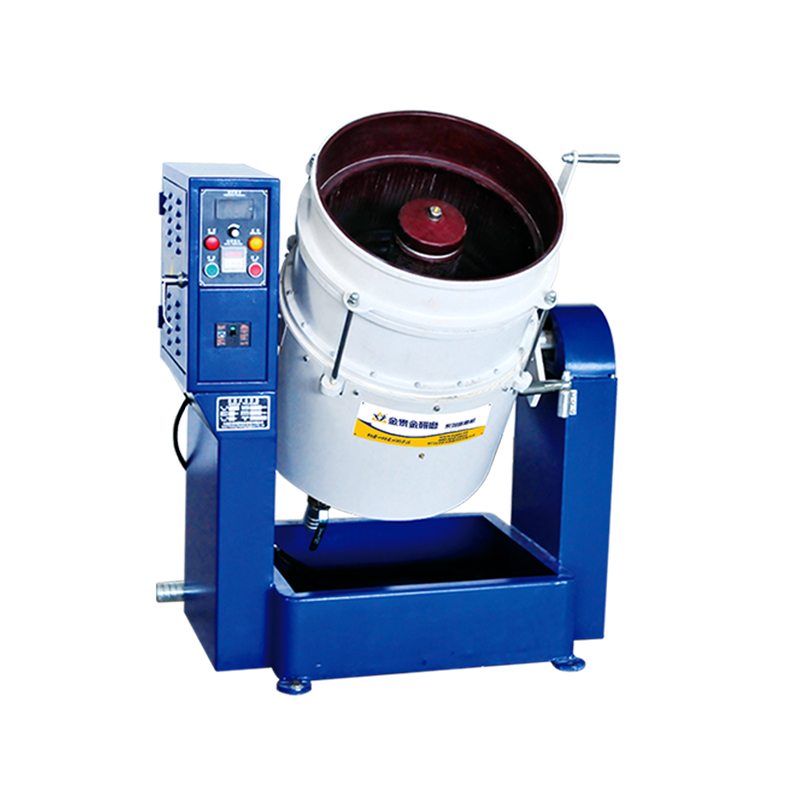
| Rotary barrel finishing machine | Gentle, low-energy deburring of small precise aluminium parts in high volume, including thin and light components | Longer cycles for the same result; flat or light parts may slide rather than tumble, and an overloaded barrel stops working the load |
Aluminium can leave a finishing cycle looking worse in colour than it went in. Over-alkaline compound etches and darkens the surface; hard water leaves mineral spotting that dries into rings; iron transferred from steel media or worn machine parts appears as black smut or scattered dark specks; and a slow or hot dry lets an oxide film form unevenly across a face. Castings with porosity are especially prone, because they hold liquid and release it later as a bloom. Check the part dry, under the lighting the customer will use, and compare against a retained reference part rather than memory. Control compound pH and concentration, rinse with controlled water quality, dry promptly and completely, and keep steel out of the aluminium loop. A stain found after anodising or packaging has already cost the value of the part.
| Failure mode | Likely cause | How to catch it |
|---|---|---|
| Media or abrasive fragment lodged in a blind hole, cross-drilling or thin-wall pocket | Media size class too small for the feature, unshielded pockets, flexing thin wall gripping the fragment, no dedicated retrieval step | Borescope the internal features, weigh against a known-clean reference, tap over white paper, and inspect the residue from an ultrasonic clean |
| Uneven finish with bright and dull bands on the same face | Part settling in one attitude, self-shadowing on a long or recessed part, wrong load ratio, media too large to flow around the geometry | Compare several parts taken from different positions in the load under directional light rather than sampling only the discharge gate |
| Black smut or scattered dark specks on the finished surface | Iron transferred from steel media, a shared barrel, worn machine parts or a shared media store; galvanic reaction on the soft aluminium surface | Examine under magnification and with a light acidified wipe, and audit media storage, barrel liners and screening equipment for steel contact |
| Dents, peening marks or a hammered texture from part-on-part contact | Excessive energy for the part mass, under- or over-loaded charge, no fixture to control part attitude, hard or oversized media | Inspect a full-face view under low-angle light and a cross-section of a dent under a toolmaker's microscope to confirm plastic deformation |
Strasbourg's industrial economy is a Rhine one: the Ports de Strasbourg (Groupe PAS) state the port is the second largest French river port, operate 40 hectares of available land and a new trimodal platform on the Rhine, and the port authority's own news flow is dominated by industrial and heavy-industry development on its estates, including development plans by Kawasaki Heavy Industries for the Grand Est region. INSEE counted 11 376 establishments in the commune at the end of 2024 with a 3,8 % industry share and 178 849 jobs at the place of work in 2023. The Alsace industrial base around the city is a mixed one - automotive equipment suppliers, mechanical engineering, pharmaceuticals and medical devices, and food processing - supported by the ADIRA regional development agency, which reports 418 business development projects handled in 2025 and more than EUR 1,376 billion invested by the companies it supported in Alsace.
For this brief the relevant part of that base is medical: INSEE records 15,6 % of Strasbourg establishments in public administration, education, health and social action in 2024, the highest share among the ten French cities studied, on a base that also includes Alsace's pharmaceutical and medical-device industry.
Alsace's automotive equipment and mechanical engineering base deburrs high-volume machined and stamped parts, where burr removal and edge quality are specified by the vehicle-maker and verified by cleanliness testing rather than visual inspection. The region's pharmaceutical and medical-device plants add stainless and hygienic-surface requirements in which surface roughness and residue-free cleaning are functional, and the port's heavy-industry estates generate large fabricated steelwork where weld dressing and coating preparation are the finishing tasks. The Rhine location also means German and Swiss customer specifications frequently apply alongside the French ones.
A Strasbourg buyer should settle which customer's specification governs - French, German or Swiss - before fixing edge and cleanliness acceptance criteria, because documentation, surface-roughness callouts and acceptance tests can differ between those customer chains for the same part.
Freight context: Ports de Strasbourg (Groupe PAS, Rhine river port), Strasbourg-Entzheim Airport, Strasbourg trimodal (road-rail-water) platform. The Ports de Strasbourg state the port is the second largest French river port and offer 40 hectares of available land plus a new trimodal platform on the Rhine, giving direct barge access to the Rhine corridor and the North Sea ports as well as rail and road links to Germany and Switzerland. That is the practical route for receiving containerised machines and media and for shipping sample parts into the German-speaking industrial belt.
The working language of French industrial procurement is French: tenders, drawings, inspection plans and technical dossiers are normally issued and answered in French, and quotations that omit French documentation slow down qualification. Buyers qualify a machine against a written specification and expect traceable material certificates, machine safety documentation and, where applicable, a CE declaration of conformity and a risk assessment; acceptance is often staged (documentary review, factory acceptance test, then commissioning). Payment and documentation norms are conventional EU practice: euro invoicing, SEPA or SWIFT bank transfer, Incoterms agreed in writing, and customs paperwork (commercial invoice, packing list, transport document, proof of origin where a preference is claimed) prepared for the declarant or customs representative. Because customs and tax authorisations are handled jointly through SOPRANO, non-EU sellers are normally advised to sell to an established French/EU importing entity rather than to act as importer of record themselves.
France applies the EU common commercial policy, so industrial machinery arriving from China enters under the Union Customs Code and the Common Customs Tariff rather than under any bilateral French regime; the EU has no free-trade agreement with China, so no preferential duty rate applies and normal third-country duties are due on the customs value. Importers classify the machine in the tariff nomenclature and lodge a customs declaration; French Customs publishes the common and national tariff through its RITA online service and states that three notions are fundamental: the tariff classification of the product, its origin or destination, and the value of the goods.
SurfacePolish supplies from Xiamen, China. The buyer's own destination rules, conformity marking, tariff classification and documentation responsibilities stay with the buyer; confirm them against the authorities named above before ordering.
Treat the first finished part of every batch as a first article and hold it until it has been checked against the agreed criteria. Record the part number, alloy and temper, the machine and route, the media charge identity and its accumulated hours, the compound and concentration, the cycle time, the load ratio and the drying step. Retain a reference part from the accepted first article, and when a later batch differs, compare the two physically before adjusting anything. Segregate batches by alloy and part number, and keep the aluminium loop separate from steel work so iron cannot transfer onto a soft surface. This discipline, not the machine settings, is what makes a finish reproducible. Who performs the checks and who signs the release is a buyer decision, but the record of what was run is worth keeping.
Send parts that represent the real production condition, not a polished bench sample. A useful set includes the worst case: the thinnest wall, the tightest sealing edge, the deepest tool mark, the casting with visible porosity, the smallest hole and the feature most likely to trap media. Include two or three pieces of each condition so one can be sectioned or inspected internally, and include an untreated part as the comparison reference. Label every part with its alloy and temper, its part number, the surfaces that are cosmetic, the surfaces that are functional, and the edge radius or chamfer allowed at each critical feature. State the current process and the defect that prompted the enquiry, plus the downstream operation such as anodising, laser marking or assembly.
No. SurfacePolish is a cross-border supplier of finishing machines, media and compounds and runs a free sample trial on parts the buyer sends. A trial reports observations on the parts tested under the settings used; it does not qualify, approve or validate a process, and it does not create biocompatibility, cleanability, sterility or regulatory documentation. Any requirement of that kind must be defined by the buyer and verified by the buyer's own engineering and quality functions, usually with the help of specialist testing providers. For a device programme in France, treat the finishing route as one input into the buyer's own verification plan rather than as evidence for it.
Lodging is a geometry problem before it is a media problem. Blind holes, cross-drillings, thread roots, undercuts and thin-wall pockets trap fragments, and a pocket that flexes under load grips them harder. Options include shielding or plugging the trapping features, changing the media size class so pieces cannot enter, moving to a route whose loading geometry differs, and adding an inspection step with a borescope or a weighed reference part. A visual pass on an exterior face proves nothing about a cavity. For parts made in France, agree with the buyer which internal features are checked and how, before the first batch is run.
Send representative parts, including the worst case: the thinnest wall, the tightest sealing edge, the deepest tool mark, a casting with visible porosity, the smallest hole and the feature most likely to trap media. Include two or three pieces of each condition, an untreated reference part, and a note of the alloy and temper, the part number, which surfaces are cosmetic and which are functional, and the edge radius or chamfer allowed at each critical feature. State the current process, the defect that prompted the enquiry and the downstream operation, whether anodising, laser marking, bonding or assembly. The clearer the part definition, the more useful the observations returned.
Use Strasbourg, France as the destination on the enquiry and state whether the deliverable is equipment, media and compound, a representative sample review or a line concept. A destination does not imply local stock, a local service point or a local delivery time.
A Strasbourg buyer would reference ISO/NF EN surface-texture standards and, for automotive supply, IATF 16949 with customer-specific edge and cleanliness requirements; medical and pharmaceutical equipment brings ISO 13485 or hygienic-design requirements with defined surface roughness. Because Alsace suppliers frequently deliver into Germany and Switzerland, DIN/EN standard versions and German-language documentation are commonly required alongside the French.
Sources were retrieved on 2026-09-29 and describe the local industrial and trade context only. They do not evidence any SurfacePolish project, shipment, installation or service in Strasbourg.
The buyer needs part-to-part consistency across a large batch and is worried about small parts escaping a screen or lodging in each other.
Send the material, dimensions, approximate weight, batch quantity, the incoming condition and photographs of the difficult features. Mark which features must not be contacted by media and state how the result will be inspected. This form carries source reference PSEO-0583; quote it if you prefer an additional manual reference.
Open the SurfacePolish enquiry form Email a prepared enquiry
No price, lead time, certification or result is promised here. Confirm whether a sample trial is available for the specific part and what the trial can and cannot show.
Page PSEO-0583 · revised 2026-09-29 · cross-border equipment, media and scoped sample review. City context is sourced and cited above.
Use this local checker to identify missing part and inspection information. It prepares a technical-review brief; it does not approve a machine, process recipe or production result.
Complete the part details to prepare a review brief.
Email : info@surface-polish.com


 IPv6 network supported


 +86-592-2381506
