A filling equipment builder in Bologna, Italy working in food processing equipment has a 316L manifold with two dozen small orifices and a sealing face that must stay flat. Media small enough to pass a 1.5 mm hole can also disappear inside the part, so the buyer needs a route that deburrs without creating a retrieval problem. SurfacePolish supplies finishing machines, media and compounds across borders with a free sample trial. This brief is written for a buyer in Bologna working on food processing equipment; it describes equipment, media and a scoped sample review, not a local polishing service.
Which internal surfaces can a mechanical route physically reach, and what happens to the zones it cannot?
Where will roughness be measured, with which cut-off and in which direction, and does that location represent the surface the product actually sees?
What free-iron and chloride exposure does the process itself introduce, and can the buyer's own cleanliness test detect it before the part is released?
The first screening question is which surfaces actually touch product, which sit adjacent to it and which are structural. A tank shell, a tube bore, a gasket seat and an agitator face carry different requirements from a mounting frame or a nameplate bracket, and one blanket finish call on the drawing usually means the wrong zones get the most attention. Mark each zone and state what has to be true of it: oxide-free, inside a stated roughness band, flat at a sealing face, unbroken at an edge radius. Product-contact geometry is where a mechanical route is judged, because heat tint, crevices and unreachable internal surfaces decide whether the surface can be brought to the condition the buyer's own specification describes. Surface classification also drives inspection, since reading roughness on a structural frame says nothing about a weld inside a vessel.
Plastic media in cones, triangles and cylinders cuts gently and is chosen when the requirement is a light edge blend or a cosmetic touch rather than weld-zone oxide removal. It suits softer non-ferrous fittings, thin sections and parts that must not lose measurable material, and it can wear more predictably than ceramic in some applications. What it cannot do is remove heat tint, mill scale or a proud weld cap, so it belongs late in a sequence, after the aggressive work, or on parts that never carried those conditions. Dry media such as walnut shell and corn cob works by light abrasion and burnishing on a dry machine, produces dust that needs extraction, and leaves a different surface character from a wet abrasive cycle. Neither plastic nor dry media substitutes for the operation that removes oxide.
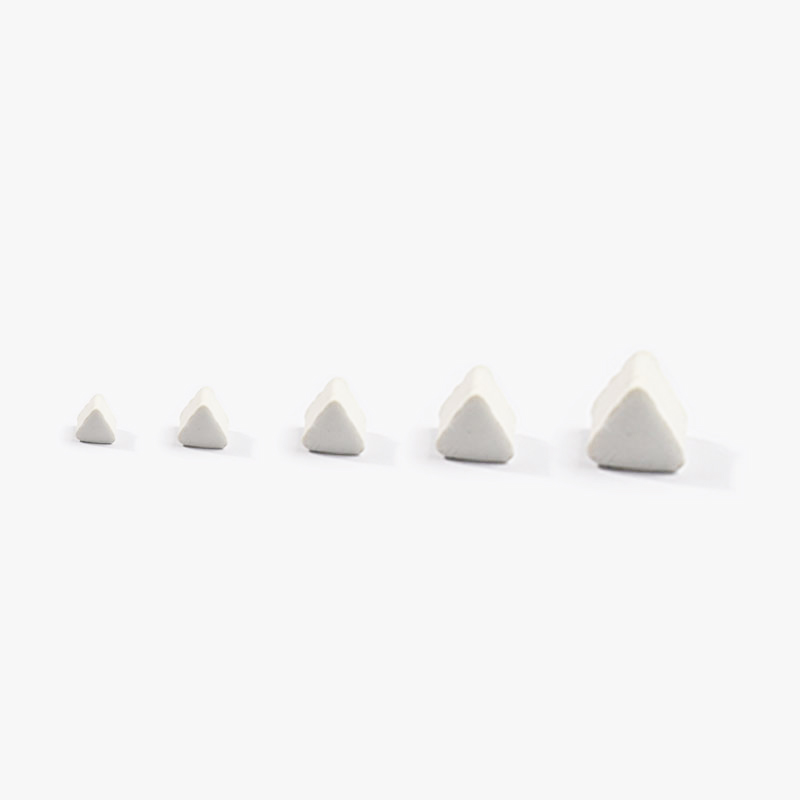
| Media | Best fit | Watch out for |
|---|---|---|
| Steel pins and fine media for magnetic finishing | Small precise components, short bores, slots and blind features that shaped tumbling media cannot enter. | Limited to small parts, will not remove a proud weld cap, and pins must be counted and recovered from every opening. |
| Dry media, walnut shell and corn cob | Light dry burnishing and cosmetic refinement where retained water in a crevice or assembly is a problem. | Generates dust requiring extraction, removes no oxide, and leaves a surface character different from a wet abrasive cycle. |
| Liquid compound, abrasive cleaning slurry family | Cleaning, descaling and fine abrasive work through the cycle, with dosing and flow matched to the load and the alloy. | Chloride content and pH matter on stainless, foam can cushion the cut, and residue left in a crevice becomes a later defect. |
| Steel media, balls and diagonals | Bright surface refinement on robust stainless parts where a dense medium is wanted to work into recesses. | Can transfer iron to stainless, imprint soft or thin features, flatten a deliberate edge radius, and needs magnetic recovery. |
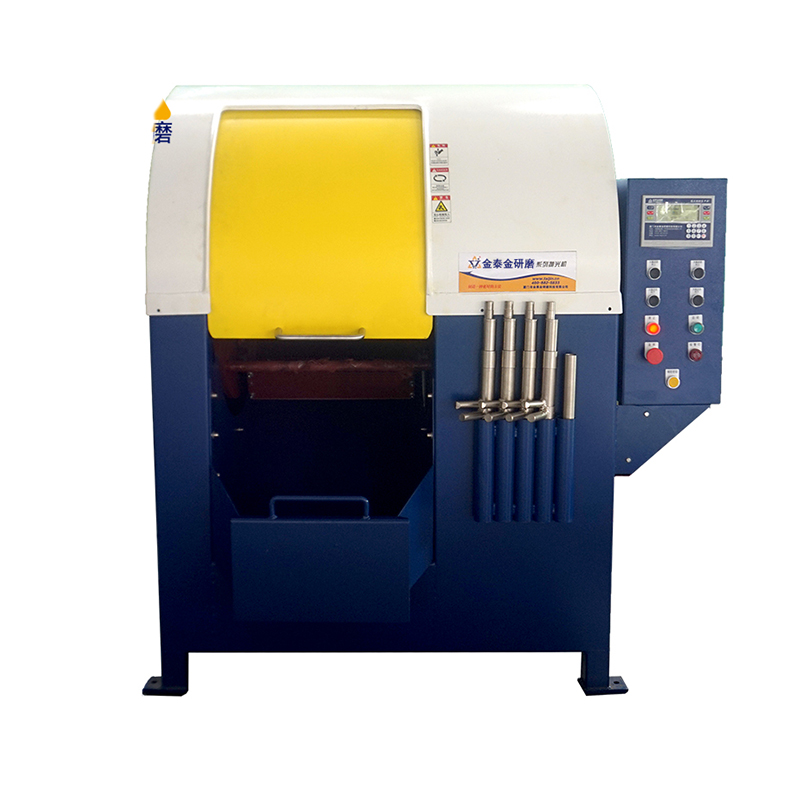
Barrel and rotary barrel machines suit small, robust fittings in quantity: ferrules, clamps, elbows, valve trim, pump internals and fasteners that tumble freely without damage. With no fixturing every surface sees media, which is efficient but means part-on-part contact is part of the process and cannot be excluded. Centrifugal barrel machines raise the energy considerably by rotating barrels around a central axis, which shortens the time needed to blend an edge or refine a small part, but the same energy increases the risk of over-rounding a soft detail or imprinting one part on another. Fine threads, sharp sealing lips and thin diaphragms are poor candidates. Load composition matters too: mixing heavy and light parts in one barrel usually means the light ones finish first and the heavy ones keep going.
| Machine route | Where it fits | What it will not do |
|---|---|---|
| Grinding finishing machine | Removing a proud weld cap, heavy scale and heat tint before any tumbling or refinement stage. | Leaves a scratch pattern that needs refining, can smear oxide, and iron-bearing tooling can deposit free iron on stainless. |
| Barrel finishing machine, rotary barrel tumbler | Large batches of small robust fittings, fasteners and valve trim that can tumble freely without damage. | Part-on-part contact is unavoidable, and fine threads, sealing lips and thin diaphragms are poor candidates. |
| Vibratory finishing machine, bowl type | Edge and weld-toe blending plus surface refinement on mid-sized parts, with a visible load and adjustable energy. | Chamber geometry caps part size, and the inside of a long tube or a narrow crevice stays out of reach. |
| Centrifugal barrel finishing machine | Higher-energy cycles that shorten the time to blend an edge or refine a small part in quantity. | The added energy increases over-rounding and imprinting risk, and delicate or mixed-size loads need careful planning. |
Removing material always changes the part, and the change is not always wanted. A weld toe can be rounded past the radius the drawing implies, a sealing lip can lose its bite, a gasket seat can dish enough to leak, and a thin tank panel can deflect under a heavy load. Media size class and density drive this: a large dense piece on a soft detail rounds it quickly, while a small light piece barely touches it. Detection uses an optical comparator or radius gauge on edges, a flatness check on sealing faces, and dimensional measurement of any feature that carries a tolerance. Dye penetrant or a visual check finds an undercut created by over-grinding a weld cap. Thin-wall parts deserve measurement before and after, because distortion in a small load only worsens at production fill levels.
| Failure mode | Likely cause | How to catch it |
|---|---|---|
| Heat tint or oxide remaining at the weld toe and in the crevice beside it | Cycle too gentle or too short for the oxide thickness, or a medium size class too large to enter the toe line. | Inspect the toe at magnification under raking light against an agreed visual reference, photograph at a fixed angle before and after, and apply the buyer's own free-iron or passive-condition method where specified. |
| Media lodged in gasket grooves, threads, blind holes or tube ends | Medium size class too close to the opening size, no masking or plugging, and no counted retrieval step at the end of the cycle. | Count media into and out of the load, use a borescope at an agreed angle plus a pin gauge on critical openings, and weigh or shake parts over a tray to reveal retained pieces. |
| Compound residue or dried film trapped in crevices and threads | Insufficient rinse volume, a rinse that does not reach the recess, or draining in an orientation that holds fluid in place. | Wipe or swab the recess with a clean white cloth and inspect, run a water-break or residue check on product-contact surfaces, and re-check after changing rinse volume or orientation. |
| Cross-contamination from tooling, racks or media shared with carbon steel | No dedicated stainless area, undocumented consumable grades, or media stored where mild steel fabrication dust settles. | Audit which tools, racks and media touch the part, record their grades, store media covered and segregated, and confirm cleanliness with the buyer's own test after a tooling change. |
Bologna's economy is services-heavy but keeps a solid industrial core. The Camera di Commercio di Bologna counted 90,392 firms registered with headquarters in Bologna at the end of 2025, 80,830 of them active; 64% operate in services and 24% in industry, of which 15% in construction and 9% in manufacturing, and the municipality alone holds 40% of the active firms. Confindustria Emilia, the local industry association, organises its members into sector supply chains that include Packaging, Metalli e materiali compositi, Elettronica e Meccatronica and Agroalimentare. The territory is best known for automatic packaging machinery and industrial automation, and its metals and composite-materials supply chain explicitly lists metallurgy, steel, metal treatment, painting, laser cutting, fabrication and stamping among its scopes.
For this brief the relevant part of that base is food: Confindustria Emilia's Agroalimentare supply chain covers agricultural machinery and spare parts, machinery for the food industry, food products, beverages and analysis laboratories.
Bologna's packaging-machine and mechatronics builders work in stainless steel and aluminium: machine frames, filling and wrapping mechanisms and precision components must be burr-free, edge-controlled and hygienically clean before assembly and before any food-contact qualification. The local Metalli e materiali compositi supply chain names metallurgy, steel, metal-object manufacture, metal treatment, painting, laser cutting, fabrication and stamping as its scope, which is exactly the upstream work whose edges and surfaces determine whether a component can go straight to assembly or coating.
The question to settle first is whether the specification is cosmetic (visible stainless panels and frames) or functional and hygiene-related (burrs, crevices, retained polishing media, cleanability on food-contact parts), because the two answers lead to different media, compounds and - in the packaging-machinery business - different validation evidence for the customer's own acceptance.
Freight context: Interporto di Bologna (rail-road intermodal terminal), Aeroporto di Bologna Guglielmo Marconi. Interporto Bologna integrates rail, road and logistics infrastructure for freight, offers direct connections to the national rail network, warehouses and intermodal terminals, and hosts more than 100 companies on site, which makes it the natural inland receiving point for machinery or heavy media consignments. Incoming non-EU goods clear customs at their EU point of entry before moving on to Bologna by road or rail.
Italy applies the EU's common commercial policy to imports from China, so Chinese industrial machinery enters under the EU Common Customs Tariff, where the duty rate depends on the type and origin of the goods and the working tariff is TARIC. Istat's August 2026 extra-EU trade release records a 16.0% year-on-year increase in Italian purchases from China, alongside strong growth from India, OPEC and Mercosur, so China remains one of the fastest-growing sources of Italian imports. Anti-dumping and other trade-defence measures apply case by case to specific product categories rather than to finishing machinery in general, so the applicable rate must be checked against the specific commodity code before a quotation is finalised.
The customs authority is the Agenzia delle Dogane e dei Monopoli (ADM), which is the regulatory, supervisory and control authority for customs and collects the duties. Goods arriving from China are cleared by customs before they can enter the single market and are released into free circulation by means of a customs declaration; the date of acceptance of that declaration is the date used to calculate and apply the import duty and any VAT or excise duty. Importers should settle in advance who lodges the declaration and under which VAT and EORI arrangements, and must ensure the machine carries CE marking and is supported by the EU declaration of conformity and technical file. Because the CE mark is compulsory for machinery covered by the EU machinery legislation and forbidden for products outside it, the conformity route must be settled before shipment rather than at the border.
SurfacePolish supplies from Xiamen, China. The buyer's own destination rules, conformity marking, tariff classification and documentation responsibilities stay with the buyer; confirm them against the authorities named above before ordering.
Acceptance has to exist before finishing begins, otherwise every batch becomes a negotiation about appearance. Write the requirement per zone: which surfaces are product-contact, what roughness band applies to each, which edges keep a radius, which faces stay flat, what cleanliness and residue condition is required, and which features come back untouched. Name the inspection method and instrument for each requirement and the person who accepts or rejects. Where a requirement comes from a design code or a customer specification, the buyer's own quality function states and verifies it. A first article fully inspected and retained as the physical reference removes most later argument, particularly on welds, where a kept part says far more than a written description. Re-confirm the requirement whenever drawing, material or upstream fabrication changes.
Without an incoming record a returned part cannot be judged. Photograph and measure each part before it is sent, at the same locations that will be measured afterwards, and note tint, burrs and scratches. If two media, two compounds or two cycle settings are compared, change one variable per test and keep everything else identical, including load fill and cycle time. Keep the parts separated through the process so a result can be attributed to the right condition. Where appearance is the question, have two people assess the same parts against the same reference under the same light before discussing the result. Mark which parts are left unfinished as controls. A comparison that moves several variables at once produces a result nobody can act on.
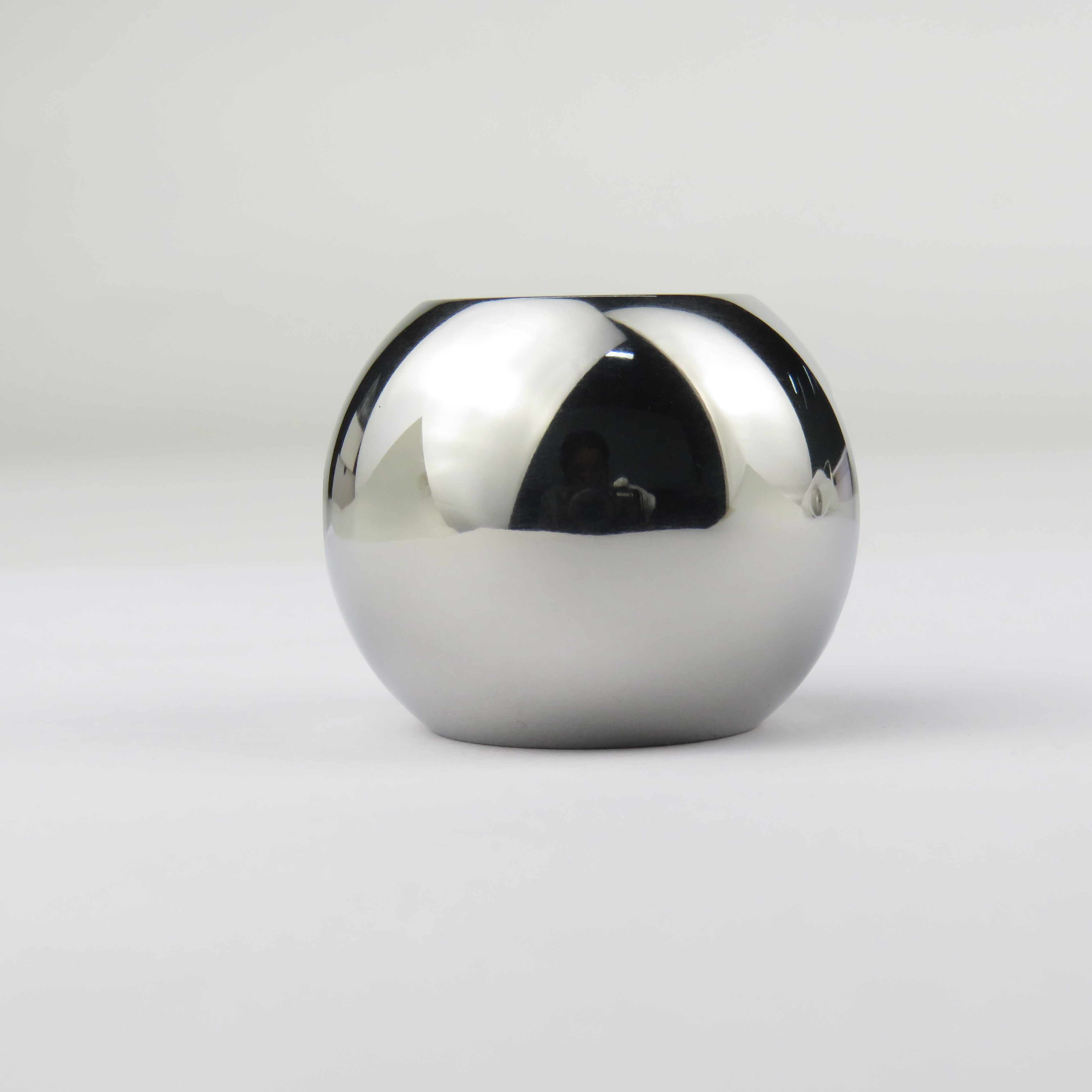
Chloride is the first thing to establish on stainless, because a chloride-bearing fluid left in contact with a sensitised or stressed surface is a pitting risk, and residue trapped in a crevice is worse than residue on an open face. Ask for compound composition data and set your own limit against your material and service conditions, and check the rinse water too, since a plant supply can carry chloride that the compound does not. Concentration and flow affect how much residue remains, and rinsing and drying determine whether it stays. Mechanical finishing does not remove the need for those limits; it makes them part of the specification.
Heat tint is oxide, so it is removed by cut rather than by cleaning. Ceramic media with an aggressive shape and bonding, or a grinding stage followed by refinement, are the usual mechanical answers on accessible weld zones. The limit is reach: a tint line that runs into a toe, a crevice or a small bore may survive a cycle that polishes the cap, which is why the toe should be inspected rather than judged by the shine of the weld face. Media size, shape and cycle energy must suit the oxide thickness. A trial on your own parts shows what was removed on the geometry tested.
Generally no, and this is the clearest practical difference between the routes. Tumbling media, whether ceramic, plastic or steel, has to physically enter a bore to work on it, and a tube whose length is many times its diameter and whose bore is narrow will not admit media in a way that produces an even result. Some internal work is possible with a magnetic finishing machine on short bores and small precise parts, but long runs of small-bore sanitary tubing are out of reach for a mechanical process. Zones a machine cannot reach have to be finished another way, accepted as they are, or designed out.
Use Bologna, Italy as the destination on the enquiry and state whether the deliverable is equipment, media and compound, a representative sample review or a line concept. A destination does not imply local stock, a local service point or a local delivery time.
Bologna buyers reference UNI, the Italian standards body, for the EN/ISO surface-texture standards, and the EU machinery legislation now dominates machine procurement: Regulation (EU) 2023/1230 replaces Directive 2006/42/EC for machinery placed on the EU market from 20 January 2027. Food-contact and hygiene requirements on packaging machinery are specified separately from surface roughness and have to be evidenced in the machine's own conformity file.
Sources were retrieved on 2026-09-29 and describe the local industrial and trade context only. They do not evidence any SurfacePolish project, shipment, installation or service in Bologna.
The buyer needs burrs removed from the orifice edges without lodging media in holes that are too small for most shapes.
Send the material, dimensions, approximate weight, batch quantity, the incoming condition and photographs of the difficult features. Mark which features must not be contacted by media and state how the result will be inspected. This form carries source reference PSEO-0424; quote it if you prefer an additional manual reference.
Open the SurfacePolish enquiry form Email a prepared enquiry
No price, lead time, certification or result is promised here. Confirm whether a sample trial is available for the specific part and what the trial can and cannot show.
Page PSEO-0424 · revised 2026-09-29 · cross-border equipment, media and scoped sample review. City context is sourced and cited above.
Use this local checker to identify missing part and inspection information. It prepares a technical-review brief; it does not approve a machine, process recipe or production result.
Complete the part details to prepare a review brief.
Email : info@surface-polish.com


 IPv6 network supported


 +86-592-2381506