A filling equipment builder in Dusseldorf, Germany working in food processing equipment has a 316L manifold with two dozen small orifices and a sealing face that must stay flat. Media small enough to pass a 1.5 mm hole can also disappear inside the part, so the buyer needs a route that deburrs without creating a retrieval problem. SurfacePolish supplies finishing machines, media and compounds across borders with a free sample trial. This brief is written for a buyer in Dusseldorf working on food processing equipment; it describes equipment, media and a scoped sample review, not a local polishing service.
Which surfaces on this part touch product, and what does each one have to satisfy in roughness, oxide freedom, edge condition and cleanliness?
Which internal surfaces can a mechanical route physically reach, and what happens to the zones it cannot?
Does the route have to remove heat tint and restore a passive condition, or refine a surface that is already clean, and who verifies that difference?
Before any trial, fix the starting condition in a way that can be compared later. Take roughness readings at agreed locations, photograph the part under consistent lighting, note visible burrs, tint and scratches, and keep one untouched part as a reference. Describe the batch: how many pieces of each size, whether they are identical, and whether mixed sizes will share a chamber. Decide how parts will be separated, racked or compartmented, and which surfaces may touch each other or a fixture. Handling rules matter as much as process settings on stainless, because a bench, a rack or a glove that has touched carbon steel can leave the contamination that later appears as a rust bloom. Write the baseline down, because a trial without an incoming record produces observations nobody can interpret.
A tub vibrator gives a long, open chamber that accepts parts a bowl cannot, including tube spools, chute sections, small vessels and long fabrications. The part can be repositioned, rotated or left static depending on what has to be reached, and the open design makes it easier to watch what is happening to a weld during the cycle. The trade-off is evenness: coverage depends on how the part sits relative to the media mass, so banding and untouched shadow zones are common unless fixture and part orientation are planned. Internal surfaces of a long small-bore tube remain out of reach regardless of tub size. Tub capacity, media volume, how the part is supported and how it is lifted in and out should be settled before the route is accepted.
| Machine route | Where it fits | What it will not do |
|---|---|---|
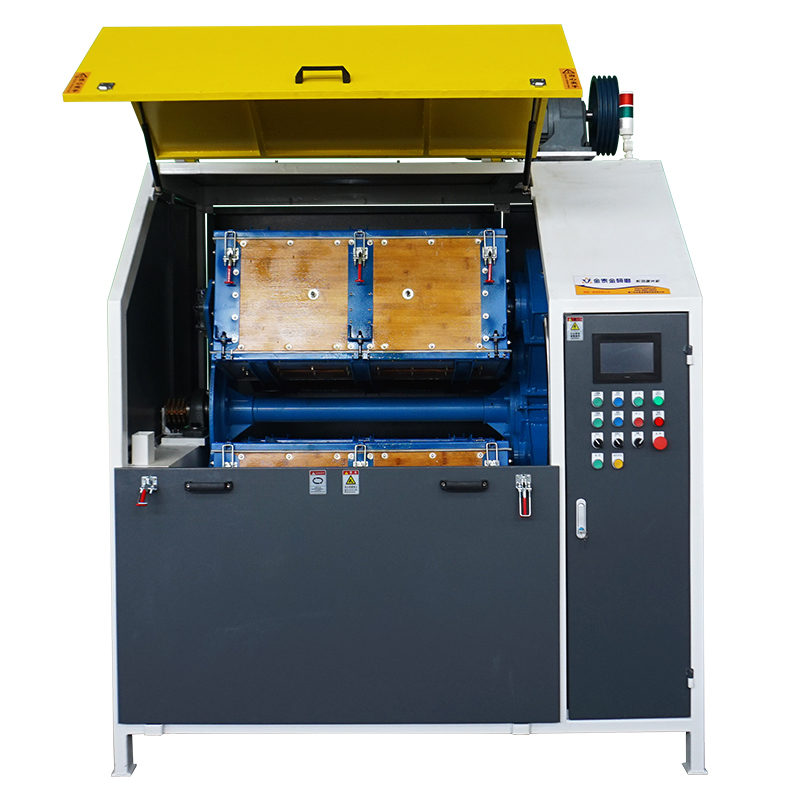
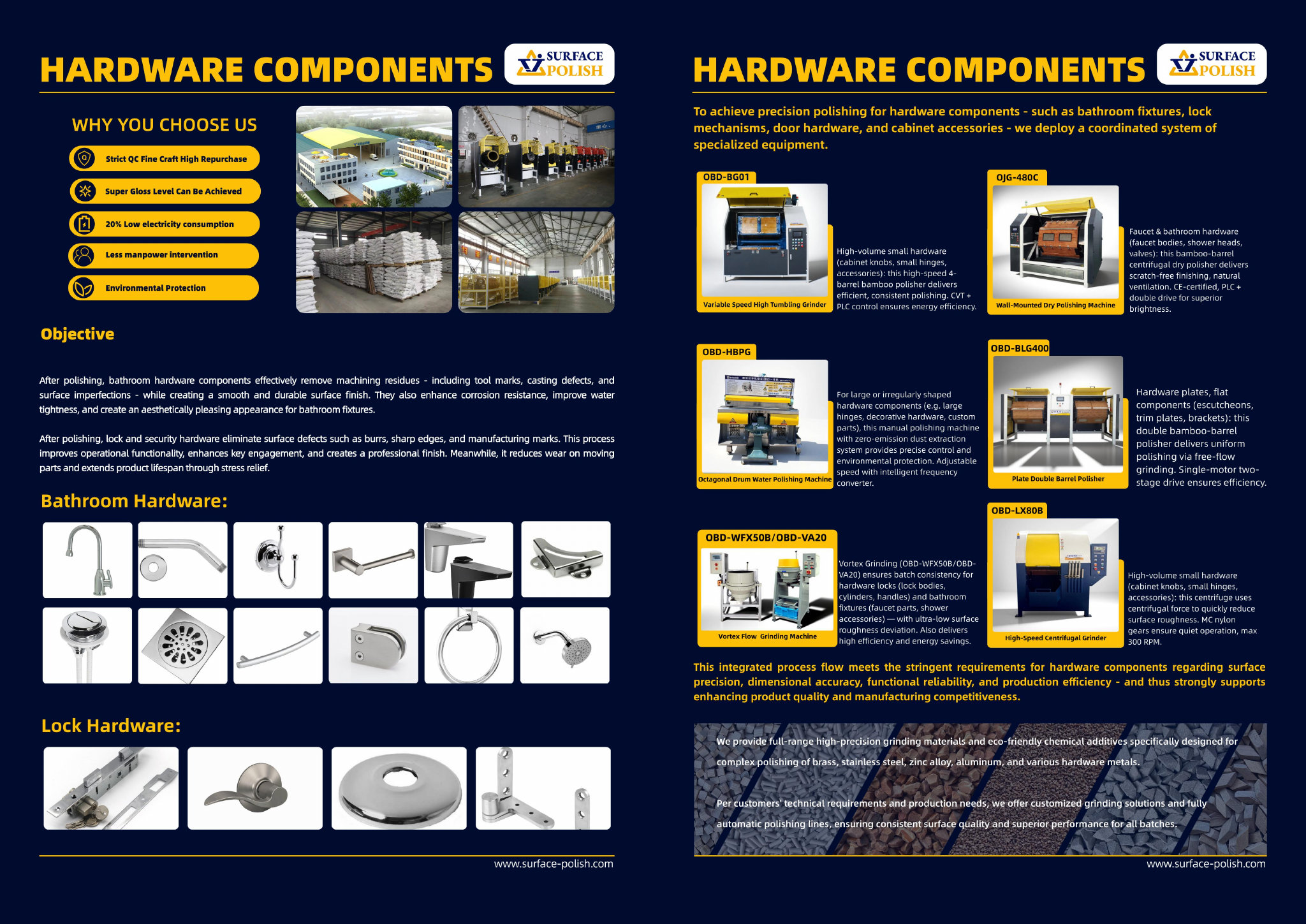
| Centrifugal barrel finishing machine | Higher-energy cycles that shorten the time to blend an edge or refine a small part in quantity. | The added energy increases over-rounding and imprinting risk, and delicate or mixed-size loads need careful planning. |
| Vibratory finishing machine, bowl type | Edge and weld-toe blending plus surface refinement on mid-sized parts, with a visible load and adjustable energy. | Chamber geometry caps part size, and the inside of a long tube or a narrow crevice stays out of reach. |
| Disc finishing machine | High-energy work on flat faces, flanges and convex zones where material removal or fast refinement is wanted. | Poor reach into recesses and around complex geometry, and it can dish a flat face if the cycle is not controlled. |
| Magnetic finishing machine | Small precise parts and short internal features such as slots, small bores and blind recesses. | Part size and surface area are limited, large panels and long tubes are out of scope, and it will not dress a weld cap. |
Plastic media in cones, triangles and cylinders cuts gently and is chosen when the requirement is a light edge blend or a cosmetic touch rather than weld-zone oxide removal. It suits softer non-ferrous fittings, thin sections and parts that must not lose measurable material, and it can wear more predictably than ceramic in some applications. What it cannot do is remove heat tint, mill scale or a proud weld cap, so it belongs late in a sequence, after the aggressive work, or on parts that never carried those conditions. Dry media such as walnut shell and corn cob works by light abrasion and burnishing on a dry machine, produces dust that needs extraction, and leaves a different surface character from a wet abrasive cycle. Neither plastic nor dry media substitutes for the operation that removes oxide.
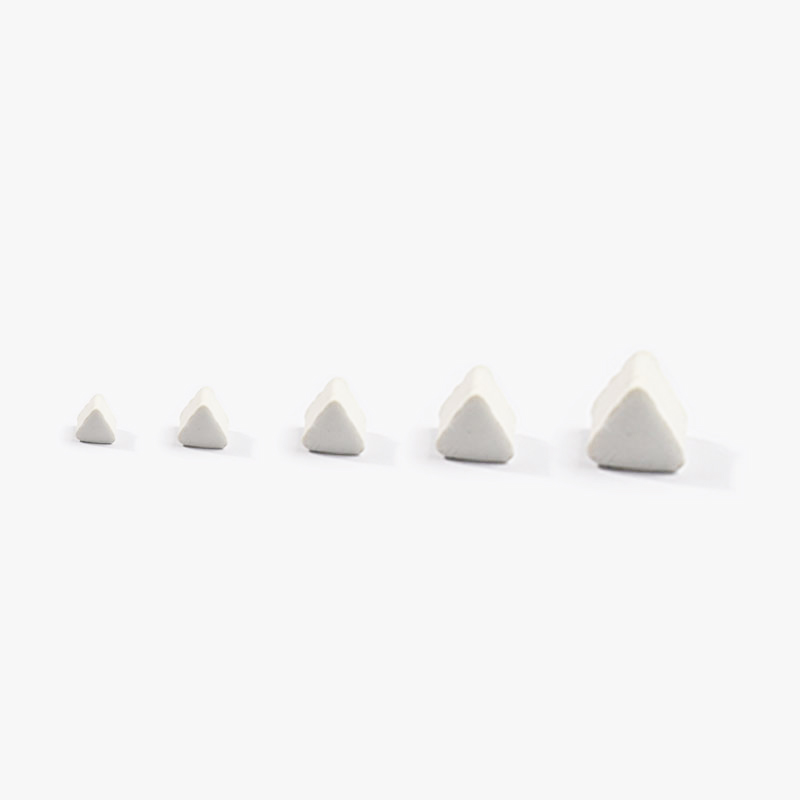
| Media | Best fit | Watch out for |
|---|---|---|
| Grinding media, coarse alumina-based | Removing a proud weld cap, heavy scale and heat tint before a refinement stage on accessible external surfaces. | Leaves a coarse scratch pattern that must be refined, removes material fast, and can gouge thin sheet or a soft alloy. |
| Steel pins and fine media for magnetic finishing | Small precise components, short bores, slots and blind features that shaped tumbling media cannot enter. | Limited to small parts, will not remove a proud weld cap, and pins must be counted and recovered from every opening. |
| Liquid compound, abrasive cleaning slurry family | Cleaning, descaling and fine abrasive work through the cycle, with dosing and flow matched to the load and the alloy. | Chloride content and pH matter on stainless, foam can cushion the cut, and residue left in a crevice becomes a later defect. |
| Ceramic media, small cylinders and spheres | General deburring and light radius work on hygienic fittings, with less edge cutting than an angle-cut shape. | Small sizes lodge in gasket grooves and drilled openings, and a sphere refines slowly where oxide is thick. |
Heat tint is an oxide layer whose thickness varies across a weld, thickest where the metal was hottest and often receding into a crevice or along the toe line where no medium reaches. A mechanical cycle can polish the visible cap and leave the toe untouched, so a part passes a glance and still carries oxide in exactly the location that matters. Colour is a practical indicator: straw and light blue suggest a thinner film, while grey and black scale suggests a heavier one that needs real removal before any refinement means anything. Detection is by inspection at magnification, comparison with an agreed visual reference, and the buyer's own test for free iron or passive condition where their specification asks for one. Photograph the toe at a fixed angle before and after each stage.
| Failure mode | Likely cause | How to catch it |
|---|---|---|
| Cross-contamination from tooling, racks or media shared with carbon steel | No dedicated stainless area, undocumented consumable grades, or media stored where mild steel fabrication dust settles. | Audit which tools, racks and media touch the part, record their grades, store media covered and segregated, and confirm cleanliness with the buyer's own test after a tooling change. |
| Gasket seat or sealing face dished so it no longer seals | Over-finishing a machined face, part-on-part contact in an unseparated load, or media hammering a face that should have been masked. | Check flatness of the sealing face with a straight edge, a feeler gauge or a surface plate before and after, and confirm against the sealing requirement the buyer's specification states. |
| Heat tint or oxide remaining at the weld toe and in the crevice beside it | Cycle too gentle or too short for the oxide thickness, or a medium size class too large to enter the toe line. | Inspect the toe at magnification under raking light against an agreed visual reference, photograph at a fixed angle before and after, and apply the buyer's own free-iron or passive-condition method where specified. |
| Media lodged in gasket grooves, threads, blind holes or tube ends | Medium size class too close to the opening size, no masking or plugging, and no counted retrieval step at the end of the cycle. | Count media into and out of the load, use a borescope at an agreed angle plus a pin gauge on critical openings, and weigh or shake parts over a tray to reveal retained pieces. |
Düsseldorf is the state capital of North Rhine-Westphalia and its chamber of industry and commerce represents around 103,000 member companies from industry, trade and services in the city and the ten towns of Kreis Mettmann. The city's economic development agency puts about 100,000 jobs in classic production companies and industry-related services and cites concrete machinery sites, including a new hall built by Komatsu Germany in Benrath for the world's largest hydraulic excavator and the Konecranes crane-technology plant in Benrath; the former Vallourec tube works in Reisholz is being redeveloped as the industrial and commercial park 'The Tube'. Messe Düsseldorf gives the city a metal-processing anchor: it hosts the wire (wire and cable) and Tube (tube and pipe) world-leading trade fairs. Health and life sciences are a second growth pole, and more than 100 local companies have committed to CO2 reduction targets under the city's climate pact.
The nearest part of that base to this brief is machinery: Around 100,000 jobs in Düsseldorf are in classic production companies and industry-related services, and the city's trade-fair calendar includes the world's leading tube and pipe fair in Düsseldorf with 1,200 exhibitors from 54 countries.
Düsseldorf's industrial base is concentrated in machine building, tube and pipe processing, crane and construction machinery and their supplier tier, and the city's trade-fair profile (Tube, wire) reflects exactly the cutting, forming and joining processes that generate burrs, sharp edges and contaminated surfaces. Tube ends, machined bores, weld seams and hydraulic components are the typical parts where deburring, edge rounding and defined surface finish determine fit, seal performance and coating adhesion. Because buyers here compare process technology at Düsseldorf's metal fairs, they tend to evaluate finishing machinery and media with an explicit process route and throughput figure rather than a finish description alone.
Decide first whether the requirement is an edge condition (deburring, edge break for seals and hydraulics) or a defined roughness/cleanliness value, then specify the process route and throughput that Düsseldorf's machine-building and tube-processing suppliers must reproduce in series with documented, repeatable results.
Freight context: Düsseldorf Airport (DUS), Rhine ports and rail terminals of the RheinCargo network in the Düsseldorf/Neuss area, Messe Düsseldorf exhibition grounds (trade-fair logistics). The economic development agency presents Düsseldorf as having Germany's fourth-largest airport plus direct links to the overseas ports of Zeebrugge, Amsterdam, Rotterdam and Antwerp, and the RheinCargo network moves more than 50 million tonnes a year by rail and inland port across its Rhine sites. Machines can be brought in by air or via Rhine container/rail hubs, and the Düsseldorf/Neuss port group serves as the regional inland terminal.
Germany sits inside the EU customs union, so Chinese-origin industrial machinery enters against the EU's common commercial tariff rather than a German national tariff, and the duty that applies is determined by the commodity code declared on the import declaration. China is one of the EU's largest goods trading partners and the EU has long run a goods deficit with it, while the Commission characterises the relationship as simultaneously partnership, competition and systemic rivalry (c1, c2). The Commission publishes the EU's trade agreements; no agreement with China appears in that overview, so Chinese-origin goods cannot claim a preferential origin rate and are assessed under the standard tariff (c8). German customs is administered by the Zoll under the Generalzolldirektion, and the importer must hold an EORI number - valid throughout the European Union and replacing the former German customs number - before goods can be cleared (c5, c6).
German is the working language of drawings, contracts, test reports and conformity documentation, and German buyers normally expect English-language technical documentation to be supplied alongside it. Procurement is documentation-driven: the EU declaration of conformity, the technical file, and the identity of the EU-based importer or authorised representative are settled before the order, and the EORI registration and customs declaration are the importer's responsibility rather than the exporter's (c3, c4, c5). Germany is the world's leading machinery and equipment manufacturer, so quotations compete against established domestic builders on technical documentation and measurable process data rather than on price alone (c9). Payment, delivery and risk terms are normally fixed by written contract with a named Incoterm, and classification (commodity code) is commonly confirmed in writing before shipment because it drives the duty and the import declaration.
SurfacePolish supplies from Xiamen, China. The buyer's own destination rules, conformity marking, tariff classification and documentation responsibilities stay with the buyer; confirm them against the authorities named above before ordering.
Visual acceptance is only repeatable when the viewing conditions are fixed. Agree the light source, distance, angle and magnification, whether raking light is used to reveal tint and scratches, and whether comparison is made against a physical reference or a photograph taken at the same settings. Define what counts as a defect: a colour band, a scratch, the scratch pattern left by coarse abrasive, a water spot, a handling mark. Internal surfaces need their own method, usually a borescope at an agreed insertion depth and view angle, with images retained so a later batch can be compared. Photographs are the practical record in a cross-border discussion, because a described appearance travels badly while a fixed-angle image travels well. Both sides should work from the same written standard.
A sample trial reports what was observed on the parts tested under the settings used, and that is the whole of it. It cannot promise a roughness value, an edge dimension, a cycle time, a throughput, a cost per part or a delivery date, and it does not qualify a machine, medium, compound or process for food contact, hygienic service or any regulated application. A handful of parts does not represent production variation in material, welding or fit-up, and performance in service, including corrosion behaviour after cleaning and any passivation step, is not established by a finishing trial. What a trial does give is evidence: how a route behaved on real geometry, which zones it reached, what the surface looked like, and where a mechanical route runs out of reach. The decisions that follow belong with the buyer.
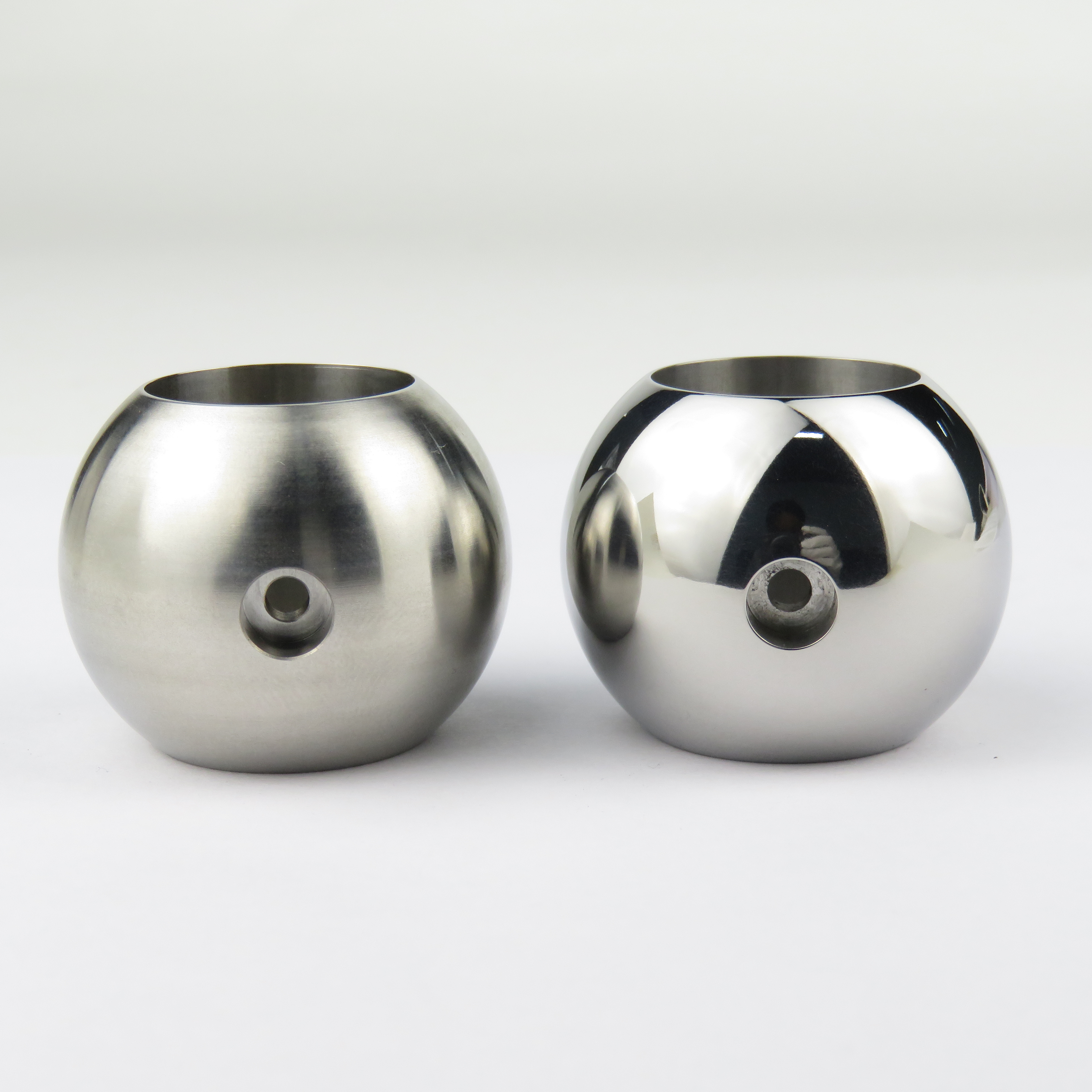
Generally no, and this is the clearest practical difference between the routes. Tumbling media, whether ceramic, plastic or steel, has to physically enter a bore to work on it, and a tube whose length is many times its diameter and whose bore is narrow will not admit media in a way that produces an even result. Some internal work is possible with a magnetic finishing machine on short bores and small precise parts, but long runs of small-bore sanitary tubing are out of reach for a mechanical process. Zones a machine cannot reach have to be finished another way, accepted as they are, or designed out.
Send representative parts, including the most difficult geometry in the family, and SurfacePolish runs them through a mechanical finishing route and returns the tested parts with observations and a proposed media, compound and cycle direction. The report describes what was seen on those parts under those settings. It is not a guarantee of a roughness value, an edge dimension, a cycle time, a capacity, a cost or a delivery date, and it does not qualify a process for any regulated use. Production variation in material, welding and fit-up is not represented by a small trial load, so your own verification still decides.
Heat tint is oxide, so it is removed by cut rather than by cleaning. Ceramic media with an aggressive shape and bonding, or a grinding stage followed by refinement, are the usual mechanical answers on accessible weld zones. The limit is reach: a tint line that runs into a toe, a crevice or a small bore may survive a cycle that polishes the cap, which is why the toe should be inspected rather than judged by the shine of the weld face. Media size, shape and cycle energy must suit the oxide thickness. A trial on your own parts shows what was removed on the geometry tested.
Use Dusseldorf, Germany as the destination on the enquiry and state whether the deliverable is equipment, media and compound, a representative sample review or a line concept. A destination does not imply local stock, a local service point or a local delivery time.
Buyers in the Düsseldorf district work in a DIN-centred regime: surface-texture specifications to ISO 21920, technical cleanliness to VDA 19.1 / ISO 16232 (relevant for hydraulic and powertrain parts), material certificates to EN 10204 (3.1) and, in suppliers to the vehicle industry, IATF 16949 with VDA 6.3 audits. Imported finishing equipment additionally needs CE marking under the EU Machinery Regulation for placing on the EEA market.
Sources were retrieved on 2026-09-29 and describe the local industrial and trade context only. They do not evidence any SurfacePolish project, shipment, installation or service in Dusseldorf.
The buyer needs burrs removed from the orifice edges without lodging media in holes that are too small for most shapes.
Send the material, dimensions, approximate weight, batch quantity, the incoming condition and photographs of the difficult features. Mark which features must not be contacted by media and state how the result will be inspected. This form carries source reference PSEO-0364; quote it if you prefer an additional manual reference.
Open the SurfacePolish enquiry form Email a prepared enquiry
No price, lead time, certification or result is promised here. Confirm whether a sample trial is available for the specific part and what the trial can and cannot show.
Page PSEO-0364 · revised 2026-09-29 · cross-border equipment, media and scoped sample review. City context is sourced and cited above.
Use this local checker to identify missing part and inspection information. It prepares a technical-review brief; it does not approve a machine, process recipe or production result.
Complete the part details to prepare a review brief.
Email : info@surface-polish.com


 IPv6 network supported


 +86-592-2381506