A bulk handling fabricator in Hamilton, Canada serving food processing equipment has a 2.4 m 304 auger with a helical weld along its flights. The part is far too long for a bowl machine, and its drive-end bore has a tolerance that finishing must not disturb, so the buyer needs a route that suits long geometry. SurfacePolish supplies finishing equipment, media and compounds across borders and runs a free sample trial. This brief is written for a buyer in Hamilton working on food processing equipment; it describes equipment, media and a scoped sample review, not a local polishing service.
What must the finished surface survive in service, including cleaning cycles, and how will that be checked without leaning on a finishing trial?
Which internal surfaces can a mechanical route physically reach, and what happens to the zones it cannot?
Where will roughness be measured, with which cut-off and in which direction, and does that location represent the surface the product actually sees?
Before any trial, fix the starting condition in a way that can be compared later. Take roughness readings at agreed locations, photograph the part under consistent lighting, note visible burrs, tint and scratches, and keep one untouched part as a reference. Describe the batch: how many pieces of each size, whether they are identical, and whether mixed sizes will share a chamber. Decide how parts will be separated, racked or compartmented, and which surfaces may touch each other or a fixture. Handling rules matter as much as process settings on stainless, because a bench, a rack or a glove that has touched carbon steel can leave the contamination that later appears as a rust bloom. Write the baseline down, because a trial without an incoming record produces observations nobody can interpret.
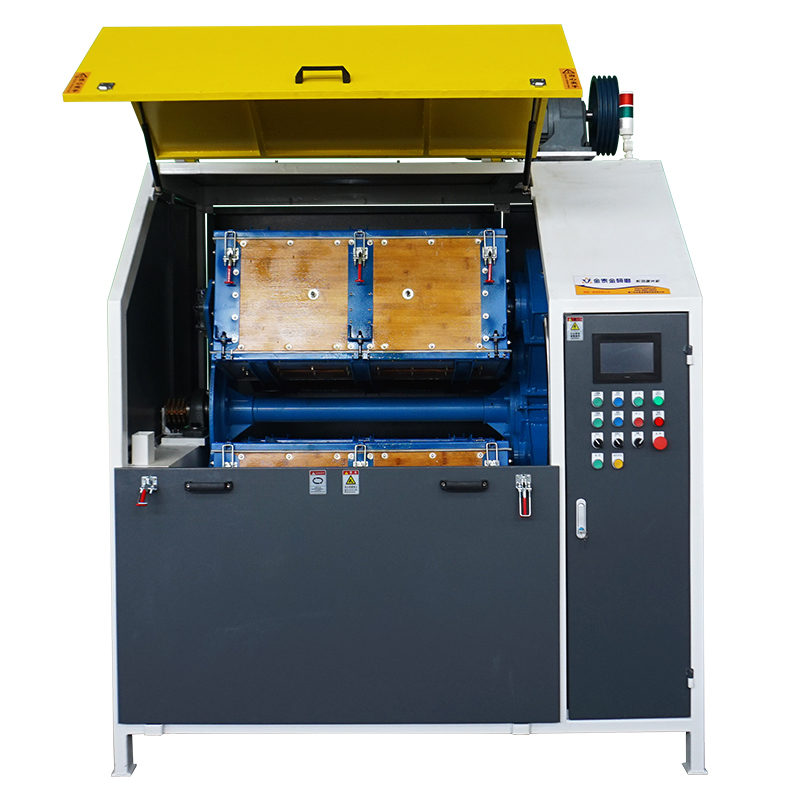
A tub vibrator gives a long, open chamber that accepts parts a bowl cannot, including tube spools, chute sections, small vessels and long fabrications. The part can be repositioned, rotated or left static depending on what has to be reached, and the open design makes it easier to watch what is happening to a weld during the cycle. The trade-off is evenness: coverage depends on how the part sits relative to the media mass, so banding and untouched shadow zones are common unless fixture and part orientation are planned. Internal surfaces of a long small-bore tube remain out of reach regardless of tub size. Tub capacity, media volume, how the part is supported and how it is lifted in and out should be settled before the route is accepted.
| Machine route | Where it fits | What it will not do |
|---|---|---|
| Magnetic finishing machine | Small precise parts and short internal features such as slots, small bores and blind recesses. | Part size and surface area are limited, large panels and long tubes are out of scope, and it will not dress a weld cap. |
| Vibratory finishing machine, bowl type | Edge and weld-toe blending plus surface refinement on mid-sized parts, with a visible load and adjustable energy. | Chamber geometry caps part size, and the inside of a long tube or a narrow crevice stays out of reach. |
| Grinding finishing machine | Removing a proud weld cap, heavy scale and heat tint before any tumbling or refinement stage. | Leaves a scratch pattern that needs refining, can smear oxide, and iron-bearing tooling can deposit free iron on stainless. |
| Barrel finishing machine, rotary barrel tumbler | Large batches of small robust fittings, fasteners and valve trim that can tumble freely without damage. | Part-on-part contact is unavoidable, and fine threads, sealing lips and thin diaphragms are poor candidates. |
Media that leaves the chamber with the parts is a defect, not a housekeeping issue, so separation is designed rather than improvised. Screens sized below the smallest medium and above the largest acceptable chip, magnetic separators for steel media, and a counted retrieval step for any feature that can trap a piece all belong in the plan. Media wear management is the other half: as ceramic wears the load loses cut, so a schedule for top-up, screening out fines and removing broken pieces keeps the process from drifting. Compound carryover into threads, gasket grooves and tube ends is controlled by rinse volume, rinse water quality, orientation while draining and drying. Sludge and spent compound disposal is a production cost and a housekeeping discipline that should be costed before a line is specified.
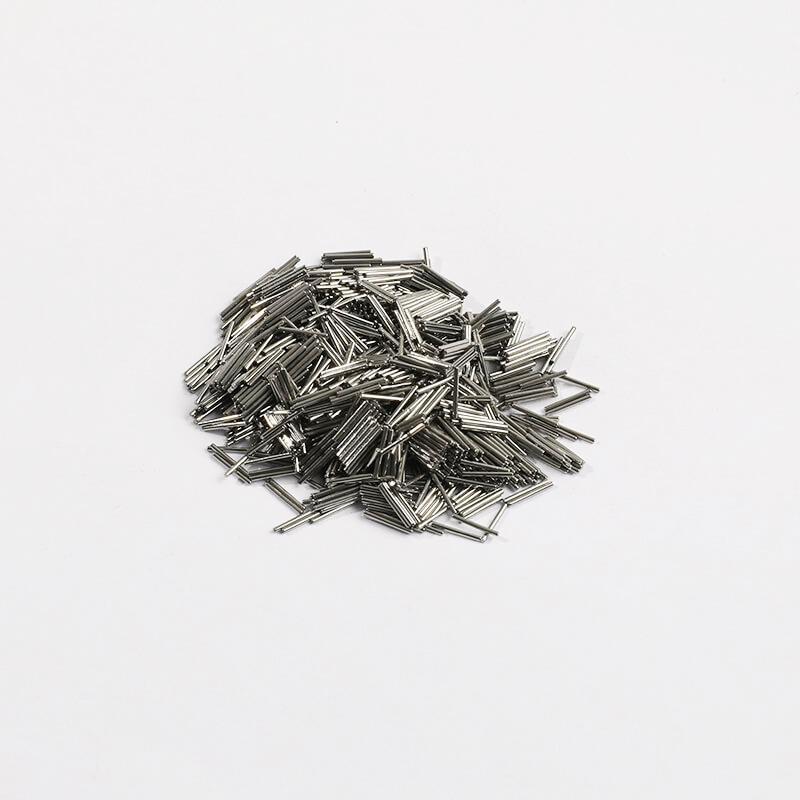
| Media | Best fit | Watch out for |
|---|---|---|
| Ceramic media, angle-cut triangles | Heavier weld-zone refinement and edge blending on 304 and 316L parts where a corner or a toe line has to be reached. | Wears down and changes its effective size class, produces sludge, and can over-round a thin edge or a soft detail. |
| Grinding media, coarse alumina-based | Removing a proud weld cap, heavy scale and heat tint before a refinement stage on accessible external surfaces. | Leaves a coarse scratch pattern that must be refined, removes material fast, and can gouge thin sheet or a soft alloy. |
| Liquid compound, abrasive cleaning slurry family | Cleaning, descaling and fine abrasive work through the cycle, with dosing and flow matched to the load and the alloy. | Chloride content and pH matter on stainless, foam can cushion the cut, and residue left in a crevice becomes a later defect. |
| Steel media, balls and diagonals | Bright surface refinement on robust stainless parts where a dense medium is wanted to work into recesses. | Can transfer iron to stainless, imprint soft or thin features, flatten a deliberate edge radius, and needs magnetic recovery. |
Removing material always changes the part, and the change is not always wanted. A weld toe can be rounded past the radius the drawing implies, a sealing lip can lose its bite, a gasket seat can dish enough to leak, and a thin tank panel can deflect under a heavy load. Media size class and density drive this: a large dense piece on a soft detail rounds it quickly, while a small light piece barely touches it. Detection uses an optical comparator or radius gauge on edges, a flatness check on sealing faces, and dimensional measurement of any feature that carries a tolerance. Dye penetrant or a visual check finds an undercut created by over-grinding a weld cap. Thin-wall parts deserve measurement before and after, because distortion in a small load only worsens at production fill levels.
| Failure mode | Likely cause | How to catch it |
|---|---|---|
| Uneven finish, banding or untouched shadow zones across one part | Part position in the chamber, a fixture holding a surface out of the media mass, or a load that is too full or too empty for even contact. | Take roughness readings at several marked locations instead of one, photograph at fixed angles around the part, and compare parts from the top and bottom of the same load. |
| Media lodged in gasket grooves, threads, blind holes or tube ends | Medium size class too close to the opening size, no masking or plugging, and no counted retrieval step at the end of the cycle. | Count media into and out of the load, use a borescope at an agreed angle plus a pin gauge on critical openings, and weigh or shake parts over a tray to reveal retained pieces. |
| Edge or weld toe rounded beyond the specified limit | Dense or large media running too long at high energy, or a part left free to tumble when it should have been fixtured. | Measure edges with an optical comparator or radius gauge and compare with the drawing limit, and measure a weld toe before and after the cycle on the same part. |
| Heat tint or oxide remaining at the weld toe and in the crevice beside it | Cycle too gentle or too short for the oxide thickness, or a medium size class too large to enter the toe line. | Inspect the toe at magnification under raking light against an agreed visual reference, photograph at a fixed angle before and after, and apply the buyer's own free-iron or passive-condition method where specified. |
Hamilton is Ontario's steel city, and the federal government describes its industrial base in those terms: the region plays a critical role in Ontario's economy, "supported by a diverse industrial base that includes advanced manufacturing, automation technologies, steel production, packaging solutions, and specialized industrial equipment". In August 2026, FedDev Ontario announced a combined investment of over CAD 12.5 million for nine Hamilton-area businesses responding to tariff-related pressures, and the backgrounder names the actual mix: custom robotic welding systems and CNC machining, steel fabrication of pressure equipment, hot-rolled steel bar production, prefabricated steel buildings, grease cartridges and industrial packaging, high-performance technical textiles for aviation, rail, defence and medical markets, and high-efficiency heating equipment. The national steel industry association frames the wider context, reporting over 40 producing facilities across Canada and a CAD 4.2 billion contribution to GDP from Canadian steel producers, and listing ArcelorMittal among its members. Automation is not incidental here — one of the funded Hamilton-area firms, Automation Design and Installation Inc., designs and manufactures custom robotic welding systems and automation solutions and is expanding into the mining and nuclear sectors.
The nearest part of that base to this brief is automotive: The steel bar producer Max Aicher North America is described as supplying hot-rolled steel bar products for construction, oil and gas and automotive sectors, and received CAD 7,000,000 toward a CAD 9.33 million rolling-mill modernisation project.
Hamilton's steel and heavy-fabrication base produces rolled bar, pressure equipment, welded structures and machined components where scale, edge condition and coating preparation are recurring production issues: mill scale and oxide on hot-rolled product, weld spatter and heat-tint on fabricated stainless, and burrs on cut and machined edges. Pressure-equipment fabrication adds a code-driven requirement, because a ground or dressed weld and a clean base metal surface are part of what the fabricator's quality system has to demonstrate. The robotics and automation cluster is a second, distinct driver: custom welding and machining cells are built to run unattended, which raises the value of a deburring or finishing step that is equally repeatable and not dependent on an operator standing at the machine.
A Hamilton buyer should settle whether the finishing step exists to meet a code or customer surface requirement or simply to prepare a surface for coating, because the first case requires documented, inspectable results and the second is a cost-and-throughput decision; conflating the two usually produces either an over-specified machine or an audit finding. The second question is how the finishing step will be loaded and unloaded inside a fabrication shop that is already organised around heavy lifts and long cycle times, since material handling, not the finishing process itself, is where most of the labour and the safety risk sits in heavy fabrication.
Freight context: Port of Hamilton (Hamilton-Oshawa Port Authority), John C. Munro Hamilton International Airport, CN and CPKC rail corridors, Great Lakes / St. Lawrence Seaway marine corridor. Hamilton combines a Great Lakes seaport with an international airport and direct Class 1 rail service, which is what allows heavy steel and fabricated industrial equipment to move in and out by water and rail rather than only by road. The Hamilton Chamber of Commerce, one of the oldest in Canada, also issues certificates of origin and maintains a tariff and trade resource hub, reflecting how much of the local manufacturing base is export-facing.
The customs authority is the Canada Border Services Agency (CBSA), and importers of commercial goods must work through the CBSA Assessment and Revenue Management (CARM) system, which is where registration, the duties-and-taxes calculator, advance rulings and national customs rulings, and the commercial accounting declaration (CAD) are handled. Documentation expectations are explicit: "You must provide proof of country of origin when you import goods into Canada and, in some cases, your goods must also be clearly marked", the invoice or sales receipt must carry "a complete description of the goods", "the selling price" and "any conditions and terms of the sale", and the value for duty must be declared in Canadian currency only. Duties and taxes are layered rather than single: customs duty on the tariff item, the Goods and Services Tax calculated on the duty-paid value, and potentially excise duty, excise tax, surtax or safeguard measures. Importers must also clear non-tariff gates: goods must be admissible, some goods need permits, certificates or inspections from other federal departments that the CBSA applies on their behalf, controlled goods under the Defence Production Act require consultation with the CBSA and Global Affairs Canada before import, and "Goods manufactured or produced wholly or in part by forced or prison labour are prohibited from entering Canada", with due diligence resting on the importer. For electrical machinery, the practical conformity route in Canada is certification of the product to Canadian electrical safety standards by an accredited certification body rather than a self-declared CE-style mark; buyers should confirm the specific certification body and mark required before shipment. For a first shipment of a finishing machine or a media/compound sample lot, the fastest way to remove classification and valuation uncertainty is to use the CARM portal to request an advance ruling for tariff classification and origin.
China is one of Canada's ten principal merchandise trading partners and the second-largest single-country source of Canadian imports after the United States: Statistics Canada reported CAD 5,369 million of balance-of-payments imports from China in January 2025, against a CAD 2,299 million bilateral merchandise deficit that month. Canada has no free trade agreement with China, so Chinese-origin industrial machinery enters under the Most-Favoured-Nation (MFN) tariff column of the Canadian Customs Tariff; the preferential treatments listed in the tariff (CUSMA/UST and MXT, CETA/CEUT, CPTPP/CPTPT, UKT, KRT and others) do not include China, and preferential rates require proof of origin plus the applicable shipping rules, so a China-origin machine cannot claim them. Tariff classification is mandatory work, not a formality: vibratory, barrel, centrifugal and disc finishing machines are classified in Chapter 84 ("Nuclear reactors, boilers, machinery and mechanical appliances; parts thereof") according to the function of the machine, and the ten-digit Canadian tariff item drives both the duty rate and the statistics. A further landed-cost risk sits outside the tariff schedule: under the Special Import Measures Act (SIMA), the CBSA and the Canadian International Trade Tribunal may apply anti-dumping and countervailing duties to named goods, so a buyer should check the measures-in-force list for the specific product before assuming the MFN rate is the final duty.
SurfacePolish supplies from Xiamen, China. The buyer's own destination rules, conformity marking, tariff classification and documentation responsibilities stay with the buyer; confirm them against the authorities named above before ordering.
Acceptance has to exist before finishing begins, otherwise every batch becomes a negotiation about appearance. Write the requirement per zone: which surfaces are product-contact, what roughness band applies to each, which edges keep a radius, which faces stay flat, what cleanliness and residue condition is required, and which features come back untouched. Name the inspection method and instrument for each requirement and the person who accepts or rejects. Where a requirement comes from a design code or a customer specification, the buyer's own quality function states and verifies it. A first article fully inspected and retained as the physical reference removes most later argument, particularly on welds, where a kept part says far more than a written description. Re-confirm the requirement whenever drawing, material or upstream fabrication changes.
A sample trial reports what was observed on the parts tested under the settings used, and that is the whole of it. It cannot promise a roughness value, an edge dimension, a cycle time, a throughput, a cost per part or a delivery date, and it does not qualify a machine, medium, compound or process for food contact, hygienic service or any regulated application. A handful of parts does not represent production variation in material, welding or fit-up, and performance in service, including corrosion behaviour after cleaning and any passivation step, is not established by a finishing trial. What a trial does give is evidence: how a route behaved on real geometry, which zones it reached, what the surface looked like, and where a mechanical route runs out of reach. The decisions that follow belong with the buyer.
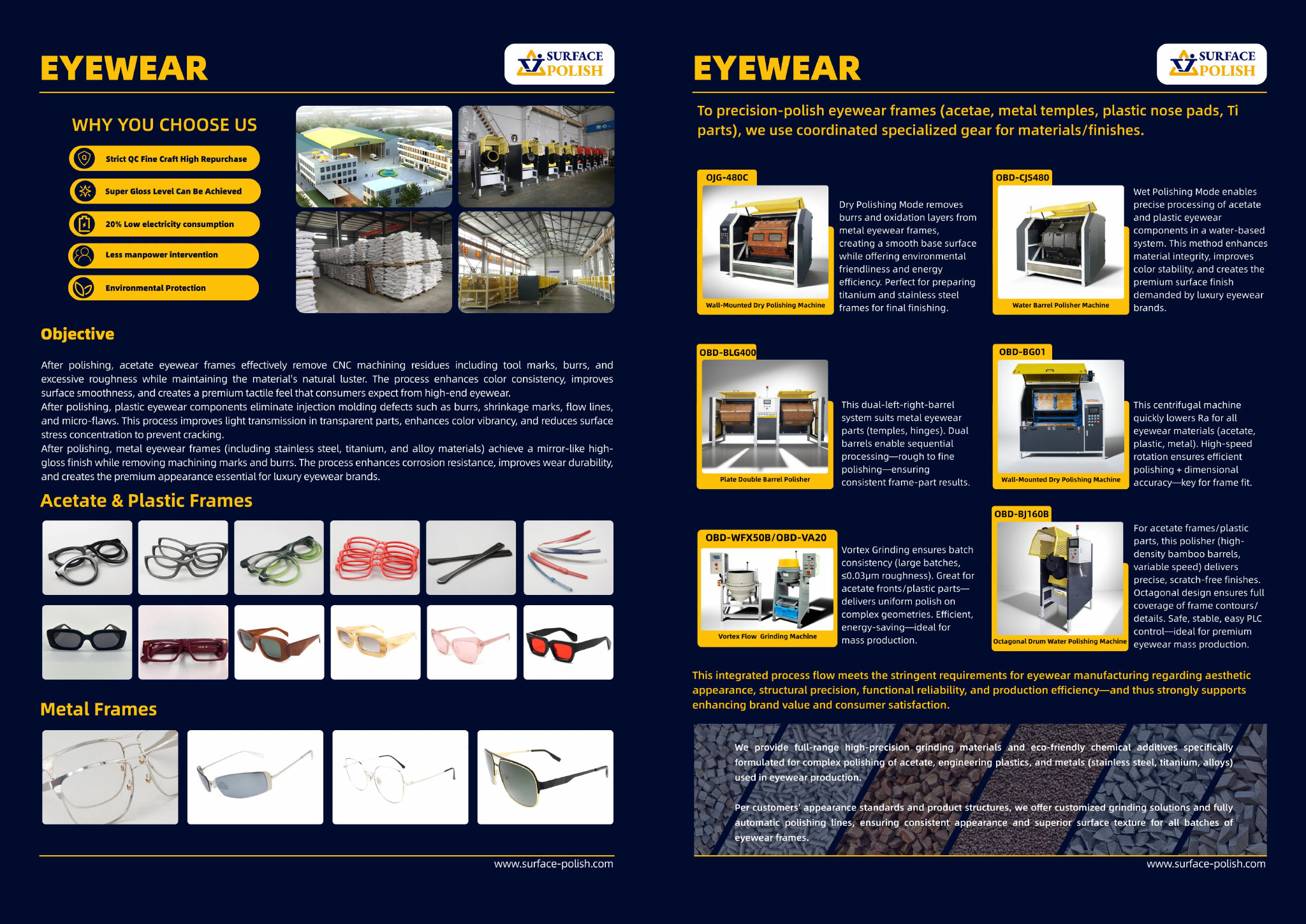
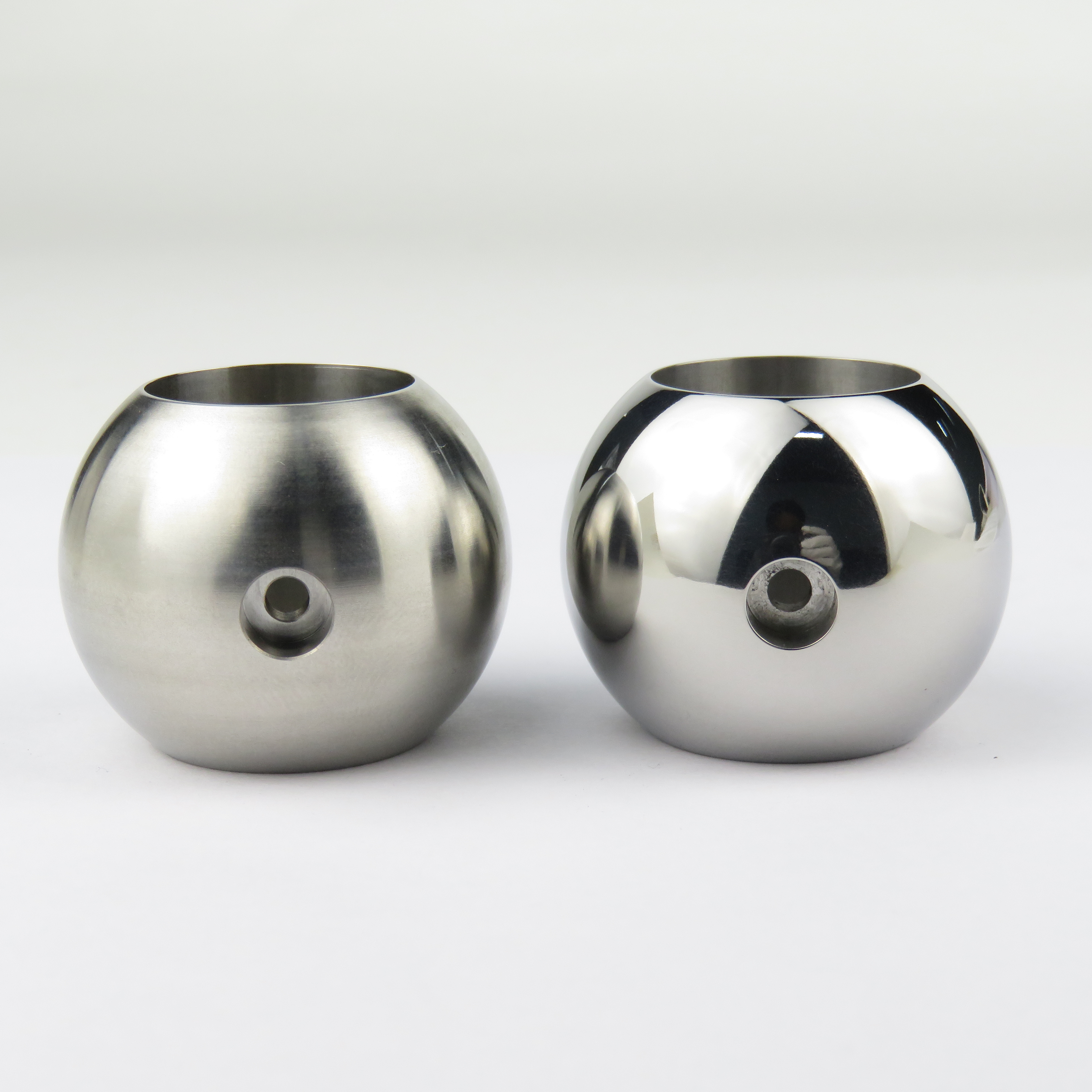
Heat tint is oxide, so it is removed by cut rather than by cleaning. Ceramic media with an aggressive shape and bonding, or a grinding stage followed by refinement, are the usual mechanical answers on accessible weld zones. The limit is reach: a tint line that runs into a toe, a crevice or a small bore may survive a cycle that polishes the cap, which is why the toe should be inspected rather than judged by the shine of the weld face. Media size, shape and cycle energy must suit the oxide thickness. A trial on your own parts shows what was removed on the geometry tested.
Specify it with a location, a cut-off and a direction, not as a single number. Mark the measurement points on the drawing and say whether each sits on base metal, a dressed weld or the heat-affected zone, because those are different surfaces. State the cut-off and evaluation length, and require readings across the lay at each point rather than one convenient traverse. Also state what Ra is not being asked to prove: it does not describe a crevice, an oxide film, embedded contamination or an edge condition. A buyer in Canada should record the instrument and the calibration specimen on every report.
No. Mechanical finishing removes material and can strip oxide and free iron from the surfaces it touches, but it does not restore a passive film and it does not perform a chemical passivation step. Passivation, whether by a paste, a bath or an electrochemical process, is a separate operation with its own method and verification that belongs to your own specification and supply chain. Mechanical work can leave a surface in better or worse condition for that step, which is one reason media and compound selection on 316L should consider what comes afterwards rather than only the finish you see at the end of the cycle.
Use Hamilton, Canada as the destination on the enquiry and state whether the deliverable is equipment, media and compound, a representative sample review or a line concept. A destination does not imply local stock, a local service point or a local delivery time.
A Hamilton fabricator normally works to the material and fabrication standards named on the customer's drawing, the welding and pressure-equipment code applicable to the vessel or structure being built, and the customer's coating or surface-preparation specification. Plant-side requirements come from Ontario occupational health and safety regulation, including guarding, lockout and welding fume control, and equipment must carry Canadian electrical safety certification.
Sources were retrieved on 2026-09-29 and describe the local industrial and trade context only. They do not evidence any SurfacePolish project, shipment, installation or service in Hamilton.
The buyer wants the helical weld dressed and the flights refined while holding the drive-end bore and the shaft straightness.
Send the material, dimensions, approximate weight, batch quantity, the incoming condition and photographs of the difficult features. Mark which features must not be contacted by media and state how the result will be inspected. This form carries source reference PSEO-0164; quote it if you prefer an additional manual reference.
Open the SurfacePolish enquiry form Email a prepared enquiry
No price, lead time, certification or result is promised here. Confirm whether a sample trial is available for the specific part and what the trial can and cannot show.
Page PSEO-0164 · revised 2026-09-29 · cross-border equipment, media and scoped sample review. City context is sourced and cited above.
Use this local checker to identify missing part and inspection information. It prepares a technical-review brief; it does not approve a machine, process recipe or production result.
Complete the part details to prepare a review brief.
Email : info@surface-polish.com


 IPv6 network supported


 +86-592-2381506