A fittings supplier in Hobart, Australia supplying food processing equipment has 600 small 316L components that need consistent refinement at volume. Free tumbling would be efficient, but machined gasket faces and mixed sizes make part-on-part contact and over-rounding real concerns, so the load and medium have to be planned. SurfacePolish supplies machines, media and compounds across borders and runs a free sample trial. This brief is written for a buyer in Hobart working on food processing equipment; it describes equipment, media and a scoped sample review, not a local polishing service.
What must the finished surface survive in service, including cleaning cycles, and how will that be checked without leaning on a finishing trial?
Which internal surfaces can a mechanical route physically reach, and what happens to the zones it cannot?
Which surfaces on this part touch product, and what does each one have to satisfy in roughness, oxide freedom, edge condition and cleanliness?
The first screening question is which surfaces actually touch product, which sit adjacent to it and which are structural. A tank shell, a tube bore, a gasket seat and an agitator face carry different requirements from a mounting frame or a nameplate bracket, and one blanket finish call on the drawing usually means the wrong zones get the most attention. Mark each zone and state what has to be true of it: oxide-free, inside a stated roughness band, flat at a sealing face, unbroken at an edge radius. Product-contact geometry is where a mechanical route is judged, because heat tint, crevices and unreachable internal surfaces decide whether the surface can be brought to the condition the buyer's own specification describes. Surface classification also drives inspection, since reading roughness on a structural frame says nothing about a weld inside a vessel.
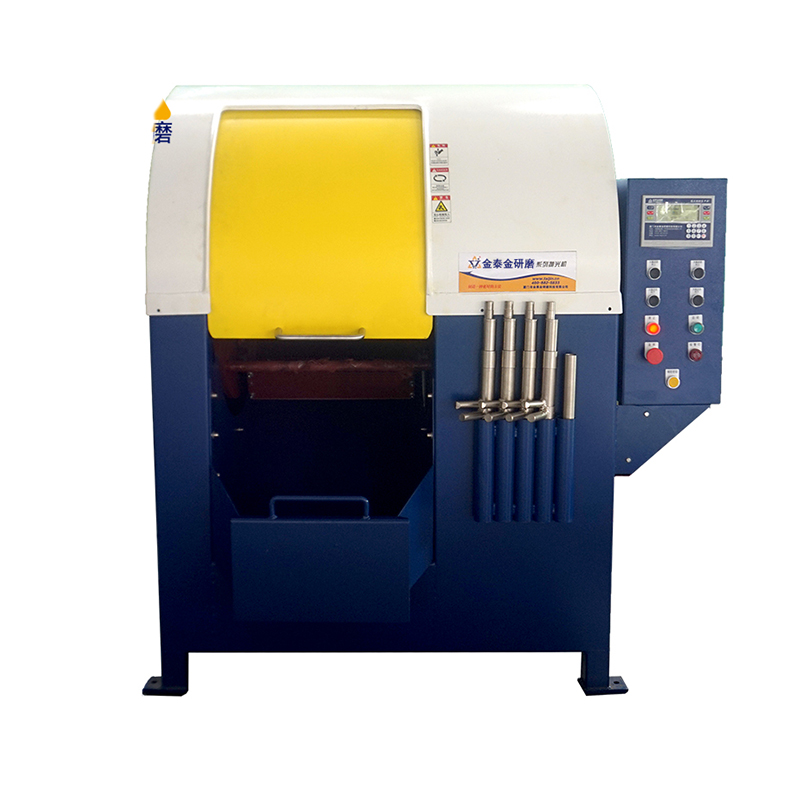
A bowl vibrator keeps a visible, continuously moving load and suits mid-sized parts where edges, weld toes and accessible external surfaces need blending and refinement. Energy is set by amplitude, motor speed and load fill, so one machine can deburr aggressively or refine gently, and the effect on a weld toe is judged by how much cap material the buyer is willing to lose. The bowl reaches external geometry and shallow recesses well, and it can carry compartments or fixtures to limit part-on-part contact on thin or appearance-critical pieces. It does not reach the inside of a long tube or a narrow crevice, and chamber geometry caps part size. Media class and fill level matter more than nominal machine size: an under-filled chamber raises impingement risk, and an over-filled one starves the part of contact.
| Machine route | Where it fits | What it will not do |
|---|---|---|
| Barrel finishing machine, rotary barrel tumbler | Large batches of small robust fittings, fasteners and valve trim that can tumble freely without damage. | Part-on-part contact is unavoidable, and fine threads, sealing lips and thin diaphragms are poor candidates. |
| Centrifugal barrel finishing machine | Higher-energy cycles that shorten the time to blend an edge or refine a small part in quantity. | The added energy increases over-rounding and imprinting risk, and delicate or mixed-size loads need careful planning. |
| Grinding finishing machine | Removing a proud weld cap, heavy scale and heat tint before any tumbling or refinement stage. | Leaves a scratch pattern that needs refining, can smear oxide, and iron-bearing tooling can deposit free iron on stainless. |
| Vibratory finishing machine, bowl type | Edge and weld-toe blending plus surface refinement on mid-sized parts, with a visible load and adjustable energy. | Chamber geometry caps part size, and the inside of a long tube or a narrow crevice stays out of reach. |
Media that leaves the chamber with the parts is a defect, not a housekeeping issue, so separation is designed rather than improvised. Screens sized below the smallest medium and above the largest acceptable chip, magnetic separators for steel media, and a counted retrieval step for any feature that can trap a piece all belong in the plan. Media wear management is the other half: as ceramic wears the load loses cut, so a schedule for top-up, screening out fines and removing broken pieces keeps the process from drifting. Compound carryover into threads, gasket grooves and tube ends is controlled by rinse volume, rinse water quality, orientation while draining and drying. Sludge and spent compound disposal is a production cost and a housekeeping discipline that should be costed before a line is specified.
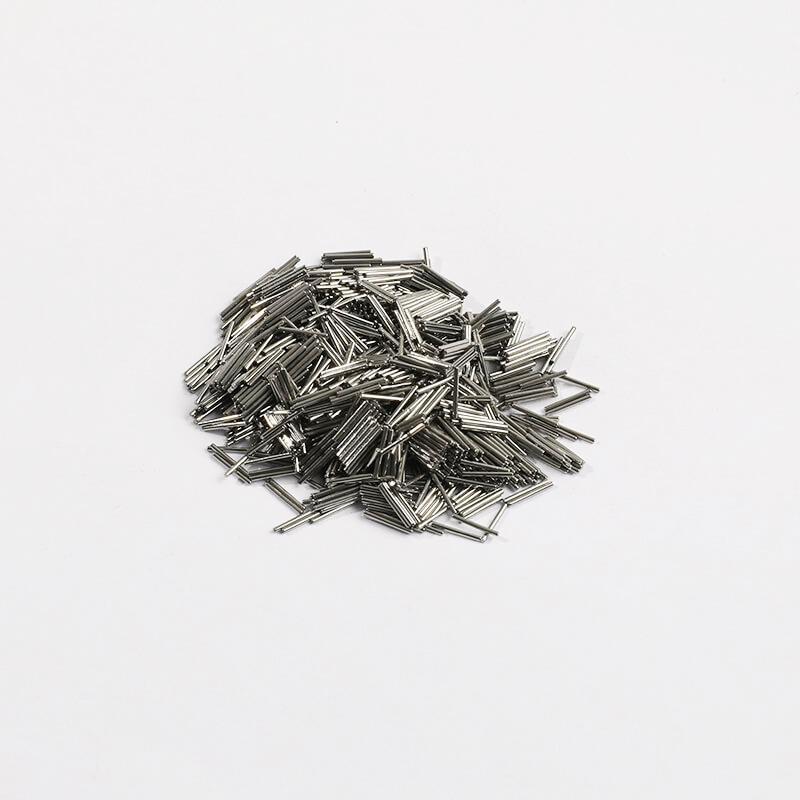
| Media | Best fit | Watch out for |
|---|---|---|
| Ceramic media, small cylinders and spheres | General deburring and light radius work on hygienic fittings, with less edge cutting than an angle-cut shape. | Small sizes lodge in gasket grooves and drilled openings, and a sphere refines slowly where oxide is thick. |
| Grinding media, coarse alumina-based | Removing a proud weld cap, heavy scale and heat tint before a refinement stage on accessible external surfaces. | Leaves a coarse scratch pattern that must be refined, removes material fast, and can gouge thin sheet or a soft alloy. |
| Ceramic media, angle-cut triangles | Heavier weld-zone refinement and edge blending on 304 and 316L parts where a corner or a toe line has to be reached. | Wears down and changes its effective size class, produces sludge, and can over-round a thin edge or a soft detail. |
| Dry media, walnut shell and corn cob | Light dry burnishing and cosmetic refinement where retained water in a crevice or assembly is a problem. | Generates dust requiring extraction, removes no oxide, and leaves a surface character different from a wet abrasive cycle. |
Abrasive media working on a tinted weld can smear and burnish the oxide into a smooth, shiny, deceptive layer instead of cutting through it. The surface reads better visually than the starting condition while the chromium-depleted zone underneath is unchanged, and roughness readings may even improve because the profile has been flattened. This is most likely where a cycle is too gentle or too short for the oxide thickness, or where the compound is cleaning rather than cutting. Detection means looking at the transition zone rather than the cap: a dye-based or free-iron check, a cross-section of a sample part, or a controlled comparison between a mechanically worked area and a freshly ground area. Refinement should only follow a stage that genuinely removed the oxide, which is why sequence matters more than final polish.
| Failure mode | Likely cause | How to catch it |
|---|---|---|
| Rust bloom or free-iron staining appearing after finishing | Carbon steel brushes, iron-bearing media, shared racks or contaminated rinse water depositing free iron on a 304 or 316L surface. | Run a ferroxyl-type test or the buyer's own equivalent at agreed locations including crevices and internal surfaces, after rinsing and drying, and record the result with the batch. |
| Discolouration, water spotting or flash rust after the cycle | Contaminated or hard rinse water, incomplete draining of a crevice, or a part left wet before drying. | Inspect after drying under consistent lighting, check the rinse water source and quality, and verify that orientation during draining lets every recess empty. |
| Cross-contamination from tooling, racks or media shared with carbon steel | No dedicated stainless area, undocumented consumable grades, or media stored where mild steel fabrication dust settles. | Audit which tools, racks and media touch the part, record their grades, store media covered and segregated, and confirm cleanliness with the buyer's own test after a tooling change. |
| Thin-wall distortion or dishing on tanks, panels and chutes | Heavy media load striking unsupported thin sheet, or a chamber fill level that lets parts fall rather than tumble. | Measure wall flatness and key dimensions before and after, inspect under raking light for oil-canning, and run the test at the production fill level rather than a light one. |
Hobart's manufacturing base is smaller than the mainland capitals but unusually specialised, with world-scale capability in a few niches rather than broad heavy industry. The clearest example is shipbuilding: Incat has built high-speed aluminium catamarans at its Hobart shipyard for more than four decades, has built around 100 vessels for operators in 24 countries, employs more than 500 people, and is now building large battery-electric ferries, having been named Tasmanian Exporter of the Year 2026. The city is also the port and service centre for Tasmanian industry: TasPorts, the state-owned ports company, operates the Port of Hobart and reports that across its ports it has facilitated the movement of over 145 million tonnes of freight in the past decade, serving mining, manufacturing, timber and dairy. Hydro Tasmania, based in Hobart, is Australia's largest generator of clean renewable energy, and the state's hydro-industrial base has historically supported energy-intensive processing. Hobart Airport is Australia's southernmost airport and describes itself as curfew free.
For this brief the relevant part of that base is food: TasPorts states its trade covers 'mining and manufacturing to timber and dairy products', and the Port of Hobart is the state's principal port with berths at Macquarie Wharf and Princes Wharf handling the island's export trades; no Hobart-specific food processing cluster source was reachable, so this is evidenced at the Tasmanian trade level rather than as a mapped Hobart cluster.
Aluminium shipbuilding is the defining finishing challenge in Hobart: welded aluminium structures in high-speed ferries require weld dressing, oxide removal and controlled surface preparation before painting or coating, and surface defects matter for fatigue performance and corrosion resistance in a marine environment. Stainless and aluminium components used in marine fit-out, in Hydro Tasmania's generation and water infrastructure, and in food and dairy processing equipment all need burr-free edges and contamination-free surfaces for hygiene, sealing and corrosion reasons. Because volumes are low and parts are large or awkward, finishing method selection is typically driven by part size and geometry rather than throughput.
A Hobart buyer should first establish whether the surface being finished is structural aluminium that will be welded and painted, or a stainless product-contact surface in food, dairy or marine service, because the acceptable media, the cleanliness requirement and the evidence of a correct finish are entirely different in each case.
Freight context: Port of Hobart (Macquarie Wharf and Princes Wharf berths, operated by TasPorts), Hobart Airport (Australia's southernmost airport, curfew free, at Cambridge), Bell Bay (TasPorts' northern deep-water port serving Bass Strait trades). TasPorts reports that over the past decade its ports and people have facilitated the movement of over 145 million tonnes of freight, covering mining, manufacturing, timber and dairy, and it publishes quarterly trade reports by port and commodity. The Port of Hobart handles the state's southern trades through the Macquarie Wharf berths, and Incat's Hobart shipyard relies on heavy-lift vessels calling at Hobart to collect completed hulls for delivery overseas, as shown by its Hull 096 shipment. Hobart Airport is curfew free, which matters for time-critical air freight, while Bass Strait sea freight between Tasmania and the mainland is the principal route for inbound machinery.
The national standards body is Standards Australia, which publishes Australian Standards (AS) and joint Australian/New Zealand Standards (AS/NZS); on their own, standards are voluntary and there is no general requirement for the public to comply, but state and Commonwealth governments often refer to AS or AS/NZS standards in legislation and they can then become mandatory. For finishing and machinery work, the applicable documents are the ones cited in the buyer's own contract, purchase specification, licence condition or safety management system, together with the marking rules in AS/NZS 4417.1 and AS/NZS 4417.2 for in-scope electrical equipment sold under the EESS.
Australia and China are parties to the China-Australia Free Trade Agreement (ChAFTA), signed on 17 June 2015 and in force since 20 December 2015; the Australian Border Force maintains a dedicated ChAFTA page and working tariff schedule, and FTAs give importers a route to preferential rates of duty where the rules of origin are met. China was Australia's largest source of imports in 2025 at $130.2b, up 12.5% on 2024, and 56% (69,567) of Australian business importers traded at least once with China in 2020-21. A Chinese supplier of finishing machines, media or compounds is therefore shipping into Australia's single largest import stream, and preferential duty depends on origin documentation rather than on a blanket zero-tariff guarantee for every product line.
SurfacePolish supplies from Xiamen, China. The buyer's own destination rules, conformity marking, tariff classification and documentation responsibilities stay with the buyer; confirm them against the authorities named above before ordering.
Acceptance has to exist before finishing begins, otherwise every batch becomes a negotiation about appearance. Write the requirement per zone: which surfaces are product-contact, what roughness band applies to each, which edges keep a radius, which faces stay flat, what cleanliness and residue condition is required, and which features come back untouched. Name the inspection method and instrument for each requirement and the person who accepts or rejects. Where a requirement comes from a design code or a customer specification, the buyer's own quality function states and verifies it. A first article fully inspected and retained as the physical reference removes most later argument, particularly on welds, where a kept part says far more than a written description. Re-confirm the requirement whenever drawing, material or upstream fabrication changes.
A trial is only as informative as the parts that go into it, so send pieces that carry the deciding geometry rather than whatever is easiest to pack. Include the tightest crevice, the smallest bore, the longest tube, the thinnest wall, the most awkward weld toe and the surface that must stay untouched, even when those features sit on different parts. Send at least one part already rejected for a finishing-related reason so the failure can be examined directly, and note which operations have already been applied. State the grade and provide the material certificate, and mark up the drawing with the zones to be finished, protected and inspected. Package parts so they arrive in the condition they left in, and label each one for identification on return.
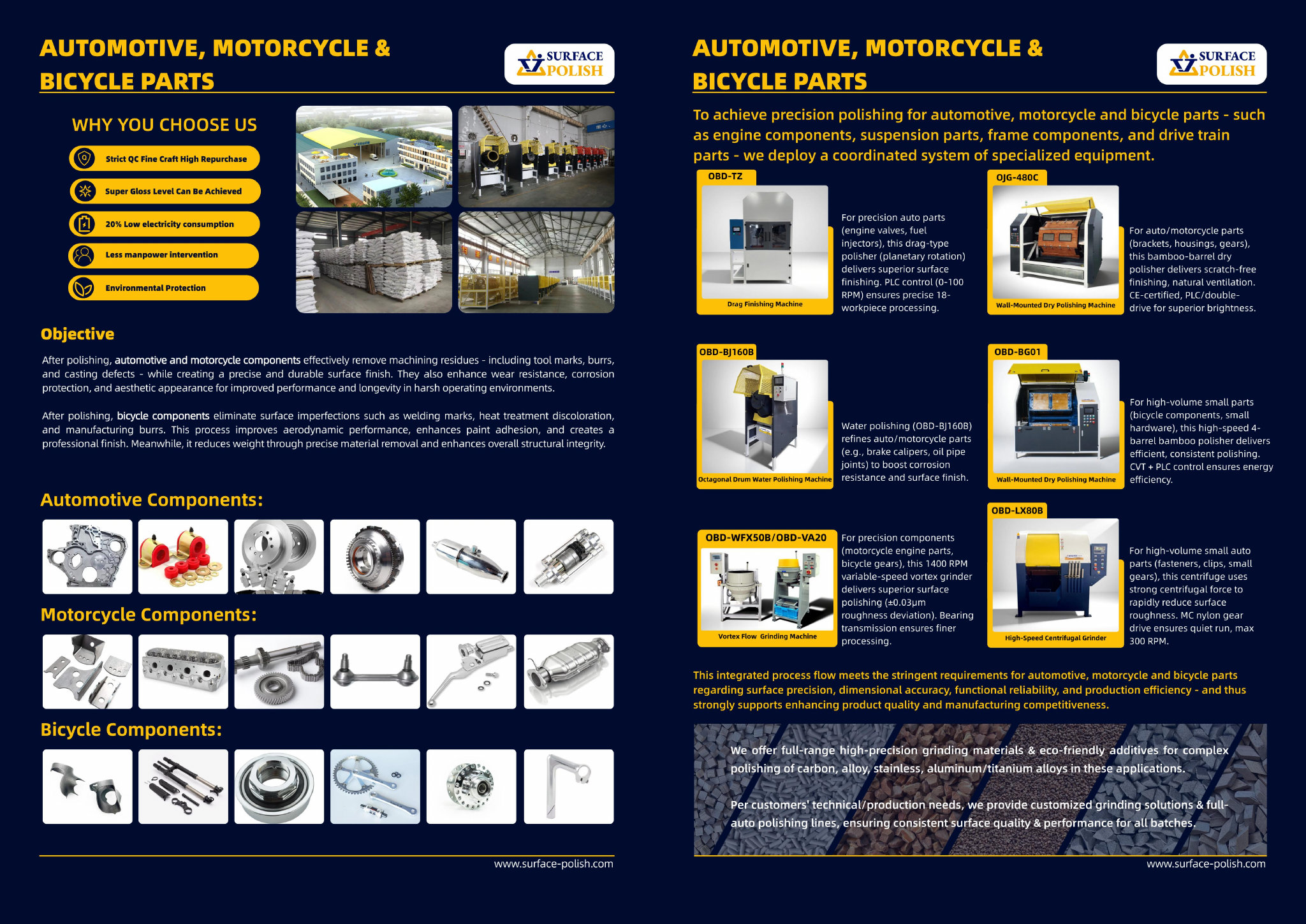
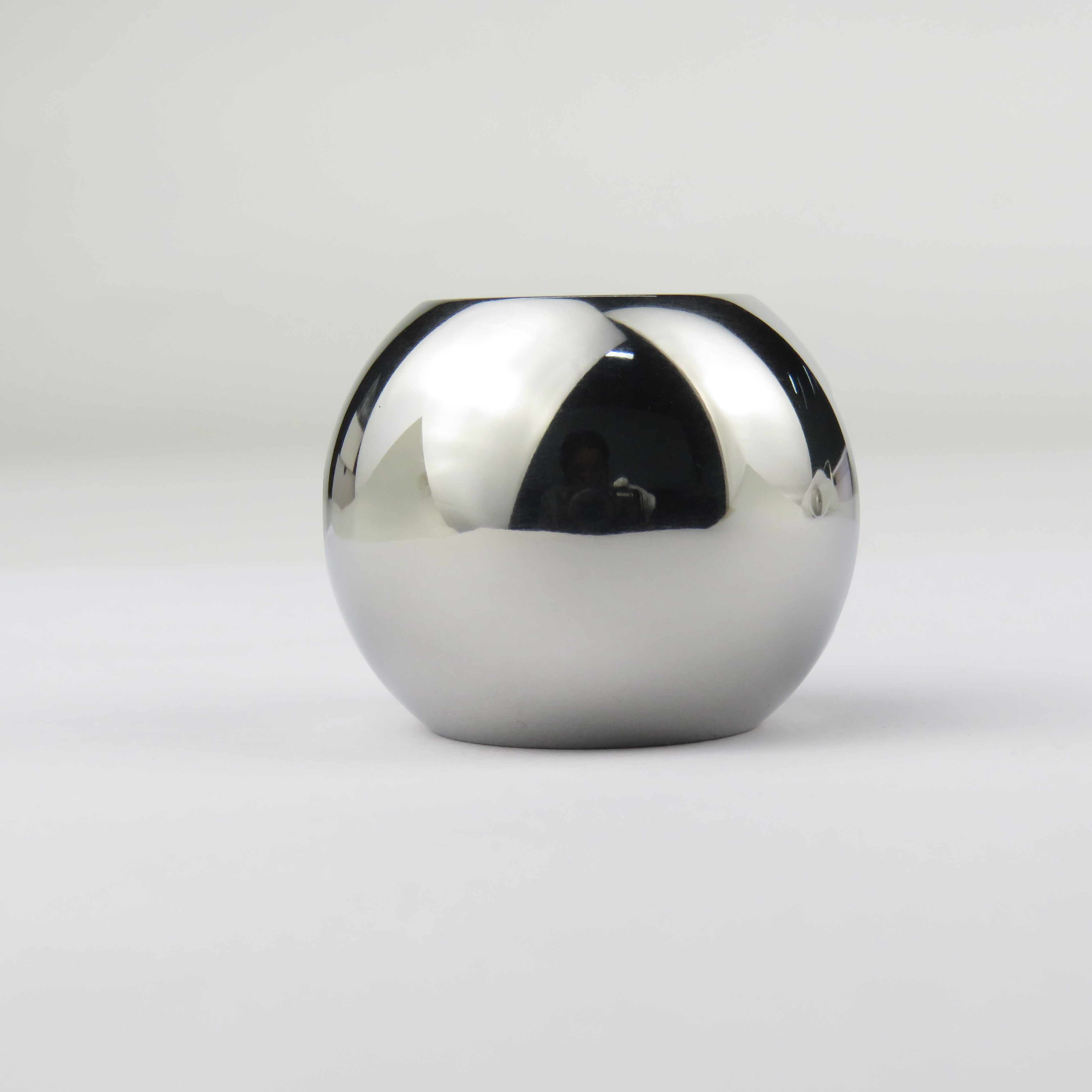
Send representative parts, including the most difficult geometry in the family, and SurfacePolish runs them through a mechanical finishing route and returns the tested parts with observations and a proposed media, compound and cycle direction. The report describes what was seen on those parts under those settings. It is not a guarantee of a roughness value, an edge dimension, a cycle time, a capacity, a cost or a delivery date, and it does not qualify a process for any regulated use. Production variation in material, welding and fit-up is not represented by a small trial load, so your own verification still decides.
They are different operations rather than interchangeable ones. Mechanical finishing can remove a weld cap and oxide where a medium or tool physically reaches, and it refines the surface it contacts. Electrochemical polishing removes a thin layer more uniformly and can reach inside small-bore tubing and enclosed channels that no tumbling medium enters. A mechanical route is usually the practical answer for accessible weld zones and external surfaces, and it cannot level the inside of a long narrow tube. Whether that reach matters on your part is the decision; a trial at Hobart can show what was reached on the parts tested.
Start from geometry, not finish numbers. Map every internal surface, its bore diameter, its depth and whether a tool or medium can enter it; that map usually settles which zones an electrochemical route can level and which a mechanical route can touch. Then compare what each route leaves behind: a mechanically worked surface can carry a scratch pattern and embedded debris, while an electrochemical route changes the surface uniformly but brings its own process controls and an acid step. Cost per part, downstream passivation and your own inspection evidence should drive the decision, and a comparison trial at Hobart can show the mechanical side on your geometry.
Use Hobart, Australia as the destination on the enquiry and state whether the deliverable is equipment, media and compound, a representative sample review or a line concept. A destination does not imply local stock, a local service point or a local delivery time.
Hobart manufacturers work to Australian Standards administered by Standards Australia, and Tasmanian marine work additionally references Australian and international maritime classification and survey requirements for vessel construction and repair. Electrically powered machinery must comply with the EESS and carry the Regulatory Compliance Mark under AS/NZS 4417.1 and AS/NZS 4417.2 where in scope.
Sources were retrieved on 2026-09-29 and describe the local industrial and trade context only. They do not evidence any SurfacePolish project, shipment, installation or service in Hobart.
The buyer needs consistent edge and surface refinement across a large fitting batch without damaging machined gasket faces or losing parts in the load.
Send the material, dimensions, approximate weight, batch quantity, the incoming condition and photographs of the difficult features. Mark which features must not be contacted by media and state how the result will be inspected. This form carries source reference PSEO-0794; quote it if you prefer an additional manual reference.
Open the SurfacePolish enquiry form Email a prepared enquiry
No price, lead time, certification or result is promised here. Confirm whether a sample trial is available for the specific part and what the trial can and cannot show.
Page PSEO-0794 · revised 2026-09-29 · cross-border equipment, media and scoped sample review. City context is sourced and cited above.
Use this local checker to identify missing part and inspection information. It prepares a technical-review brief; it does not approve a machine, process recipe or production result.
Complete the part details to prepare a review brief.
Email : info@surface-polish.com


 IPv6 network supported


 +86-592-2381506