A bulk handling fabricator in Montreal, Canada serving food processing equipment has a 2.4 m 304 auger with a helical weld along its flights. The part is far too long for a bowl machine, and its drive-end bore has a tolerance that finishing must not disturb, so the buyer needs a route that suits long geometry. SurfacePolish supplies finishing equipment, media and compounds across borders and runs a free sample trial. This brief is written for a buyer in Montreal working on food processing equipment; it describes equipment, media and a scoped sample review, not a local polishing service.
What must the finished surface survive in service, including cleaning cycles, and how will that be checked without leaning on a finishing trial?
Which internal surfaces can a mechanical route physically reach, and what happens to the zones it cannot?
Where will roughness be measured, with which cut-off and in which direction, and does that location represent the surface the product actually sees?
Grade and history determine what the surface can tolerate. Confirm whether the part is 304, 304L, 316 or 316L, whether it is annealed or cold worked, and whether a free-machining grade with added sulphur has been used in a product-contact position. Record every operation that has already touched the surface: forming, shot blasting, wire brushing with carbon steel, grinding with iron-bearing tooling, acid pickling, electrochemical polishing or an earlier mechanical polish. Each leaves a different starting condition and a different contamination risk. Note heat treatment and any sensitisation concern from welding or high-temperature service, because material condition affects how the surface behaves later and cannot be changed by finishing. Certificates for the delivered material and a written sequence of operations are the minimum evidence to request.
Magnetic finishing uses small steel pins or fine media driven by a rotating magnetic field, which lets it work inside small bores, slots and blind features that tumbling media cannot enter, and the pin-like medium is less likely to lodge than a shaped ceramic piece. It suits small precise components rather than large panels or long tubes, and it will not remove a proud weld cap. A dry route, using dry media on a dry polishing machine, is chosen when retained water in a crevice or an assembly is a problem, or when a light cosmetic refinement is wanted on a part that must not be wet. Dry processing generates dust and cannot remove heat tint or oxide, so it complements rather than replaces a wet abrasive stage. The dryer after a wet cycle is a process step, not an afterthought.
| Machine route | Where it fits | What it will not do |
|---|---|---|
| Magnetic finishing machine | Small precise parts and short internal features such as slots, small bores and blind recesses. | Part size and surface area are limited, large panels and long tubes are out of scope, and it will not dress a weld cap. |
| Grinding finishing machine | Removing a proud weld cap, heavy scale and heat tint before any tumbling or refinement stage. | Leaves a scratch pattern that needs refining, can smear oxide, and iron-bearing tooling can deposit free iron on stainless. |
| Tub vibrator | Long parts, tube spools, chute sections and small vessels that a bowl cannot accept, with the part repositioned as needed. | Coverage depends on how the part sits in the media mass, so banding and shadow zones are common without a planned fixture. |
| Dry polishing machine and dryer | Dry burnishing where a wet cycle is unwanted, and drying parts after a wet cycle so crevices do not stay wet. | Removes no oxide and needs dust extraction; a dryer manages water, it does not change the finish left by the wet stage. |
Steel media in balls, diagonals and pins is dense and produces a bright refined surface quickly, which makes it attractive where appearance matters. On stainless the trade-off is contamination: steel media and its wear debris can transfer iron to the surface, and that iron is exactly what later appears as a rust bloom in service. Magnetic separation makes steel media easy to recover, and its mass helps it work into recesses, but it can also imprint soft or thin features and flatten a deliberate edge radius. Whether steel is acceptable depends on the buyer's own cleanliness and free-iron requirements and on what happens downstream. If a stainless part will meet moisture or a chloride-bearing environment, settle the contamination question before steel media is written into the process.
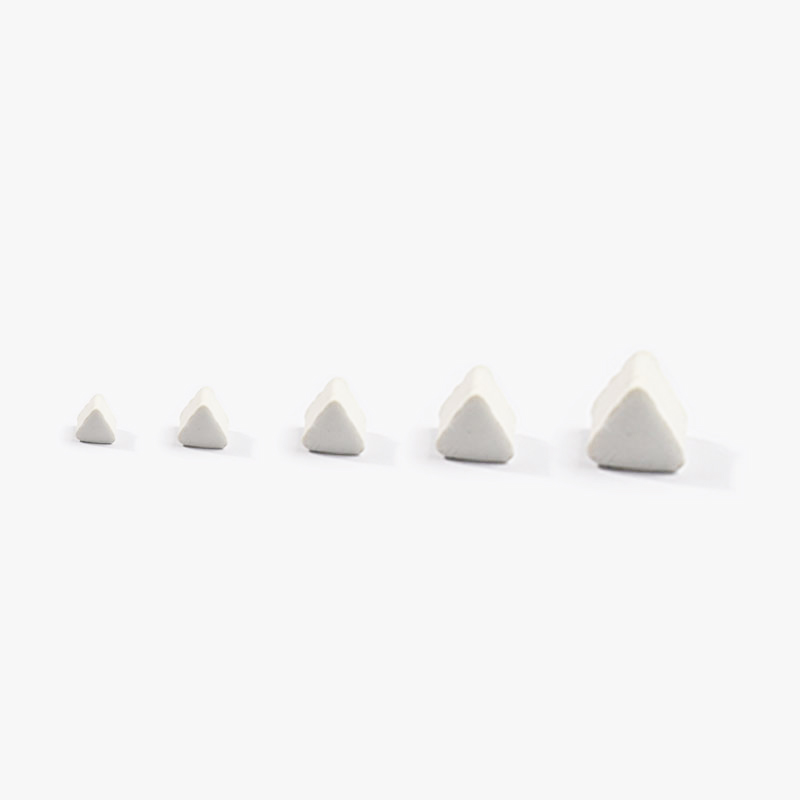
| Media | Best fit | Watch out for |
|---|---|---|
| Ceramic media, angle-cut triangles | Heavier weld-zone refinement and edge blending on 304 and 316L parts where a corner or a toe line has to be reached. | Wears down and changes its effective size class, produces sludge, and can over-round a thin edge or a soft detail. |
| Dry media, walnut shell and corn cob | Light dry burnishing and cosmetic refinement where retained water in a crevice or assembly is a problem. | Generates dust requiring extraction, removes no oxide, and leaves a surface character different from a wet abrasive cycle. |
| Ceramic media, small cylinders and spheres | General deburring and light radius work on hygienic fittings, with less edge cutting than an angle-cut shape. | Small sizes lodge in gasket grooves and drilled openings, and a sphere refines slowly where oxide is thick. |
| Grinding media, coarse alumina-based | Removing a proud weld cap, heavy scale and heat tint before a refinement stage on accessible external surfaces. | Leaves a coarse scratch pattern that must be refined, removes material fast, and can gouge thin sheet or a soft alloy. |
Free iron on stainless usually comes from tooling and consumables rather than from the part: carbon steel brushes, wire wheels, blasting grit or shot, iron-bearing media, shared racks, gloves that have handled mild steel and water from a contaminated line. It appears days or weeks later as a bloom of rust, often localised near a weld or a crevice. Detection uses a ferroxyl-type test or an equivalent method chosen by the buyer's own quality function, applied at the agreed locations including crevices and internal surfaces after finishing and rinsing. Control is separation: dedicated stainless tooling, media and racks; documented grade of every consumable that touches the surface; and a cleaning step after mechanical work. An upstream acid pickle or electrochemical polish brings its own concerns, including hydrogen, and sits outside what finishing equipment does.
| Failure mode | Likely cause | How to catch it |
|---|---|---|
| Media lodged in gasket grooves, threads, blind holes or tube ends | Medium size class too close to the opening size, no masking or plugging, and no counted retrieval step at the end of the cycle. | Count media into and out of the load, use a borescope at an agreed angle plus a pin gauge on critical openings, and weigh or shake parts over a tray to reveal retained pieces. |
| Rust bloom or free-iron staining appearing after finishing | Carbon steel brushes, iron-bearing media, shared racks or contaminated rinse water depositing free iron on a 304 or 316L surface. | Run a ferroxyl-type test or the buyer's own equivalent at agreed locations including crevices and internal surfaces, after rinsing and drying, and record the result with the batch. |
| Edge or weld toe rounded beyond the specified limit | Dense or large media running too long at high energy, or a part left free to tumble when it should have been fixtured. | Measure edges with an optical comparator or radius gauge and compare with the drawing limit, and measure a weld toe before and after the cycle on the same part. |
| Gasket seat or sealing face dished so it no longer seals | Over-finishing a machined face, part-on-part contact in an unseparated load, or media hammering a face that should have been masked. | Check flatness of the sealing face with a straight edge, a feeler gauge or a surface plate before and after, and confirm against the sealing requirement the buyer's specification states. |
Montreal's industrial identity is anchored in aerospace, and the province-level cluster is organised, funded and internationally visible: when announcing defence-supply-chain funding at Aéro Montréal's 2026 International Aerospace Innovation Forum, the federal government described Aéro Montréal as the "Quebec aerospace industrial cluster" and paired it with Propulsion Québec for electric and smart transportation and with Sous-traitance industrielle Québec (STIQ) for manufacturing businesses. The same announcement shows how deliberately the region builds supplier capability, with CAD 4,495,000 of non-repayable federal funding to prepare Quebec SMEs for defence-sector requirements, and STIQ's share explicitly targeted at "manufacturing businesses in order to prepare them to meet defence sector requirements". Manufacturing is broad beyond aerospace, and the federal funding is deliberately aimed at the supplier tier: STIQ's contribution is targeted at manufacturing businesses across Quebec to prepare them to meet defence sector requirements, which is the metal-fabrication, machining and process-equipment base that Greater Montreal depends on for aerospace and transport-equipment work. The region's economic development agency also runs formal industrial clusters, including a green and smart buildings cluster whose members develop and manufacture architectural products and innovative building technologies, plus a life sciences and health technologies cluster.
The nearest part of that base to this brief is architectural: The Québec City region's own industrial cluster program lists a "Green and smart buildings" niche, QUÉBEC BVI, whose members include firms in architectural products and building design and construction, evidencing an architectural-products manufacturing cluster in the province that Montreal fabricators also serve.
Aerospace and defence supply chains are the sharpest finishing driver in Montreal: structural and engine components, hydraulic and pneumatic fittings, and machined aluminium and titanium parts are specified with controlled edge condition, surface integrity and cleanliness because burrs and residual media create foreign-object-debris and fatigue risks. The cluster funding is explicitly aimed at moving SMEs into defence supply chains, and defence primes impose documented process control, which pushes suppliers toward repeatable, verifiable deburring and surface conditioning rather than manual operator judgement. Architectural-products and metal fabrication work in the same region adds a second, more cosmetic requirement set, where a uniform brushed or satin finish on visible stainless and aluminium is the acceptance criterion.
A Montreal aerospace or defence supplier should first settle whether the finishing step has to be a controlled, traceable process that can survive a prime-contractor audit, including media lot control, compound chemistry control and records, because adding those controls after machine selection is expensive. The second question is language and documentation: quotations, machine labelling, manuals and training material for a Quebec plant normally have to be usable in French, and that should be settled before order rather than during commissioning.
Freight context: Port of Montreal, Montréal-Trudeau International Airport, Mirabel (Mirabel airport and industrial park), CN and CPKC rail corridors. Montreal sits on the St. Lawrence corridor and combines a container and bulk seaport with a major international airport and a dedicated aerospace industrial park at Mirabel, which is what makes the region workable for both importing a machine and shipping sample parts to a supplier. For a cross-border equipment sale, the practical sequence is that machines move as sea freight into a St. Lawrence or coastal container port and are trucked or railed to the plant, while test parts and media samples can move by air through Montréal-Trudeau.
The customs authority is the Canada Border Services Agency (CBSA), and importers of commercial goods must work through the CBSA Assessment and Revenue Management (CARM) system, which is where registration, the duties-and-taxes calculator, advance rulings and national customs rulings, and the commercial accounting declaration (CAD) are handled. Documentation expectations are explicit: "You must provide proof of country of origin when you import goods into Canada and, in some cases, your goods must also be clearly marked", the invoice or sales receipt must carry "a complete description of the goods", "the selling price" and "any conditions and terms of the sale", and the value for duty must be declared in Canadian currency only. Duties and taxes are layered rather than single: customs duty on the tariff item, the Goods and Services Tax calculated on the duty-paid value, and potentially excise duty, excise tax, surtax or safeguard measures. Importers must also clear non-tariff gates: goods must be admissible, some goods need permits, certificates or inspections from other federal departments that the CBSA applies on their behalf, controlled goods under the Defence Production Act require consultation with the CBSA and Global Affairs Canada before import, and "Goods manufactured or produced wholly or in part by forced or prison labour are prohibited from entering Canada", with due diligence resting on the importer. For electrical machinery, the practical conformity route in Canada is certification of the product to Canadian electrical safety standards by an accredited certification body rather than a self-declared CE-style mark; buyers should confirm the specific certification body and mark required before shipment. For a first shipment of a finishing machine or a media/compound sample lot, the fastest way to remove classification and valuation uncertainty is to use the CARM portal to request an advance ruling for tariff classification and origin.
Canada's national standards system is coordinated by the Standards Council of Canada (SCC), which accredits standards-development organizations, certification bodies and testing laboratories; the SCC and CSA Group websites could not be retrieved for citation during this research, so this entry rests on the accessible Government of Canada and CCOHS material below. The Canadian Centre for Occupational Health and Safety describes standards as documents that "establish specifications and procedures to ensure the reliability of the products, methods, and services people use every day on the job", and Innovation, Science and Economic Development Canada (ISED) maintains the federal entry point for "[t]he different types of standards and certifying bodies that can be used by your business". In practice a Canadian buyer of finishing equipment references (a) the Canadian electrical safety certification of the machine and its control panel, (b) provincial occupational health and safety regulation for machine guarding, lockout and dust/ventilation control, which in Canada is enforced by the provinces rather than by a single federal inspectorate, and (c) the buyer's own customer-specific surface finish, edge-condition and cleanliness specifications, which are contractual rather than national standards. Finishing-process standards in the ISO 25.080 machine-tool and ISO 8500-series surface-preparation families are the usual technical reference points, but product-level standards sold by CSA Group were not retrievable for verification here.
SurfacePolish supplies from Xiamen, China. The buyer's own destination rules, conformity marking, tariff classification and documentation responsibilities stay with the buyer; confirm them against the authorities named above before ordering.
Ask for a record that lets a later batch be compared with the one that was accepted. That means material grade and certificate, the media and compound used with composition data including chloride content, the cycle parameters, load composition and any fixture used, and inspection results with instrument, location and cut-off. Batch identity should be traceable from incoming material through finishing to dispatch, and any deviation should be recorded rather than corrected quietly. Where a sample trial has been run, treat its report as observations on the tested parts, under the settings used, not as a specification or a qualification. First-article discipline applies to production as much as to the trial: fully inspect the first parts of a new batch, retain one, and re-inspect whenever anything upstream changes.
A trial is only as informative as the parts that go into it, so send pieces that carry the deciding geometry rather than whatever is easiest to pack. Include the tightest crevice, the smallest bore, the longest tube, the thinnest wall, the most awkward weld toe and the surface that must stay untouched, even when those features sit on different parts. Send at least one part already rejected for a finishing-related reason so the failure can be examined directly, and note which operations have already been applied. State the grade and provide the material certificate, and mark up the drawing with the zones to be finished, protected and inspected. Package parts so they arrive in the condition they left in, and label each one for identification on return.
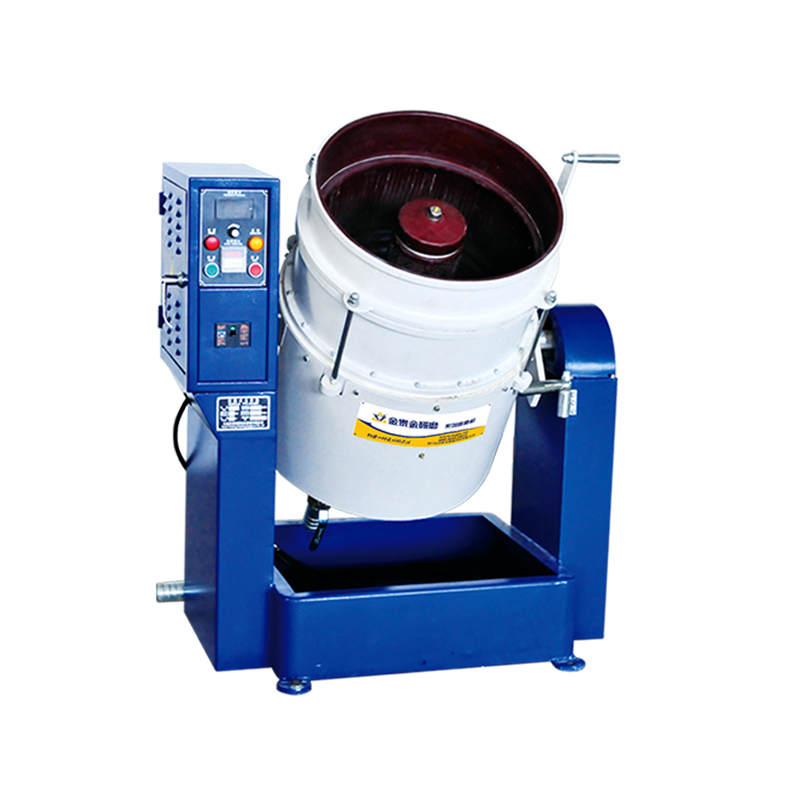
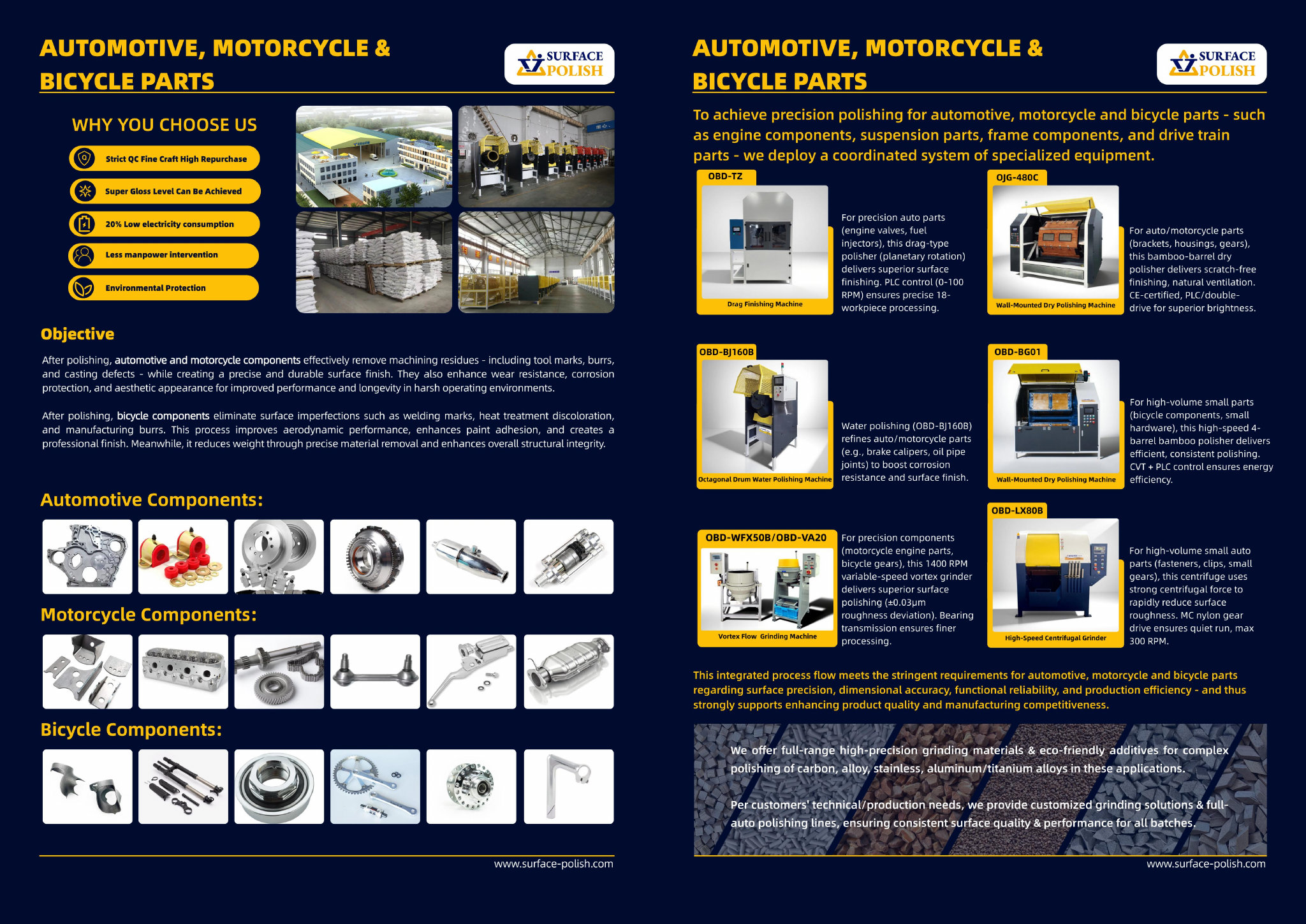
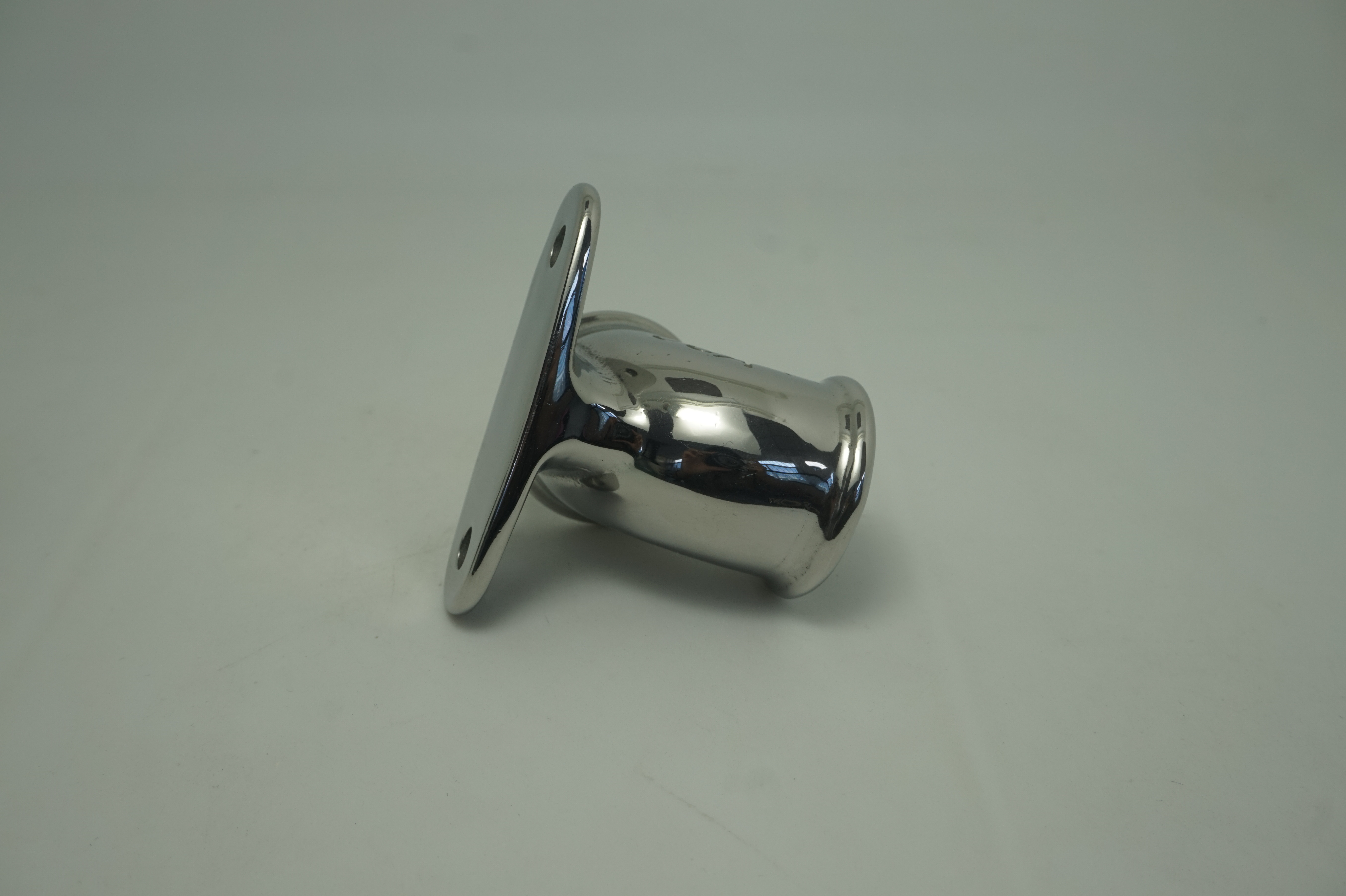
Start from geometry, not finish numbers. Map every internal surface, its bore diameter, its depth and whether a tool or medium can enter it; that map usually settles which zones an electrochemical route can level and which a mechanical route can touch. Then compare what each route leaves behind: a mechanically worked surface can carry a scratch pattern and embedded debris, while an electrochemical route changes the surface uniformly but brings its own process controls and an acid step. Cost per part, downstream passivation and your own inspection evidence should drive the decision, and a comparison trial at Montreal can show the mechanical side on your geometry.
Chloride is the first thing to establish on stainless, because a chloride-bearing fluid left in contact with a sensitised or stressed surface is a pitting risk, and residue trapped in a crevice is worse than residue on an open face. Ask for compound composition data and set your own limit against your material and service conditions, and check the rinse water too, since a plant supply can carry chloride that the compound does not. Concentration and flow affect how much residue remains, and rinsing and drying determine whether it stays. Mechanical finishing does not remove the need for those limits; it makes them part of the specification.
Heat tint is oxide, so it is removed by cut rather than by cleaning. Ceramic media with an aggressive shape and bonding, or a grinding stage followed by refinement, are the usual mechanical answers on accessible weld zones. The limit is reach: a tint line that runs into a toe, a crevice or a small bore may survive a cycle that polishes the cap, which is why the toe should be inspected rather than judged by the shine of the weld face. Media size, shape and cycle energy must suit the oxide thickness. A trial on your own parts shows what was removed on the geometry tested.
Use Montreal, Canada as the destination on the enquiry and state whether the deliverable is equipment, media and compound, a representative sample review or a line concept. A destination does not imply local stock, a local service point or a local delivery time.
A Montreal buyer works in French for documentation and in the Quebec occupational health and safety regime, which is administered separately from the other provinces, alongside Canadian electrical safety certification of the machine. Where the buyer is in the aerospace or defence supply chain, the governing requirement set is the prime contractor's process specification and its audit of the finishing operation, including traceability of media and compounds, rather than a single national finishing standard.
Sources were retrieved on 2026-09-29 and describe the local industrial and trade context only. They do not evidence any SurfacePolish project, shipment, installation or service in Montreal.
The buyer wants the helical weld dressed and the flights refined while holding the drive-end bore and the shaft straightness.
Send the material, dimensions, approximate weight, batch quantity, the incoming condition and photographs of the difficult features. Mark which features must not be contacted by media and state how the result will be inspected. This form carries source reference PSEO-0114; quote it if you prefer an additional manual reference.
Open the SurfacePolish enquiry form Email a prepared enquiry
No price, lead time, certification or result is promised here. Confirm whether a sample trial is available for the specific part and what the trial can and cannot show.
Page PSEO-0114 · revised 2026-09-29 · cross-border equipment, media and scoped sample review. City context is sourced and cited above.
Use this local checker to identify missing part and inspection information. It prepares a technical-review brief; it does not approve a machine, process recipe or production result.
Complete the part details to prepare a review brief.
Email : info@surface-polish.com


 IPv6 network supported


 +86-592-2381506