A valve maker in Pune, India supplying food processing equipment has a 316L butterfly valve whose body bore and disc need refinement without touching a fine sealing lip. The part cannot be tumbled freely because the lip would round over, so the buyer needs to understand which mechanical route suits the geometry and what it leaves behind. SurfacePolish supplies finishing equipment, media and compounds across borders, with a free sample trial. This brief is written for a buyer in Pune working on food processing equipment; it describes equipment, media and a scoped sample review, not a local polishing service.
Where will roughness be measured, with which cut-off and in which direction, and does that location represent the surface the product actually sees?
Which internal surfaces can a mechanical route physically reach, and what happens to the zones it cannot?
What free-iron and chloride exposure does the process itself introduce, and can the buyer's own cleanliness test detect it before the part is released?
Reachability decides the route more often than the finish target does. Measure the internal diameter of every tube, the depth and diameter of every blind hole, the width of every crevice and gasket groove and the corner radius at every internal weld. Ratios matter more than absolute size: a bore that is wide but very deep, or a groove narrower than the smallest available medium, stays untouched by any tumbling process however long the cycle runs. Ask whether a borescope can be inserted and at what angle, because a surface that cannot be seen cannot be inspected after finishing. List the zones a machine cannot reach, and decide in advance whether those zones are finished by another method, accepted as-is with a stated condition, or designed out of the part.
The compound does the cleaning, descaling, foam control and fine abrasive work that media alone cannot, and its chemistry family has to match the alloy. On stainless the critical questions are pH through the cycle and the chloride content of both the compound and the water used to mix and rinse it, because a chloride-bearing fluid on a sensitised or stressed surface is a pitting risk, and a residue left in a crevice is worse. Concentration and flow rate set how fast the work proceeds and how well the load is kept clean; too little compound leaves swarf and sludge on the part, while too much can foam, cushion the media and slow the cut. Water hardness affects how the compound behaves and how the rinsed surface dries. Ask for composition data and set limits.
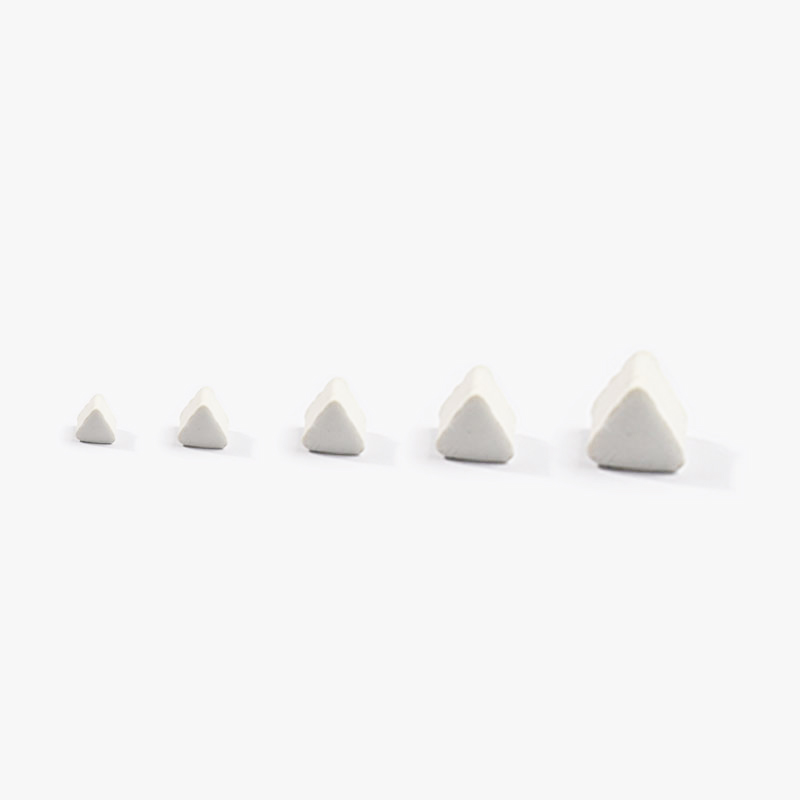
| Media | Best fit | Watch out for |
|---|---|---|
| Ceramic media, angle-cut triangles | Heavier weld-zone refinement and edge blending on 304 and 316L parts where a corner or a toe line has to be reached. | Wears down and changes its effective size class, produces sludge, and can over-round a thin edge or a soft detail. |
| Ceramic media, small cylinders and spheres | General deburring and light radius work on hygienic fittings, with less edge cutting than an angle-cut shape. | Small sizes lodge in gasket grooves and drilled openings, and a sphere refines slowly where oxide is thick. |
| Plastic media, cones and triangles | Gentle edge blending and cosmetic refinement on softer non-ferrous fittings, thin sections and delicate parts. | Cannot remove heat tint, mill scale or a weld cap, so it must follow the operation that does that work. |
| Steel pins and fine media for magnetic finishing | Small precise components, short bores, slots and blind features that shaped tumbling media cannot enter. | Limited to small parts, will not remove a proud weld cap, and pins must be counted and recovered from every opening. |
Where a weld cap stands proud and has to come down, a grinding finishing machine removes material far faster than any tumbling route, and a disc finishing machine delivers high energy to flat faces and convex zones. This is the stage that takes off heat tint and the top of the cap, but it is also where damage is created: an over-ground toe leaves an undercut that traps product, a fast wheel can smear oxide into the surface rather than lift it, and abrasive tooling that has touched carbon steel can deposit free iron. Ground zones then need refining, because the scratch pattern left by coarse abrasive is not a finish. The sequence is what matters: remove the cap, blend the toe, refine the zone, then verify. Grinding alone rarely satisfies a stated product-contact surface requirement.
| Machine route | Where it fits | What it will not do |
|---|---|---|
| Grinding finishing machine | Removing a proud weld cap, heavy scale and heat tint before any tumbling or refinement stage. | Leaves a scratch pattern that needs refining, can smear oxide, and iron-bearing tooling can deposit free iron on stainless. |
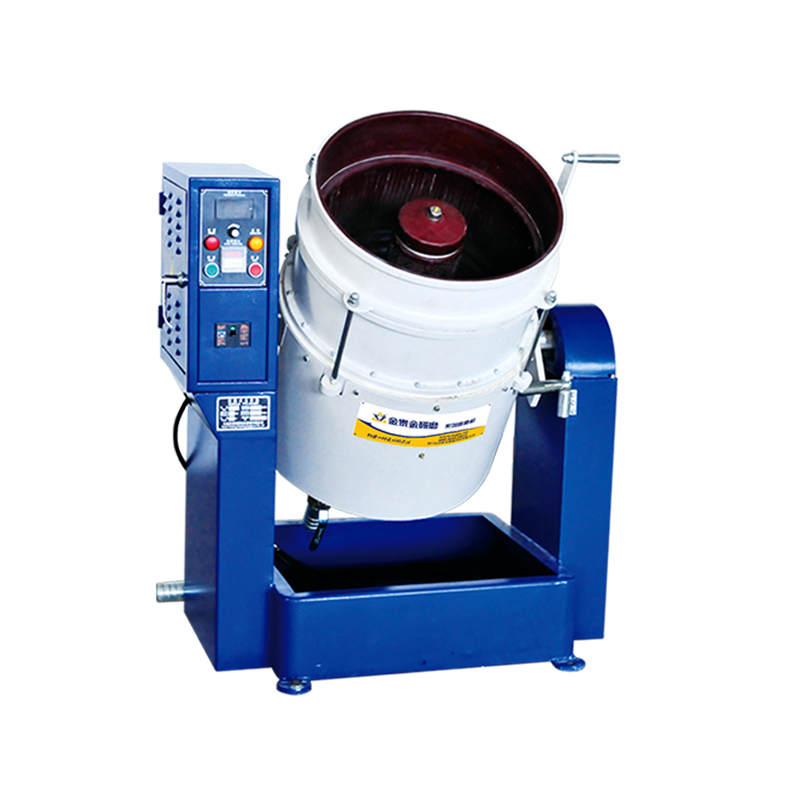
| Vibratory finishing machine, bowl type | Edge and weld-toe blending plus surface refinement on mid-sized parts, with a visible load and adjustable energy. | Chamber geometry caps part size, and the inside of a long tube or a narrow crevice stays out of reach. |
| Barrel finishing machine, rotary barrel tumbler | Large batches of small robust fittings, fasteners and valve trim that can tumble freely without damage. | Part-on-part contact is unavoidable, and fine threads, sealing lips and thin diaphragms are poor candidates. |
| Magnetic finishing machine | Small precise parts and short internal features such as slots, small bores and blind recesses. | Part size and surface area are limited, large panels and long tubes are out of scope, and it will not dress a weld cap. |
Removing material always changes the part, and the change is not always wanted. A weld toe can be rounded past the radius the drawing implies, a sealing lip can lose its bite, a gasket seat can dish enough to leak, and a thin tank panel can deflect under a heavy load. Media size class and density drive this: a large dense piece on a soft detail rounds it quickly, while a small light piece barely touches it. Detection uses an optical comparator or radius gauge on edges, a flatness check on sealing faces, and dimensional measurement of any feature that carries a tolerance. Dye penetrant or a visual check finds an undercut created by over-grinding a weld cap. Thin-wall parts deserve measurement before and after, because distortion in a small load only worsens at production fill levels.
| Failure mode | Likely cause | How to catch it |
|---|---|---|
| Compound residue or dried film trapped in crevices and threads | Insufficient rinse volume, a rinse that does not reach the recess, or draining in an orientation that holds fluid in place. | Wipe or swab the recess with a clean white cloth and inspect, run a water-break or residue check on product-contact surfaces, and re-check after changing rinse volume or orientation. |
| A shiny but burnished surface with intact oxide beneath it | Abrasive media smearing the oxide instead of cutting through it, often where a cleaning compound was relied on to do the cutting. | Examine the transition zone rather than the cap, compare a mechanically worked area with a freshly ground control area, and cross-section one sample part under magnification. |
| Discolouration, water spotting or flash rust after the cycle | Contaminated or hard rinse water, incomplete draining of a crevice, or a part left wet before drying. | Inspect after drying under consistent lighting, check the rinse water source and quality, and verify that orientation during draining lets every recess empty. |
| Gasket seat or sealing face dished so it no longer seals | Over-finishing a machined face, part-on-part contact in an unseparated load, or media hammering a face that should have been masked. | Check flatness of the sealing face with a straight edge, a feeler gauge or a surface plate before and after, and confirm against the sealing requirement the buyer's specification states. |
Pune is one of the industrial and commercial centres that Invest India names, alongside Mumbai and Chhatrapati Sambhajinagar, on Maharashtra's road network of more than 6.7 lakh km (s1). The district carries a major concentration of the state's approved private industrial parks - 669 private IT parks statewide, concentrated in Pune, Mumbai City & Suburban and Thane - on top of the 289-292 industrial areas developed statewide by the Maharashtra Industrial Development Corporation (s1). The city's industry association is the Mahratta Chamber of Commerce, Industries and Agriculture, which presents itself as Maharashtra's Largest Industry Network and runs sector committees including food processing and defence from its Senapati Bapat Road office in Pune (s2). The Delhi-Mumbai Industrial Corridor, spanning about 1,504 km across six states, is the wider industrial-growth driver for this belt (s1).
For this brief the relevant part of that base is food: The Mahratta Chamber of Commerce, Industries and Agriculture, Pune's industry association, lists Food Processing among its standing industry committees (s2).
Pune's component and machinery manufacturing base produces machined castings, forgings, gears, shafts and sheet-metal parts whose edges, burrs and surface condition are inspected by the receiving OEM or tier-one customer, so deburring and controlled surface finish are routine process steps rather than cosmetic extras. Food-processing equipment adds a cleanliness and passivation dimension where product-contact surfaces must be free of burrs, scale and residue after fabrication.
A Pune buyer should decide whether the acceptance criterion is a measured surface roughness and burr-free edge on a defined alloy, or a visual finish, and whether the part family is high-mix/low-volume job work or a single high-volume line - that choice, not machine size alone, determines whether batch barrel/vibratory finishing or a more controlled process is the right answer.
Freight context: Jawaharlal Nehru Port (JNPT) / Nhava Sheva, Delhi-Mumbai Industrial Corridor (DMIC) road corridor, Mumbai-Pune expressway and national highway corridor. Pune is connected to Mumbai and Chhatrapati Sambhajinagar by one of India's largest road networks and sits on the Delhi-Mumbai Industrial Corridor (s1). Containerised imports are normally cleared through the JNPT/Vadhvan port complex and trucked down the Mumbai-Pune corridor, so inland transit and unloading access at the plant should be planned together with the bill of entry timeline (s1).
An Importer-Exporter Code (IEC) issued by DGFT is a key business identification number which is mandatory for exports or imports, and since the introduction of GST the IEC number is the same as the PAN of the firm (c6). The post-incorporation clearance list published by Invest India includes the IEC, a Customs- Special Valuation Branch reference and the grant of a Bureau of Indian Standards (BIS) licence, and it names the Central Board of Excise and Customs among the agencies in the framework (c10). The Foreign Trade Policy fixes the mandatory import documents as a bill of lading / airway bill / lorry receipt / railway receipt, a commercial invoice cum packing list and a bill of entry, with additional documents or NOCs possible for goods subject to product-specific compliance (c3); it also states that domestic laws, rules, orders, technical specifications and environmental, safety and health norms applicable to domestically produced goods apply mutatis mutandis to imports unless specifically exempted (c2), which is the basis on which a BIS quality-control order can bite on imported machinery. A landed-cost plan therefore needs the correct ITC(HS) classification and the basic customs duty and IGST that follow from it, plus the IEC, the bill of entry documentation and any BIS licence or registration obligation, and a related-party import can additionally be pulled into special customs valuation.
India's foreign-trade, customs and standards machinery works in English: the Foreign Trade Policy, DGFT's IEC and scheme material, the BIS standards catalogue and Invest India's investor guide are all published in English, and the mandatory import documents are the internationally conventional bill of lading, commercial invoice cum packing list and bill of entry (c1, c3, c6, c10). Payment in the import channel is bank-intermediated; the Foreign Trade Policy treats the irrevocable commercial letter of credit as the instrument that fixes an importer's commitment when import policy changes (c4), so a supplier should expect LC or advance terms rather than open-account credit on a first order. Indian industry associations are explicit about import substitution: the Bombay Chamber of Commerce and Industry states that one of its major focuses today is how to expand manufacturing setups and substitute imported products (c13), so a cross-border equipment seller should expect questions about local support, spares, training and total cost of ownership rather than price alone, and should hold the IEC, GST registration, bill of entry documentation and any BIS obligation as part of the commercial discussion.
SurfacePolish supplies from Xiamen, China. The buyer's own destination rules, conformity marking, tariff classification and documentation responsibilities stay with the buyer; confirm them against the authorities named above before ordering.
Visual acceptance is only repeatable when the viewing conditions are fixed. Agree the light source, distance, angle and magnification, whether raking light is used to reveal tint and scratches, and whether comparison is made against a physical reference or a photograph taken at the same settings. Define what counts as a defect: a colour band, a scratch, the scratch pattern left by coarse abrasive, a water spot, a handling mark. Internal surfaces need their own method, usually a borescope at an agreed insertion depth and view angle, with images retained so a later batch can be compared. Photographs are the practical record in a cross-border discussion, because a described appearance travels badly while a fixed-angle image travels well. Both sides should work from the same written standard.
Media is a consumable with a working life, and treating it as a fixed asset is a common reason a validated-looking process drifts. Plan for screening fines and broken pieces out, topping up to hold the size class and the load volume, and recording what was added and when. Compound concentration, dosing rate and rinse water quality need the same discipline, including a chloride check where the buyer's own requirements limit it, because concentration that creeps upward changes both the cut and the residue left behind. Sludge and spent compound have to be removed on a schedule, not when the chamber looks bad. Store media and compound so they cannot pick up contamination from a carbon steel fabrication area. Write the routine down, because a process that depends on one experienced operator is not yet a line.
It can, and the source is usually the tooling or the consumable rather than the stainless itself. Carbon steel brushes, wire wheels, blasting grit, iron-bearing media, shared racks and contaminated rinse water can all deposit free iron that appears later as a rust bloom. Control means dedicated stainless tooling and racks, documented grades for everything that touches the surface, and a cleaning step after mechanical work. Detection is by a ferroxyl-type test or an equivalent method chosen by your own quality function, applied at agreed locations including crevices. The acceptance decision and its critical locations remain yours.
They are different operations rather than interchangeable ones. Mechanical finishing can remove a weld cap and oxide where a medium or tool physically reaches, and it refines the surface it contacts. Electrochemical polishing removes a thin layer more uniformly and can reach inside small-bore tubing and enclosed channels that no tumbling medium enters. A mechanical route is usually the practical answer for accessible weld zones and external surfaces, and it cannot level the inside of a long narrow tube. Whether that reach matters on your part is the decision; a trial at Pune can show what was reached on the parts tested.
Chloride is the first thing to establish on stainless, because a chloride-bearing fluid left in contact with a sensitised or stressed surface is a pitting risk, and residue trapped in a crevice is worse than residue on an open face. Ask for compound composition data and set your own limit against your material and service conditions, and check the rinse water too, since a plant supply can carry chloride that the compound does not. Concentration and flow affect how much residue remains, and rinsing and drying determine whether it stays. Mechanical finishing does not remove the need for those limits; it makes them part of the specification.
Use Pune, India as the destination on the enquiry and state whether the deliverable is equipment, media and compound, a representative sample review or a line concept. A destination does not imply local stock, a local service point or a local delivery time.
Finish, edge and material conformity requirements for a Pune buyer are specified against Indian Standards (IS) issued by the Bureau of Indian Standards, the National Standards Body of India (s3). Where a finished part or the finishing consumable falls under a BIS quality-control order, the licence or registration requirement applies to the product on the Indian market, so the applicable IS reference should be agreed with the customer's quality function up front (s3).
Sources were retrieved on 2026-09-29 and describe the local industrial and trade context only. They do not evidence any SurfacePolish project, shipment, installation or service in Pune.
The buyer must improve the product-contact bore and weld-free body surfaces while keeping the sealing lip sharp and the gasket groove free of lodged media.
Send the material, dimensions, approximate weight, batch quantity, the incoming condition and photographs of the difficult features. Mark which features must not be contacted by media and state how the result will be inspected. This form carries source reference PSEO-0944; quote it if you prefer an additional manual reference.
Open the SurfacePolish enquiry form Email a prepared enquiry
No price, lead time, certification or result is promised here. Confirm whether a sample trial is available for the specific part and what the trial can and cannot show.
Page PSEO-0944 · revised 2026-09-29 · cross-border equipment, media and scoped sample review. City context is sourced and cited above.
Use this local checker to identify missing part and inspection information. It prepares a technical-review brief; it does not approve a machine, process recipe or production result.
Complete the part details to prepare a review brief.
Email : info@surface-polish.com


 IPv6 network supported


 +86-592-2381506