A conveyor maker in Venice, Italy serving food processing equipment has a thin 304 chute with long weld seams and a folded edge that carries stiffness. Weld dressing is wanted, but a heavy tumbling cycle would thin the sheet and round the fold, so the route must suit the material thickness. SurfacePolish supplies finishing equipment, media and compounds across borders and runs a free sample trial on parts sent in. This brief is written for a buyer in Venice working on food processing equipment; it describes equipment, media and a scoped sample review, not a local polishing service.
What free-iron and chloride exposure does the process itself introduce, and can the buyer's own cleanliness test detect it before the part is released?
Does the route have to remove heat tint and restore a passive condition, or refine a surface that is already clean, and who verifies that difference?
Which surfaces on this part touch product, and what does each one have to satisfy in roughness, oxide freedom, edge condition and cleanliness?
Grade and history determine what the surface can tolerate. Confirm whether the part is 304, 304L, 316 or 316L, whether it is annealed or cold worked, and whether a free-machining grade with added sulphur has been used in a product-contact position. Record every operation that has already touched the surface: forming, shot blasting, wire brushing with carbon steel, grinding with iron-bearing tooling, acid pickling, electrochemical polishing or an earlier mechanical polish. Each leaves a different starting condition and a different contamination risk. Note heat treatment and any sensitisation concern from welding or high-temperature service, because material condition affects how the surface behaves later and cannot be changed by finishing. Certificates for the delivered material and a written sequence of operations are the minimum evidence to request.
A tub vibrator gives a long, open chamber that accepts parts a bowl cannot, including tube spools, chute sections, small vessels and long fabrications. The part can be repositioned, rotated or left static depending on what has to be reached, and the open design makes it easier to watch what is happening to a weld during the cycle. The trade-off is evenness: coverage depends on how the part sits relative to the media mass, so banding and untouched shadow zones are common unless fixture and part orientation are planned. Internal surfaces of a long small-bore tube remain out of reach regardless of tub size. Tub capacity, media volume, how the part is supported and how it is lifted in and out should be settled before the route is accepted.
| Machine route | Where it fits | What it will not do |
|---|---|---|
| Barrel finishing machine, rotary barrel tumbler | Large batches of small robust fittings, fasteners and valve trim that can tumble freely without damage. | Part-on-part contact is unavoidable, and fine threads, sealing lips and thin diaphragms are poor candidates. |
| Grinding finishing machine | Removing a proud weld cap, heavy scale and heat tint before any tumbling or refinement stage. | Leaves a scratch pattern that needs refining, can smear oxide, and iron-bearing tooling can deposit free iron on stainless. |
| Dry polishing machine and dryer | Dry burnishing where a wet cycle is unwanted, and drying parts after a wet cycle so crevices do not stay wet. | Removes no oxide and needs dust extraction; a dryer manages water, it does not change the finish left by the wet stage. |
| Magnetic finishing machine | Small precise parts and short internal features such as slots, small bores and blind recesses. | Part size and surface area are limited, large panels and long tubes are out of scope, and it will not dress a weld cap. |
The compound does the cleaning, descaling, foam control and fine abrasive work that media alone cannot, and its chemistry family has to match the alloy. On stainless the critical questions are pH through the cycle and the chloride content of both the compound and the water used to mix and rinse it, because a chloride-bearing fluid on a sensitised or stressed surface is a pitting risk, and a residue left in a crevice is worse. Concentration and flow rate set how fast the work proceeds and how well the load is kept clean; too little compound leaves swarf and sludge on the part, while too much can foam, cushion the media and slow the cut. Water hardness affects how the compound behaves and how the rinsed surface dries. Ask for composition data and set limits.
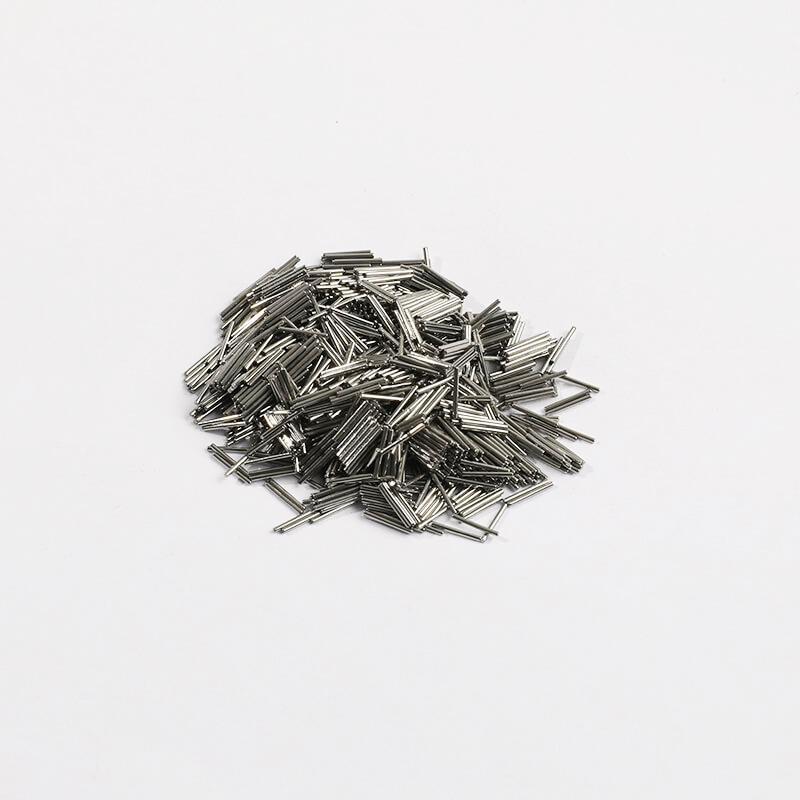
| Media | Best fit | Watch out for |
|---|---|---|
| Liquid compound, abrasive cleaning slurry family | Cleaning, descaling and fine abrasive work through the cycle, with dosing and flow matched to the load and the alloy. | Chloride content and pH matter on stainless, foam can cushion the cut, and residue left in a crevice becomes a later defect. |
| Dry media, walnut shell and corn cob | Light dry burnishing and cosmetic refinement where retained water in a crevice or assembly is a problem. | Generates dust requiring extraction, removes no oxide, and leaves a surface character different from a wet abrasive cycle. |
| Steel media, balls and diagonals | Bright surface refinement on robust stainless parts where a dense medium is wanted to work into recesses. | Can transfer iron to stainless, imprint soft or thin features, flatten a deliberate edge radius, and needs magnetic recovery. |
| Plastic media, cones and triangles | Gentle edge blending and cosmetic refinement on softer non-ferrous fittings, thin sections and delicate parts. | Cannot remove heat tint, mill scale or a weld cap, so it must follow the operation that does that work. |
Removing material always changes the part, and the change is not always wanted. A weld toe can be rounded past the radius the drawing implies, a sealing lip can lose its bite, a gasket seat can dish enough to leak, and a thin tank panel can deflect under a heavy load. Media size class and density drive this: a large dense piece on a soft detail rounds it quickly, while a small light piece barely touches it. Detection uses an optical comparator or radius gauge on edges, a flatness check on sealing faces, and dimensional measurement of any feature that carries a tolerance. Dye penetrant or a visual check finds an undercut created by over-grinding a weld cap. Thin-wall parts deserve measurement before and after, because distortion in a small load only worsens at production fill levels.
| Failure mode | Likely cause | How to catch it |
|---|---|---|
| Ceramic or steel media fragments embedded in the surface | Chipped or worn media, excessive cycle energy on a soft or thin feature, or a broken piece recirculating in the load. | Inspect under magnification at low angle, screen the media for broken pieces, and check the surface before and after a refinement stage to see whether fragments were present earlier. |
| Cross-contamination from tooling, racks or media shared with carbon steel | No dedicated stainless area, undocumented consumable grades, or media stored where mild steel fabrication dust settles. | Audit which tools, racks and media touch the part, record their grades, store media covered and segregated, and confirm cleanliness with the buyer's own test after a tooling change. |
| Heat tint or oxide remaining at the weld toe and in the crevice beside it | Cycle too gentle or too short for the oxide thickness, or a medium size class too large to enter the toe line. | Inspect the toe at magnification under raking light against an agreed visual reference, photograph at a fixed angle before and after, and apply the buyer's own free-iron or passive-condition method where specified. |
| Uneven finish, banding or untouched shadow zones across one part | Part position in the chamber, a fixture holding a surface out of the media mass, or a load that is too full or too empty for even contact. | Take roughness readings at several marked locations instead of one, photograph at fixed angles around the part, and compare parts from the top and bottom of the same load. |
Venice's industrial identity is built on the port system and on the Porto Marghera industrial zone on the mainland. The port authority reports that the lagoon port handled 24,220,555 tonnes of goods in the twelve months to March 2023, a fall of 3.6% year on year, with 517,781 TEU of containers and a decline in refined petroleum products that it attributes both to the green conversion of the Marghera pole and to the effects of sanctions on Russia (s1). The authority describes the Veneto port system as multipurpose, with the ports of Venice and Chioggia working agro-food, steel, chemical and energy supply chains as well as commercial and tourist traffic, and Chioggia holding national standing in fishing (s2). Alongside this, Murano retains a concentrated glass manufacturing base: the Consorzio Promovetro represents more than 40 artisan and industrial glass firms on the island (s3).
For this brief the relevant part of that base is food: The port authority reports the agro-food supply chain as substantially stable in the lagoon ports and lists agro-food among the supply chains the ports serve.
The Venice-area finishing problem is split between metal and glass. In the Marghera and port-related industrial zone, ship repair, steel and process-plant work create deburring and weld-dressing requirements on large fabrications, where the constraint is access and part size rather than cycle time. On Murano the requirement is different again, because glass finishing is about cold working, edge polishing and surface defect control where a metal-media process is not applicable; a supplier should be clear about which of the two it is being asked to solve.
The first distinction to settle is whether the part is a metal fabrication or a glass article, because almost nothing about the process carries over between them. For the Marghera and port-side industrial work, the practical questions are whether the part can be moved to a machine at all and what the acceptance criterion for weld dressing or edge condition will be.
Freight context: Porto di Venezia (Marghera), Porto di Chioggia, Porto di Fusina (ro-ro). The lagoon port system is the freight gateway: 24,220,555 tonnes of goods in the twelve months to March 2023 with 517,781 TEU of containers, and ro-ro units at Fusina up 11.5% (s1). The authority describes the ports as multipurpose and working agro-food, steel, chemical and energy supply chains (s2), so Marghera is the natural point of discharge for a machine or a pallet of sample parts destined for the Venice-Padua industrial area. Venice Marco Polo airport was not verified in this session and is therefore not listed as a confirmed hub.
The customs authority is the Agenzia delle Dogane e dei Monopoli (ADM), which is the regulatory, supervisory and control authority for customs and collects the duties. Goods arriving from China are cleared by customs before they can enter the single market and are released into free circulation by means of a customs declaration; the date of acceptance of that declaration is the date used to calculate and apply the import duty and any VAT or excise duty. Importers should settle in advance who lodges the declaration and under which VAT and EORI arrangements, and must ensure the machine carries CE marking and is supported by the EU declaration of conformity and technical file. Because the CE mark is compulsory for machinery covered by the EU machinery legislation and forbidden for products outside it, the conformity route must be settled before shipment rather than at the border.
Italy applies the EU's common commercial policy to imports from China, so Chinese industrial machinery enters under the EU Common Customs Tariff, where the duty rate depends on the type and origin of the goods and the working tariff is TARIC. Istat's August 2026 extra-EU trade release records a 16.0% year-on-year increase in Italian purchases from China, alongside strong growth from India, OPEC and Mercosur, so China remains one of the fastest-growing sources of Italian imports. Anti-dumping and other trade-defence measures apply case by case to specific product categories rather than to finishing machinery in general, so the applicable rate must be checked against the specific commodity code before a quotation is finalised.
SurfacePolish supplies from Xiamen, China. The buyer's own destination rules, conformity marking, tariff classification and documentation responsibilities stay with the buyer; confirm them against the authorities named above before ordering.
Visual acceptance is only repeatable when the viewing conditions are fixed. Agree the light source, distance, angle and magnification, whether raking light is used to reveal tint and scratches, and whether comparison is made against a physical reference or a photograph taken at the same settings. Define what counts as a defect: a colour band, a scratch, the scratch pattern left by coarse abrasive, a water spot, a handling mark. Internal surfaces need their own method, usually a borescope at an agreed insertion depth and view angle, with images retained so a later batch can be compared. Photographs are the practical record in a cross-border discussion, because a described appearance travels badly while a fixed-angle image travels well. Both sides should work from the same written standard.
Without an incoming record a returned part cannot be judged. Photograph and measure each part before it is sent, at the same locations that will be measured afterwards, and note tint, burrs and scratches. If two media, two compounds or two cycle settings are compared, change one variable per test and keep everything else identical, including load fill and cycle time. Keep the parts separated through the process so a result can be attributed to the right condition. Where appearance is the question, have two people assess the same parts against the same reference under the same light before discussing the result. Mark which parts are left unfinished as controls. A comparison that moves several variables at once produces a result nobody can act on.


Start from geometry, not finish numbers. Map every internal surface, its bore diameter, its depth and whether a tool or medium can enter it; that map usually settles which zones an electrochemical route can level and which a mechanical route can touch. Then compare what each route leaves behind: a mechanically worked surface can carry a scratch pattern and embedded debris, while an electrochemical route changes the surface uniformly but brings its own process controls and an acid step. Cost per part, downstream passivation and your own inspection evidence should drive the decision, and a comparison trial at Venice can show the mechanical side on your geometry.
No. SurfacePolish supplies finishing machines, media and compounds, and no machine, medium, compound or process is presented as approved, certified or qualified for food contact, hygienic service or any regulated application. Certification of that kind depends on the finished equipment, its design, its materials and the way it is operated, and it is defined and verified by your own quality and regulatory functions against the requirements that apply to your market. What a supplier can provide is equipment and consumables information, including composition data for media and compounds, so your own assessment has something to work from. A sample trial is not a certification.
Specify it with a location, a cut-off and a direction, not as a single number. Mark the measurement points on the drawing and say whether each sits on base metal, a dressed weld or the heat-affected zone, because those are different surfaces. State the cut-off and evaluation length, and require readings across the lay at each point rather than one convenient traverse. Also state what Ra is not being asked to prove: it does not describe a crevice, an oxide film, embedded contamination or an edge condition. A buyer in Italy should record the instrument and the calibration specimen on every report.
Use Venice, Italy as the destination on the enquiry and state whether the deliverable is equipment, media and compound, a representative sample review or a line concept. A destination does not imply local stock, a local service point or a local delivery time.
Italian buyers reference UNI and the ISO/EN surface-texture, tolerancing and cleanliness standards transposed into it, while glass and ceramic producers work to product standards rather than to metal-finishing standards. In the Venice industrial area the finish requirement usually arrives inside the individual order from the shipyard's or plant operator's own specification, so it has to be read off the customer's drawing and inspection plan rather than from a generic default.
Sources were retrieved on 2026-09-29 and describe the local industrial and trade context only. They do not evidence any SurfacePolish project, shipment, installation or service in Venice.
The buyer wants the weld seams dressed and the sheet refined without thinning the panel or softening the folded edge.
Send the material, dimensions, approximate weight, batch quantity, the incoming condition and photographs of the difficult features. Mark which features must not be contacted by media and state how the result will be inspected. This form carries source reference PSEO-0484; quote it if you prefer an additional manual reference.
Open the SurfacePolish enquiry form Email a prepared enquiry
No price, lead time, certification or result is promised here. Confirm whether a sample trial is available for the specific part and what the trial can and cannot show.
Page PSEO-0484 · revised 2026-09-29 · cross-border equipment, media and scoped sample review. City context is sourced and cited above.
Use this local checker to identify missing part and inspection information. It prepares a technical-review brief; it does not approve a machine, process recipe or production result.
Complete the part details to prepare a review brief.
Email : info@surface-polish.com


 IPv6 network supported


 +86-592-2381506