A buyer in Bologna, Italy finishing high-strength steel pins for aerospace components wants a light surface refinement without acid-bearing chemistry and without pushing edge breaks past a tight limit. SurfacePolish is a cross-border source of finishing machines, media and compounds with a free sample trial, so the chemistry and media can be compared on the buyer's parts before specifications are settled. This brief is written for a buyer in Bologna working on aerospace components; it describes equipment, media and a scoped sample review, not a local polishing service.
How will media be kept out of drilled passages, tapped holes and closed volumes, and what retrieval and verification step proves it?
Which datum and mating surfaces carry assembly geometry, and is a flatness or fit check required on them after finishing?
At what batch size, load pattern and media wear state does the trial result still describe what production will produce?
Alloy and temper decide which media and compound families are realistic before any machine is discussed. Unaged aluminum alloys are soft and galling-prone, precipitation-hardening stainless steels are harder and respond to cutting media, and titanium has low thermal conductivity and a tendency to smear rather than cut cleanly. High-strength steels also bring a documented concern about hydrogen picked up from acidic chemistry. Heat treatment matters twice, because the same alloy in a solution-treated and an aged condition finishes differently and a part that has already been aged cannot be straightened after processing. Record alloy, temper, hardness range, prior manufacturing operations such as welding or grinding, and any stress-relief history. Then match media hardness and compound pH to the material instead of reusing a successful recipe from an unrelated part, because the same blend that brightens one alloy can stain another.
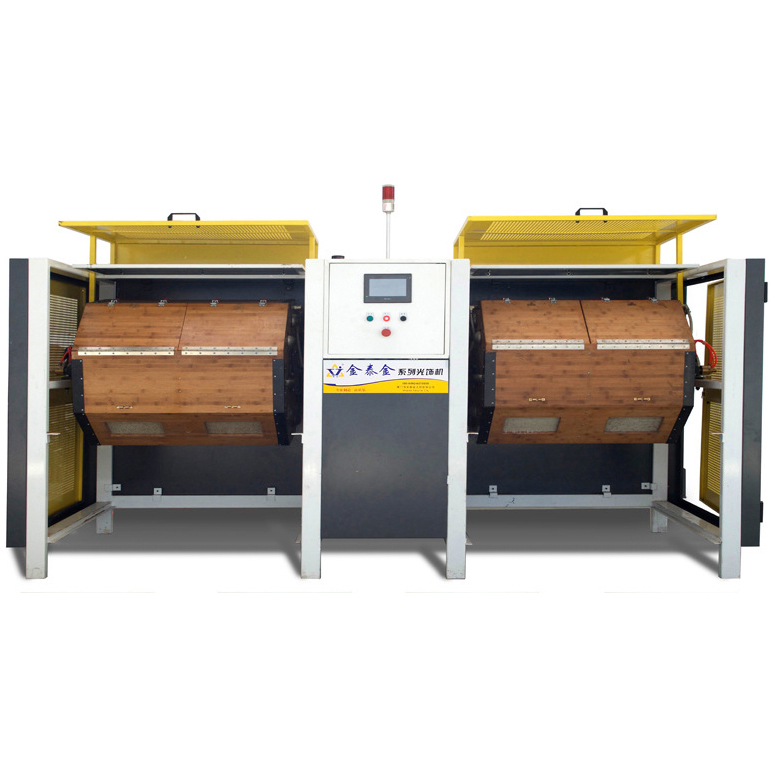
Magnetic finishing uses small pins or needles driven by a moving magnetic field to reach edges and recesses that loose media cannot enter, which suits small precise parts such as fuel system components, sensor bodies and thin stamped hardware where internal edges matter more than overall brightness. The honest limits are part size and mass, whether the workpiece material attracts the pins, and the retrieval job afterwards, because residual pins in blind holes are a genuine escape route for contamination. Dry polishing and drying are a separate decision: blind holes, narrow passages and surfaces that must not carry moisture usually need forced-air drying or a dry medium such as walnut shell or corn cob, and dry media cut more slowly and require dust extraction and medium condition control. Choose the dry route when cleanliness and carryover, not removal rate, are the governing requirement.
| Machine route | Where it fits | What it will not do |
|---|---|---|
| Vibratory tub or long-channel machine | Long shafts, tubes, housings and large parts that will not turn or circulate in a bowl. | Media circulation is less uniform along a long chamber, and bridging can leave sections of a long bore unprocessed. |
| Dry polishing machine and dryer | Post-wet drying and light dry finishing of parts with blind holes and passages where moisture carryover matters. | Dry media cut slowly, require dust extraction and medium condition control, and forced-air drying must be matched to internal geometry. |
| Disc finishing machine | Fast cycles on flat plates, brackets and robust turned parts with simple geometry. | High energy risks edge roll, distortion of thin sections and part-on-part marking; part size is bounded by the working gap. |
| Grinding finishing machine | Applications needing higher material removal before a refinement stage, such as heavy burrs or a defined stock removal. | Higher removal raises the risk of edge over-rounding and dimensional change on close-tolerance features. |
Steel media works by burnishing: it displaces surface metal and compresses it rather than cutting it away, which produces a bright, uniform appearance and can improve surface texture without the dimensional change that a cutting medium causes. That property makes it attractive where features must keep their geometry and only the surface appearance needs to change. The conditions are strict. Burnishing needs a clean load, correct compound chemistry and controlled water, because any debris, iron contamination or hard water deposit is pressed into the surface rather than flushed away. Steel media is heavy and concentrates energy, so thin walls and unsupported sections need lower energy or fixturing. It also carries a cross-contamination risk: stainless and aluminum parts can pick up iron from carbon steel media, so keep baths and media dedicated. Select it after the removal requirement has been met, not as a substitute for deburring.
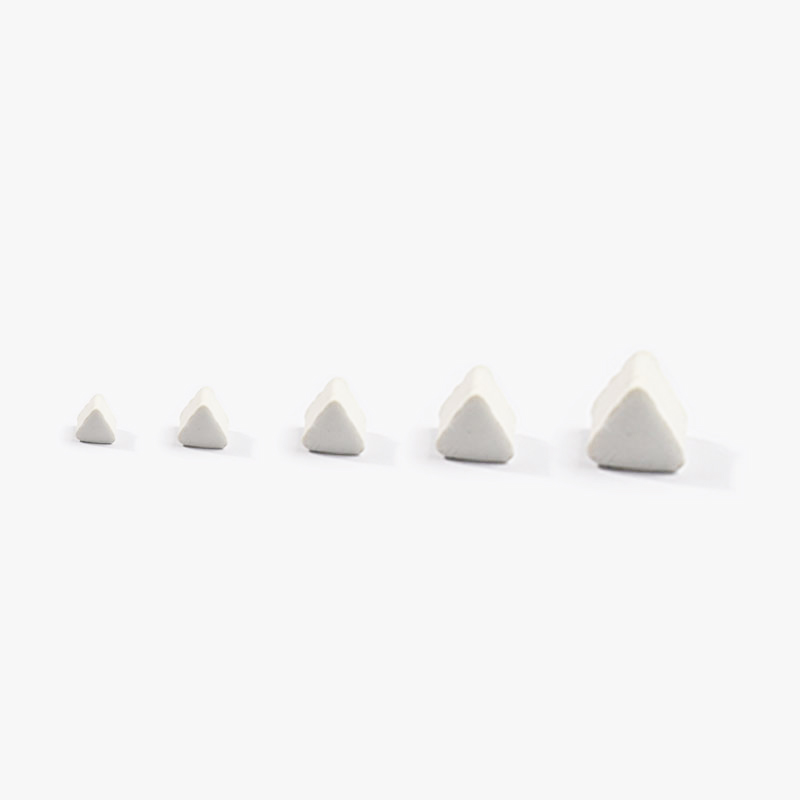
| Media | Best fit | Watch out for |
|---|---|---|
| Ceramic media, angle-cut and triangular shapes | Heavier deburring and edge blending on steel, stainless and titanium parts with accessible corners and recesses. | Wears down and changes effective size class, generates sludge, and can chip or over-round thin sections and soft alloys. |
| Compound with corrosion inhibitor for sensitive alloys | Aluminium and stainless parts that must not stain or pit during processing and between-stage handling. | Inhibitor does not compensate for hard or chloride-bearing water, and residue left in recesses can mask later inspection. |
| Ceramic media, small size class for tight features | Reaching small holes, slots and fillets where a standard size class cannot enter, at reduced removal rate. | Screens differently from larger media, lodges more easily in drilled passages and must be kept below the smallest hole to stay clear. |
| Mildly acidic or chelated brightening compound | Brightening certain stainless grades where the buyer's specification permits that chemistry family. | Not appropriate where hydrogen uptake is a concern on high-strength steel, and requires close pH control and good rinse water quality. |
A lodged piece of media is the failure mode that puts a finished aerospace part at greatest risk, because it may survive cleaning and only appear at final inspection or, worse, in service. Lodging happens where a feature's smallest dimension is close to the media size, which is why blind tapped holes, cross-drilled passage intersections, keyways, undercuts, dovetails and small counterbores are the usual sites. It is aggravated by soft or worn media that deform and wedge, by running a broad size-class blend, and by unmasked holes that were never intended to see media. Check with a known pin gauge, a borescope at an agreed viewing angle and a defined count of media in the batch before and after, and add a documented retrieval step such as bar-end magnets, directed air or a flush. The reliable prevention is size discipline: media sized well below the smallest hole to be left clear.
| Failure mode | Likely cause | How to catch it |
|---|---|---|
| Media wedged at a cross-drilled passage intersection | Media small enough to enter the passage, plus no defined retrieval step in the routing before final cleaning. | Flush the passage with a measured volume, examine the flush medium and the passage with a borescope, and add a documented retrieval step such as directed air or a magnet. |
| Media lodged in a blind tapped hole or counterbore | Media size class too close to the hole diameter, soft or worn media that wedge, or an unmasked hole not intended to see media. | Check with a known pin gauge and a borescope at an agreed angle, and reconcile a counted media batch before and after the cycle. |
| Impingement marks or gouges on thin webs and sharp corners | Excess amplitude or speed with too little media in the chamber, or parts free to strike each other in an under-filled load. | Inspect the vulnerable features under magnification before and after, photograph under raking light, and compare the same feature across several parts from the load. |
| Thread entry chamfer rounded away or thread crests burnished | Unmasked threaded features run in a burnishing or high-energy cutting load. | Gauge the thread with the buyer's own gauge and inspect the entry chamfer under magnification against the recorded pre-finish condition. |
Bologna's economy is services-heavy but keeps a solid industrial core. The Camera di Commercio di Bologna counted 90,392 firms registered with headquarters in Bologna at the end of 2025, 80,830 of them active; 64% operate in services and 24% in industry, of which 15% in construction and 9% in manufacturing, and the municipality alone holds 40% of the active firms. Confindustria Emilia, the local industry association, organises its members into sector supply chains that include Packaging, Metalli e materiali compositi, Elettronica e Meccatronica and Agroalimentare. The territory is best known for automatic packaging machinery and industrial automation, and its metals and composite-materials supply chain explicitly lists metallurgy, steel, metal treatment, painting, laser cutting, fabrication and stamping among its scopes.
The nearest part of that base to this brief is machinery: Confindustria Emilia's Packaging supply chain covers the production and trade of automatic packaging machines and packaging, and its Metalli e materiali compositi chain covers metallurgy, steel, metal-object manufacture, metal treatment, painting, laser cutting, fabrication and stamping.
Bologna's packaging-machine and mechatronics builders work in stainless steel and aluminium: machine frames, filling and wrapping mechanisms and precision components must be burr-free, edge-controlled and hygienically clean before assembly and before any food-contact qualification. The local Metalli e materiali compositi supply chain names metallurgy, steel, metal-object manufacture, metal treatment, painting, laser cutting, fabrication and stamping as its scope, which is exactly the upstream work whose edges and surfaces determine whether a component can go straight to assembly or coating.
The question to settle first is whether the specification is cosmetic (visible stainless panels and frames) or functional and hygiene-related (burrs, crevices, retained polishing media, cleanability on food-contact parts), because the two answers lead to different media, compounds and - in the packaging-machinery business - different validation evidence for the customer's own acceptance.
Freight context: Interporto di Bologna (rail-road intermodal terminal), Aeroporto di Bologna Guglielmo Marconi. Interporto Bologna integrates rail, road and logistics infrastructure for freight, offers direct connections to the national rail network, warehouses and intermodal terminals, and hosts more than 100 companies on site, which makes it the natural inland receiving point for machinery or heavy media consignments. Incoming non-EU goods clear customs at their EU point of entry before moving on to Bologna by road or rail.
The national standards body is UNI - Ente Italiano di Normazione, a private non-profit association founded over a century ago, which develops, publishes and disseminates voluntary technical standards and adopts the European and international standards as Italian editions. For finishing work the operative references are the surface-texture series UNI EN ISO 21920-1:2022, which fixes how the surface state (roughness, waviness, primary profile) is indicated on technical product documentation, and UNI EN ISO 21920-2:2022, which defines the terms, definitions and parameters used with profile methods. Machinery safety requirements come from the EU machinery legislation rather than from UNI alone: Machinery Directive 2006/42/EC applies to machinery placed on the EU market before 20 January 2027, after which Machinery Regulation (EU) 2023/1230 takes over.
Business is conducted in Italian; quotations, drawings, technical dossiers and declarations of conformity are normally expected in Italian, and correspondence in English is workable but rarely sufficient for a purchase order or for a conformity file. Italian industrial buyers qualify suppliers through a documented process: a part drawing with surface-texture indications, a sample or trial batch, and written acceptance criteria are the usual gate before a machine or media is specified into production. Payment and documentation norms follow Italian/EU practice - the importing entity's VAT and EORI details, invoice data matching the customs declaration, and standard EU commercial terms - so a cross-border seller should expect the conformity documentation (declaration of conformity, technical file, material certificates) to be requested before, not after, delivery.
SurfacePolish supplies from Xiamen, China. The buyer's own destination rules, conformity marking, tariff classification and documentation responsibilities stay with the buyer; confirm them against the authorities named above before ordering.
Appearance should be defined by an agreed physical master or a calibrated image set viewed under specified lighting and magnification, because written adjectives such as bright or uniform are not acceptance criteria. Beside appearance, insist on the checks that reflect how the part actually works. A seal land is checked for sealing condition, a bearing seat for fit and contact pattern, a sliding surface for freedom from raised material and a threaded feature for gauge entry. Edges are measured rather than viewed, using radius gauges, an optical comparator or a cast impression against the recorded pre-finish state. Functional checks should be performed with the buyer's own gauges where the buyer owns the acceptance decision, and the results recorded against the specified requirement instead of a pass or fail opinion. Where a check damages a part, define it as a sampling check on dedicated parts.
Send parts that represent the production condition, not the best examples from a setup rack. Include the part with the tightest internal feature, the thinnest wall and the most difficult edge, because those features decide the process more than the largest flat face does. Provide the material and heat treatment, the drawing requirements you can share, and a marked-up photograph that identifies the features which must not change and those which must. Include one or two parts in the incoming condition with no prior finishing, plus, where available, a part finished the way you want the result to look. State the batch size and how parts are separated in your own shop, since load pattern affects outcome as much as media choice. Where a family has variants, send the extremes of the family rather than a middle case.
Only partly. A trial is run with extra attention on a small number of pieces, while production runs a full load with a different operator, a partly worn media blend and the normal handling between operations. Treat trial output as evidence about the parts tested and the settings used, then plan a ramp-up in which the first production part is fully inspected and compared against the retained trial part at the same locations. Where results diverge, check the media blend and load pattern first, since those drift before a machine setting changes. SurfacePolish reports observations and a proposed direction; qualification and acceptance stay with the buyer.
High-strength steels carry a documented concern about hydrogen picked up from acidic or hydrogen-bearing chemistry, so the conservative route is a mechanical process with a neutral or alkaline compound and no acid stage. If your own specification permits acid-bearing chemistry, that decision and any subsequent treatment belong to your engineering and quality functions, not to the equipment supplier. SurfacePolish supplies compounds and media across borders and can run a trial with the chemistry family you nominate, reporting observations on the parts tested. Buyers in Bologna should confirm hydrogen-related requirements with their own specialists before any process is set.
Ask for records that let a later batch be compared with the approved one: machine and bath identification, media type and size class, compound product and measured concentration, cycle time and energy setting, load weight or part count, rinse and dry method, and measurement results with the instrument, setup and locations. Photographs taken under consistent lighting before and after belong in the record, along with any deviation raised during the run. A document that only asserts quality is less useful than one that names the configuration. Hold the configuration under change control, so a new media supplier or compound batch triggers re-verification rather than silently altering the output.
Use Bologna, Italy as the destination on the enquiry and state whether the deliverable is equipment, media and compound, a representative sample review or a line concept. A destination does not imply local stock, a local service point or a local delivery time.
Bologna buyers reference UNI, the Italian standards body, for the EN/ISO surface-texture standards, and the EU machinery legislation now dominates machine procurement: Regulation (EU) 2023/1230 replaces Directive 2006/42/EC for machinery placed on the EU market from 20 January 2027. Food-contact and hygiene requirements on packaging machinery are specified separately from surface roughness and have to be evidenced in the machine's own conformity file.
Sources were retrieved on 2026-09-29 and describe the local industrial and trade context only. They do not evidence any SurfacePolish project, shipment, installation or service in Bologna.
The buyer needs light surface refinement while avoiding hydrogen-bearing chemistry and staying inside tight edge limits.
Send the material, dimensions, approximate weight, batch quantity, the incoming condition and photographs of the difficult features. Mark which features must not be contacted by media and state how the result will be inspected. This form carries source reference PSEO-0421; quote it if you prefer an additional manual reference.
Open the SurfacePolish enquiry form Email a prepared enquiry
No price, lead time, certification or result is promised here. Confirm whether a sample trial is available for the specific part and what the trial can and cannot show.
Page PSEO-0421 · revised 2026-09-29 · cross-border equipment, media and scoped sample review. City context is sourced and cited above.
Use this local checker to identify missing part and inspection information. It prepares a technical-review brief; it does not approve a machine, process recipe or production result.
Complete the part details to prepare a review brief.
Email : info@surface-polish.com


 IPv6 network supported


 +86-592-2381506