A manufacturing engineer in Edmonton, Canada is finishing an aluminium fuel manifold for aerospace components and needs the outer face refined without disturbing a flat mating face or trapping media in cross-drilled passages. SurfacePolish runs a free sample trial from its own factory: representative parts are sent to Xiamen, tested, and returned with a media and cycle direction plus a record of what was measured. This brief is written for a buyer in Edmonton working on aerospace components; it describes equipment, media and a scoped sample review, not a local polishing service.
Does the compound chemistry family create a hydrogen, staining or residue risk for this alloy and heat treatment, and who verifies that?
Which datum and mating surfaces carry assembly geometry, and is a flatness or fit check required on them after finishing?
Which features on this part must not be touched by media, and how will each one be masked, plugged, fixtured or deliberately finished?
Alloy and temper decide which media and compound families are realistic before any machine is discussed. Unaged aluminum alloys are soft and galling-prone, precipitation-hardening stainless steels are harder and respond to cutting media, and titanium has low thermal conductivity and a tendency to smear rather than cut cleanly. High-strength steels also bring a documented concern about hydrogen picked up from acidic chemistry. Heat treatment matters twice, because the same alloy in a solution-treated and an aged condition finishes differently and a part that has already been aged cannot be straightened after processing. Record alloy, temper, hardness range, prior manufacturing operations such as welding or grinding, and any stress-relief history. Then match media hardness and compound pH to the material instead of reusing a successful recipe from an unrelated part, because the same blend that brightens one alloy can stain another.
Steel media works by burnishing: it displaces surface metal and compresses it rather than cutting it away, which produces a bright, uniform appearance and can improve surface texture without the dimensional change that a cutting medium causes. That property makes it attractive where features must keep their geometry and only the surface appearance needs to change. The conditions are strict. Burnishing needs a clean load, correct compound chemistry and controlled water, because any debris, iron contamination or hard water deposit is pressed into the surface rather than flushed away. Steel media is heavy and concentrates energy, so thin walls and unsupported sections need lower energy or fixturing. It also carries a cross-contamination risk: stainless and aluminum parts can pick up iron from carbon steel media, so keep baths and media dedicated. Select it after the removal requirement has been met, not as a substitute for deburring.
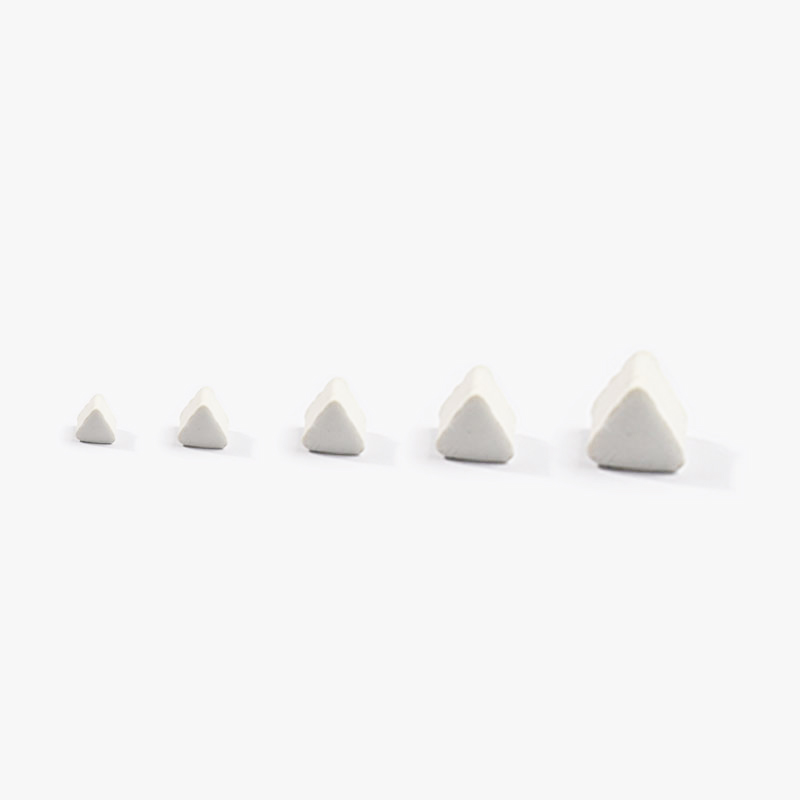
| Media | Best fit | Watch out for |
|---|---|---|
| Ceramic media, small size class for tight features | Reaching small holes, slots and fillets where a standard size class cannot enter, at reduced removal rate. | Screens differently from larger media, lodges more easily in drilled passages and must be kept below the smallest hole to stay clear. |
| Compound with corrosion inhibitor for sensitive alloys | Aluminium and stainless parts that must not stain or pit during processing and between-stage handling. | Inhibitor does not compensate for hard or chloride-bearing water, and residue left in recesses can mask later inspection. |
| Ceramic media, angle-cut and triangular shapes | Heavier deburring and edge blending on steel, stainless and titanium parts with accessible corners and recesses. | Wears down and changes effective size class, generates sludge, and can chip or over-round thin sections and soft alloys. |
| Steel media for burnishing | Bright, uniform appearance with minimal dimensional change on parts whose geometry must stay as machined. | Presses debris and hard-water deposits into the surface, concentrates energy on thin sections, and carries iron cross-contamination risk. |
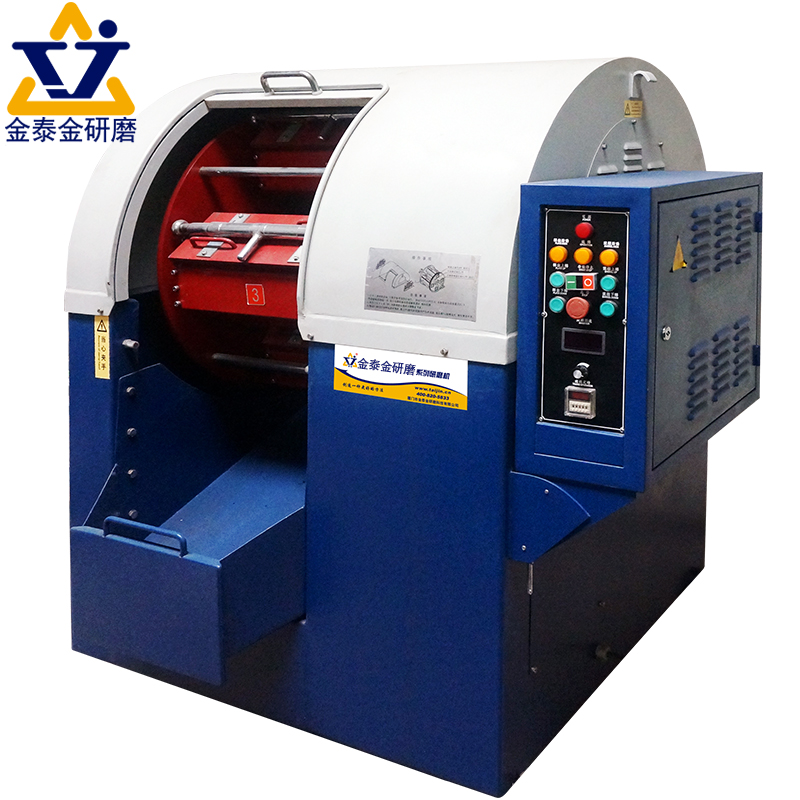
Rotary barrel tumbling is the gentlest of the mechanical routes and rewards parts that can tolerate slow, uniform abrasion: small fittings, spacers, bushings, fasteners and formed hardware that would be marked by higher-energy machines. Centrifugal barrel finishing raises the same principle to high speed, using barrels mounted on a rotating turret so the media presses against the parts with much greater force, which shortens cycles considerably for small, hard, robust components. Both routes share constraints that matter on aerospace work. Thin walls and long unsupported sections are at risk, fixtures and barrel liners wear, and the geometry of the barrel and the pattern of loading determine which faces actually see media. Weight limits per barrel also cap batch size. Evaluate these routes for small parts by the thousand, and treat fixture design and liner condition as first-order process variables rather than workshop detail.
| Machine route | Where it fits | What it will not do |
|---|---|---|
| Rotary barrel tumbling machine | Gentle, uniform processing of small robust parts in large quantities, such as bushings, spacers and fasteners. | Slow cycles, per-barrel weight limits, and limited access for inspecting or repositioning parts during the run. |
| Centrifugal barrel finishing machine | Short cycles on small, hard, robust parts where high pressure at the part-media interface is acceptable. | High energy transfers into thin walls and fixtures and wears liners; part size and barrel geometry bound what can be run. |
| Dry polishing machine and dryer | Post-wet drying and light dry finishing of parts with blind holes and passages where moisture carryover matters. | Dry media cut slowly, require dust extraction and medium condition control, and forced-air drying must be matched to internal geometry. |
| Magnetic finishing machine | Small precise parts with internal edges and recesses that loose media cannot enter, using small pins or needles. | Bounded by part size and mass, by workpiece material attraction to the pins, and by the need to retrieve residual pins. |
Discolouration and residue usually arrive together and point at chemistry rather than mechanics. A lean compound lets metal fines and heat build up, producing a dark or heat-tinted patch that follows the media flow pattern. Rich, hard or contaminated water leaves dried salts and films, especially in blind holes where rinse water does not circulate. Uneven finish across one part or across a batch typically has a loading cause: parts blocking each other, too large a load, unmixed sizes, inconsistent fixturing or a chamber run below its proper load volume. Check by comparing appearance against an agreed physical master under fixed lighting, by reading rinse-water conductivity or chloride level, and by measuring surface texture at multiple recorded locations instead of one convenient spot. Then separate the two problems, because chemistry fixes do not solve loading variation and loading changes will not remove a residue film.
| Failure mode | Likely cause | How to catch it |
|---|---|---|
| Edge radius grown past the drawing limit | Cycle time, energy setting or media size class allowing continued edge removal after the adjacent face has stabilised. | Compare the recorded pre-finish edge state with the finished state using radius gauges, an optical comparator or a cast impression at fixed positions. |
| Thread entry chamfer rounded away or thread crests burnished | Unmasked threaded features run in a burnishing or high-energy cutting load. | Gauge the thread with the buyer's own gauge and inspect the entry chamfer under magnification against the recorded pre-finish condition. |
| Dried compound residue or water spotting in recesses | Rich compound, hard or chloride-bearing rinse water, or a drying method that does not move air through blind features. | Inspect recesses with a borescope, read rinse-water conductivity or hardness, and verify the drying method against the part's internal geometry. |
| Embedded media fragments or metal smeared into the surface | Dirty or overloaded compound, media hardness mismatched to the alloy, or high-pressure burnishing that presses debris into the surface. | Borescope internal features, examine agreed locations at low magnification, and use dye penetrant only where the buyer's own procedure requires it. |
Edmonton's industrial base is built on hydrocarbons and the processing industries that grew around them, combined with a substantial aerospace and aviation maintenance presence at the provincial level. The Government of Alberta describes Alberta's Industrial Heartland as the province's designated industrial zone and an emerging international hub for petrochemicals, home to global companies including Dow Chemical and Shell, and it cites Dow's CAD 11.6 billion net-zero petrochemical plant as one of the largest private investments in provincial history. Aerospace and aviation is the other measurable cluster: the province states that Alberta is becoming a premier aviation and aircraft manufacturing hub, with De Havilland selecting Alberta for an aircraft assembly facility, parts manufacturing and distribution centre, training centre and museum, and Lufthansa Technik Canada establishing a maintenance and repair facility at Calgary International Airport. The Edmonton region also hosts defence and security manufacturing: the national defence industry association reports that Western and Northern Canada accounts for 21 per cent of Canada's defence and security industry, with aircraft maintenance, repair and overhaul among the key regional activities. The City of Edmonton tracks and publishes its own economic reporting through the Corporate Economics function, including quarterly economic updates and long-term outlook documents.
For this brief the relevant part of that base is aerospace: The Government of Alberta states that Alberta is becoming a premier aviation and aircraft manufacturing hub, citing De Havilland's aircraft assembly facility, parts manufacturing and distribution centre and training centre, and Lufthansa Technik Canada's maintenance and repair facility at Calgary International Airport.
Petrochemical and hydrocarbon processing plants in the Edmonton region depend on valves, pumps, compressors, heat-exchanger components and piping spools whose sealing surfaces, gasket faces and machined bores must be burr-free and finished to specification, and turnaround work creates a recurring demand for reconditioning those components. Aviation maintenance, repair and overhaul adds engine and airframe component work where edge condition, surface integrity and cleanliness carry airworthiness implications, and where the finishing process has to be documented. Both customer groups buy on specification and inspection records rather than on appearance, so the practical requirement in Edmonton is process repeatability and the ability to prove what was done to a part.
An Edmonton buyer should settle whether the finishing requirement is driven by seal integrity or by fatigue and cleanliness, because those two answers point to different processes and different acceptance testing; on petrochemical hardware the specification is usually a defined gasket-face or sealing-surface finish, while in aviation MRO it is edge condition and cleanliness. The second question is whether the shop can produce and retain the process records that a petrochemical operator or an aviation quality system will ask for, since a finishing cell that cannot produce evidence of repeatability will not pass either customer's audit.
Freight context: Edmonton International Airport and Alberta Aerospace and Technology Centre, CN and CPKC rail corridors, Alberta's Industrial Heartland industrial zone (Fort Saskatchewan / Strathcona County), Edmonton's inland rail and industrial parks. Edmonton combines an international airport with an adjacent aerospace and technology industrial cluster, direct Class 1 rail service, and the large contiguous heavy-industry land base of Alberta's Industrial Heartland, which is why Alberta can site petrochemical plants of the scale of the Dow investment there. For equipment import, a machine would normally arrive through a coastal container port and be railed into Edmonton, while urgent parts can move by air; heavy modules and oversized components can also move by rail directly to industrial sites.
China is one of Canada's ten principal merchandise trading partners and the second-largest single-country source of Canadian imports after the United States: Statistics Canada reported CAD 5,369 million of balance-of-payments imports from China in January 2025, against a CAD 2,299 million bilateral merchandise deficit that month. Canada has no free trade agreement with China, so Chinese-origin industrial machinery enters under the Most-Favoured-Nation (MFN) tariff column of the Canadian Customs Tariff; the preferential treatments listed in the tariff (CUSMA/UST and MXT, CETA/CEUT, CPTPP/CPTPT, UKT, KRT and others) do not include China, and preferential rates require proof of origin plus the applicable shipping rules, so a China-origin machine cannot claim them. Tariff classification is mandatory work, not a formality: vibratory, barrel, centrifugal and disc finishing machines are classified in Chapter 84 ("Nuclear reactors, boilers, machinery and mechanical appliances; parts thereof") according to the function of the machine, and the ten-digit Canadian tariff item drives both the duty rate and the statistics. A further landed-cost risk sits outside the tariff schedule: under the Special Import Measures Act (SIMA), the CBSA and the Canadian International Trade Tribunal may apply anti-dumping and countervailing duties to named goods, so a buyer should check the measures-in-force list for the specific product before assuming the MFN rate is the final duty.
Canada is a bilingual market for selling purposes: English is the working language of procurement outside Quebec, while Quebec buyers (Montreal, Quebec City) normally expect French-language quotations, technical documentation and after-sales support, and Quebec's Charter of the French Language makes French the default for commercial documentation in the province. Procurement expectations are formal and auditable: a Canadian industrial buyer will typically ask for the tariff classification and country of origin up front, expect a commercial invoice that satisfies the CBSA invoice requirements, and expect the seller to provide proof of origin for any preferential claim. Payment norms are bank-to-bank, with wire transfer or letter of credit rather than platform payment, and Canadian buyers commonly net-30 to net-60 from invoice, so a cross-border seller should price the working-capital gap into the offer. Certificates of origin for export documentation are issued through chambers of commerce, which is why chambers such as the Hamilton Chamber of Commerce and the Winnipeg Chamber of Commerce offer document certification. The current trade environment adds policy risk to landed cost: Canadian federal programs are explicitly framed around responding to U.S. tariffs, with the FedDev Ontario Regional Tariff Response Initiative described as supporting "businesses to respond to tariff pressures" in southern Ontario, and tariff and surtax measures can change by Order in Council, so quotations should state the tariff basis and the date on which the landed-cost calculation was made.
SurfacePolish supplies from Xiamen, China. The buyer's own destination rules, conformity marking, tariff classification and documentation responsibilities stay with the buyer; confirm them against the authorities named above before ordering.
Parts can meet every roughness and appearance requirement and still be unusable because of what remains on them. Define the cleanliness check explicitly: which features are examined, with what instrument, at what magnification, and what counts as a reject. Borescope inspection of blind holes and passage intersections, flushing with a measured volume, examining the flush medium, and a defined particulate or residue check are all practical options, but the method must be fixed in advance. Three further checks are commonly omitted. Include media carryover, iron contamination pickup on stainless and aluminum, and residual compound film in recesses, and confirm that rinse water quality is controlled, since hard or chloride-bearing water can leave deposits that later read as corrosion. Keep the cleaning and drying method in the acceptance record, because it is part of the result, not workshop housekeeping.
Expect the first production batches to differ from trial parts, because a trial is run with extra attention on one or two pieces while a line runs a full load with a different operator, a partly worn blend and normal handling between operations. Reduce that gap by planning a ramp-up sequence: run a low quantity, inspect the first part fully, compare it against the retained trial part at the agreed locations, then increase load size only after the comparison holds. Re-inspect at defined intervals through the ramp and keep a reference part from each stage. Be clear about what a sample trial cannot establish. Observations apply to the parts tested and to the setup used. A trial does not establish fitness for a regulated or safety-critical application, does not replace the buyer's own qualification or structural testing, and does not transfer responsibility for acceptance, which always remains with the buyer's engineering and quality functions.
Size the media well below the smallest hole to keep clear, and treat every drilled passage as a retrieval point rather than hoping it stays empty. Mask or plug features that were never meant to see media, count media into and out of the batch, and add a defined check such as a borescope at an agreed angle plus a pin gauge. For Canada buyers shipping parts for a trial, send the part with the tightest hole so the media class is chosen against real geometry rather than an average. SurfacePolish reports what was found on the parts tested; your own cleanliness inspection remains the acceptance decision.
Only partly. A trial is run with extra attention on a small number of pieces, while production runs a full load with a different operator, a partly worn media blend and the normal handling between operations. Treat trial output as evidence about the parts tested and the settings used, then plan a ramp-up in which the first production part is fully inspected and compared against the retained trial part at the same locations. Where results diverge, check the media blend and load pattern first, since those drift before a machine setting changes. SurfacePolish reports observations and a proposed direction; qualification and acceptance stay with the buyer.
No. A part can look bright and uniform while carrying embedded media fragments, a smeared surface layer, dried compound residue in a recess or an edge that has rolled past its limit. Acceptance needs measurement at defined locations, edge checks where edges are specified, and cleanliness checks of internal features, all recorded against the drawing requirement. Define appearance with a physical master or a calibrated image set under fixed lighting and magnification, since adjectives are not criteria. For a buyer in Canada, the practical rule is that appearance is one input among several, and no appearance result on its own establishes fitness for a regulated application.
Use Edmonton, Canada as the destination on the enquiry and state whether the deliverable is equipment, media and compound, a representative sample review or a line concept. A destination does not imply local stock, a local service point or a local delivery time.
An Edmonton buyer in the petrochemical and oil and gas chain works to the applicable pressure-equipment and piping standards their engineering contractor names, together with Alberta occupational health and safety requirements and Canadian electrical certification for equipment installed in the plant. In aviation MRO, the requirements come from the transport-aircraft maintenance regime and the customer's approved process specifications rather than from a finishing-specific national standard.
Sources were retrieved on 2026-09-29 and describe the local industrial and trade context only. They do not evidence any SurfacePolish project, shipment, installation or service in Edmonton.
The buyer needs the outer face brightened while the mating face stays flat and the passages are proven clear of media.
Send the material, dimensions, approximate weight, batch quantity, the incoming condition and photographs of the difficult features. Mark which features must not be contacted by media and state how the result will be inspected. This form carries source reference PSEO-0141; quote it if you prefer an additional manual reference.
Open the SurfacePolish enquiry form Email a prepared enquiry
No price, lead time, certification or result is promised here. Confirm whether a sample trial is available for the specific part and what the trial can and cannot show.
Page PSEO-0141 · revised 2026-09-29 · cross-border equipment, media and scoped sample review. City context is sourced and cited above.
Use this local checker to identify missing part and inspection information. It prepares a technical-review brief; it does not approve a machine, process recipe or production result.
Complete the part details to prepare a review brief.
Email : info@surface-polish.com


 IPv6 network supported


 +86-592-2381506