A buyer in Rennes, France working on aerospace components has an actuator housing that must be deburred without rounding a thin flange or leaving media in two blind M6 holes. SurfacePolish supplies finishing machines and consumables across borders and runs a free sample trial: the parts travel to Xiamen, and the tested parts come back with a proposed media, compound and cycle direction for the buyer's own engineering review. This brief is written for a buyer in Rennes working on aerospace components; it describes equipment, media and a scoped sample review, not a local polishing service.
What edge condition is actually specified at each critical location, and which machine and media combination can hold inside that band?
At what batch size, load pattern and media wear state does the trial result still describe what production will produce?
How will media be kept out of drilled passages, tapped holes and closed volumes, and what retrieval and verification step proves it?
Alloy and temper decide which media and compound families are realistic before any machine is discussed. Unaged aluminum alloys are soft and galling-prone, precipitation-hardening stainless steels are harder and respond to cutting media, and titanium has low thermal conductivity and a tendency to smear rather than cut cleanly. High-strength steels also bring a documented concern about hydrogen picked up from acidic chemistry. Heat treatment matters twice, because the same alloy in a solution-treated and an aged condition finishes differently and a part that has already been aged cannot be straightened after processing. Record alloy, temper, hardness range, prior manufacturing operations such as welding or grinding, and any stress-relief history. Then match media hardness and compound pH to the material instead of reusing a successful recipe from an unrelated part, because the same blend that brightens one alloy can stain another.
Rotary barrel tumbling is the gentlest of the mechanical routes and rewards parts that can tolerate slow, uniform abrasion: small fittings, spacers, bushings, fasteners and formed hardware that would be marked by higher-energy machines. Centrifugal barrel finishing raises the same principle to high speed, using barrels mounted on a rotating turret so the media presses against the parts with much greater force, which shortens cycles considerably for small, hard, robust components. Both routes share constraints that matter on aerospace work. Thin walls and long unsupported sections are at risk, fixtures and barrel liners wear, and the geometry of the barrel and the pattern of loading determine which faces actually see media. Weight limits per barrel also cap batch size. Evaluate these routes for small parts by the thousand, and treat fixture design and liner condition as first-order process variables rather than workshop detail.
| Machine route | Where it fits | What it will not do |
|---|---|---|
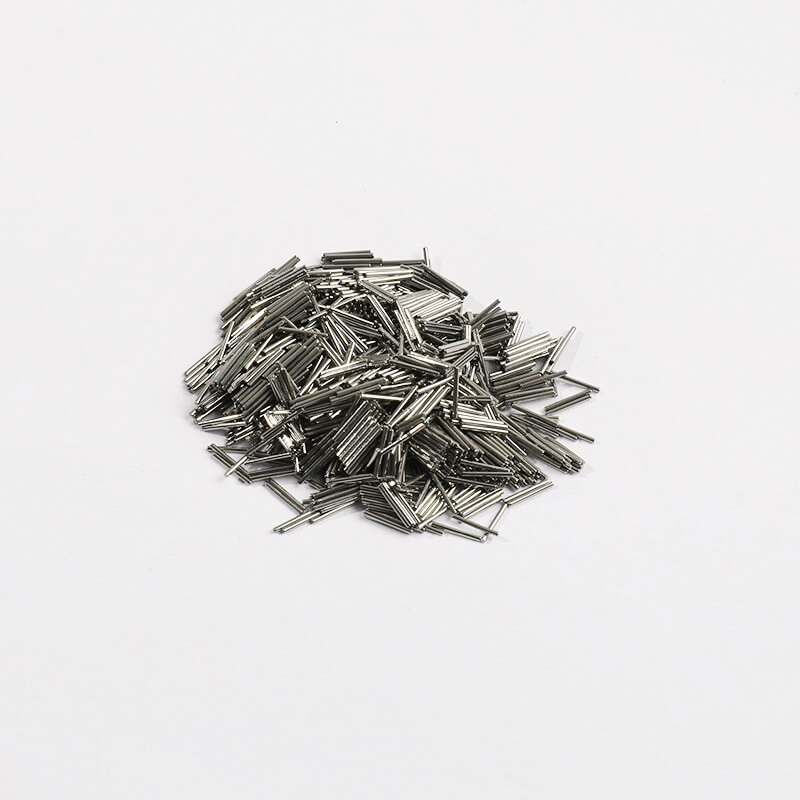
| Magnetic finishing machine | Small precise parts with internal edges and recesses that loose media cannot enter, using small pins or needles. | Bounded by part size and mass, by workpiece material attraction to the pins, and by the need to retrieve residual pins. |
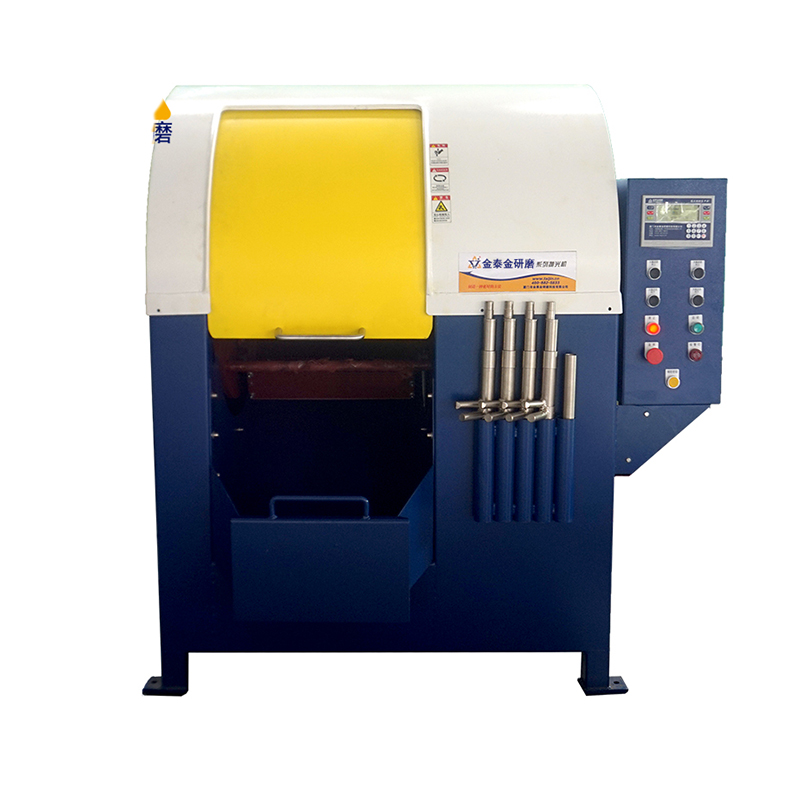
| Rotary barrel tumbling machine | Gentle, uniform processing of small robust parts in large quantities, such as bushings, spacers and fasteners. | Slow cycles, per-barrel weight limits, and limited access for inspecting or repositioning parts during the run. |
| Vibratory finishing machine, bowl type | General edge blending and surface refinement on medium-sized parts with a continuous, visible load. | Part size is capped by chamber geometry, and thin or delicate parts may need compartments or fixtures to limit part-on-part contact. |
| Grinding finishing machine | Applications needing higher material removal before a refinement stage, such as heavy burrs or a defined stock removal. | Higher removal raises the risk of edge over-rounding and dimensional change on close-tolerance features. |
The compound is not a lubricant added at the end of the setup; it is the variable that keeps the process stable. Alkaline builders and detergents keep media and parts clean and suspend removed material, mildly acidic or chelated chemistry brightens certain alloys, and inhibitors are used to limit attack on sensitive surfaces. Concentration and flow rate at the machine are the actual levers: running lean loads the media, slows the cut and lets heat and discoloration develop, while running rich produces foam, residue that lodges in blind holes and unnecessary cost. Water quality belongs in the same discussion because hardness leaves scale and spotting, and chlorides present a pitting risk on stainless and aluminum. Set concentration by a measured dilution routine and a daily check, record it with the batch, and treat any drift as a process deviation rather than an operator preference.
| Media | Best fit | Watch out for |
|---|---|---|
| Dry media: walnut shell and corn cob | Light deburring, drying support and residue removal on parts where moisture carryover is the governing concern. | Slower cutting, generates dust requiring extraction, and its condition and moisture content must be controlled to stay repeatable. |
| Ceramic media, angle-cut and triangular shapes | Heavier deburring and edge blending on steel, stainless and titanium parts with accessible corners and recesses. | Wears down and changes effective size class, generates sludge, and can chip or over-round thin sections and soft alloys. |
| Steel media for burnishing | Bright, uniform appearance with minimal dimensional change on parts whose geometry must stay as machined. | Presses debris and hard-water deposits into the surface, concentrates energy on thin sections, and carries iron cross-contamination risk. |
| Mildly acidic or chelated brightening compound | Brightening certain stainless grades where the buyer's specification permits that chemistry family. | Not appropriate where hydrogen uptake is a concern on high-strength steel, and requires close pH control and good rinse water quality. |
A lodged piece of media is the failure mode that puts a finished aerospace part at greatest risk, because it may survive cleaning and only appear at final inspection or, worse, in service. Lodging happens where a feature's smallest dimension is close to the media size, which is why blind tapped holes, cross-drilled passage intersections, keyways, undercuts, dovetails and small counterbores are the usual sites. It is aggravated by soft or worn media that deform and wedge, by running a broad size-class blend, and by unmasked holes that were never intended to see media. Check with a known pin gauge, a borescope at an agreed viewing angle and a defined count of media in the batch before and after, and add a documented retrieval step such as bar-end magnets, directed air or a flush. The reliable prevention is size discipline: media sized well below the smallest hole to be left clear.
| Failure mode | Likely cause | How to catch it |
|---|---|---|
| Embedded media fragments or metal smeared into the surface | Dirty or overloaded compound, media hardness mismatched to the alloy, or high-pressure burnishing that presses debris into the surface. | Borescope internal features, examine agreed locations at low magnification, and use dye penetrant only where the buyer's own procedure requires it. |
| Dried compound residue or water spotting in recesses | Rich compound, hard or chloride-bearing rinse water, or a drying method that does not move air through blind features. | Inspect recesses with a borescope, read rinse-water conductivity or hardness, and verify the drying method against the part's internal geometry. |
| Local flatness or geometry change on a datum face | Media contact on a surface where appearance was treated as the only requirement and flatness was not protected. | Confirm the datum condition with the buyer's own method, such as a CMM or a surface plate check against the stated requirement, on parts from the first and last part of the load. |
| Dark or heat-tinted patch following the media flow | Lean compound concentration or restricted flow, letting metal fines and heat build up in the working mass. | Compare against the agreed appearance master under fixed lighting and check the measured compound concentration and flow rate recorded for the batch. |
Rennes is the Breton capital of digital technology, health and agri-food, with an industrial renewal story attached to its former car plant: Rennes Metropole states that La Janais, historically linked to the automobile industry with the presence of Stellantis (formerly PSA), is being developed into a low-carbon industrial excellence hub, with the Bâtiment 78 offering 25 000 m2 of industrial premises, incubator, nursery and business hotel space for young industrial companies. INSEE counted 8 482 establishments in the commune at the end of 2024 with a 2,8 % industry share and 156 532 jobs at the place of work in 2023. The metropolitan strategy names digital, sustainable agriculture and food, health and biotech, creative industries, cybersecurity, circular economy and mobility as its strategic sectors, and Bretagne Developpement Innovation is the regional agency for those transitions.
The nearest part of that base to this brief is automotive: Rennes Metropole states that the La Janais site is historically linked to the automobile industry with the presence of Stellantis (formerly PSA), and that the metropolis bought land from the carmaker to create an industrial excellence hub aimed at mobility and sustainable-building industries.
The Rennes industrial base mixes automotive-supplier work at and around La Janais with mechanical and electrical equipment manufacture, agri-food equipment and medical technology. In the automotive-supplier part, deburring and edge control on machined and pressed parts is a specified, audited operation with cleanliness limits; in agri-food and medical equipment, stainless fabrication needs controlled surface roughness for cleanability and residue-free rinsing. The industrial-renewal programme at La Janais is explicitly aimed at low-carbon industry, so suppliers setting up there will be specifying new process equipment rather than adapting old lines.
A Rennes buyer should settle whether the finishing process will be installed in an existing plant with limited space and services, or specified as part of a new industrial building such as those on the La Janais hub, because footprint, drainage and ventilation constraints decide which machine types are realistically installable.
Freight context: Rennes Bretagne Airport, Port of Saint-Malo (regional cross-Channel and freight), Rennes rail-road combined terminal. Rennes has no major seaport of its own and relies on Saint-Malo and the Loire estuary ports for sea freight, with Rennes Bretagne Airport for urgent air movements; the metropolitan area's economic programme notes that industrial land is being densified rather than expanded (65 ha of need between 2025 and 2035, 60 % of it from renewal of existing business zones). That makes delivery access, floor loading and installation space at existing plants the practical planning constraint.
The French national standards body is AFNOR (Association francaise de normalisation), which coordinates French participation in standardisation and publishes the NF and NF EN standards that transpose ISO and CEN work; AFNOR also runs the certification activity attached to many of those standards. A French buyer of finishing equipment would normally reference ISO/NF EN surface-texture standards for roughness and profile parameters, ISO/NF EN cleanliness or residue specifications for critical parts, and management-system or sector schemes such as ISO 9001, IATF 16949 for automotive and EN 9100 for aerospace.
The working language of French industrial procurement is French: tenders, drawings, inspection plans and technical dossiers are normally issued and answered in French, and quotations that omit French documentation slow down qualification. Buyers qualify a machine against a written specification and expect traceable material certificates, machine safety documentation and, where applicable, a CE declaration of conformity and a risk assessment; acceptance is often staged (documentary review, factory acceptance test, then commissioning). Payment and documentation norms are conventional EU practice: euro invoicing, SEPA or SWIFT bank transfer, Incoterms agreed in writing, and customs paperwork (commercial invoice, packing list, transport document, proof of origin where a preference is claimed) prepared for the declarant or customs representative. Because customs and tax authorisations are handled jointly through SOPRANO, non-EU sellers are normally advised to sell to an established French/EU importing entity rather than to act as importer of record themselves.
SurfacePolish supplies from Xiamen, China. The buyer's own destination rules, conformity marking, tariff classification and documentation responsibilities stay with the buyer; confirm them against the authorities named above before ordering.
A roughness number is only meaningful with its measurement setup attached. Agree the exact locations, which surfaces are excluded, the evaluation length and cutoff, the filter and whether the requirement is stated as an average, a maximum or a profile parameter. Values taken at different cutoffs on the same surface will not agree, and values taken on a curved or interrupted surface such as a fillet, thread flank or cast skin are unreliable unless the setup is designed for it. Record instrument identification, stylus condition and the calibration status in use at the time, and keep the readings with the batch. For areal or functional appearance requirements, prefer a documented procedure over an informal comparison, and state plainly that roughness readings describe the sampled locations on the parts measured. Repeatability comes from repeating the same setup, not from taking more readings in different ways.
Comparative trials lose their value when several things change together. Fix the machine, load volume, part count, compound concentration and cycle time, then change one variable: media material first, then size class, then compound, then time or energy setting. Ask for the same recorded locations to be measured with the same instrument and the same setting across all variants, and for photographs taken under identical lighting, so the comparison is between processes rather than between photographers. Retain all tested parts, including the ones that went wrong, because a rejected variant often explains which mechanism caused a defect and therefore which limit must be respected in production. A comparison of two media blends run with different cycle times and different operators tells you nothing about the media, which is the most common reason a trial result fails to transfer into a line.
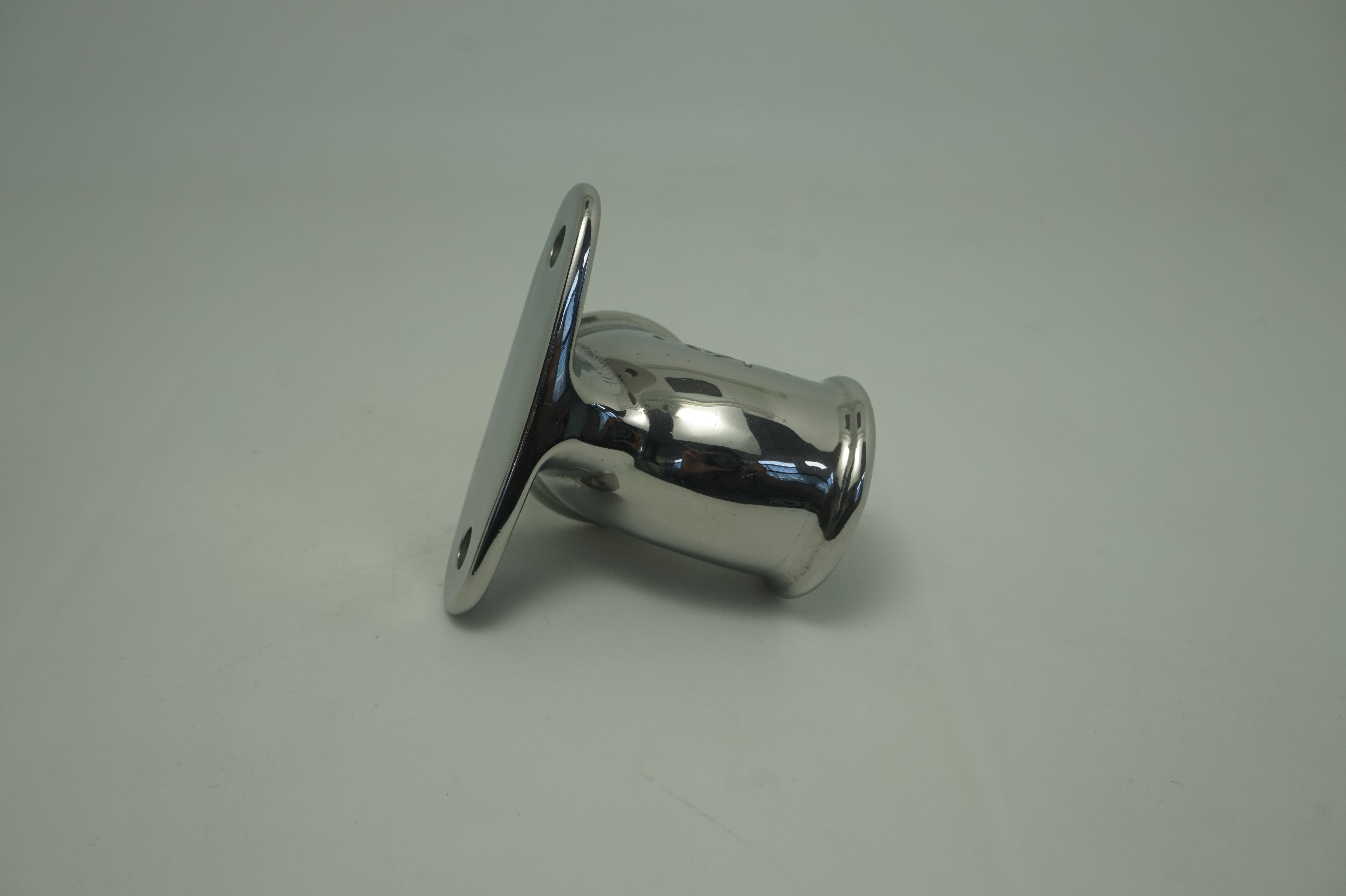
Record the edge condition before finishing, set the allowable band in writing, and measure afterwards with radius gauges, an optical comparator or a cast impression at fixed positions. Because edges lose material much faster than adjacent faces, the cycle continues to change them after the face has stabilised, so time, energy setting and media size class are the controlling variables. If the band is tight, plan a separate edge operation rather than relying on a bulk cycle. A sample trial can show how a named edge behaves under two media classes on the parts you send, which gives your engineering group data to set a limit instead of an opinion.
Keep dedicated media, baths and, where practical, dedicated machines or chambers for each material family, because stainless and aluminium can pick up iron from carbon steel media and soft alloys absorb debris from harder work. Change or filter compound on a schedule rather than when the bath looks dirty, control rinse water quality since hardness and chlorides leave deposits, and clean parts between stages instead of carrying sludge forward. Record which media ran in which machine and when the bath was last cleaned. For a buyer in Rennes running mixed families, separating the load plan is usually cheaper than cleaning contamination out of finished parts.
Only partly. A trial is run with extra attention on a small number of pieces, while production runs a full load with a different operator, a partly worn media blend and the normal handling between operations. Treat trial output as evidence about the parts tested and the settings used, then plan a ramp-up in which the first production part is fully inspected and compared against the retained trial part at the same locations. Where results diverge, check the media blend and load pattern first, since those drift before a machine setting changes. SurfacePolish reports observations and a proposed direction; qualification and acceptance stay with the buyer.
Use Rennes, France as the destination on the enquiry and state whether the deliverable is equipment, media and compound, a representative sample review or a line concept. A destination does not imply local stock, a local service point or a local delivery time.
A Rennes buyer would reference ISO/NF EN surface-texture standards for finish and the automotive IATF 16949 regime with customer-specific edge and cleanliness requirements where vehicle work is involved, and hygiene-related surface requirements for food equipment; ISO 9001 is the general baseline and ISO 13485 applies to medical devices. AFNOR publishes the NF/NF EN versions of the ISO standards used on local drawings.
Sources were retrieved on 2026-09-29 and describe the local industrial and trade context only. They do not evidence any SurfacePolish project, shipment, installation or service in Rennes.
The buyer needs to remove machining burrs and blend edges without rounding the flange or lodging media in the blind tapped holes.
Send the material, dimensions, approximate weight, batch quantity, the incoming condition and photographs of the difficult features. Mark which features must not be contacted by media and state how the result will be inspected. This form carries source reference PSEO-0591; quote it if you prefer an additional manual reference.
Open the SurfacePolish enquiry form Email a prepared enquiry
No price, lead time, certification or result is promised here. Confirm whether a sample trial is available for the specific part and what the trial can and cannot show.
Page PSEO-0591 · revised 2026-09-29 · cross-border equipment, media and scoped sample review. City context is sourced and cited above.
Use this local checker to identify missing part and inspection information. It prepares a technical-review brief; it does not approve a machine, process recipe or production result.
Complete the part details to prepare a review brief.
Email : info@surface-polish.com


 IPv6 network supported


 +86-592-2381506
