


Jintaijin | Independent versioned catalog reference
Roesler R 400 HTZ vs R 600 HTZ: dryer catalog comparison
Compare R 400 HTZ and R 600 HTZ from the Roesler dryer factsheet, physical page 3, revision 04/2023. Read the exact source labels, original ratings and options side by side. Choose one of two catalog-field profiles, enter optional maxima in millimetres and export the current comparison for supplier review. Use current drawings and workpiece trials to confirm the offered configuration and drying process.
Compare exact models and original source fields
| Factsheet field | R 400 HTZ | R 600 HTZ |
|---|---|---|
| Diameter of cylindrical *1 centrifuge basket Ø (mm) | 400 mm | 600 mm |
| Thickness of basket wall (mm) | 3 mm | 4 mm |
| Diameter of basket perforation Ø (mm) Special perforation is possible | 3 mm | 4 mm |
| Max. batch loading (kg) | 50 kg | 100 kg |
| Max. batches per hour | 12-14 [unit not explicit / notation retained] | 10-12 [unit not explicit / notation retained] |
| Speed, rpm *2 | 960 rpm | 690 rpm |
| Heating power (kW) *3 | 4 kW | 4 kW |
| Voltage Special voltage is possible | 230/400 [unit not explicit / notation retained] | 230/400 [unit not explicit / notation retained] |
| Motor (kW) | 1.5 kW | 3.0 kW |
| Hot air fan (kW) | 0.06 kW | 0.06 kW |
| Length / Width (mm) | 650 mm | 900 mm |
| Diameter basket – (mm) | 400 mm | 600 mm |
| Diameter Loading area – (mm) | 300 mm | 500 mm |
| Height without lid (mm) | 990 mm | 1,190 mm |
| Height basket (mm) | 260 mm | 410 mm |
| Height drain pipe – (mm) | 570 mm | 570 mm |
| External thread drain pipe - (mm) | R 2“ [unit not explicit / notation retained] | R 2“ [unit not explicit / notation retained] |
| Length max. – (mm) | 740 mm | 990 mm |
| Total width – (mm) | 730 mm | 980 mm |
| Total length – (mm) | 730 mm | 980 mm |
| Machine height, closed (mm) | 1,045 mm | 1,245 mm |
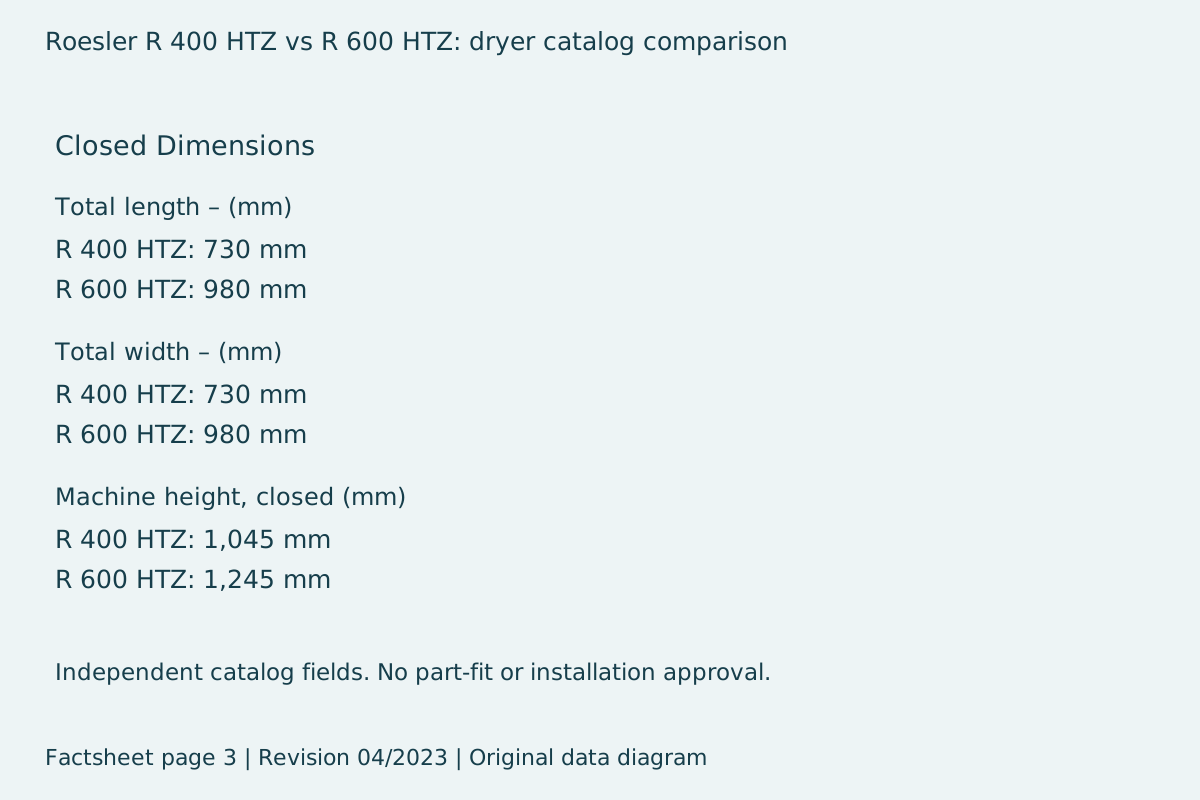
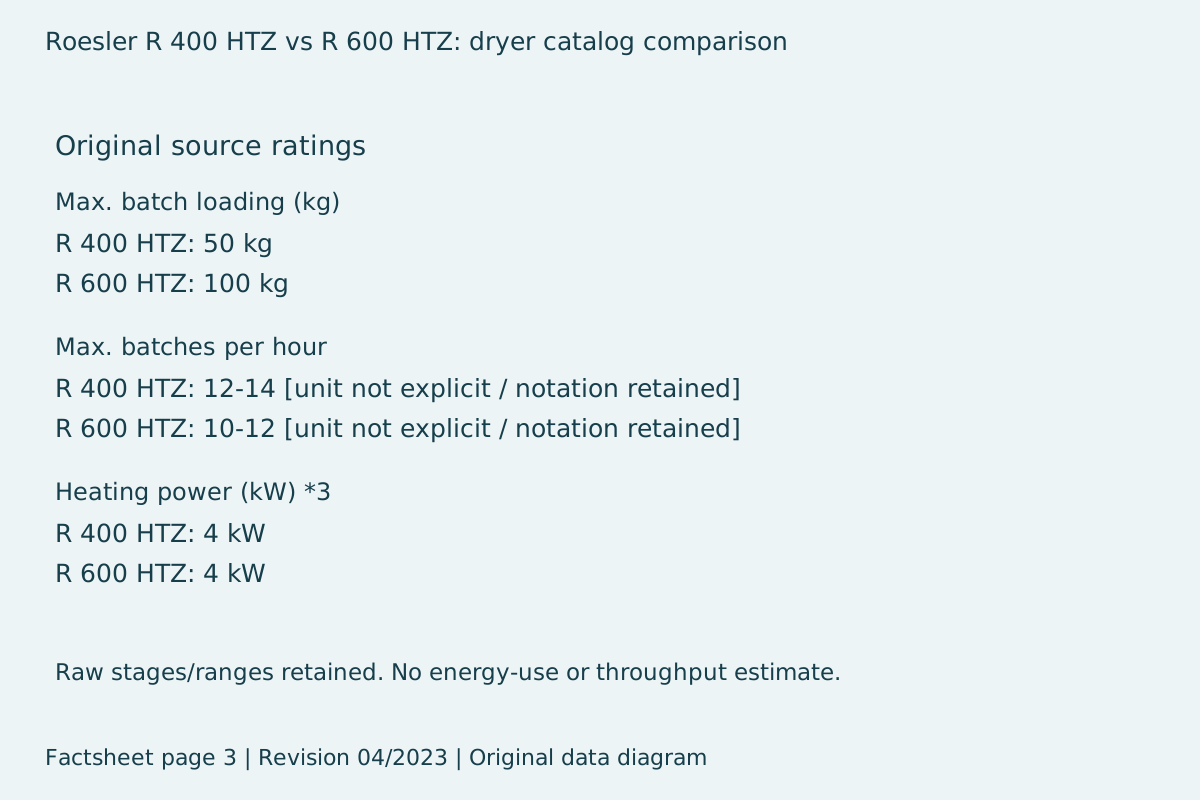
Max. batch loading (kg): 50 kg versus 100 kg; Max. batches per hour: 12-14 [unit not explicit / notation retained] versus 10-12 [unit not explicit / notation retained]; Heating power (kW) *3: 4 kW versus 4 kW.
The complete source table is shown with its original labels and notation. Unit-ambiguous fields, stages, ranges and unselected options remain raw; the query only screens cleared numeric dimension fields.
Compare your catalog-field maxima
Select a profile to see the three exact field names. Leave all three inputs blank for comparison, or enter all three positive decimal maxima in mm. Switching profiles clears previous values so one condition cannot inherit another condition’s limits.
Review the two field conditions separately
For closed dimensions, Total length – (mm) is 730 mm versus 980 mm; Total width – (mm) is 730 mm versus 980 mm; Machine height, closed (mm) is 1,045 mm versus 1,245 mm. These named fields are compared independently; they do not prove installation clearance, part fit or drying suitability.
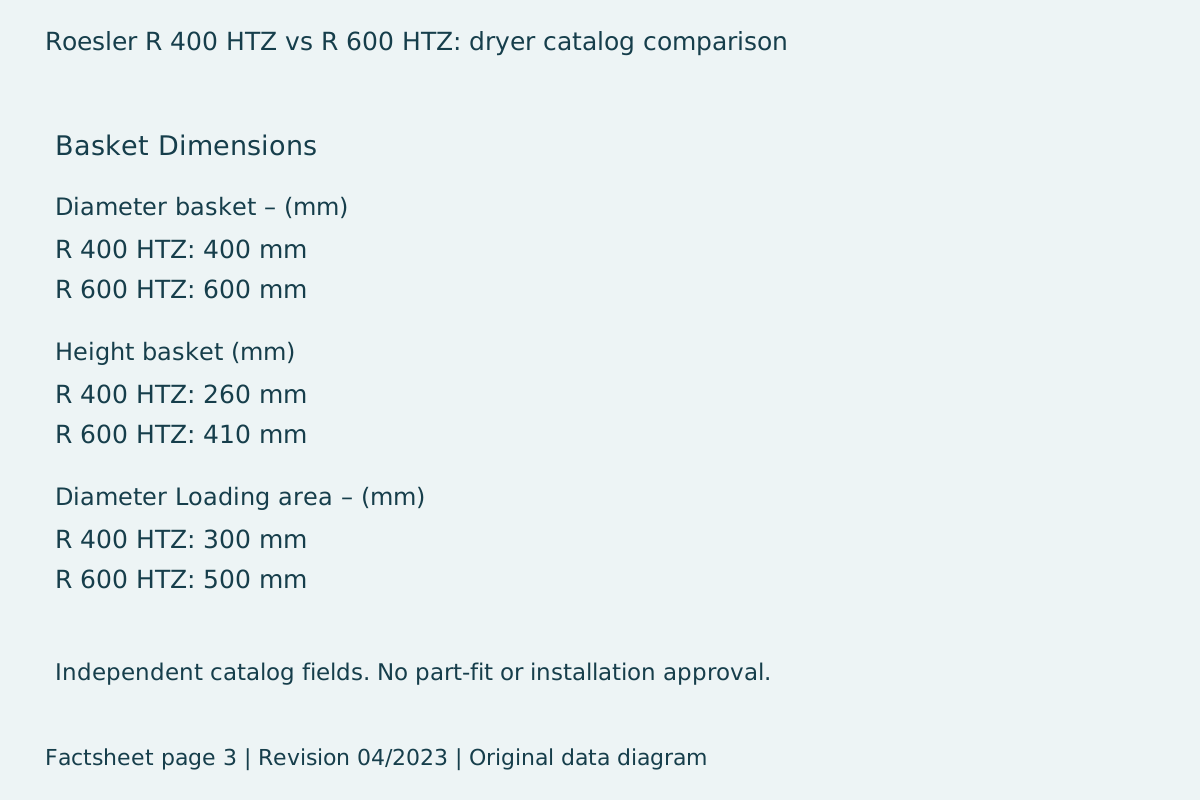
For basket dimensions, Diameter basket – (mm) is 400 mm versus 600 mm; Height basket (mm) is 260 mm versus 410 mm; Diameter Loading area – (mm) is 300 mm versus 500 mm. These named fields are compared independently; they do not prove installation clearance, part fit or drying suitability.
Every result names its selected fields and retains the original source record. A field maximum is a numerical query on a catalog value. In particular, aperture and passage values do not constitute maximum permissible workpiece geometry. Consult the drawing and a trial with actual parts, drying media and loading arrangements.
- Closed height, height without lid, body square dimension and total dimensions are separate conditions.
- Length max. is larger than total length in the catalog; neither is silently substituted. Clearance requires a current drawing and review.
- R 2-inch is retained as nominal thread notation despite the primary row (mm) label; no conversion to 50.8 mm is made.
- Max batch loading is a catalog maximum; batch-per-hour ranges remain raw. No kg/hour production claim is derived.
- Basket material, special speed, variable control, voltage and special heating options require confirmation; no option is selected.
Prepare a supplier review and sample trial
Request the complete drawing showing open-lid clearance, maximum length, total dimensions and loading access. Review permissible batch mass and imbalance with the actual workpiece. Keep the basket-perforation and nominal drain-thread specifications separate. The batch-rate range and maximum loading do not justify a multiplied kg/hour claim.
Record the incoming moisture condition, workpiece geometry, material, sensitivity, handling and separation criteria before requesting a trial. Ask for measured drying outcomes and cycle or residence conditions for the offered setup. This catalog record does not establish acceptable residual moisture, finish quality, corrosion behavior, production output or utility consumption.
Source: Roesler dryer factsheet, physical page 3, revision04/2023. The EN.148.19 revision04/2023 dryer brochure, physical page 11, supplies drawing and label context from the same publisher.
Confirm current configuration, options and availability with the manufacturer. No Jintaijin equivalence or manufacturer partnership is established.
Questions about this pair
What source fields differ between R 400 HTZ and R 600 HTZ?
For closed dimensions, Total length – (mm) is 730 mm versus 980 mm; Total width – (mm) is 730 mm versus 980 mm; Machine height, closed (mm) is 1,045 mm versus 1,245 mm. These named fields are compared independently; they do not prove installation clearance, part fit or drying suitability. Max. batch loading (kg): 50 kg versus 100 kg; Max. batches per hour: 12-14 [unit not explicit / notation retained] versus 10-12 [unit not explicit / notation retained]; Heating power (kW) *3: 4 kW versus 4 kW.
Which second field profile is available?
For basket dimensions, Diameter basket – (mm) is 400 mm versus 600 mm; Height basket (mm) is 260 mm versus 410 mm; Diameter Loading area – (mm) is 300 mm versus 500 mm. These named fields are compared independently; they do not prove installation clearance, part fit or drying suitability.
Can these dryer ratings establish throughput or operating cost?
Request the complete drawing showing open-lid clearance, maximum length, total dimensions and loading access. Review permissible batch mass and imbalance with the actual workpiece. Keep the basket-perforation and nominal drain-thread specifications separate. The batch-rate range and maximum loading do not justify a multiplied kg/hour claim. Catalog powers are ratings, not measured consumption. No selected heat stage, cycle time, kg/hour or output guarantee is calculated.
What does a passing maximum-field test mean?
It means each of the three selected source fields is at or below the maximum you entered for that named field. These are independent catalog queries, including aperture or loading fields where selected. They do not establish that a part fits, a dryer fits an installation space or a process will work. Leave all three inputs blank for a comparison, or enter all three positive decimal maxima. Confirm the source revision, offered options, clearance, workpiece handling and sample-trial requirements with the supplier.
Related trial and inspection tools
Discuss your workpiece and sample-trial requirements with Jintaijin
 +86-592-2381506

 IPv6 network supported