


Jintaijin | Independent versioned catalog reference
Roesler RZ 150 A vs RZ 60 M: liquid-cleaning catalog comparison
Compare RZ 150 A and RZ 60 M using the Roesler centrifuge factsheet, physical page 1, revision 07/2024. Keep liquid flow, sludge volume or mass, power and options on their printed basis. Filter the fields, enter your own liquid-flow requirement and optional solids concentration, and export the current review record. Confirm actual cleaning performance and the offered configuration through supplier drawings and a representative fluid trial.
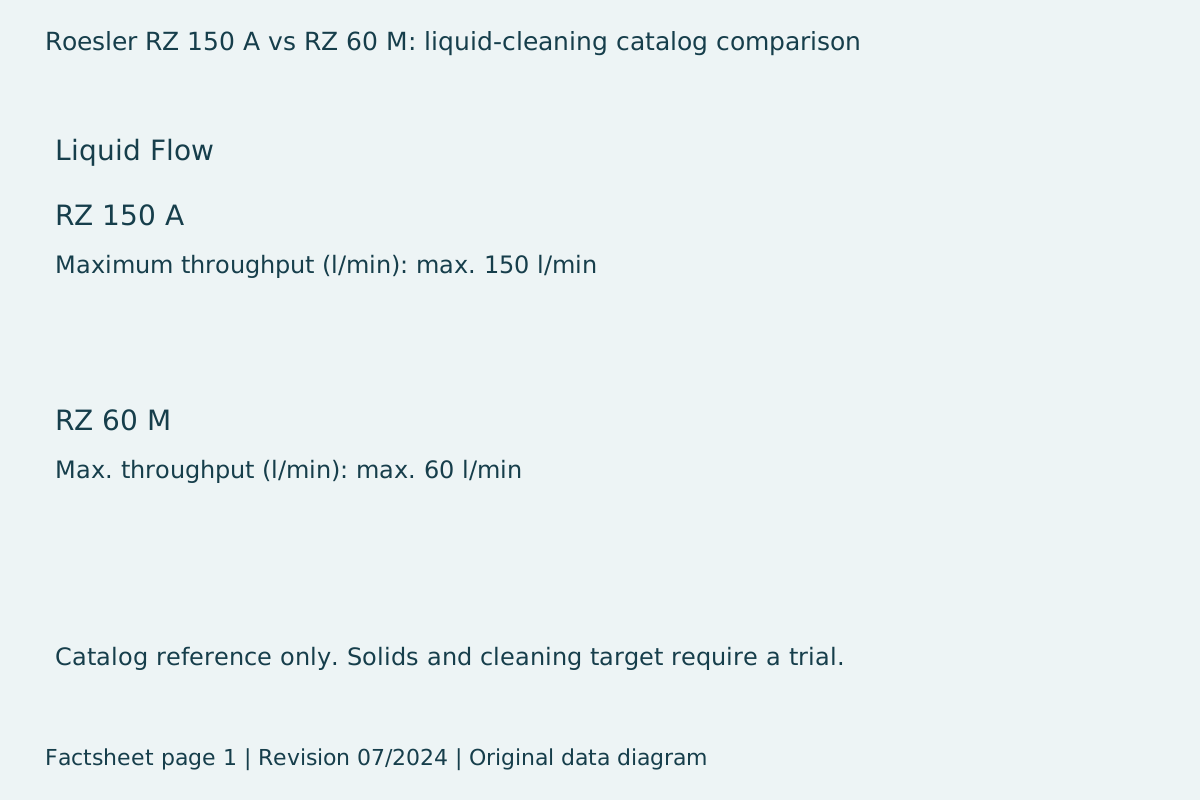
Read each source field on its own basis
| Field group | RZ 150 A | RZ 60 M |
|---|---|---|
| Flow | Maximum throughput (l/min) max. 150 l/min | Max. throughput (l/min) max. 60 l/min |
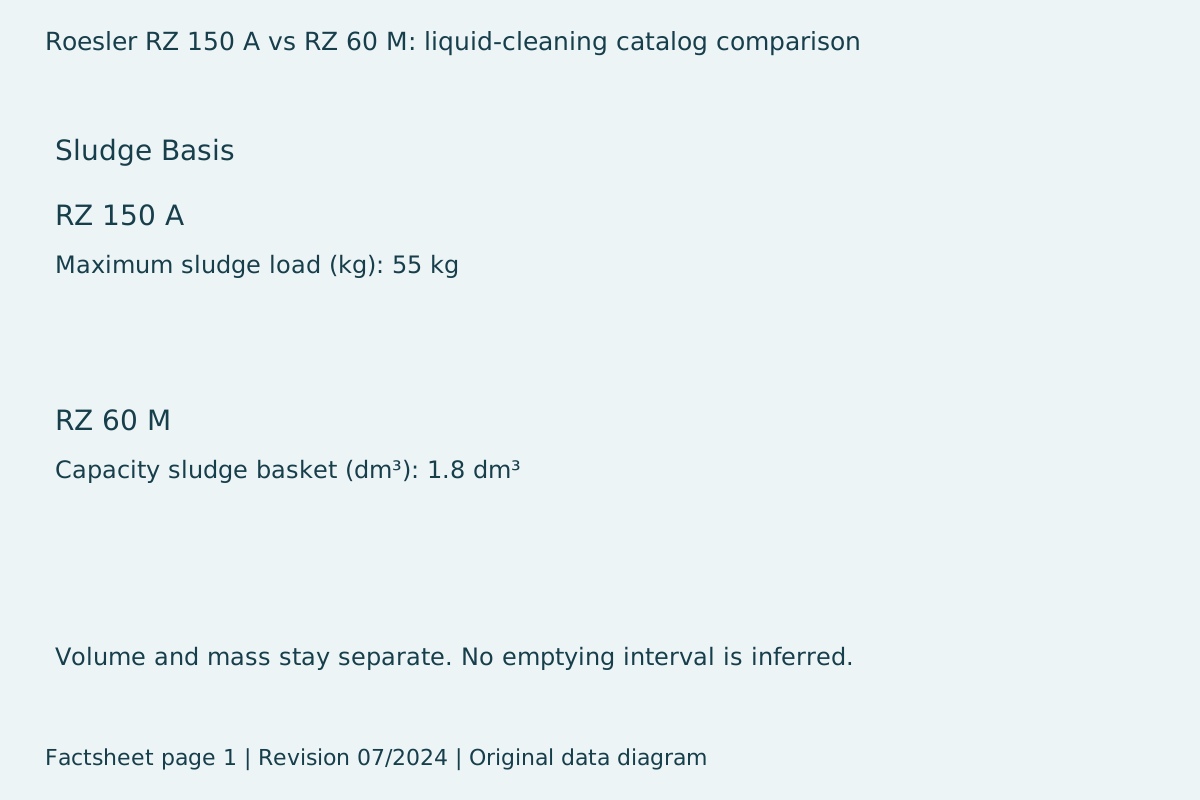
| Sludge | Maximum sludge load (kg) 55 kg | Capacity sludge basket (dm³) 1.8 dm³ |
| Temperature | Temperature resistance (° C) 50 °C | Temperature resistance (° C) 50 °C |
| Force | Centrifugal force (g) approx. 1,800 g | Centrifugal force (g) 1,800 g |
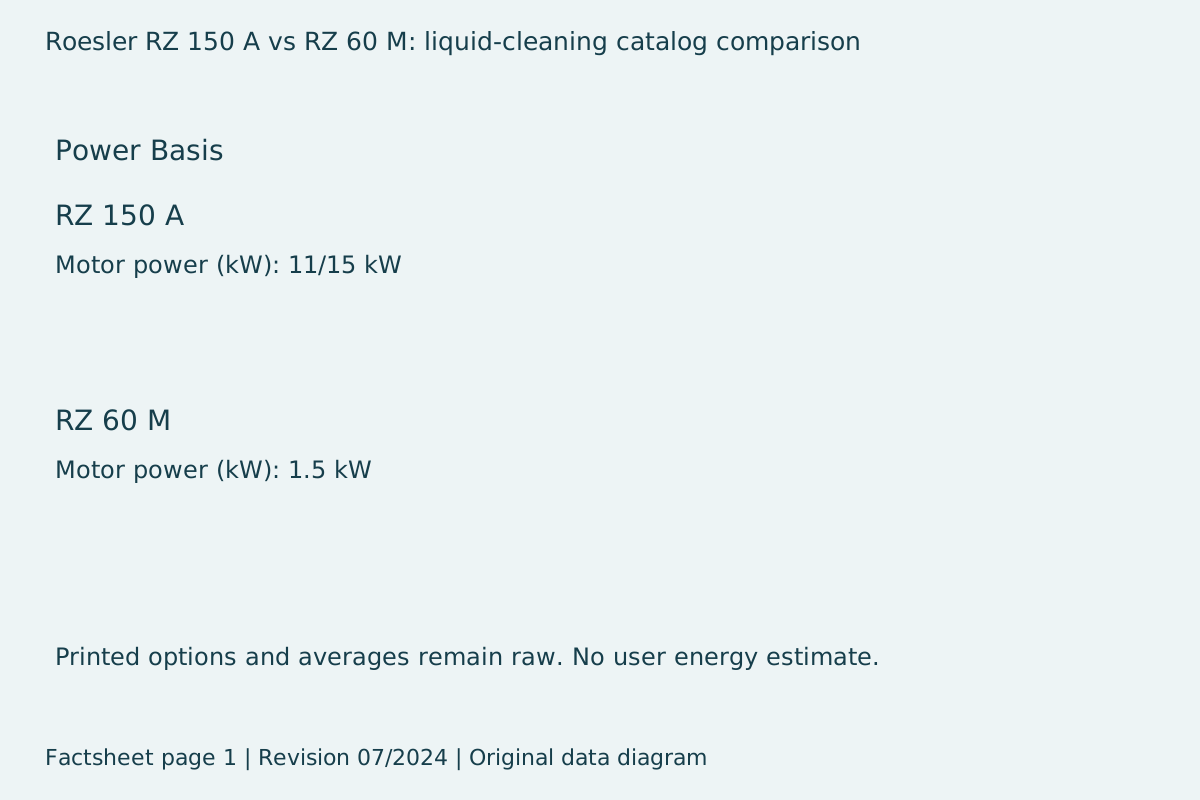
| Motor | Motor power (kW) 11/15 kW | Motor power (kW) 1.5 kW |
| Speed | Speed (RPM) max. 2,650 RPM | Speed (RPM) 4,100 RPM |
The printed liquid-flow entry is max. 150 l/min for RZ 150 A and max. 60 l/min for RZ 60 M. The source uses maximum litres per minute; multiplying the numerical maximum by 60 changes the reporting unit to litres per hour. This conversion does not establish actual separation performance. RZ 60 M and RZ 120 M are semi-automatic in the reviewed brochure, whereas RZ 150 A uses automatic sludge removal.
Review source fields and your fluid inputs
Choose a field group. Flow is optional; solids concentration requires flow. No process values are prefilled. Catalog comparisons do not select a centrifuge or prove the desired cleaning effect.
Separate fluid load from collected sludge
RZ 150 A: Maximum sludge load (kg) = 55 kg; RZ 60 M: Capacity sludge basket (dm³) = 1.8 dm³. Volume and mass are separate source bases. A range does not select a basket insert, and a volume does not establish a sludge mass without density and loading evidence.
The optional incoming-solids calculation uses your own flow and concentration. It does not infer captured solids, residual moisture, sludge density, cake volume or basket-fill duration. Ask the supplier to establish these quantities with the actual liquid and an agreed cleaning target before selecting a discharge or handling schedule.
Record liquid composition, temperature, solids concentration, particle-size distribution, material densities, emulsified or free oil and the desired cleaning effect. Also record variability during a shift, collection and return paths, tank arrangements and sample handling. A nominal maximum flow cannot replace this fluid-specific review.
- Catalog liquid flow is not finished-workpiece throughput.
- Sludge volume and mass are separate source fields; no density, basket-fill duration or emptying interval is inferred.
- Ranges, approximate force, motor options, missing tank entries and unspecified options remain raw; missing is not zero.
- No residence time, separation result, particle cut, measured energy use, actual flow guarantee, current build or Jintaijin equivalence is established.
- RZ 60 M/RZ 120 M are semi-automatic; RZ 150 A is automatic in the reviewed brochure. Sludge removal modes differ.
- RZ 120 M-3PH has conflicting flow entries and is excluded from candidate tools.
Prepare a source-backed supplier review
RZ 150 A: Motor power (kW) = 11/15 kW; RZ 60 M: Motor power (kW) = 1.5 kW. Original options and catalog averages remain visible; this tool does not turn them into measured electricity use for your process.
Request an offered configuration with current electrical, tank, cooling, dosing, sludge-removal and access details. Specify how inlet and outlet samples will be collected and how the required cleaning effect will be measured. Obtain a trial result rather than adopting a catalog capacity as guaranteed performance. No installation dimensions or floor-loading approval is supplied by the selected tables.
Source: Roesler centrifuge factsheet, physical page 1, revision07/2024. Industrial-liquid cleaning centrifuge brochure supplies RZ context. RZ120M-3PH has conflicting official flow entries and is excluded from this tool.
This independent catalog reference does not establish current availability, Jintaijin equipment equivalence or manufacturer partnership.
Questions about this pair
How do RZ 150 A and RZ 60 M differ in catalog liquid flow?
The printed liquid-flow entry is max. 150 l/min for RZ 150 A and max. 60 l/min for RZ 60 M. The source uses maximum litres per minute; multiplying the numerical maximum by 60 changes the reporting unit to litres per hour. This conversion does not establish actual separation performance. RZ 60 M and RZ 120 M are semi-automatic in the reviewed brochure, whereas RZ 150 A uses automatic sludge removal.
Can the sludge entries be used to set an emptying interval?
RZ 150 A: Maximum sludge load (kg) = 55 kg; RZ 60 M: Capacity sludge basket (dm³) = 1.8 dm³. Volume and mass are separate source bases. A range does not select a basket insert, and a volume does not establish a sludge mass without density and loading evidence. No. Incoming solids, captured solids and wet cake are different quantities. Density, capture efficiency, cake moisture, usable capacity and loading pattern would need separate evidence.
Do the power entries predict operating cost?
RZ 150 A: Motor power (kW) = 11/15 kW; RZ 60 M: Motor power (kW) = 1.5 kW. Original options and catalog averages remain visible; this tool does not turn them into measured electricity use for your process. No current duty cycle, fluid-specific trial or energy measurement protocol is established by this record.
What does the interactive flow and solids review calculate?
The tool converts your flow input between l/min and l/h and, when you also enter solids concentration in g/l, computes incoming solids in kg/h as flow_l/h × concentration_g/l ÷ 1000. It compares your flow only against a scalar printed catalog reference; ranges keep a no-value-selected status. At or below a reference is not approval of cleaning performance. The computed solids are your input mass balance, not captured sludge, part throughput or an emptying schedule. Export uses the current field group and inputs.
Related trial and inspection tools
Discuss your workpiece and fluid-trial requirements with Jintaijin
 +86-592-2381506

 IPv6 network supported