A automotive parts buyer in Brescia, Italy has a long stainless trim section that must be deburred and re-grained evenly from end to end without destroying a laser-etched area. SurfacePolish supplies finishing machines and consumables across borders and runs a free sample trial in Xiamen, where the buyer's parts are processed and returned with observations and a proposed media, compound and cycle direction for the buyer's own engineering review. This brief is written for a buyer in Brescia working on automotive parts; it describes equipment, media and a scoped sample review, not a local polishing service.
Which alloy family is the part, and has cold work, welding or heat treatment already changed its hardness, magnetic response or corrosion behaviour?
Which surfaces on this part carry a visible appearance grade, which are hidden, and which edges have a functional requirement rather than a cosmetic one?
At what batch size, load fill ratio and media wear state does a trial observation still describe what series production will produce?
Magnetic response is a sorting aid, not a material identification. Ferritic exhaust grades are strongly attracted, martensitic wear grades are magnetic, austenitic grades are effectively non-magnetic in the annealed state but become weakly magnetic after cold work, and duplex grades sit in between depending on composition and condition. A mixed load is therefore a real risk on two counts: a ferritic part can transfer free iron onto an austenitic neighbour during a shared cycle, and a magnetic retrieval or separation step can quietly fail on a grade that was assumed to be magnetic. Identify parts positively before finishing using material certificates, heat numbers and markings, and keep loads segregated by grade. Where a part is small or unmarked, settle the identification question before any consumable is chosen, because the answer changes both media chemistry and separation design.
Once media and machine are fixed, the variables a buyer can actually control are compound concentration, flow rate and water quality. Concentration influences cut rate, foam and residue; running lean to save money usually costs more in finish variation than it saves in consumable. Flow rate removes swarf and heat from the mass, and an under-flowed chamber loads up, smells, and starts depositing sludge on the parts. Water hardness, chloride content and suspended solids matter directly on stainless, because hard water leaves mineral films and chloride-bearing supply raises pitting risk on austenitic grades. Get a water analysis for the site, dose by measured concentration rather than by eye, and monitor pH and clarity at the machine. Record the actual water source used during a trial, because a good result obtained on one supply may not survive a change.
| Media | Best fit | Watch out for |
|---|---|---|
| Magnetic stainless pins and fine needles for magnetic finishing | Deburring and brightening of intricate small stainless features, slots, gear teeth and blind holes where media cannot be allowed to lodge. | Suits small part envelopes only, and the route needs testing on magnetic grades before it is assumed to apply to a given part. |
| Porcelain and fine high-density ceramic media | Pre-polish refining stages on austenitic stainless appearance parts before a brightening stage, where a finer texture is the objective. | Limited cutting power on hard or work-hardened surfaces, and wear changes the charge gradually, so finish can drift between batches. |
| Dry media, walnut shell and corn cob | Post-wet drying, light residue and scale removal, and dry polishing of surfaces that must not be re-wetted. | Does not cut stainless, generates dust, and leaves organic residue on parts if the medium is not kept clean and dry. |
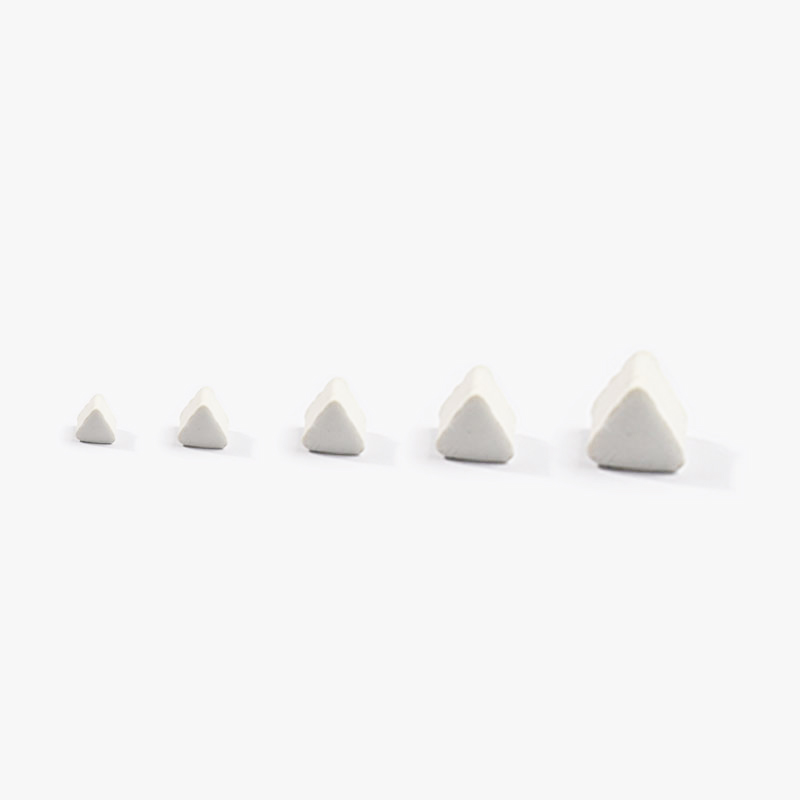
| Alumina-based ceramic triangles and angle-cut forms | Heavy deburring, edge blending and machine-mark removal on stainless brackets, flanges and housings where corners and recesses must be reached. | Wears down in size and sharpness, so cutting rate falls without any setting change; broken pieces and fines can lodge in small features and must be screened out. |
A vibratory bowl handles a broad middle band of stainless automotive parts: brackets, housings, flange blanks, handles, trim sections and small fittings. The load stays visible, amplitude, frequency and media blend can be adjusted, and the same machine serves both deburring and surface refinement when the media progression is planned. Limits are real, though. Part size and shape are capped by chamber geometry, and long or slender parts bridge and stall unless a tub or a fixture is used. Thin and threaded parts need compartments or fixtures to limit part-on-part contact. Watch fill ratio and the ratio of media to parts, because an over-filled or under-filled chamber changes both edge results and finish consistency, and keep the fill ratio stable from trial to production rather than filling to whatever the shift finds convenient.
| Machine route | Where it fits | What it will not do |
|---|---|---|
| Magnetic finishing machine | Small precise stainless parts with internal features, slots and blind holes that must be deburred without media lodging in the passages. | Works within a small part envelope, and the route has to be tested per grade because it depends on the part's magnetic response. |
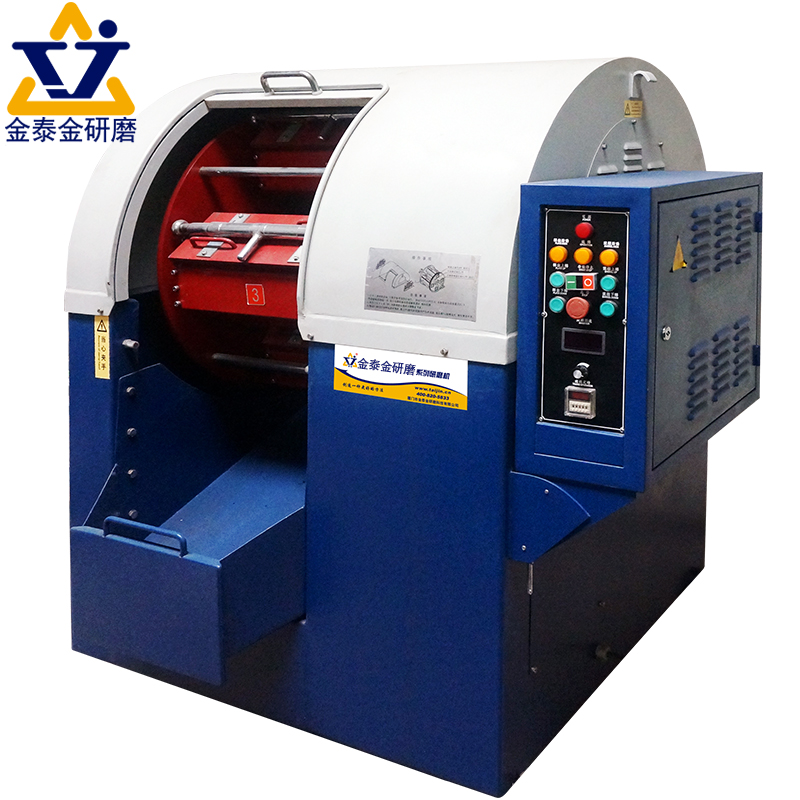
| Vibratory finishing machine, bowl type | General deburring and surface refinement of medium-sized stainless automotive parts such as brackets, small housings and flange blanks in a visible batch load. | Part size and shape are capped by chamber geometry, and thin or threaded parts may need compartments or fixtures to control part-on-part contact. |
| Tub vibrator | Long stainless parts such as trim sections, exhaust profiles and shafts that cannot be loaded into a bowl without being cut down. | Media velocity varies along the length, so finish evenness must be verified at both ends, and the machine occupies more floor space and compound volume. |
| Dry polishing machine with heated dryer | Post-wet drying, residue control and light dry finishing of stainless parts that must leave the line dry and free of moisture in blind features. | Dry media does not cut stainless, and moisture trapped in a blind hole, hem or tight joint can cause staining if drying is not effective. |
Stainless parts that emerge with speckled rust, a brown bloom or a grey smut have usually picked up foreign metal, and the source is often the shop rather than the alloy. Free iron can arrive from carbon steel parts run in the same machine or media, from worn steel components in the chamber, from steel racks and containers, from a wire brush used elsewhere, or from airborne grinding dust settling on a wet part. A ferroxyl-type test at agreed locations detects free iron, and a comparison against an untouched control part from the same batch makes the result interpretable. Because the visible bloom may take days to appear, agree an evaluation window and keep sample parts in defined conditions before judging. Prevention is segregation: dedicated media and machines for stainless, non-metallic or stainless handling, covered storage, and a check on incoming media for metallic debris.
| Failure mode | Likely cause | How to catch it |
|---|---|---|
| Dimensional drift, including bores opening slightly and thin walls thinning | Sustained media contact removing material from every accessible surface, with cycle time or media size class beyond what the feature tolerances can absorb. | Measure critical dimensions with micrometers, bore gages or a CMM before and after on a fixed sample size, and track a maximum stock removal per cycle for each feature at risk. |
| Rust blooms or speckling on austenitic or duplex parts after finishing | Free iron transferred from carbon steel, ferritic stainless or worn steel machine parts sharing the same media, chamber, racks or bench area. | Run a ferroxyl-type test for free iron at agreed locations, compare against an untouched part from the same batch, and repeat the check after a defined exposure period to catch delayed blooms. |
| Media lodged in cross-drillings, tapped holes, hems or closed volumes | Media size class small enough to enter a passage but not guaranteed to exit, or a separation step that relies on gravity alone. | Weigh the part where sensitivity allows, inspect passages with a borescope at agreed angles, pass pin or plug gages through each passage, and reconcile media counted into and out of the batch. |
| Impingement marks, nicks or gouges on thin stainless panels and webs | Part-on-part contact in an under-filled chamber, excessive amplitude, or free parts striking each other where no compartment or fixture controls them. | Inspect the suspect feature under magnification and raking light before and after processing, and compare its location across several parts from the same load to confirm the defect is random rather than systematic. |
Brescia is one of Lombardy's most industrial provinces. The Camera di Commercio di Brescia reports that industrial production in the province grew 2.6% year on year in the second quarter of 2026, above the Lombardy average of 2.1%, with industry turnover up 5.7% on the year and export orders up 8.9%. Foreign sales carry the local economy: the chamber's economy report estimates that 45.2% of the province's value added derives from exports and that exports cover 173.8% of imports. The chamber's manufacturing surveys break the local industrial fabric into steel (siderurgia), mechanical engineering (meccanica), food (alimentari), chemicals and rubber-plastics, and its 2026 investment survey shows food, transport equipment and steel among the branches that invested most in 2025.
For this brief the relevant part of that base is automotive: Transport equipment (mezzi di trasporto) is one of the branches tracked in the Brescia chamber's industrial investment survey, with 85.7% of firms in that branch having invested in 2025, behind only chemicals and food.
A production mix built on steel, metalworking, mechanical engineering and food processing generates a continuous flow of parts that need deburring, edge rounding, descaling or a controlled surface before assembly, coating or sale. In that kind of metalworking supply chain, metal treatment and surface finishing sit upstream of assembly, so cycle time, media wear and the ability to reproduce the same finish from batch to batch are the practical qualification issues - which is why consumable cost per part, rather than machine price alone, is normally the deciding number for a steel-working buyer.
The first question is whether the requirement is metallurgical and functional (removing scale and burrs, establishing an edge radius on a forged or machined steel part) or visual, and how the works will verify it on incoming inspection - because a steel-working buyer needs a process window that holds across changing part geometry and batch size, not a single demonstration part.
Freight context: Aeroporto di Brescia (airport of national interest per ENAC), Road and rail freight (no commercial seaport in the province). Brescia has no commercial seaport in the province; the national civil aviation authority ENAC lists Brescia among Italy's airports of national interest, and the province's heavy export orientation (45.2% of value added, exports covering 173.8% of imports) means freight moves mainly by road and rail to EU gateways. Non-EU machinery or sample parts therefore clear customs at their EU point of entry and are then trucked to Brescia.
Italy applies the EU's common commercial policy to imports from China, so Chinese industrial machinery enters under the EU Common Customs Tariff, where the duty rate depends on the type and origin of the goods and the working tariff is TARIC. Istat's August 2026 extra-EU trade release records a 16.0% year-on-year increase in Italian purchases from China, alongside strong growth from India, OPEC and Mercosur, so China remains one of the fastest-growing sources of Italian imports. Anti-dumping and other trade-defence measures apply case by case to specific product categories rather than to finishing machinery in general, so the applicable rate must be checked against the specific commodity code before a quotation is finalised.
Business is conducted in Italian; quotations, drawings, technical dossiers and declarations of conformity are normally expected in Italian, and correspondence in English is workable but rarely sufficient for a purchase order or for a conformity file. Italian industrial buyers qualify suppliers through a documented process: a part drawing with surface-texture indications, a sample or trial batch, and written acceptance criteria are the usual gate before a machine or media is specified into production. Payment and documentation norms follow Italian/EU practice - the importing entity's VAT and EORI details, invoice data matching the customs declaration, and standard EU commercial terms - so a cross-border seller should expect the conformity documentation (declaration of conformity, technical file, material certificates) to be requested before, not after, delivery.
SurfacePolish supplies from Xiamen, China. The buyer's own destination rules, conformity marking, tariff classification and documentation responsibilities stay with the buyer; confirm them against the authorities named above before ordering.
Measurement of appearance does not detect a functional loss, so acceptance needs checks aimed at what the part does. Thread and gear gages on the features named by the drawing, pin or plug gages on cross-drilled passages, a flatness check on sealing faces, a fit or press trial on a bearing bore, and continuity or gap checks on sensor surfaces all address function directly. Edge condition deserves a dimension rather than an opinion, because a rounding of a fraction of a millimetre at the mouth of an O-ring groove changes how the seal seats, and a deburred edge on a fatigue-relevant hole behaves differently from a polished one. Cleanliness is part of this set: wipe tests for residue, free-iron testing, and a borescope check of internal passages catch defects that appearance grading cannot. Agree every check and its instrument before the first production batch.
Parts returned from a trial are only half the deliverable; the record of what was done is the other half. A usable trial report describes the machine route, media specification and size class including its condition, compound family and concentration, water source, cycle duration, load fill ratio, and the measured results at the marked locations. Read it against your own before-and-after record, and check that the settings are described completely enough to be repeated by a different operator on a different day. Where a result is strong but the mechanism is unexplained, ask what changed rather than accepting the outcome, because an unexplained good result is hard to reproduce. Where a trial produced a good appearance and a poor edge measurement, treat the edge measurement as the governing result for a functional automotive part.

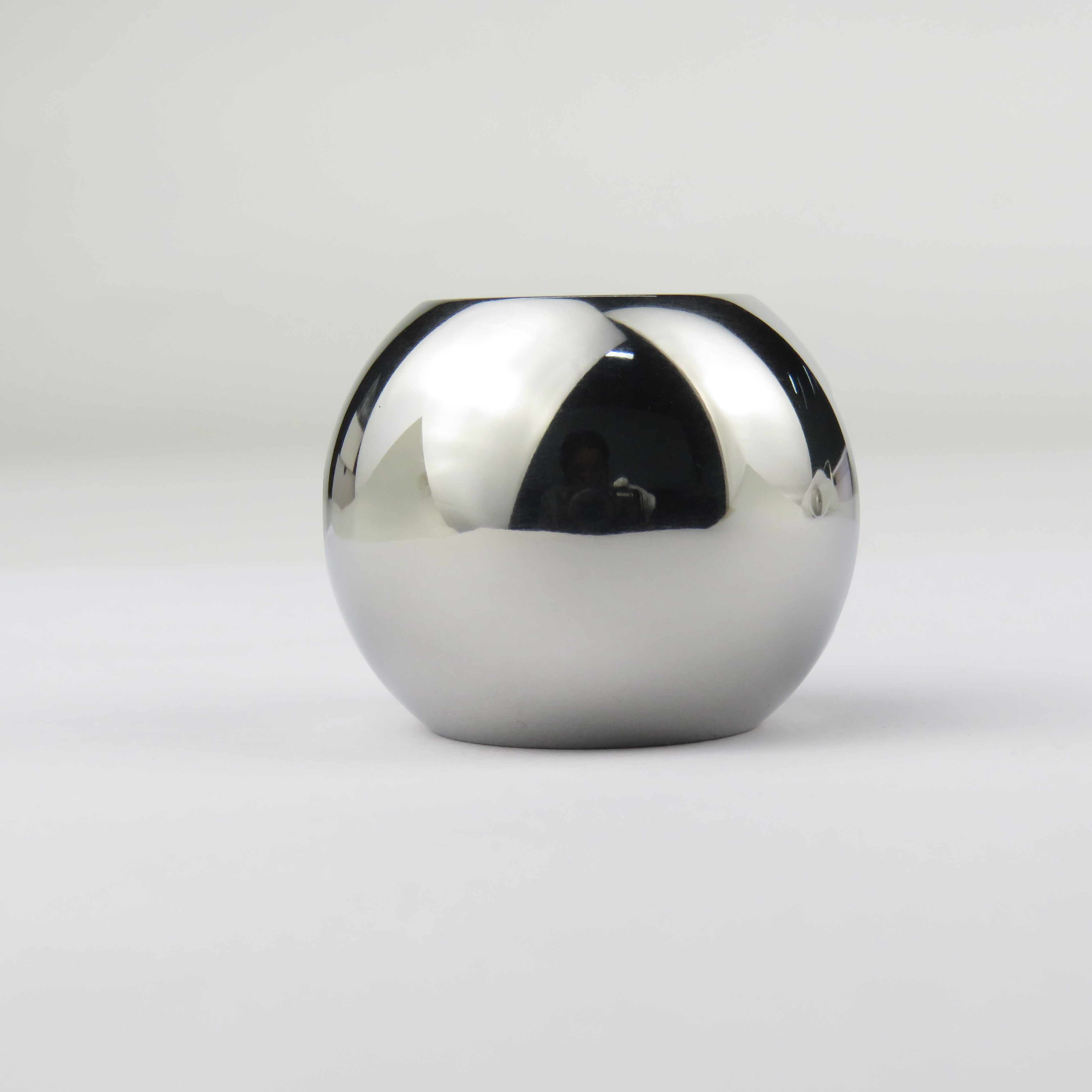
They are different processes with different effects, and SurfacePolish does not supply or perform electropolishing. Mechanical finishing works by media contact, so it blends, deburrs and brightens the surfaces the media can reach, and it rounds edges as it works. Electrochemical treatment removes material ionically and reaches into recesses that media cannot. Where an electropolished surface is specified for corrosion or cleanliness reasons, treat electrochemical processing as a comparison point and ask whether the specified requirement can be met by another route, then verify that on your own parts and against your own acceptance rule.
Uneven finish comes from position in the load, dead zones in the media mass, shielding by neighbouring parts and part-on-part contact, so evenness is a loading and handling question as much as a machine question. Mark reference locations on the part, photograph under fixed raking light, and measure the same feature at both ends and in the middle rather than at one convenient spot. If the variation is positional, rotating parts between cycles, changing the load pattern, or shortening cycles with repositioning usually helps more than adding time. Tubs suit long parts but need evenness verified along the length.
Treat them as two separate requirements rather than one. Map exterior visible surfaces, hidden surfaces and every edge that has a job such as sealing, bearing or assembly clearance. Appearance zones tolerate broad blending; functional edges need a stated limit and a measuring method. The two often pull in opposite directions, because the cycle that brightens a panel also removes material fastest at exactly the edges that must stay inside a band. Ask the designer to confirm colour, texture and direction on visible faces, and put the edge requirement in writing with its instrument before any media is chosen.
Use Brescia, Italy as the destination on the enquiry and state whether the deliverable is equipment, media and compound, a representative sample review or a line concept. A destination does not imply local stock, a local service point or a local delivery time.
Finish is specified through UNI, the Italian standards body, whose Italian editions of the EN/ISO surface-texture series (UNI EN ISO 21920-1 and -2:2022) govern drawing indications and measurement parameters, and the Camera di Commercio di Brescia is the local body that issues the certificates of origin, export visas and free-sale attestations companies need for foreign trade. Machinery supplied into the province must also satisfy the EU machinery legislation.
Sources were retrieved on 2026-09-29 and describe the local industrial and trade context only. They do not evidence any SurfacePolish project, shipment, installation or service in Brescia.
The buyer needs the long section deburred and its grain refreshed evenly along the whole length without erasing the etched marking area.
Send the material, dimensions, approximate weight, batch quantity, the incoming condition and photographs of the difficult features. Mark which features must not be contacted by media and state how the result will be inspected. This form carries source reference PSEO-0432; quote it if you prefer an additional manual reference.
Open the SurfacePolish enquiry form Email a prepared enquiry
No price, lead time, certification or result is promised here. Confirm whether a sample trial is available for the specific part and what the trial can and cannot show.
Page PSEO-0432 · revised 2026-09-29 · cross-border equipment, media and scoped sample review. City context is sourced and cited above.
Use this local checker to identify missing part and inspection information. It prepares a technical-review brief; it does not approve a machine, process recipe or production result.
Complete the part details to prepare a review brief.
Email : info@surface-polish.com


 IPv6 network supported


 +86-592-2381506