An automotive parts buyer in Nantes, France has a cast stainless housing whose cross-drilled burrs must come off with no media left behind and no change to a precision bore or gasket face. SurfacePolish supplies finishing equipment and consumables across borders and offers a free sample trial on parts shipped to Xiamen, returning observations and a proposed media, compound and cycle direction for the buyer's own verification. This brief is written for a buyer in Nantes working on automotive parts; it describes equipment, media and a scoped sample review, not a local polishing service.
Which internal features must be deburred without lodging media, and what retrieval and verification step proves the passage and thread form are clean?
At what batch size, load fill ratio and media wear state does a trial observation still describe what series production will produce?
How will free iron, embedded particles and cross-contamination from carbon steel be prevented, and how will each be detected on the finished part?
Beyond appearance, certain features establish how the part assembles, and media acts on them whether or not the drawing calls them out. Machined flange faces, O-ring and seal grooves, bearing bores, threaded holes, sensor mounting pads and dowel bores all carry that role. Media contact can shift flatness, open a bore slightly, round a thread crest or change a sensor gap, and normal shop inspection will not notice. Identify which surfaces are datums and which mate with another component, then treat the finish requirement on them separately from cosmetic areas. Protect them by masking, fixturing against a support, or finishing them with a gentler medium, and write down a maximum stock removal per cycle for every feature whose geometry could be consumed by the process. Ask the designer to confirm those limits rather than promising a blanket surface condition.
Media is a consumable that changes during use, and stainless finishing is sensitive to that drift. Ceramic media loses size and edge sharpness, its cutting rate falls, and the charge accumulates broken pieces and fines; steel media deforms and generates metallic fines; plastic media can load with metal particles; compound residue and swarf build up in the mass. The practical consequence is that a cycle tuned on fresh media behaves differently after days of running, which is why results can drift without any setting having been touched. Track wear by screening a sample of the charge at intervals, logging media make-up quantities and cycle hours, and replacing on measured condition rather than on a fixed calendar. Keeping the charge inside a known working window, and re-verifying the finish after any full charge replacement, is what makes a production result repeatable.
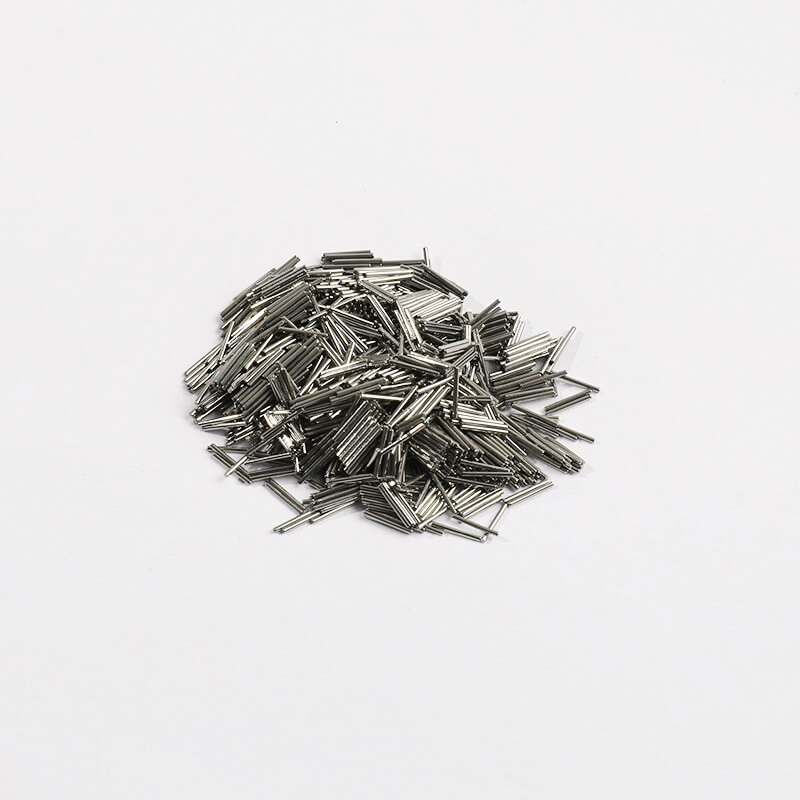
| Media | Best fit | Watch out for |
|---|---|---|
| Alumina-based ceramic triangles and angle-cut forms | Heavy deburring, edge blending and machine-mark removal on stainless brackets, flanges and housings where corners and recesses must be reached. | Wears down in size and sharpness, so cutting rate falls without any setting change; broken pieces and fines can lodge in small features and must be screened out. |
| Porcelain and fine high-density ceramic media | Pre-polish refining stages on austenitic stainless appearance parts before a brightening stage, where a finer texture is the objective. | Limited cutting power on hard or work-hardened surfaces, and wear changes the charge gradually, so finish can drift between batches. |
| Steel media, including balls and shaped steel forms | Brightening and burnishing of austenitic stainless appearance parts where the highest available gloss is the objective. | Deforms and generates metallic fines, adds weight to the load, and can transfer iron if used in a line shared with carbon steel work. |
| Plastic media, polyester and urea based | Gentle deburring of delicate or thin stainless parts and of softer metals in mixed production, where edge loss must be minimised. | Low cutting power on stainless, can load with metal particles, and is generally the wrong tool for generating a stainless appearance finish. |
A vibratory bowl handles a broad middle band of stainless automotive parts: brackets, housings, flange blanks, handles, trim sections and small fittings. The load stays visible, amplitude, frequency and media blend can be adjusted, and the same machine serves both deburring and surface refinement when the media progression is planned. Limits are real, though. Part size and shape are capped by chamber geometry, and long or slender parts bridge and stall unless a tub or a fixture is used. Thin and threaded parts need compartments or fixtures to limit part-on-part contact. Watch fill ratio and the ratio of media to parts, because an over-filled or under-filled chamber changes both edge results and finish consistency, and keep the fill ratio stable from trial to production rather than filling to whatever the shift finds convenient.
| Machine route | Where it fits | What it will not do |
|---|---|---|
| Continuous or indexed wet line with staged media charges | Multi-stage stainless finishing where deburring, refining and brightening are separated to control edge loss and texture progression. | Needs clear segregation between stages to prevent carry-over of coarse media or iron contamination, and adds handling and floor space. |
| Centrifugal barrel finishing machine | Very high energy deburring and edge radiusing of small, hard stainless parts in short cycles. | Rounds edges quickly and can exceed a tight radius within a short run; part size and shape are restricted and a substantial load is needed to justify the cycle. |
| Barrel finishing machine, rotary barrel tumbler | Gentle deburring and finishing of delicate, thin or threaded stainless parts such as small fittings, sensor bodies and precision pins. | Cycles run longer than in higher-energy machines, and coverage can be uneven on large or complex parts. |
| Vibratory finishing machine, bowl type | General deburring and surface refinement of medium-sized stainless automotive parts such as brackets, small housings and flange blanks in a visible batch load. | Part size and shape are capped by chamber geometry, and thin or threaded parts may need compartments or fixtures to control part-on-part contact. |
The defect that ends most stainless finishing trials is not a bad appearance but an edge that moved further than the drawing allows. Threads and gear teeth are the classic casualties, because mechanical action removes material from crests quickly, changing effective pitch diameter and flank form; a part can still thread by hand and still fail a gage. Radiused or chamfered edges behave similarly, since the process removes stock precisely at the edge where a callout is tightest. Start the trial with an edge record and repeat it afterwards: thread and gear gages before and after, edge radius at marked locations with an optical comparator or a cast impression, and a written allowable band agreed before any cycle runs. Treat the shortest cycle that achieves the required appearance as the control condition, and be suspicious of any proposal that adds cycle time to improve a finish that was already acceptable.
| Failure mode | Likely cause | How to catch it |
|---|---|---|
| Uneven finish, with one region bright and another dull on the same part | Positional effects in the media mass, dead zones in the chamber, shielding by neighbouring parts, or a poor fill ratio in the load. | Mark reference locations, photograph under fixed raking light, and measure the same feature at multiple points on the part and across parts in the load to separate positional variation from process variation. |
| Media lodged in cross-drillings, tapped holes, hems or closed volumes | Media size class small enough to enter a passage but not guaranteed to exit, or a separation step that relies on gravity alone. | Weigh the part where sensitivity allows, inspect passages with a borescope at agreed angles, pass pin or plug gages through each passage, and reconcile media counted into and out of the batch. |
| Hazing or waviness on a part specified as mirror or bright | An intermediate refining stage skipped or cut short, media too coarse for the final texture, or a media charge that has worn out of its working size range. | View under defined lighting against a physical master at the acceptable and marginal limits, measure roughness across the lay with a fixed instrument setup, and screen the media charge for size and condition. |
| Discolouration or mottling that appears only after drying | Mineral or compound residue carried in the final rinse, hard or chloride-bearing water, or slow drying that leaves a film on the brightened surface. | Compare wet and dry appearance under fixed lighting on the same parts, wipe a sample with a white lint-free cloth and solvent, and check the site water supply for hardness and chloride content. |
Nantes sits on the Loire estuary industrial axis, whose port authority - Nantes Saint-Nazaire Port, the fourth largest French seaport, handling about 30 million tonnes of traffic a year - describes itself as a logistics and industrial platform connected by sea, river, rail, road and air, with 1 460 ha of industrial-port land and more than 600 companies in the industrial-port complex. INSEE counted 11 718 establishments in the commune at the end of 2024 with 3,3 % in industry and 215 178 jobs at the place of work in 2023. The estuary economy combines shipbuilding and offshore-wind fabrication at Saint-Nazaire, aerostructures and composites, agri-food and agricultural machinery in the wider Loire region, and naval/aeronautical engineering in Nantes itself.
The nearest part of that base to this brief is energy: The port reports 5 973 thousand tonnes of natural gas and 7 630 thousand tonnes of crude oil traffic, and is adapting its infrastructure for offshore wind assembly through the Eole project following the first French offshore wind farm.
The Loire estuary combines two finishing problems: large welded and fabricated steelwork for shipbuilding, offshore wind and heavy industry, where weld dressing, edge preparation and surface cleanliness govern coating performance and fatigue life; and smaller precision components in aerostructures and mechanical equipment where deburring and surface finish are tolerance-driven. Agri-food equipment in the region adds stainless fabrication where surface smoothness and residue-free cleaning are hygiene requirements rather than cosmetic preferences. Both cases reward a process that can be documented and repeated, because the customers here are audited industrial buyers.
A Nantes buyer should settle whether the target is surface preparation before coating on large fabricated assemblies or deburring and finish on machined components, and then check that the proposed process can handle the part mix without cross-contamination between ferrous and stainless work.
Freight context: Nantes Saint-Nazaire Port (Nantes, Montoir-de-Bretagne, Saint-Nazaire, Donges), Nantes Atlantique Airport, Montoir container and ro-ro terminals. The port states it connects to five continents through regular maritime services linked to the main European transhipment hubs, with 209 container ship calls and 198 ro-ro calls in 2025, plus 800 freight trains and river barge convoys; 25 ha of industrial-port land reserve is available. That makes it practical to receive containerised finishing machines and bulk media through Montoir and to ship sample parts by air from Nantes Atlantique or by courier.
The French national standards body is AFNOR (Association francaise de normalisation), which coordinates French participation in standardisation and publishes the NF and NF EN standards that transpose ISO and CEN work; AFNOR also runs the certification activity attached to many of those standards. A French buyer of finishing equipment would normally reference ISO/NF EN surface-texture standards for roughness and profile parameters, ISO/NF EN cleanliness or residue specifications for critical parts, and management-system or sector schemes such as ISO 9001, IATF 16949 for automotive and EN 9100 for aerospace.
The working language of French industrial procurement is French: tenders, drawings, inspection plans and technical dossiers are normally issued and answered in French, and quotations that omit French documentation slow down qualification. Buyers qualify a machine against a written specification and expect traceable material certificates, machine safety documentation and, where applicable, a CE declaration of conformity and a risk assessment; acceptance is often staged (documentary review, factory acceptance test, then commissioning). Payment and documentation norms are conventional EU practice: euro invoicing, SEPA or SWIFT bank transfer, Incoterms agreed in writing, and customs paperwork (commercial invoice, packing list, transport document, proof of origin where a preference is claimed) prepared for the declarant or customs representative. Because customs and tax authorisations are handled jointly through SOPRANO, non-EU sellers are normally advised to sell to an established French/EU importing entity rather than to act as importer of record themselves.
SurfacePolish supplies from Xiamen, China. The buyer's own destination rules, conformity marking, tariff classification and documentation responsibilities stay with the buyer; confirm them against the authorities named above before ordering.
Acceptance for a stainless automotive part should be settled before a machine or medium is proposed, because the acceptance rule determines which route is even capable. If the finish callout is a word like bright, inspection is whoever looks last; if it is a roughness range at a named location plus a physical visual master viewed under stated lighting, inspection becomes repeatable and the argument moves to the part. Set the sampling plan, the inspection method and the instrument or gage for each characteristic, and decide separately which features get a functional check as opposed to a cosmetic one. Write the rule into the purchase documentation along with the material grade, the marked measurement locations and the acceptance limits for edge condition. A supplier can then report observations against a defined rule instead of being asked to judge its own work.
A trial answers questions only if the parts represent the real range of variation. Send the difficult members of the family rather than an ideal sample: the thinnest wall, the tightest internal feature, the part with the worst incoming burr, the most visible face, and at least two parts that represent normal production condition. Include one part that was rejected for a finishing-related reason, so the trial addresses a defect that actually occurs. With the parts, send the drawing revision, the material grade and condition, the operations that created the current surface, the specified finish requirement, and any feature that must not be touched. A trial run on a single pristine sample tends to produce a pleasant result that says nothing about the batch the buyer will actually process.

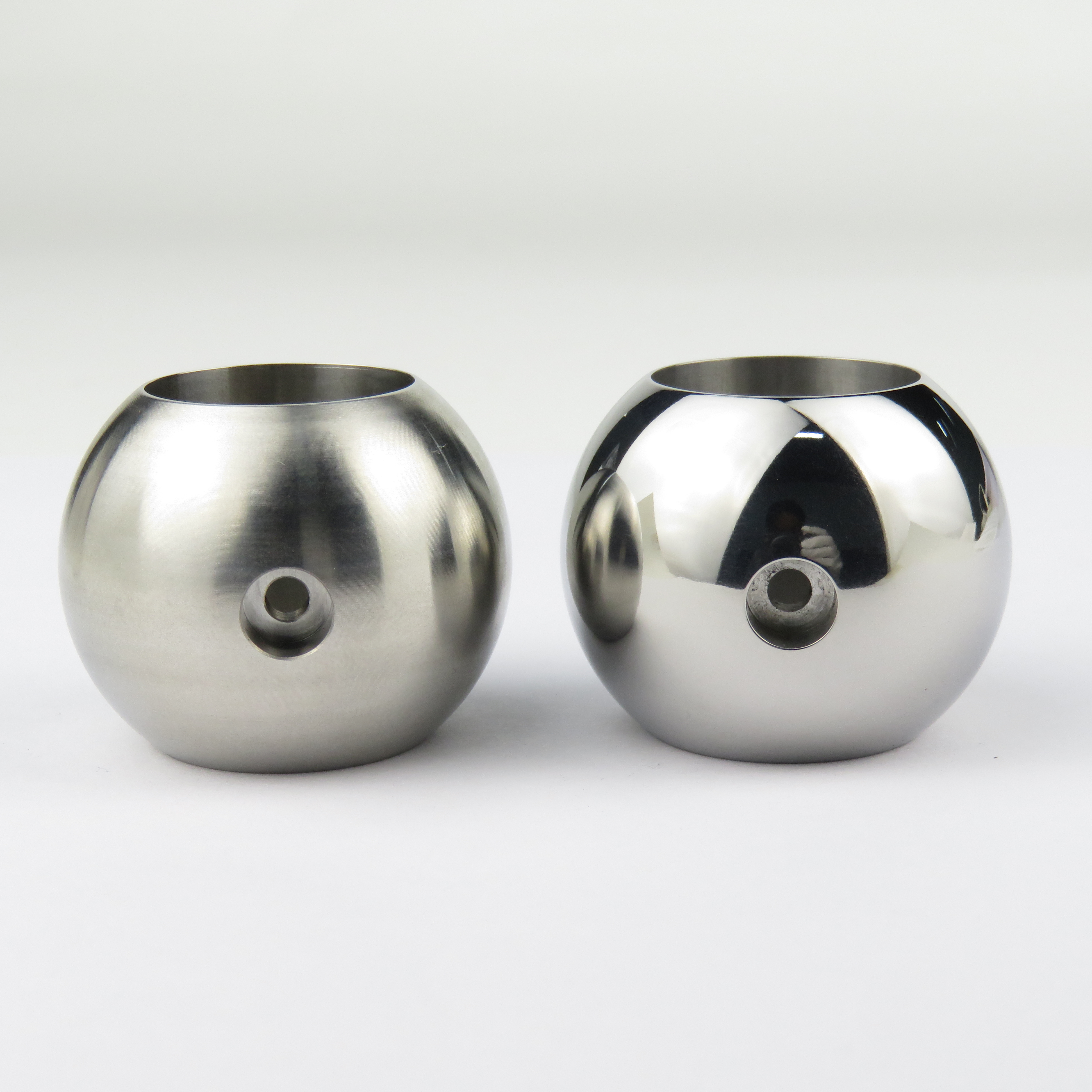
Steel media generally produces the brightest result on austenitic stainless, but brightness depends on the whole progression rather than one medium. A common sequence is a hard ceramic stage that removes burrs and machine marks, a finer stage that refines the texture, then a low-amplitude stage that brightens. Media that is too soft for the work-hardened surface burnishes and dulls instead of cutting. The shape and size class also matter, because small media reaches tight features but leaves a different texture from larger forms. Treat any proposed progression as a comparison to test on real parts with your own measurement setup.
Start from the drawing. Size the media class against the smallest opening so it flows rather than wedges, and where a passage cannot be inspected reliably, plug or mask it before the cycle instead of adding inspection afterwards. Build a retrieval routine with media counts into and out of the batch, borescope checks at agreed angles, and pin or plug gages on each passage. Weigh parts where the tolerance for retained chips is tight. For a France buyer planning a trial, send the part with the tightest passage so the media class is selected against real geometry. SurfacePolish reports what the trial found; your own cleanliness inspection remains the acceptance decision.
Hydrogen uptake is a documented concern for high-strength martensitic stainless steels when acid chemistry and mechanical work are combined, and it is not visible on the surface. The practical route is to state the material and hardness in the enquiry, ask which compound families are proposed and at what concentration, and confirm with your own engineering function whether any post-finishing treatment is required and within what window. SurfacePolish can describe the compound family and the process conditions used on a trial, but fitness for a given strength level, and any treatment specification that follows, must be defined and verified by the buyer.
Use Nantes, France as the destination on the enquiry and state whether the deliverable is equipment, media and compound, a representative sample review or a line concept. A destination does not imply local stock, a local service point or a local delivery time.
A Nantes buyer would reference ISO/NF EN surface-texture standards for finish and roughness, EN 1090 and the classification-society rules for welded steel and marine structures, and hygiene-related surface requirements for food-contact equipment; ISO 9001 is the common baseline, with EN 9100 where aerospace work is involved. Coating and surface-preparation specifications for offshore and marine fabrication are usually set by the client or the classification society on top of those standards.
Sources were retrieved on 2026-09-29 and describe the local industrial and trade context only. They do not evidence any SurfacePolish project, shipment, installation or service in Nantes.
The buyer needs machining burrs removed at the cross-drillings with no media left in the passages and no measurable change to the bore or gasket face.
Send the material, dimensions, approximate weight, batch quantity, the incoming condition and photographs of the difficult features. Mark which features must not be contacted by media and state how the result will be inspected. This form carries source reference PSEO-0552; quote it if you prefer an additional manual reference.
Open the SurfacePolish enquiry form Email a prepared enquiry
No price, lead time, certification or result is promised here. Confirm whether a sample trial is available for the specific part and what the trial can and cannot show.
Page PSEO-0552 · revised 2026-09-29 · cross-border equipment, media and scoped sample review. City context is sourced and cited above.
Use this local checker to identify missing part and inspection information. It prepares a technical-review brief; it does not approve a machine, process recipe or production result.
Complete the part details to prepare a review brief.
Email : info@surface-polish.com


 IPv6 network supported


 +86-592-2381506
