A automotive parts buyer in Seattle, United States has a long stainless trim section that must be deburred and re-grained evenly from end to end without destroying a laser-etched area. SurfacePolish supplies finishing machines and consumables across borders and runs a free sample trial in Xiamen, where the buyer's parts are processed and returned with observations and a proposed media, compound and cycle direction for the buyer's own engineering review. This brief is written for a buyer in Seattle working on automotive parts; it describes equipment, media and a scoped sample review, not a local polishing service.
Which surfaces on this part carry a visible appearance grade, which are hidden, and which edges have a functional requirement rather than a cosmetic one?
Which dimensions, seal faces and thread forms carry functional geometry, and what limit on stock removal per cycle can those features tolerate?
Which internal features must be deburred without lodging media, and what retrieval and verification step proves the passage and thread form are clean?
Stainless automotive parts usually carry two requirements that pull against each other: an appearance grade on surfaces the customer sees, and an edge or function requirement on features that must keep working. Map the part into exterior visible surfaces, hidden surfaces, and edges with a functional role such as sealing, bearing, fatigue resistance or assembly clearance. An edge that only needs a burr broken can take an energetic cycle; a bore edge that sets a seal or a press fit cannot. Ask which faces are graded after assembly, because a bright panel that meets a specification by itself may look mismatched against the mating panel next to it. A marked-up drawing that states, per surface, whether it is graded, functional or indifferent is the cheapest document in the whole finishing project.
The compound does more than clean: it carries debris, controls pH and temperature, and inhibits corrosion during and after the cycle. Chemistry has to suit the alloy family, because a compound that brightens one stainless grade can stain another or leave a film that shows as a defect. Alkaline and near-neutral formulations are common for general cleaning and finishing where brightness is secondary. Products described as brightening or burnishing formulations are selected by the media and compound supplier for austenitic and duplex work, and they are tested on the actual part before being adopted. Chloride content is a hard consideration for austenitic and duplex grades, since chloride-bearing chemistry and chloride-bearing water are associated with pitting and staining. Contamination risk also rises when a line is shared with carbon steel, so compound choice and line segregation need to be settled together.
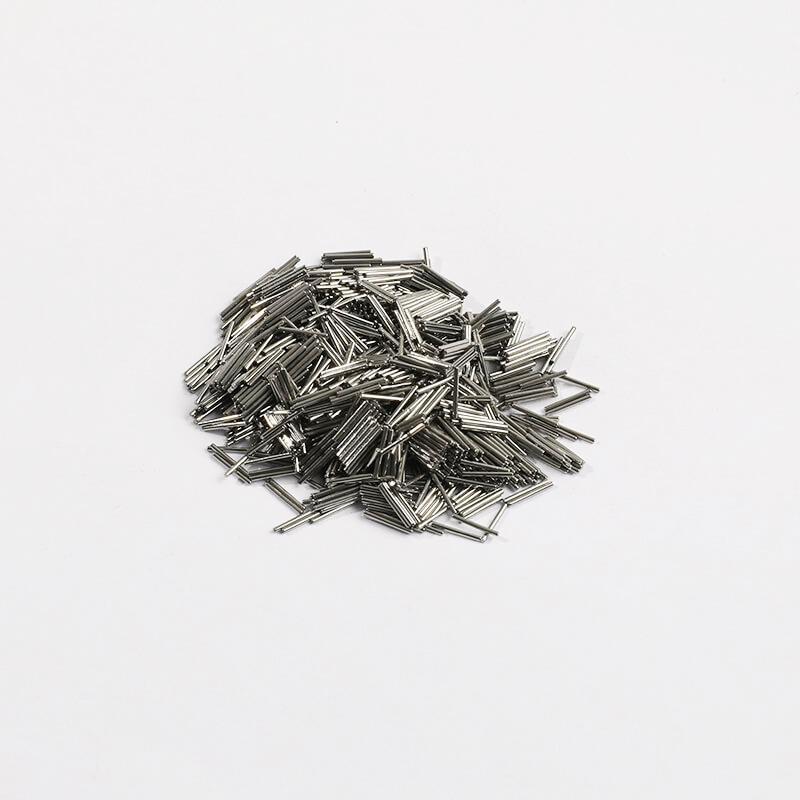
| Media | Best fit | Watch out for |
|---|---|---|
| Porcelain and fine high-density ceramic media | Pre-polish refining stages on austenitic stainless appearance parts before a brightening stage, where a finer texture is the objective. | Limited cutting power on hard or work-hardened surfaces, and wear changes the charge gradually, so finish can drift between batches. |
| Dry media, walnut shell and corn cob | Post-wet drying, light residue and scale removal, and dry polishing of surfaces that must not be re-wetted. | Does not cut stainless, generates dust, and leaves organic residue on parts if the medium is not kept clean and dry. |
| Plastic media, polyester and urea based | Gentle deburring of delicate or thin stainless parts and of softer metals in mixed production, where edge loss must be minimised. | Low cutting power on stainless, can load with metal particles, and is generally the wrong tool for generating a stainless appearance finish. |
| Magnetic stainless pins and fine needles for magnetic finishing | Deburring and brightening of intricate small stainless features, slots, gear teeth and blind holes where media cannot be allowed to lodge. | Suits small part envelopes only, and the route needs testing on magnetic grades before it is assumed to apply to a given part. |
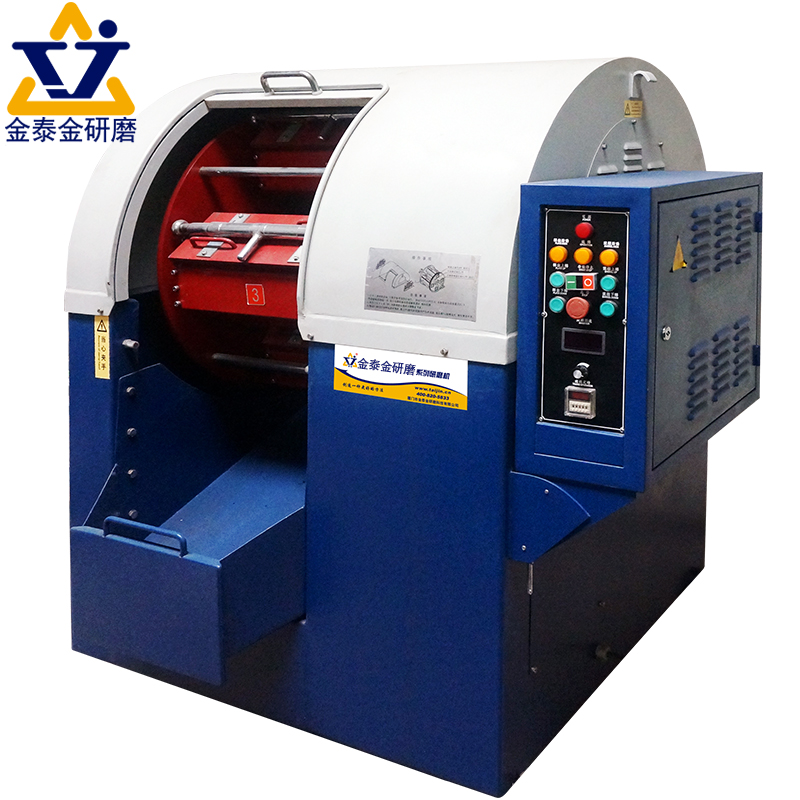
Disc finishing machines run a shallow, fast-moving charge that deburrs heavier machined stainless parts quickly: valve bodies, fittings, machined brackets and parts whose edges can lose material. The energy is an advantage for cycle time and a liability for thin walls and delicate features, so tooling and compartments often decide whether the route is acceptable at all. Centrifugal barrel finishing uses a planetary barrel motion that produces very high energy in short cycles, useful for aggressive edge radiusing on small, hard parts. The same energy rounds edges quickly, can exceed a tight radius callout within a short run, has part size and shape limits, and needs a larger load to justify the cycle. Treat both routes as candidates for heavy deburring and blending, and verify edge results on the actual part rather than assuming a shorter cycle means a safer one.
| Machine route | Where it fits | What it will not do |
|---|---|---|
| Magnetic finishing machine | Small precise stainless parts with internal features, slots and blind holes that must be deburred without media lodging in the passages. | Works within a small part envelope, and the route has to be tested per grade because it depends on the part's magnetic response. |
| Dry polishing machine with heated dryer | Post-wet drying, residue control and light dry finishing of stainless parts that must leave the line dry and free of moisture in blind features. | Dry media does not cut stainless, and moisture trapped in a blind hole, hem or tight joint can cause staining if drying is not effective. |
| Barrel finishing machine, rotary barrel tumbler | Gentle deburring and finishing of delicate, thin or threaded stainless parts such as small fittings, sensor bodies and precision pins. | Cycles run longer than in higher-energy machines, and coverage can be uneven on large or complex parts. |
| Centrifugal barrel finishing machine | Very high energy deburring and edge radiusing of small, hard stainless parts in short cycles. | Rounds edges quickly and can exceed a tight radius within a short run; part size and shape are restricted and a substantial load is needed to justify the cycle. |
Two failure modes produce a damaged edge and are often confused. Impingement, sometimes called a gouge or a nick, is local damage from part-on-part contact or media striking a feature at excessive energy, and it typically appears on thin stamped covers, large flat panels and unsupported webs. Its signature is randomness: the defect site moves from part to part and does not follow the geometry of the edge. Over-rounding is systematic, follows the edge itself, and repeats at the same location on every part in the load. Both are found with raking-light photographs, magnification on the suspect feature and comparison across several parts from the same batch. The remedy differs too, because impingement is addressed by load fill ratio, amplitude, compartments or fixtures, while over-rounding is addressed by cycle intensity, media size class and media hardness.
| Failure mode | Likely cause | How to catch it |
|---|---|---|
| Impingement marks, nicks or gouges on thin stainless panels and webs | Part-on-part contact in an under-filled chamber, excessive amplitude, or free parts striking each other where no compartment or fixture controls them. | Inspect the suspect feature under magnification and raking light before and after processing, and compare its location across several parts from the same load to confirm the defect is random rather than systematic. |
| Hydrogen-related cracking risk on high-strength martensitic stainless parts | Acid-bearing compound chemistry combined with mechanical work on a hardened structure, with no defined post-finishing treatment by the buyer. | Confirm the material and hardness against the purchase documentation, verify which compound family was used and at what concentration, and route the fitness-for-service question to the buyer's engineering function. |
| Hazing or waviness on a part specified as mirror or bright | An intermediate refining stage skipped or cut short, media too coarse for the final texture, or a media charge that has worn out of its working size range. | View under defined lighting against a physical master at the acceptable and marginal limits, measure roughness across the lay with a fixed instrument setup, and screen the media charge for size and condition. |
| Edge rounding beyond the specified radius on a functional edge | Cycle energy, time or media size class chosen for appearance rather than for the tightest edge callout on the drawing. | Measure edge radius at marked locations with an optical comparator or a cast impression before and after, and record the result against a written allowable band rather than judging it visually. |
Metropolitan Seattle's industrial base is anchored by commercial aerospace: the Washington State Department of Commerce describes aerospace as a $71 billion state industry with more than 1,500 suppliers, states that every Boeing model beginning and ending in '7' has been built in Washington, and calls the state the sole producer of the 737, 767 and 777. The same agency counts a maritime sector of about 2,300 companies and 62,000 workers, spanning maritime logistics and shipping, ship and boat building, and repair and maintenance. Life sciences is a third pillar: the state reports that the Seattle area ranked third among metro areas for life-sciences employment growth, up 25% between 2019 and 2022. Washington also counts 8,580+ semiconductor and electrical component workers, and produces 73% of its power from clean energy sources, mainly hydroelectric dams. The Northwest Seaport Alliance, the marine cargo partnership of the Port of Seattle and the Port of Tacoma, manages the container, breakbulk, auto and some bulk terminals in both harbours.
The nearest part of that base to this brief is marine: The state counts roughly 2,300 maritime companies employing about 62,000 workers, including ship and boat building, repair and maintenance, and the Northwest Seaport Alliance operates the container, breakbulk, auto and bulk terminals in Seattle and Tacoma.
For this base, deburring and edge control are production requirements rather than cosmetic steps: machined aluminium and titanium aerostructure, engine and interior-hardware parts need controlled edge radii and surface texture before anodising, conversion coating or painting, and burrs left inside fuel, hydraulic and pneumatic passages are a contamination and fatigue risk. Life-science and semiconductor-equipment parts add cleanliness requirements, because residual media, compound or metal fines from a finishing step have to be removed and verified before the part is accepted. High-volume small parts in this supply chain are usually mass-finished (vibratory, barrel or centrifugal), while edge-critical or geometry-sensitive parts are typically hand-finished or run on disc machines.
The first question to settle is which edge-break, burr-limit and Ra callouts apply to each part family, and whether the finishing step has to sit with a NADCAP-accredited special process, because that decides whether a vibratory or barrel process, its media and its compound can be qualified at all. A trial on real production parts, inspected with the customer's own method, is the practical way to confirm edge radius, media wear and residual-media cleanliness before committing to a machine size.
Freight context: Northwest Seaport Alliance container, breakbulk, auto and bulk terminals at the Port of Seattle and the Port of Tacoma, Seattle-Tacoma International Airport (SEA), Seattle, Washington (CBP port of entry 3001). The Northwest Seaport Alliance describes itself as a marine cargo operating partnership of the Port of Seattle and the Port of Tacoma and a leading US container gateway, which makes it the region's main ocean entry point for containerised machinery arriving from Asia. FAA final CY2025 enplanement data list Seattle-Tacoma International with 25,417,071 boardings, the state's dominant passenger and air-cargo airport, and CBP's Washington table is organised under a Seattle field office and includes Seattle, Washington (port 3001). In practice a Chinese machine builder ships to a West Coast container terminal, and the machine clears CBP at the port of unlading or at the Seattle port of entry before onward truck or rail movement.
The United States has no single mandatory national finishing standard. The national standards system is voluntary and consensus-based, coordinated at national level by the American National Standards Institute (ANSI): ANSI published the United States Standards Strategy (USSS) 2025 on 6 January 2026, a strategy that 'guides how the U.S. develops standards and participates in international standardization', while the National Institute of Standards and Technology (NIST) is the federal measurement and standards agency and states that 'Technical standards keep us safe, enable technology to advance, and help businesses succeed.' In practice a buyer specifies surface finish, deburring, cleaning and coating requirements on the drawing or in the purchase order using the voluntary consensus standards maintained by bodies such as ASME and ASTM International and their ISO equivalents, and the acceptance criterion is the buyer's own specification rather than a government-issued finishing standard. Where a part is destined for a regulated product - pressure equipment, food-contact equipment, aerospace or medical devices - the relevant industry code or the customer's qualification requirement governs instead.
Business is conducted in US English. Units matter: US drawings and purchase orders frequently use inches, microinch Ra and US gallons, and a supplier that quotes only metric can be asked to reissue documentation. Buyers are US legal entities with an EIN and expect an identifiable contracting entity, a correct HTSUS classification, a commercial invoice, packing list and bill of lading, country-of-origin marking, and an importer of record for customs. Procurement is normally evidence-driven: process selection is expected to be justified by a trial run on the buyer's own sample parts with measured results (burr height, edge radius, Ra, cleanliness) and by media and compound data sheets, rather than by a capability claim. Payment terms in general US industrial practice are open account with net-30 to net-60 terms for established buyers, with letters of credit or advance payment more common for a first order from a new overseas supplier; no US buyer assumes Incoterms, warranty terms or spare-parts lead times unless they are stated in the quotation.
SurfacePolish supplies from Xiamen, China. The buyer's own destination rules, conformity marking, tariff classification and documentation responsibilities stay with the buyer; confirm them against the authorities named above before ordering.
Ask for a record that lets a finished part be traced to what produced it: material certificates and heat numbers, the batch identification used during processing, media specification and size class, compound family and concentration, cycle parameters, and the measured results with locations. The distinction worth insisting on is between observations and acceptance, because a supplier reports what it saw while the buyer decides what is acceptable. First-article discipline is the practical form of this. For each part family, alloy and finish, process one article and inspect it fully against the drawing before any batch is released, retain it as a physical reference, and write down the settings that produced it. Then treat any change to media, compound, machine parameters or sources as a trigger to repeat the first-article inspection, because that is where a stable process is usually lost.
A trial is more useful as a structured comparison than as a single demonstration. Decide in advance what is being compared, such as two media shapes in the same size class, two compound families on one media charge, or two cycle lengths at one energy setting, and hold everything else constant. Keep a control part that receives no finishing at all, so that post-process differences can be attributed to the process rather than to handling. Name the features that must not change and the level of change that would be unacceptable, so that a result can be judged on the spot. Write down the questions the trial must answer before parts are shipped, and rank them, because the ranking is what tells the supplier which comparison matters most when cycle time is limited.

Cost is governed by cycle time and the number of parts that fit in a load, by media consumption and replacement rate, and by labour for loading, unloading, separation, inspection and masking. Parts with several protected features cost more before the machine starts, because plugging and fixturing consume labour. A cycle that needs several stages for deburring, refining and brightening multiplies handling. Drying time and cleanliness verification add further steps, and mixing stainless with carbon steel in shared equipment forces either segregation or extra contamination checks. Ask for cost as a function of volume and batch size rather than as a single figure.
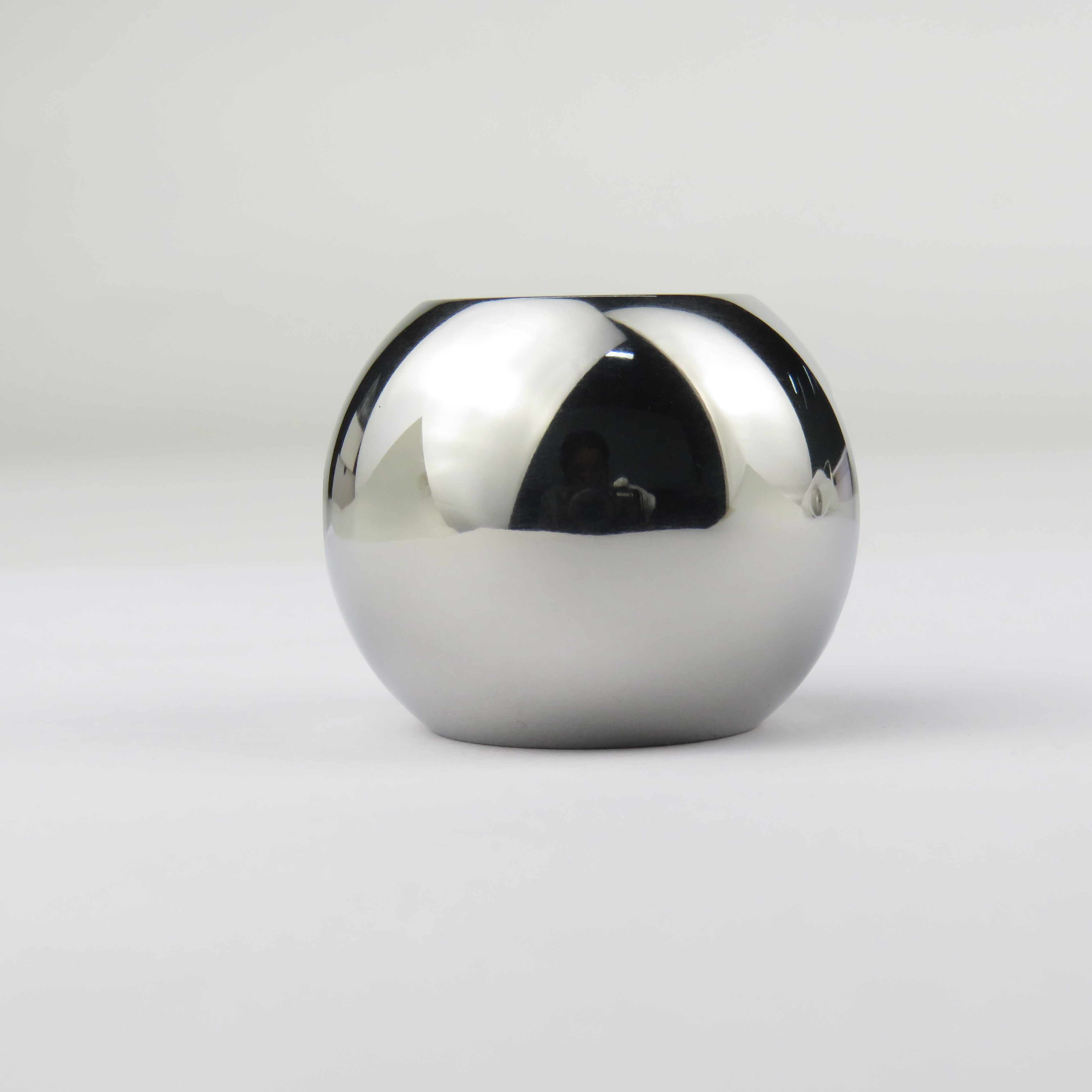
Control direction, texture depth and coverage, not only a roughness number. Mechanical finishing tends to create directionality, so agree with the customer whether the grain runs in one direction across the whole part order and how visible variation may be. Keep a physical master for the satin finish and view parts under the same lighting, distance and angle as the master, because lighting changes appearance judgements more than small process changes do. Fix media shape, size class and cycle settings in a work instruction, and re-verify the finish whenever the media charge is replaced or a new supplier batch of compound is introduced.
They are different processes with different effects, and SurfacePolish does not supply or perform electropolishing. Mechanical finishing works by media contact, so it blends, deburrs and brightens the surfaces the media can reach, and it rounds edges as it works. Electrochemical treatment removes material ionically and reaches into recesses that media cannot. Where an electropolished surface is specified for corrosion or cleanliness reasons, treat electrochemical processing as a comparison point and ask whether the specified requirement can be met by another route, then verify that on your own parts and against your own acceptance rule.
Use Seattle, United States as the destination on the enquiry and state whether the deliverable is equipment, media and compound, a representative sample review or a line concept. A destination does not imply local stock, a local service point or a local delivery time.
Aerospace buyers in the Puget Sound supply chain commonly work to AS9100 quality systems and require NADCAP accreditation for special processes, with SAE AMS process specifications (for example AMS 2700 for passivation) named on the process certificate; surface texture is normally specified to ASME B46.1 in US drawings or ISO 4287/4288 in metric drawings, and first-article inspection to AS9102 is standard practice.
Sources were retrieved on 2026-09-29 and describe the local industrial and trade context only. They do not evidence any SurfacePolish project, shipment, installation or service in Seattle.
The buyer needs the long section deburred and its grain refreshed evenly along the whole length without erasing the etched marking area.
Send the material, dimensions, approximate weight, batch quantity, the incoming condition and photographs of the difficult features. Mark which features must not be contacted by media and state how the result will be inspected. This form carries source reference PSEO-0052; quote it if you prefer an additional manual reference.
Open the SurfacePolish enquiry form Email a prepared enquiry
No price, lead time, certification or result is promised here. Confirm whether a sample trial is available for the specific part and what the trial can and cannot show.
Page PSEO-0052 · revised 2026-09-29 · cross-border equipment, media and scoped sample review. City context is sourced and cited above.
Use this local checker to identify missing part and inspection information. It prepares a technical-review brief; it does not approve a machine, process recipe or production result.
Complete the part details to prepare a review brief.
Email : info@surface-polish.com


 IPv6 network supported


 +86-592-2381506