


Walther Trowal THM 300/1 vs THM 400/2 continuous-feed blast machine catalog comparison
Review THM 300/1 and THM 400/2 from the official THM brochure marked 06/19, physical PDF page 8. Compare 9 source fields, retaining units, qualitative symbols and conditional bases. This pair differs in 7 adopted fields. Record your sample objective, compatibility or loading questions, safety and site requirements, and acceptance method. The comparison download uses your current form entries.

Compare source rows and record review questions
Versioned catalog rows
| Source field | THM 300/1 | THM 400/2 |
|---|---|---|
| Number of blast chambers (pieces) | 1 | 2 |
| Number of rods (pieces) | 43 | 53 |
| Number of turbines (pieces; range retained) | 1 | 2 |
| Power per turbine (kW; range retained) | 7,5 | 7,5 |
| Dust-collector air entry (Bm³/h; printed alternatives) | 2.000 | 3.000 |
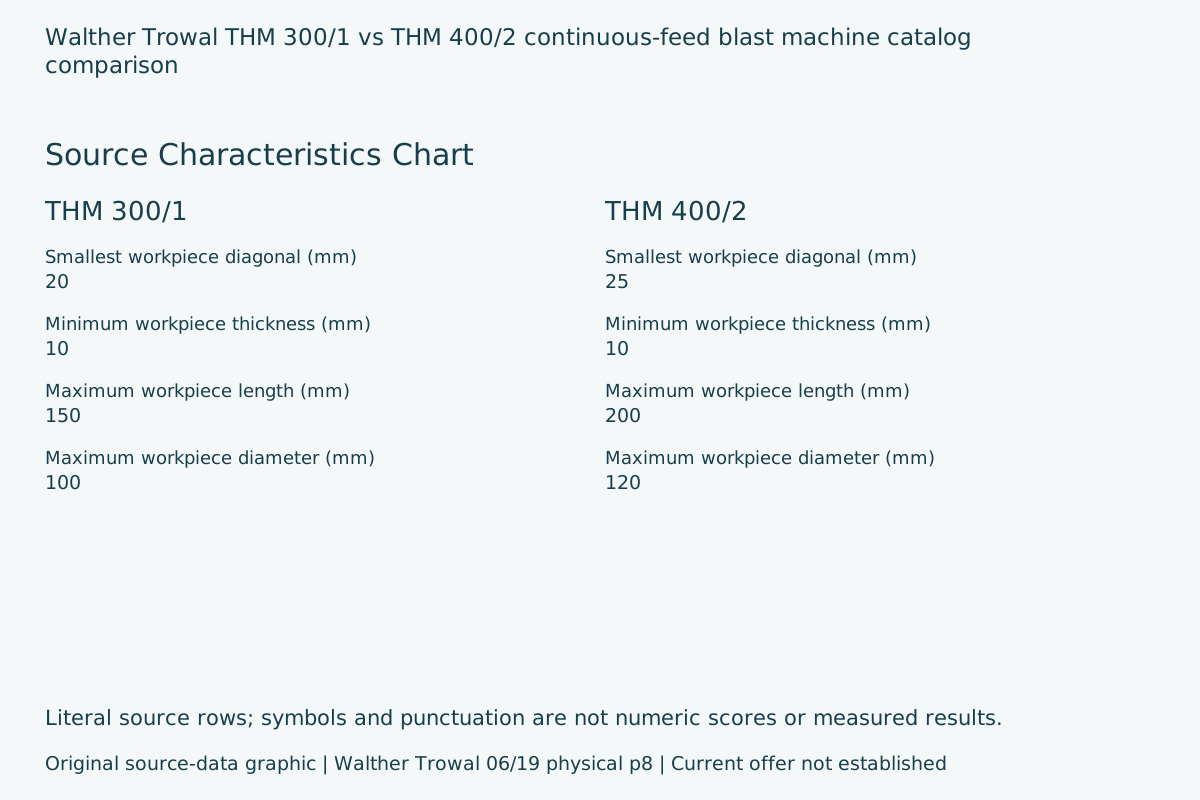
| Smallest workpiece diagonal (mm) | 20 | 25 |
| Minimum workpiece thickness (mm) | 10 | 10 |
| Maximum workpiece length (mm) | 150 | 200 |
| Maximum workpiece diameter (mm) | 100 | 120 |
Configuration entries for this pair
Number of blast chambers (pieces): THM 300/1 1; THM 400/2 2. Number of rods (pieces): THM 300/1 43; THM 400/2 53. Number of turbines (pieces; range retained): THM 300/1 1; THM 400/2 2.
Drive entries for this pair
Power per turbine (kW; range retained): THM 300/1 7,5; THM 400/2 7,5. Dust-collector air entry (Bm³/h; printed alternatives): THM 300/1 2.000; THM 400/2 3.000.
Geometry entries for this pair
Smallest workpiece diagonal (mm): THM 300/1 20; THM 400/2 25. Minimum workpiece thickness (mm): THM 300/1 10; THM 400/2 10. Maximum workpiece length (mm): THM 300/1 150; THM 400/2 200. Maximum workpiece diameter (mm): THM 300/1 100; THM 400/2 120.
Source reading and conditions
Publisher qualitative legend: ++ very good suitability; + good suitability; 0 limited suitability; - no suitability. These categories are not measured values or percentages. Blank remarks are NOT_LISTED. Paste footnote markers remain visible; *) states cycle time more than 24 hours. A merged remark is marked SHARED_REMARK_NOT_INDEPENDENTLY_MAPPED.
- Versioned manufacturer catalog entries are neither tested customer performance nor an established current configuration.
- No installed-option, site-fit, process recipe, metered energy, current offer, Jintaijin equivalent or regulatory approval is established.
- Units, decimal punctuation, multiplicity, alternatives and conditional row bases remain literal; no cross-family scoring is calculated.
- The tunnel-diameter row has no explicit unit and is excluded. Bm³/h is not converted to Nm³/h; slash alternatives are not summed or reinterpreted as ranges. Turbine powers are not multiplied to infer system power. No blast result or explosion-protection approval is established.
Source and sample-review scope
Official THM brochure, 06/19, physical page 8, captured 2026-10-05.
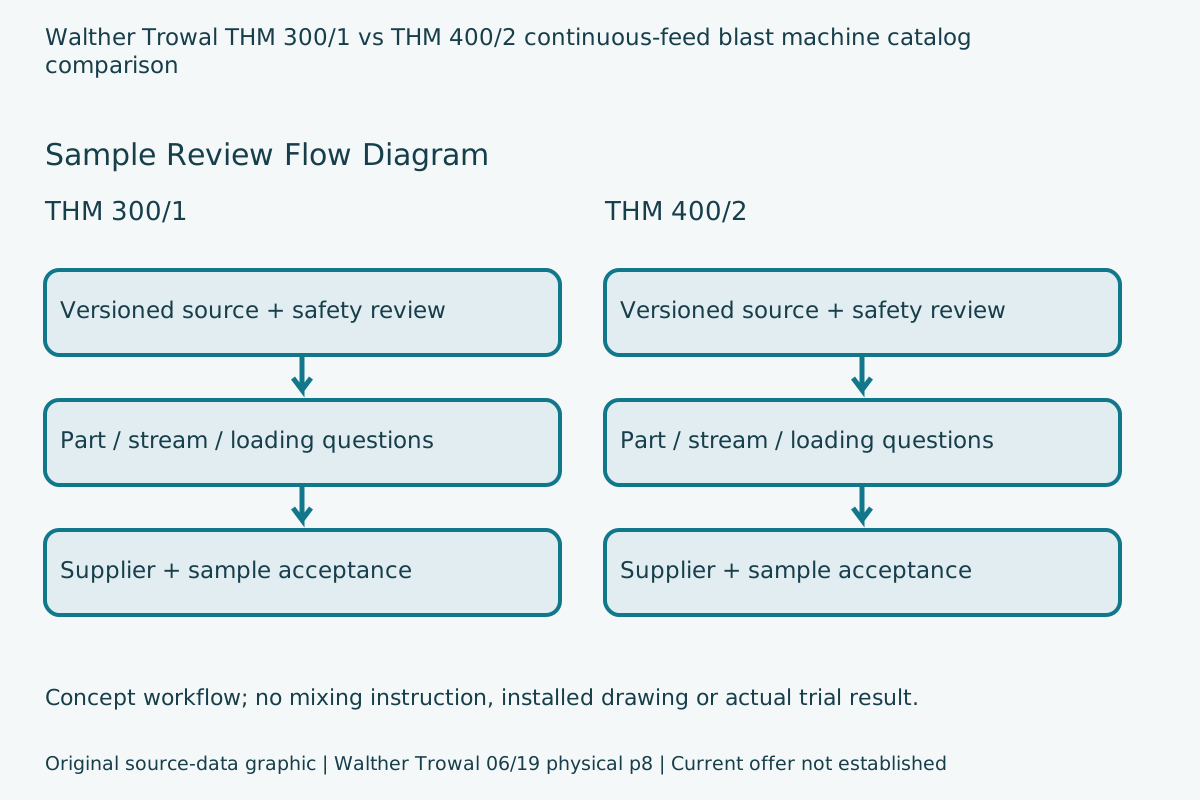
Use this independent Walther Trowal reference to prepare a supplier and sample discussion. It does not establish Jintaijin supply, partnership, an equivalent product, current offers or a customer trial. Obtain a current specification and safety documentation, then define a real sample, part or liquid-stream objective, constraints and acceptance method. User annotations remain USER_RECORDED_NOT_VERIFIED. No mixing, dosing, compatibility, hygiene or wastewater-discharge approval follows from this page.
Questions about this pair
Which adopted fields differ for THM 300/1 and THM 400/2?
Number of blast chambers (pieces): THM 300/1 1 versus THM 400/2 2. Number of rods (pieces): THM 300/1 43 versus THM 400/2 53. Number of turbines (pieces; range retained): THM 300/1 1 versus THM 400/2 2. Dust-collector air entry (Bm³/h; printed alternatives): THM 300/1 2.000 versus THM 400/2 3.000. Smallest workpiece diagonal (mm): THM 300/1 20 versus THM 400/2 25. Maximum workpiece length (mm): THM 300/1 150 versus THM 400/2 200. Maximum workpiece diameter (mm): THM 300/1 100 versus THM 400/2 120.
How should source symbols and missing remarks be read?
Publisher qualitative legend: ++ very good suitability; + good suitability; 0 limited suitability; - no suitability. These categories are not measured values or percentages. Blank remarks are NOT_LISTED. Paste footnote markers remain visible; *) states cycle time more than 24 hours. A merged remark is marked SHARED_REMARK_NOT_INDEPENDENTLY_MAPPED.
What source conditions must remain visible?
Versioned manufacturer catalog entries are neither tested customer performance nor an established current configuration. No installed-option, site-fit, process recipe, metered energy, current offer, Jintaijin equivalent or regulatory approval is established. Units, decimal punctuation, multiplicity, alternatives and conditional row bases remain literal; no cross-family scoring is calculated. The tunnel-diameter row has no explicit unit and is excluded. Bm³/h is not converted to Nm³/h; slash alternatives are not summed or reinterpreted as ranges. Turbine powers are not multiplied to infer system power. No blast result or explosion-protection approval is established.
Can these entries predict a process result or cost?
Versioned catalog values and symbols retain their source row bases; they are not measured trials or approved process settings. Symbols ++, +, 0 and - are qualitative; no numeric score, ranking or dosage is calculated. Descriptive pH is not a numeric range; media fill, batch volume and mass retain separate meanings. No part compatibility, finish, hygiene, discharge compliance, installed configuration or current offer is established. Independent Walther Trowal reference; Jintaijin supply, partnership and equivalence are not established. User annotations are not verified trials or customer facts.
What must the current supplier and sample review establish?
Use this independent Walther Trowal reference to prepare a supplier and sample discussion. It does not establish Jintaijin supply, partnership, an equivalent product, current offers or a customer trial. Obtain a current specification and safety documentation, then define a real sample, part or liquid-stream objective, constraints and acceptance method. User annotations remain USER_RECORDED_NOT_VERIFIED. No mixing, dosing, compatibility, hygiene or wastewater-discharge approval follows from this page.
Related review tools
Prepare a sample-review enquiry
Provide a drawing or liquid-stream description, objective, constraints and acceptance method for a SurfacePolish discussion.
Open the SurfacePolish enquiry form +86-592-2381506


 IPv6 network supported