An aluminium stage plate for medical devices is mostly datum: dowel holes, a tapped pattern and a flatness callout leave very little room for rounding or distortion. A buyer in Atlanta, United States can send a representative plate to SurfacePolish, a cross-border supplier of finishing machines, media and compounds, for a free sample trial. This brief is written for a buyer in Atlanta working on medical devices; it describes equipment, media and a scoped sample review, not a local polishing service.
What downstream operation follows finishing, such as anodising, laser marking, bonding or assembly, and what does it require of the surface?
Which surfaces on this aluminium part carry a cosmetic grade, which are functional seating or sealing faces, and which are indifferent?
What is the minimum wall thickness and unsupported span, and which internal features could trap media?
Begin by marking up the drawing surface by surface. An aluminium device housing may carry a visible cosmetic face, several machined mating faces that set a seal or a press fit, threaded ports, dowel holes and a thin outer wall, and each has a different finishing tolerance. Cosmetic zones can accept a uniform satin or bright finish; sealing faces and dowel bores need the edge left close to sharp or rounded to a stated radius, and a heavy media cycle destroys that. Note where the customer sees the part after assembly, because a face that meets a cosmetic grade on its own can still look wrong beside an untreated neighbour. A drawing that names, per surface, whether it is cosmetic, functional or indifferent is the cheapest document in the whole finishing project.
After a wet cycle an aluminium part carries compound residue, suspended fines, media dust and water. Some of it sits in a blind hole, under a flange or in a thread and is not removed by a plain rinse. A dried residue film or a silicate deposit can interfere with later operations: it can show as a bloom under anodising, uneven laser marking, a poor bond or a stained appearance after assembly. Define what the downstream operation needs and state it, because the buyer owns that requirement; the realistic levers are rinse stages, water quality, a controlled dry, and verification by the buyer on the parts they receive. Nothing about equipment supply or a sample trial establishes biocompatibility, sterility or a validated cleaning process, and residue limits for a device must be set and verified by the buyer against their own specification.
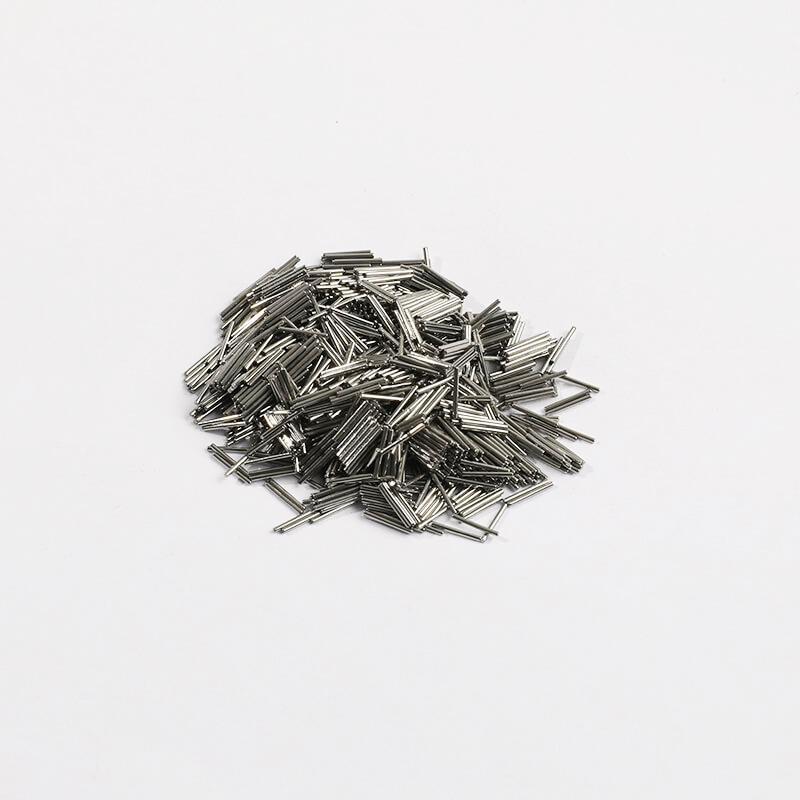
| Media | Best fit | Watch out for |
|---|---|---|
| Plastic-bonded media, light to medium abrasive grade, cone and triangle shapes | General deburring and satin finishing on 6061 and 7075 where galling risk rules out dense ceramic | Wears quickly and loses edge definition; cut rate drops as the charge ages and the cosmetic result drifts unless media is screened and topped up |
| Alumina-based ceramic media, low-density, cylindrical and pin shapes | Internal bores, slots and cross-holes on small aluminium components that a rounded tumbling body cannot reach | Pin and cylinder shapes can wedge in a bore or a slot; confirm retrieval and inspection before running a production batch |
| Ceramic media, spheres and low-density ceramic, fine size class | Bright surface development and light edge work on small aluminium components with mixed cosmetic and internal features | Fine media lodges in blind holes, cross-drillings and thin-wall pockets and is harder to screen out of the load |
| Ceramic media, angle-cut triangles, medium size class | Heavy-cut deburring on cast or robust aluminium parts where the machined surface will be finished again or is not appearance graded | Rounds functional edges quickly and can chip or peen thin walls; not suitable where a sealing land or press fit is exposed |
A rotary barrel tumbles the load under gravity at comparatively low energy, which makes it a reasonable route for small precise aluminium parts that must not be peened, distorted or made to impinge on each other. It suits high-volume small components such as connector bodies, pins, small fittings and thin machined parts where the requirement is a consistent light deburr and surface refinement rather than heavy stock removal. Two costs come with that gentleness: cycles are longer for the same result, and parts with flats, pockets or low mass can slide rather than tumble, so one face may receive almost no work. Barrel loading, rotational speed, media-to-part ratio and compound quantity all change the result, and an overloaded barrel simply rotates with the mass instead of working it.
| Machine route | Where it fits | What it will not do |
|---|---|---|
| Disc finishing machine | Fast burr removal and edge radiusing on robust aluminium parts where a short cycle and high material removal matter most | High part-on-part contact and impingement risk; smears soft 6061, is hard to localise, and adds fixturing labour to every cycle |
| Dry polishing machine and dryer | Post-wet drying and dry polishing of aluminium parts before anodising, laser marking, bonding or packaging | Does not remove a burr or refine a surface on its own; residual media dust and incomplete drying still cause marking and coating defects |
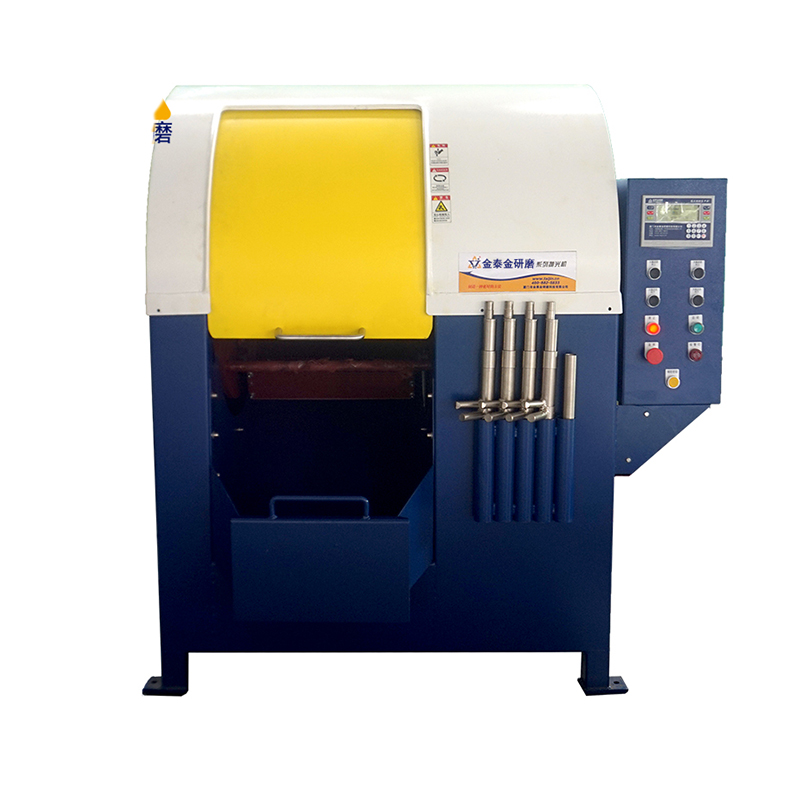
| Centrifugal barrel finishing machine | Short, controlled cycles producing a fine satin finish and a defined edge on small to medium aluminium device parts | High energy bends thin walls and distorts light sections; barrel geometry limits part length and pieces per run |
| Vibratory bowl finishing machine | Small to medium aluminium components that tumble freely: ferrules, handles, brackets and cover plates needing uniform deburring or satin finishing | Long, tall or heavily recessed parts shadow themselves and finish unevenly; part envelope must fit free circulation in the bowl |
Parts that do not circulate freely receive uneven work. In a bowl or barrel a long part, a heavy part or a part with a deep recess can sit in one attitude, shelter its own face, or trap a neighbour against the wall, leaving a bright band beside a dull one. Impingement is the more visible version: two parts strike each other repeatedly and produce dents, peened patches, scratches or a hammered texture that will not polish out without further material removal. The cause is usually charge geometry rather than media: wrong load ratio, media too large to flow around the part, insufficient compound lubricity, or a fixture that holds parts where the media field is weak. Check under directional light and compare several parts from different positions in the load, not one sample from the discharge gate.
| Failure mode | Likely cause | How to catch it |
|---|---|---|
| Finish bloom or speckle, or poor laser mark contrast, revealed after anodising or marking | Embedded media, a silicate or residue film, a directional texture that marks unevenly, or an oxide layer from a slow dry | Evaluate the appearance on a coated or marked sample rather than bare metal, and compare marking contrast on parts from different positions in the load |
| Sealing land or dowel bore edge rounded past the drawing limit | Long or energetic cycle on an unprotected functional edge, sharp-edged media, cumulative material removal across repeated passes | Measure the edge with an optical comparator or radius gauge on a cross-section, or compare a CMM scan of the feature before and after finishing |
| Media or abrasive fragment lodged in a blind hole, cross-drilling or thin-wall pocket | Media size class too small for the feature, unshielded pockets, flexing thin wall gripping the fragment, no dedicated retrieval step | Borescope the internal features, weigh against a known-clean reference, tap over white paper, and inspect the residue from an ultrasonic clean |
| Black smut or scattered dark specks on the finished surface | Iron transferred from steel media, a shared barrel, worn machine parts or a shared media store; galvanic reaction on the soft aluminium surface | Examine under magnification and with a light acidified wipe, and audit media storage, barrel liners and screening equipment for steel contact |
Atlanta's industrial base combines transportation and logistics head offices with aerospace, defence and specialty metal fabrication, plus food and beverage production and a large academic medical centre. The Federal Reserve's Sixth District Beige Book, which covers Georgia, reports manufacturing activity growing at a moderate pace, with a fabricator of specialty metal products seeing particularly strong demand for aerospace and defence-related goods and a military shipbuilder expecting a decade of defence-driven demand. Hartsfield/Jackson Atlanta International tops the FAA's final CY2025 enplanement table, and CBP lists Atlanta, Georgia (port 1704) as a port of entry with its field office in the city. The Coca-Cola Company's own history page records the drink's first serving in downtown Atlanta in 1886, Norfolk Southern's corporate address is 650 W. Peachtree Street NW in Atlanta, and Emory University, based in the city, presents health and medical research as central to its mission.
For this brief the relevant part of that base is medical: Emory University, whose main campus is in Atlanta, presents medical breakthroughs and health education as core to the city's economy on its institutional homepage.
Aerospace, defence and general machinery fabrication in the Atlanta region produces machined and formed metal parts whose burrs and edge condition affect fatigue life, coating adhesion and assembly fit, so edge blending and surface preparation before priming, anodising or plating are routine process steps. Fabricated sheet-metal and tube assemblies typically need weld dressing and edge radiusing, while food and beverage equipment adds a hygiene requirement: stainless product-contact parts are usually finished to a cleanable, pit-free surface with controlled roughness rather than to a decorative polish.
The first decision is whether the part is governed by an aerospace or defence special-process requirement (for example NADCAP-approved passivation, anodising or painting) or by a general industrial finish, because that sets the acceptable media, compound chemistry and documentation package. Confirming the inspection method for edge radius, Ra and burr limits before any media trial avoids qualifying a finish against the wrong criterion.
Freight context: Hartsfield/Jackson Atlanta International Airport (ATL), Atlanta, Georgia (CBP port of entry 1704 with the Atlanta field office), Norfolk Southern rail network, corporate headquarters at 650 W. Peachtree Street NW, Atlanta. FAA final CY2025 enplanement data rank Hartsfield/Jackson Atlanta International first in the country with 51,459,786 boardings, and CBP's Georgia table lists Atlanta, Georgia (1704) with the field office in the city; Norfolk Southern's published corporate address is 650 W. Peachtree Street NW, Atlanta, Georgia 30308. Metro Atlanta has no seaport, so containerised machines from China normally land at a US East or Gulf coast port and reach Atlanta by rail or truck, with air consignments and sample parts clearing at the Atlanta port of entry.
The United States has no free-trade agreement with China, so Chinese industrial machinery enters under normal-trade-relations (MFN) duty rates in the Harmonized Tariff Schedule of the United States plus any Section 301 duty that applies to the specific HTSUS subheading. USTR's four-year-review modification of the Section 301 China technology-transfer investigation imposed additional Section 301 duties or increased existing rates on certain Chinese products in strategic sectors, and created a temporary exclusion process for machinery used in domestic manufacturing: chapters 84 and 85 of the HTSUS, which cover most machinery used in manufacturing processes, are the chapters that were made eligible for exclusion requests. CBP still administers Section 301 China duties, the four-year-review increases and product exclusions. The IEEPA-based additional ad valorem duties of 2025 - including the reciprocal-tariff actions and the China synthetic-opioid supply-chain duties imposed under Executive Orders 14195 and 14257 - were ordered terminated by Executive Order 14389 of 20 February 2026 and, as soon as practicable, are no longer collected. A buyer should therefore price the MFN rate plus any applicable Section 301 rate and check whether the machine's exact subheading is covered by a current exclusion, rather than assuming either the 2025 IEEPA tariffs or a blanket China rate still applies.
Business is conducted in US English. Units matter: US drawings and purchase orders frequently use inches, microinch Ra and US gallons, and a supplier that quotes only metric can be asked to reissue documentation. Buyers are US legal entities with an EIN and expect an identifiable contracting entity, a correct HTSUS classification, a commercial invoice, packing list and bill of lading, country-of-origin marking, and an importer of record for customs. Procurement is normally evidence-driven: process selection is expected to be justified by a trial run on the buyer's own sample parts with measured results (burr height, edge radius, Ra, cleanliness) and by media and compound data sheets, rather than by a capability claim. Payment terms in general US industrial practice are open account with net-30 to net-60 terms for established buyers, with letters of credit or advance payment more common for a first order from a new overseas supplier; no US buyer assumes Incoterms, warranty terms or spare-parts lead times unless they are stated in the quotation.
SurfacePolish supplies from Xiamen, China. The buyer's own destination rules, conformity marking, tariff classification and documentation responsibilities stay with the buyer; confirm them against the authorities named above before ordering.
Treat the first finished part of every batch as a first article and hold it until it has been checked against the agreed criteria. Record the part number, alloy and temper, the machine and route, the media charge identity and its accumulated hours, the compound and concentration, the cycle time, the load ratio and the drying step. Retain a reference part from the accepted first article, and when a later batch differs, compare the two physically before adjusting anything. Segregate batches by alloy and part number, and keep the aluminium loop separate from steel work so iron cannot transfer onto a soft surface. This discipline, not the machine settings, is what makes a finish reproducible. Who performs the checks and who signs the release is a buyer decision, but the record of what was run is worth keeping.
A sample trial produces observations on the parts that were tested, under the settings that were used, on the equipment that ran them. It does not guarantee a roughness value, an appearance grade, an edge radius, a dimensional result, a cycle time, a capacity or a production cost, and it does not qualify, approve or validate a process for a medical device or any regulated application. It cannot prove biocompatibility, cleanability, sterility, corrosion life or a cleaning validation, and it does not create a specification the buyer can rely on for regulatory purposes. Those determinations belong to the buyer's own engineering and quality functions, working to their own requirements. What a trial can do is show whether a mechanical route is plausible for a part and which media and compound direction is worth pursuing.

Laser marking interacts with surface texture, so contrast depends on whether the surface is directional, random satin or bright. A strong directional finish from a tub or a linishing step can produce a marking that reads differently when the part is turned, while a uniform random texture marks more consistently. Residue and embedded media also interfere, because the marking energy meets a contaminated surface. For a marked cover plate in United States, the practical sequence is to fix the finish first, then qualify the marking programme on finished parts, and to check the mark under the lighting the end user will use rather than a bench lamp.
No. SurfacePolish is a cross-border supplier of finishing machines, media and compounds and runs a free sample trial on parts the buyer sends. A trial reports observations on the parts tested under the settings used; it does not qualify, approve or validate a process, and it does not create biocompatibility, cleanability, sterility or regulatory documentation. Any requirement of that kind must be defined by the buyer and verified by the buyer's own engineering and quality functions, usually with the help of specialist testing providers. For a device programme in United States, treat the finishing route as one input into the buyer's own verification plan rather than as evidence for it.
A bowl vibrator circulates a load through a media field at moderate energy, with good uniformity on small parts that tumble freely and easy discharge. A centrifugal barrel presses media and parts together at high force in a much shorter cycle, producing a fine finish and controlled edge quickly, but bending thin walls, distorting light sections and rounding edges faster. Bowl routes suit mixed small parts and gentle work; centrifugal routes suit a narrow part family that fits the barrel and accepts the energy. Parts made in United States should be trialled in the specific geometry before a machine size is fixed, because barrel dimensions limit part length and load size.
Use Atlanta, United States as the destination on the enquiry and state whether the deliverable is equipment, media and compound, a representative sample review or a line concept. A destination does not imply local stock, a local service point or a local delivery time.
Buyers in this supply chain commonly reference AS9100 and NADCAP-approved special processes for aerospace work, with SAE AMS process specifications such as AMS 2700 for passivation named on the certificate, while general industrial and food-equipment parts are specified to ASME B46.1 or ISO 4287 for texture with the customer's chosen salt-spray, adhesion or cleanliness test for coatings and hygiene.
Sources were retrieved on 2026-09-29 and describe the local industrial and trade context only. They do not evidence any SurfacePolish project, shipment, installation or service in Atlanta.
The buyer must remove machining burrs from the hole pattern without moving the dowel hole edges or disturbing the plate's flatness.
Send the material, dimensions, approximate weight, batch quantity, the incoming condition and photographs of the difficult features. Mark which features must not be contacted by media and state how the result will be inspected. This form carries source reference PSEO-0073; quote it if you prefer an additional manual reference.
Open the SurfacePolish enquiry form Email a prepared enquiry
No price, lead time, certification or result is promised here. Confirm whether a sample trial is available for the specific part and what the trial can and cannot show.
Page PSEO-0073 · revised 2026-09-29 · cross-border equipment, media and scoped sample review. City context is sourced and cited above.
Use this local checker to identify missing part and inspection information. It prepares a technical-review brief; it does not approve a machine, process recipe or production result.
Complete the part details to prepare a review brief.
Email : info@surface-polish.com


 IPv6 network supported


 +86-592-2381506