High-volume small aluminium components for medical devices live or die on part-to-part consistency, and a batch of several thousand ferrules in Glasgow, United Kingdom will show any weakness in media size class, screening or load control. SurfacePolish supplies finishing machines, media and compounds across borders and runs a free sample trial on the buyer's parts. This brief is written for a buyer in Glasgow working on medical devices; it describes equipment, media and a scoped sample review, not a local polishing service.
What downstream operation follows finishing, such as anodising, laser marking, bonding or assembly, and what does it require of the surface?
What is the minimum wall thickness and unsupported span, and which internal features could trap media?
What are the alloy and temper, and has machining, casting, welding or heat treatment already changed the surface hardness and porosity?
Controlled edge rounding is where a finishing route earns or loses its place. Every machined aluminium edge carries a burr and a stress concentration, and a deburring cycle removes both, but it also moves the edge position. On a mating face, a seal groove, a bearing seat or a dowel hole that movement is a functional change, not a cosmetic one. Establish the allowed edge radius or chamfer per feature, then measure the finished edge against it rather than judging by eye, using an optical comparator or a radius gauge on a sectioned or replica sample. A part with generous cosmetic edges and one tight sealing edge usually needs a shielded fixture or selective hand finishing after the machine cycle. Deciding this after the first batch has run is how an assembly ends up with a leak path.
A round bowl vibrator suits small to medium aluminium components that tumble freely and pass a media gate: instrument handles, ferrules, cover plates, brackets. It gives good part-to-part uniformity because the whole load circulates through the same energy field, and it is easy to automate with compound flow and a discharge gate. The limit is size and shape. A long extruded frame, a tall manifold or a part with a protruding boss will not circulate well in a bowl and will shadow itself, leaving the sheltered side unfinished. Tub vibrators handle long and large parts because the working channel is linear and the part can be oriented; the trade-off is slower uniform coverage and a greater tendency for parts to settle in one attitude. Match machine to part envelope first, then to finish.
| Machine route | Where it fits | What it will not do |
|---|---|---|
| Vibratory bowl finishing machine | Small to medium aluminium components that tumble freely: ferrules, handles, brackets and cover plates needing uniform deburring or satin finishing | Long, tall or heavily recessed parts shadow themselves and finish unevenly; part envelope must fit free circulation in the bowl |
| Magnetic finishing machine | Small aluminium parts with fine internal features such as cross-holes, slots and recesses that tumbling media cannot reach | Small working envelope and low throughput; pins and fine media can lodge in blind features, and mixed part families are awkward |
| Tub vibrator | Long and large aluminium parts such as extruded frames and housings that can be oriented in a linear working channel | Slower uniform coverage, a tendency for parts to settle in one attitude, and greater floor space and media volume than a bowl |
| Grinding finishing machine | Higher material removal on aluminium parts that need a heavy burr or a pronounced chamfer removed before a gentler finishing step | Aggressive on soft aluminium, difficult to control on cosmetic faces and functional edges, and not a finishing step on its own |
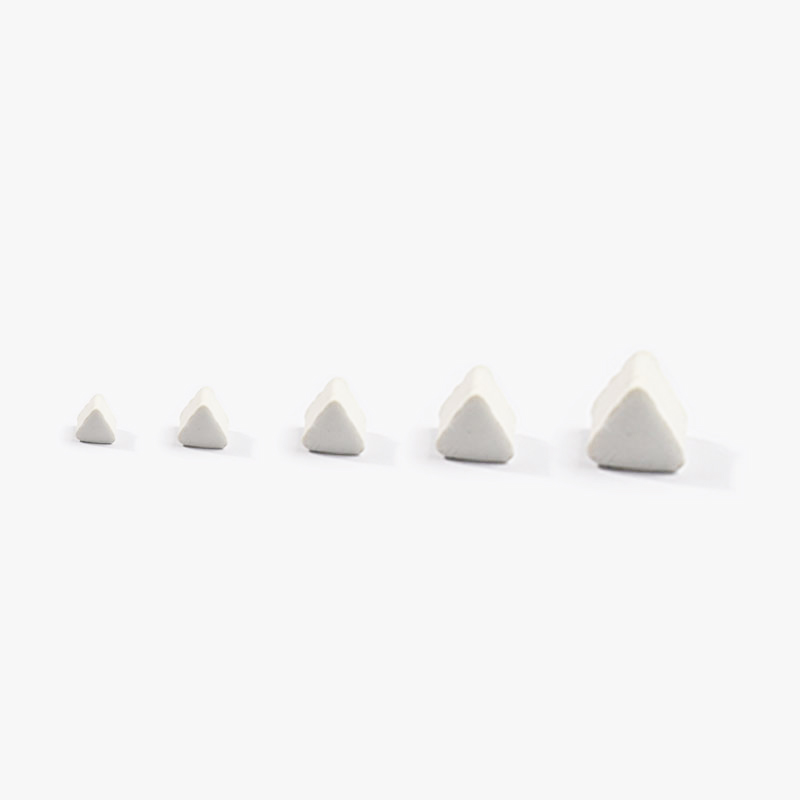
Media choice on aluminium is dominated by one fact: the workpiece is softer than most media used on steel. Dense ceramic and steel media that cut steel efficiently will embed, smear or gall an aluminium surface, implant iron particles that later show as staining or a galvanic couple, and round edges faster than the drawing allows. Plastic-bonded media in a light or medium abrasive grade, or a low-density ceramic, is the usual starting family for cosmetic work on 6061 and 7075, with harder ceramic reserved for a genuine heavy-cut deburr where the surface is not graded. The trade-off is real: gentle media remove less material and take longer, so a deep tool mark or heavy burr may need a coarser first stage and a gentler second. Choose media around the surface and edge the part must end with.
| Media | Best fit | Watch out for |
|---|---|---|
| Dry media, walnut shell, fine grade | Dry polishing, light surface cleaning and preparation before anodising or laser marking on aluminium parts | Shell dust must be extracted and the part cleaned, or the residue interferes with marking, bonding or a later coating step |
| Plastic-bonded media, light to medium abrasive grade, cone and triangle shapes | General deburring and satin finishing on 6061 and 7075 where galling risk rules out dense ceramic | Wears quickly and loses edge definition; cut rate drops as the charge ages and the cosmetic result drifts unless media is screened and topped up |
| Alumina-based ceramic media, low-density, cylindrical and pin shapes | Internal bores, slots and cross-holes on small aluminium components that a rounded tumbling body cannot reach | Pin and cylinder shapes can wedge in a bore or a slot; confirm retrieval and inspection before running a production batch |
| Plastic-bonded media, ball and ellipsoid shapes | Surface refinement and blending on cosmetic aluminium faces where edges, seal lands and dowel bores must stay close to drawing | Removes very little edge material, so a burr at a bore exit or a thread crest may survive the cycle and need a separate step |
Aluminium can leave a finishing cycle looking worse in colour than it went in. Over-alkaline compound etches and darkens the surface; hard water leaves mineral spotting that dries into rings; iron transferred from steel media or worn machine parts appears as black smut or scattered dark specks; and a slow or hot dry lets an oxide film form unevenly across a face. Castings with porosity are especially prone, because they hold liquid and release it later as a bloom. Check the part dry, under the lighting the customer will use, and compare against a retained reference part rather than memory. Control compound pH and concentration, rinse with controlled water quality, dry promptly and completely, and keep steel out of the aluminium loop. A stain found after anodising or packaging has already cost the value of the part.
| Failure mode | Likely cause | How to catch it |
|---|---|---|
| Etched, darkened or chalky surface after wet finishing | Compound pH or concentration outside the aluminium working range, over-alkaline product, long dwell in a hot solution, exhausted compound | Compare a dried part against a retained reference under the customer's lighting, and log compound pH, concentration and temperature for the batch |
| Dimensional drift on a critical bore, dowel hole or press-fit diameter | Aggressive media attacking a feature the cycle should not touch, cumulative removal over repeated runs, no masking of close-tolerance geometry | Measure the feature with a CMM or bore gauge at first article and at the end of the media charge, and chart the trend against drawing limits |
| Water spotting, rings or mineral staining after drying | Hard rinse water, slow or incomplete dry, droplets trapped in blind holes or under a flange, no final deionised rinse | Inspect the dried part in raking light against a reference, and check rinse-water hardness and conductivity records for the shift |
| Media or abrasive fragment lodged in a blind hole, cross-drilling or thin-wall pocket | Media size class too small for the feature, unshielded pockets, flexing thin wall gripping the fragment, no dedicated retrieval step | Borescope the internal features, weigh against a known-clean reference, tap over white paper, and inspect the residue from an ultrasonic clean |
Glasgow is Scotland's largest city, with a metropolitan region of 1.85 million people that Invest Glasgow records as generating £48bn GVA, and the Glasgow City Region accounts for around a third of Scotland's output, business base, research power and employment. Invest Glasgow lists clinical life sciences and biotechnology, energy and green transition, space and satellite technology, and advanced manufacturing and precision engineering among the city region's key clusters. ADS Scotland, established in 2005, reports that the aerospace, defence, security and space industries add £3.7 billion to the Scottish economy, employ 36,900 people and reached £9 billion of turnover, and its Scotland Council includes BAE Systems, Rolls-Royce, Leonardo, Thales, GE Aerospace and Babcock International.
For this brief the relevant part of that base is medical: Invest Glasgow lists 'Clinical Life Sciences and Biotechnology' as a key cluster of the Glasgow City Region.
Glasgow's combination of precision engineering, an aerospace supply chain and clinical life-sciences work means machined and formed parts usually carry defined edge and surface acceptance criteria, and those are set by the customer's specification rather than by a local process convention. Clydeport's container, project and bulk cargo handling gives the city region an established route for importing finishing machines, media and compounds, with two new £25m ship-to-shore cranes at Greenock Ocean Terminal operational from autumn 2024.
A Glasgow buyer should decide early whether the part is aerospace or defence supply-chain work - where edge and surface criteria come from the prime contractor's specification - or general precision engineering, because that determines the documentation and the process route the finishing cell has to support.
Freight context: Clydeport (Peel Ports): Greenock Ocean Terminal, King George V Dock and the River Clyde network, Eurocentral (new 353,000 sq ft industrial space under a forward-funding agreement, reported by Glasgow Chamber of Commerce). Peel Ports states that Clydeport handles more than 15.4 million tonnes of cargo a year and has invested £25m in two new ship-to-shore cranes at Greenock Ocean Terminal to accommodate increased demand and support growth in transatlantic trade; the Glasgow Chamber of Commerce is the city's business body and reports industrial development at Eurocentral.
English is the working language of contracts, drawings and conformity paperwork, so quotations, technical files and Declarations of Conformity should be supplied in English. UK manufacturers have now recovered above 2019 output levels in every English region and devolved nation except Northern Ireland, and the sector is concentrated in food and drink and transport equipment, with the North West the largest manufacturing region by total output. Buyers typically expect the UKCA/CE route, a Declaration of Conformity and a UK-established economic operator to be identified before order, and they need commercial invoices, customs declarations and the C79 retained in a form their finance team can use for import VAT recovery. No source verified in this research establishes a mandated payment instrument, so payment structure should be treated as commercial negotiation rather than a regulatory requirement.
Importers need a GB-prefixed Economic Operators Registration and Identification (EORI) number, an import declaration carrying the correct commodity code, and retained commercial invoices plus the Import VAT Certificate (C79) so import VAT can be reclaimed. Machinery placed on the Great Britain market must be marked UKCA or CE: the manufacturer must draw up and retain technical documentation including a Declaration of Conformity, apply the correct marking with identification details, and cooperate with market surveillance; an authorised representative must be established in the UK. Under the Product Safety and Metrology (Amendment) Regulations 2024 the UK continues to recognise CE marking alongside or in place of UKCA for the Great Britain market, so either route can be used for most product types. Duty and import VAT are calculated from the customs value declared, and the commodity code also determines whether an import licence is needed.
SurfacePolish supplies from Xiamen, China. The buyer's own destination rules, conformity marking, tariff classification and documentation responsibilities stay with the buyer; confirm them against the authorities named above before ordering.
Appearance is the requirement most likely to be argued about, because it is easy to state and hard to define. Agree a physical reference: a first-article part or a set of graded coupons, viewed under a stated light source, at a stated distance and angle, by a named inspector. Record whether the accepted finish is bright, satin, directional or non-directional, and whether machining marks may remain visible. If the part will be anodised later, the finish that looks correct as bare aluminium may look different after anodising, because the coating is partly transparent and the underlying texture remains; evaluate the appearance on an anodised sample rather than bare metal. Keep reference parts labelled, protected and stored, because a visual standard that lives only in memory changes with every batch.
Scaling from a bench or pilot run to a producing line changes several things at once, and each has to be planned. The machine must be sized for the part envelope and the throughput the buyer needs, which sets load volume, media quantity and compound dosing. A compound delivery system with a dosing pump, a flow meter and a recirculation or once-through decision is what makes the chemistry repeatable rather than hand-mixed. Media handling needs a screen or separator, a stock of graded media for top-up, and a rule for replacing worn media. Parts need a defined load pattern, and any fixture or mask needs a duplicate so it does not become the bottleneck. Rinse and drying stages must match the downstream requirement. The layout, services and acceptance criteria remain the buyer's engineering decisions.


No. A trial shows what happened on the parts tested, with the media, compound and cycle used at that time. It does not guarantee a roughness value, appearance grade, edge radius, dimensional result, cycle time, capacity or cost in production, and it cannot cover the drift that comes from media wear, compound carry-over, water changes or a different machine. What it can do is indicate whether a mechanical route is plausible, which media and compound direction deserves a closer look, and which features need protection. A buyer in United Kingdom should plan a first-article routine and retain a reference part before releasing a production batch.
It will if the edge is exposed to the media for long enough. Media cannot distinguish a cosmetic edge from a seal land, a dowel bore or a press-fit shoulder, and rounding accumulates gradually, so a batch inside tolerance at the start of a media charge can be outside it later. Protection comes from shielding or masking the functional edge, using rounder and lighter media, shortening the cycle, and checking the feature with an optical comparator, radius gauge or CMM rather than by eye. A buyer in United Kingdom should state the allowed edge radius per feature on the drawing, because a blanket edge-break note will be read literally.
Laser marking interacts with surface texture, so contrast depends on whether the surface is directional, random satin or bright. A strong directional finish from a tub or a linishing step can produce a marking that reads differently when the part is turned, while a uniform random texture marks more consistently. Residue and embedded media also interfere, because the marking energy meets a contaminated surface. For a marked cover plate in United Kingdom, the practical sequence is to fix the finish first, then qualify the marking programme on finished parts, and to check the mark under the lighting the end user will use rather than a bench lamp.
Use Glasgow, United Kingdom as the destination on the enquiry and state whether the deliverable is equipment, media and compound, a representative sample review or a line concept. A destination does not imply local stock, a local service point or a local delivery time.
UKCA or CE marking with a Declaration of Conformity applies to machinery placed on the Great Britain market, HSE's work equipment and machinery and COSHH regimes cover operation and hazardous substances, and Scotland's aerospace and defence buyers normally receive quality and assurance requirements flowed down from primes such as those represented on the ADS Scotland Council.
Sources were retrieved on 2026-09-29 and describe the local industrial and trade context only. They do not evidence any SurfacePolish project, shipment, installation or service in Glasgow.
The buyer needs part-to-part consistency across a large batch and is worried about small parts escaping a screen or lodging in each other.
Send the material, dimensions, approximate weight, batch quantity, the incoming condition and photographs of the difficult features. Mark which features must not be contacted by media and state how the result will be inspected. This form carries source reference PSEO-0263; quote it if you prefer an additional manual reference.
Open the SurfacePolish enquiry form Email a prepared enquiry
No price, lead time, certification or result is promised here. Confirm whether a sample trial is available for the specific part and what the trial can and cannot show.
Page PSEO-0263 · revised 2026-09-29 · cross-border equipment, media and scoped sample review. City context is sourced and cited above.
Use this local checker to identify missing part and inspection information. It prepares a technical-review brief; it does not approve a machine, process recipe or production result.
Complete the part details to prepare a review brief.
Email : info@surface-polish.com


 IPv6 network supported


 +86-592-2381506