A fittings supplier in Glasgow, United Kingdom supplying food processing equipment has 600 small 316L components that need consistent refinement at volume. Free tumbling would be efficient, but machined gasket faces and mixed sizes make part-on-part contact and over-rounding real concerns, so the load and medium have to be planned. SurfacePolish supplies machines, media and compounds across borders and runs a free sample trial. This brief is written for a buyer in Glasgow working on food processing equipment; it describes equipment, media and a scoped sample review, not a local polishing service.
Does the route have to remove heat tint and restore a passive condition, or refine a surface that is already clean, and who verifies that difference?
What must the finished surface survive in service, including cleaning cycles, and how will that be checked without leaning on a finishing trial?
Which internal surfaces can a mechanical route physically reach, and what happens to the zones it cannot?
Welds are where hygienic stainless equipment most often fails a surface requirement, so screen the weld itself rather than the nominal part. Record the process, whether the cap is left proud or ground flush, whether there is spatter, undercut, overlap or a stop-start, and the colour of any heat tint from straw through blue to grey-black, since colour is a rough practical indicator of oxide thickness. Note whether the weld sits in a product-contact zone, at a gasket seat, or in a crevice where two surfaces meet. A weld that will be dressed mechanically needs enough cap material to remove without undercutting the parent metal, while a weld that will only be brushed needs a different acceptance conversation. Photograph each weld family before and after any dressing already applied.
Where a weld cap stands proud and has to come down, a grinding finishing machine removes material far faster than any tumbling route, and a disc finishing machine delivers high energy to flat faces and convex zones. This is the stage that takes off heat tint and the top of the cap, but it is also where damage is created: an over-ground toe leaves an undercut that traps product, a fast wheel can smear oxide into the surface rather than lift it, and abrasive tooling that has touched carbon steel can deposit free iron. Ground zones then need refining, because the scratch pattern left by coarse abrasive is not a finish. The sequence is what matters: remove the cap, blend the toe, refine the zone, then verify. Grinding alone rarely satisfies a stated product-contact surface requirement.
| Machine route | Where it fits | What it will not do |
|---|---|---|
| Tub vibrator | Long parts, tube spools, chute sections and small vessels that a bowl cannot accept, with the part repositioned as needed. | Coverage depends on how the part sits in the media mass, so banding and shadow zones are common without a planned fixture. |
| Barrel finishing machine, rotary barrel tumbler | Large batches of small robust fittings, fasteners and valve trim that can tumble freely without damage. | Part-on-part contact is unavoidable, and fine threads, sealing lips and thin diaphragms are poor candidates. |
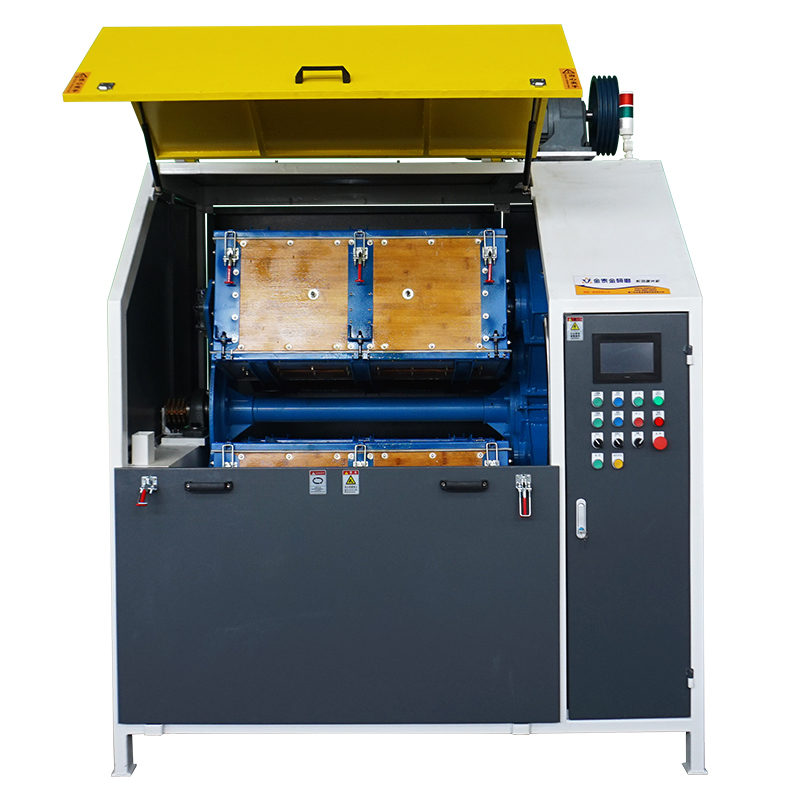
| Centrifugal barrel finishing machine | Higher-energy cycles that shorten the time to blend an edge or refine a small part in quantity. | The added energy increases over-rounding and imprinting risk, and delicate or mixed-size loads need careful planning. |
| Grinding finishing machine | Removing a proud weld cap, heavy scale and heat tint before any tumbling or refinement stage. | Leaves a scratch pattern that needs refining, can smear oxide, and iron-bearing tooling can deposit free iron on stainless. |
Plastic media in cones, triangles and cylinders cuts gently and is chosen when the requirement is a light edge blend or a cosmetic touch rather than weld-zone oxide removal. It suits softer non-ferrous fittings, thin sections and parts that must not lose measurable material, and it can wear more predictably than ceramic in some applications. What it cannot do is remove heat tint, mill scale or a proud weld cap, so it belongs late in a sequence, after the aggressive work, or on parts that never carried those conditions. Dry media such as walnut shell and corn cob works by light abrasion and burnishing on a dry machine, produces dust that needs extraction, and leaves a different surface character from a wet abrasive cycle. Neither plastic nor dry media substitutes for the operation that removes oxide.
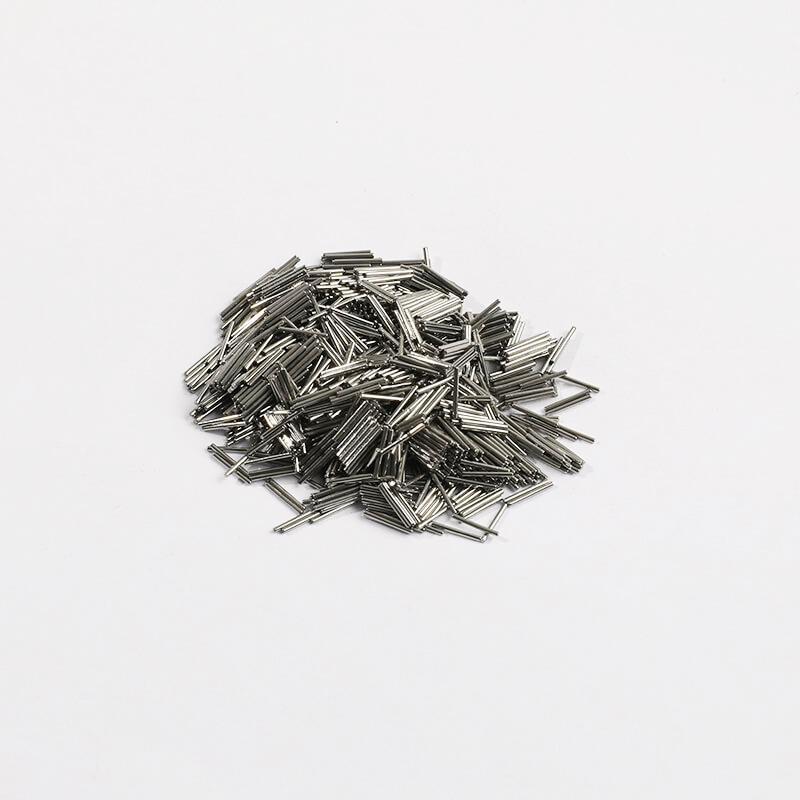
| Media | Best fit | Watch out for |
|---|---|---|
| Steel media, balls and diagonals | Bright surface refinement on robust stainless parts where a dense medium is wanted to work into recesses. | Can transfer iron to stainless, imprint soft or thin features, flatten a deliberate edge radius, and needs magnetic recovery. |
| Liquid compound, abrasive cleaning slurry family | Cleaning, descaling and fine abrasive work through the cycle, with dosing and flow matched to the load and the alloy. | Chloride content and pH matter on stainless, foam can cushion the cut, and residue left in a crevice becomes a later defect. |
| Dry media, walnut shell and corn cob | Light dry burnishing and cosmetic refinement where retained water in a crevice or assembly is a problem. | Generates dust requiring extraction, removes no oxide, and leaves a surface character different from a wet abrasive cycle. |
| Plastic media, cones and triangles | Gentle edge blending and cosmetic refinement on softer non-ferrous fittings, thin sections and delicate parts. | Cannot remove heat tint, mill scale or a weld cap, so it must follow the operation that does that work. |
Abrasive media working on a tinted weld can smear and burnish the oxide into a smooth, shiny, deceptive layer instead of cutting through it. The surface reads better visually than the starting condition while the chromium-depleted zone underneath is unchanged, and roughness readings may even improve because the profile has been flattened. This is most likely where a cycle is too gentle or too short for the oxide thickness, or where the compound is cleaning rather than cutting. Detection means looking at the transition zone rather than the cap: a dye-based or free-iron check, a cross-section of a sample part, or a controlled comparison between a mechanically worked area and a freshly ground area. Refinement should only follow a stage that genuinely removed the oxide, which is why sequence matters more than final polish.
| Failure mode | Likely cause | How to catch it |
|---|---|---|
| A shiny but burnished surface with intact oxide beneath it | Abrasive media smearing the oxide instead of cutting through it, often where a cleaning compound was relied on to do the cutting. | Examine the transition zone rather than the cap, compare a mechanically worked area with a freshly ground control area, and cross-section one sample part under magnification. |
| Thin-wall distortion or dishing on tanks, panels and chutes | Heavy media load striking unsupported thin sheet, or a chamber fill level that lets parts fall rather than tumble. | Measure wall flatness and key dimensions before and after, inspect under raking light for oil-canning, and run the test at the production fill level rather than a light one. |
| Ceramic or steel media fragments embedded in the surface | Chipped or worn media, excessive cycle energy on a soft or thin feature, or a broken piece recirculating in the load. | Inspect under magnification at low angle, screen the media for broken pieces, and check the surface before and after a refinement stage to see whether fragments were present earlier. |
| Cross-contamination from tooling, racks or media shared with carbon steel | No dedicated stainless area, undocumented consumable grades, or media stored where mild steel fabrication dust settles. | Audit which tools, racks and media touch the part, record their grades, store media covered and segregated, and confirm cleanliness with the buyer's own test after a tooling change. |
Glasgow is Scotland's largest city, with a metropolitan region of 1.85 million people that Invest Glasgow records as generating £48bn GVA, and the Glasgow City Region accounts for around a third of Scotland's output, business base, research power and employment. Invest Glasgow lists clinical life sciences and biotechnology, energy and green transition, space and satellite technology, and advanced manufacturing and precision engineering among the city region's key clusters. ADS Scotland, established in 2005, reports that the aerospace, defence, security and space industries add £3.7 billion to the Scottish economy, employ 36,900 people and reached £9 billion of turnover, and its Scotland Council includes BAE Systems, Rolls-Royce, Leonardo, Thales, GE Aerospace and Babcock International.
The nearest part of that base to this brief is machinery: Invest Glasgow lists 'Advanced Manufacturing and Precision Engineering' as a key cluster of the Glasgow City Region.
Glasgow's combination of precision engineering, an aerospace supply chain and clinical life-sciences work means machined and formed parts usually carry defined edge and surface acceptance criteria, and those are set by the customer's specification rather than by a local process convention. Clydeport's container, project and bulk cargo handling gives the city region an established route for importing finishing machines, media and compounds, with two new £25m ship-to-shore cranes at Greenock Ocean Terminal operational from autumn 2024.
A Glasgow buyer should decide early whether the part is aerospace or defence supply-chain work - where edge and surface criteria come from the prime contractor's specification - or general precision engineering, because that determines the documentation and the process route the finishing cell has to support.
Freight context: Clydeport (Peel Ports): Greenock Ocean Terminal, King George V Dock and the River Clyde network, Eurocentral (new 353,000 sq ft industrial space under a forward-funding agreement, reported by Glasgow Chamber of Commerce). Peel Ports states that Clydeport handles more than 15.4 million tonnes of cargo a year and has invested £25m in two new ship-to-shore cranes at Greenock Ocean Terminal to accommodate increased demand and support growth in transatlantic trade; the Glasgow Chamber of Commerce is the city's business body and reports industrial development at Eurocentral.
BSI is the UK's National Standards Body, and British Standards (BS, including adopted BS EN ISO texts) are the documents a UK buyer's surface-finish, edge and cleanliness specifications are normally written against and purchased through. On the plant side, HSE maintains the work equipment and machinery topic covering the safe supply and use of machinery, and the COSHH regime, which requires employers to identify, assess and control risks from hazardous substances - the regime that applies to finishing compounds, abrasive media and the dust and effluent they generate.
Importers need a GB-prefixed Economic Operators Registration and Identification (EORI) number, an import declaration carrying the correct commodity code, and retained commercial invoices plus the Import VAT Certificate (C79) so import VAT can be reclaimed. Machinery placed on the Great Britain market must be marked UKCA or CE: the manufacturer must draw up and retain technical documentation including a Declaration of Conformity, apply the correct marking with identification details, and cooperate with market surveillance; an authorised representative must be established in the UK. Under the Product Safety and Metrology (Amendment) Regulations 2024 the UK continues to recognise CE marking alongside or in place of UKCA for the Great Britain market, so either route can be used for most product types. Duty and import VAT are calculated from the customs value declared, and the commodity code also determines whether an import licence is needed.
SurfacePolish supplies from Xiamen, China. The buyer's own destination rules, conformity marking, tariff classification and documentation responsibilities stay with the buyer; confirm them against the authorities named above before ordering.
Ask for a record that lets a later batch be compared with the one that was accepted. That means material grade and certificate, the media and compound used with composition data including chloride content, the cycle parameters, load composition and any fixture used, and inspection results with instrument, location and cut-off. Batch identity should be traceable from incoming material through finishing to dispatch, and any deviation should be recorded rather than corrected quietly. Where a sample trial has been run, treat its report as observations on the tested parts, under the settings used, not as a specification or a qualification. First-article discipline applies to production as much as to the trial: fully inspect the first parts of a new batch, retain one, and re-inspect whenever anything upstream changes.
A trial is only as informative as the parts that go into it, so send pieces that carry the deciding geometry rather than whatever is easiest to pack. Include the tightest crevice, the smallest bore, the longest tube, the thinnest wall, the most awkward weld toe and the surface that must stay untouched, even when those features sit on different parts. Send at least one part already rejected for a finishing-related reason so the failure can be examined directly, and note which operations have already been applied. State the grade and provide the material certificate, and mark up the drawing with the zones to be finished, protected and inspected. Package parts so they arrive in the condition they left in, and label each one for identification on return.
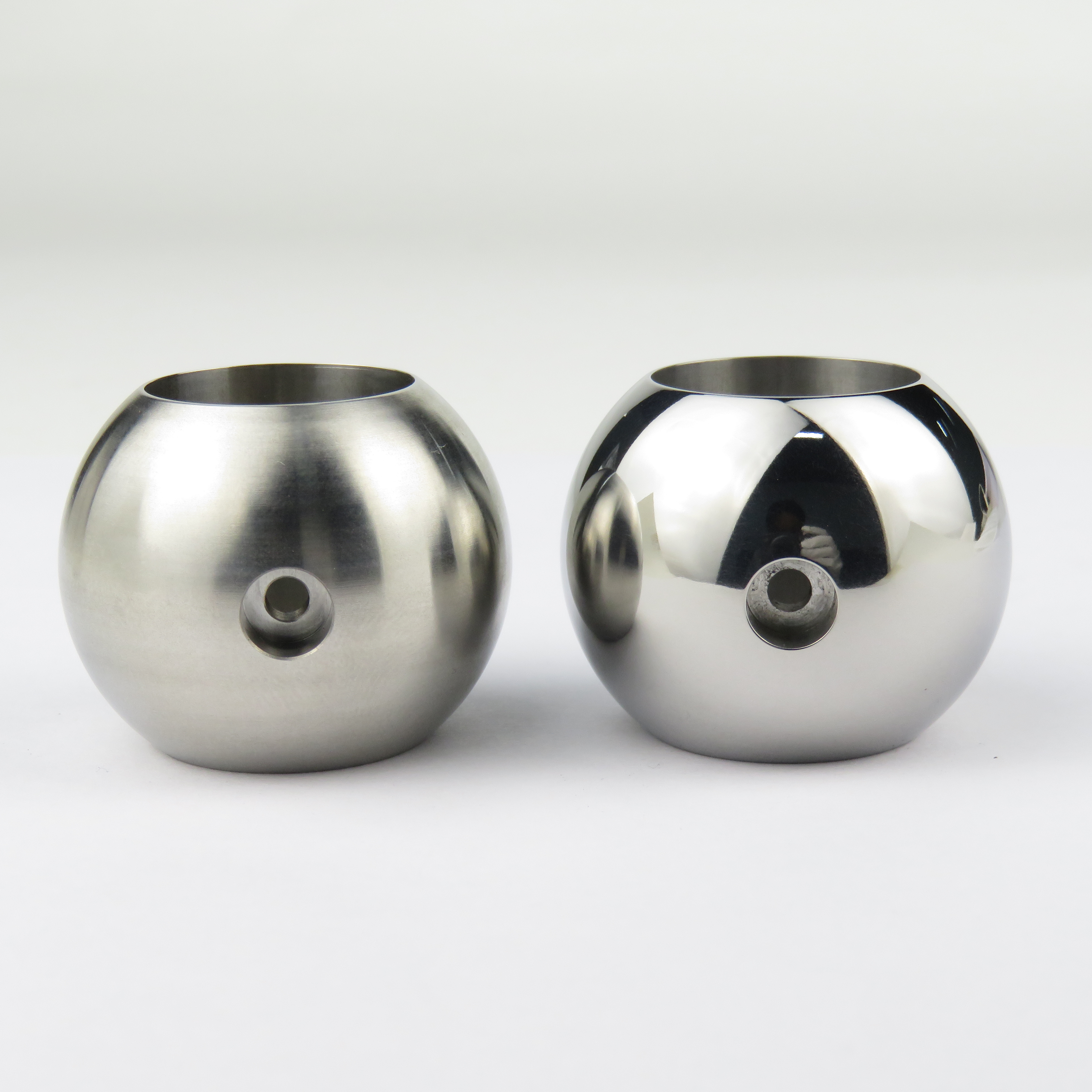
Chloride is the first thing to establish on stainless, because a chloride-bearing fluid left in contact with a sensitised or stressed surface is a pitting risk, and residue trapped in a crevice is worse than residue on an open face. Ask for compound composition data and set your own limit against your material and service conditions, and check the rinse water too, since a plant supply can carry chloride that the compound does not. Concentration and flow affect how much residue remains, and rinsing and drying determine whether it stays. Mechanical finishing does not remove the need for those limits; it makes them part of the specification.
Send representative parts, including the most difficult geometry in the family, and SurfacePolish runs them through a mechanical finishing route and returns the tested parts with observations and a proposed media, compound and cycle direction. The report describes what was seen on those parts under those settings. It is not a guarantee of a roughness value, an edge dimension, a cycle time, a capacity, a cost or a delivery date, and it does not qualify a process for any regulated use. Production variation in material, welding and fit-up is not represented by a small trial load, so your own verification still decides.
They are different operations rather than interchangeable ones. Mechanical finishing can remove a weld cap and oxide where a medium or tool physically reaches, and it refines the surface it contacts. Electrochemical polishing removes a thin layer more uniformly and can reach inside small-bore tubing and enclosed channels that no tumbling medium enters. A mechanical route is usually the practical answer for accessible weld zones and external surfaces, and it cannot level the inside of a long narrow tube. Whether that reach matters on your part is the decision; a trial at Glasgow can show what was reached on the parts tested.
Use Glasgow, United Kingdom as the destination on the enquiry and state whether the deliverable is equipment, media and compound, a representative sample review or a line concept. A destination does not imply local stock, a local service point or a local delivery time.
UKCA or CE marking with a Declaration of Conformity applies to machinery placed on the Great Britain market, HSE's work equipment and machinery and COSHH regimes cover operation and hazardous substances, and Scotland's aerospace and defence buyers normally receive quality and assurance requirements flowed down from primes such as those represented on the ADS Scotland Council.
Sources were retrieved on 2026-09-29 and describe the local industrial and trade context only. They do not evidence any SurfacePolish project, shipment, installation or service in Glasgow.
The buyer needs consistent edge and surface refinement across a large fitting batch without damaging machined gasket faces or losing parts in the load.
Send the material, dimensions, approximate weight, batch quantity, the incoming condition and photographs of the difficult features. Mark which features must not be contacted by media and state how the result will be inspected. This form carries source reference PSEO-0264; quote it if you prefer an additional manual reference.
Open the SurfacePolish enquiry form Email a prepared enquiry
No price, lead time, certification or result is promised here. Confirm whether a sample trial is available for the specific part and what the trial can and cannot show.
Page PSEO-0264 · revised 2026-09-29 · cross-border equipment, media and scoped sample review. City context is sourced and cited above.
Use this local checker to identify missing part and inspection information. It prepares a technical-review brief; it does not approve a machine, process recipe or production result.
Complete the part details to prepare a review brief.
Email : info@surface-polish.com


 IPv6 network supported


 +86-592-2381506