A heat exchanger supplier in Leeds, United Kingdom working with food processing equipment has 316L plates whose corrugations and gasket grooves must survive finishing unchanged. The surface requirement is modest but the geometry is unforgiving, so the buyer needs to know whether any tumbling route can work at all or whether the plates must be handled individually. SurfacePolish supplies machines, media and compounds across borders and runs a free sample trial. This brief is written for a buyer in Leeds working on food processing equipment; it describes equipment, media and a scoped sample review, not a local polishing service.
Which internal surfaces can a mechanical route physically reach, and what happens to the zones it cannot?
What must the finished surface survive in service, including cleaning cycles, and how will that be checked without leaning on a finishing trial?
Which surfaces on this part touch product, and what does each one have to satisfy in roughness, oxide freedom, edge condition and cleanliness?
Welds are where hygienic stainless equipment most often fails a surface requirement, so screen the weld itself rather than the nominal part. Record the process, whether the cap is left proud or ground flush, whether there is spatter, undercut, overlap or a stop-start, and the colour of any heat tint from straw through blue to grey-black, since colour is a rough practical indicator of oxide thickness. Note whether the weld sits in a product-contact zone, at a gasket seat, or in a crevice where two surfaces meet. A weld that will be dressed mechanically needs enough cap material to remove without undercutting the parent metal, while a weld that will only be brushed needs a different acceptance conversation. Photograph each weld family before and after any dressing already applied.
The compound does the cleaning, descaling, foam control and fine abrasive work that media alone cannot, and its chemistry family has to match the alloy. On stainless the critical questions are pH through the cycle and the chloride content of both the compound and the water used to mix and rinse it, because a chloride-bearing fluid on a sensitised or stressed surface is a pitting risk, and a residue left in a crevice is worse. Concentration and flow rate set how fast the work proceeds and how well the load is kept clean; too little compound leaves swarf and sludge on the part, while too much can foam, cushion the media and slow the cut. Water hardness affects how the compound behaves and how the rinsed surface dries. Ask for composition data and set limits.
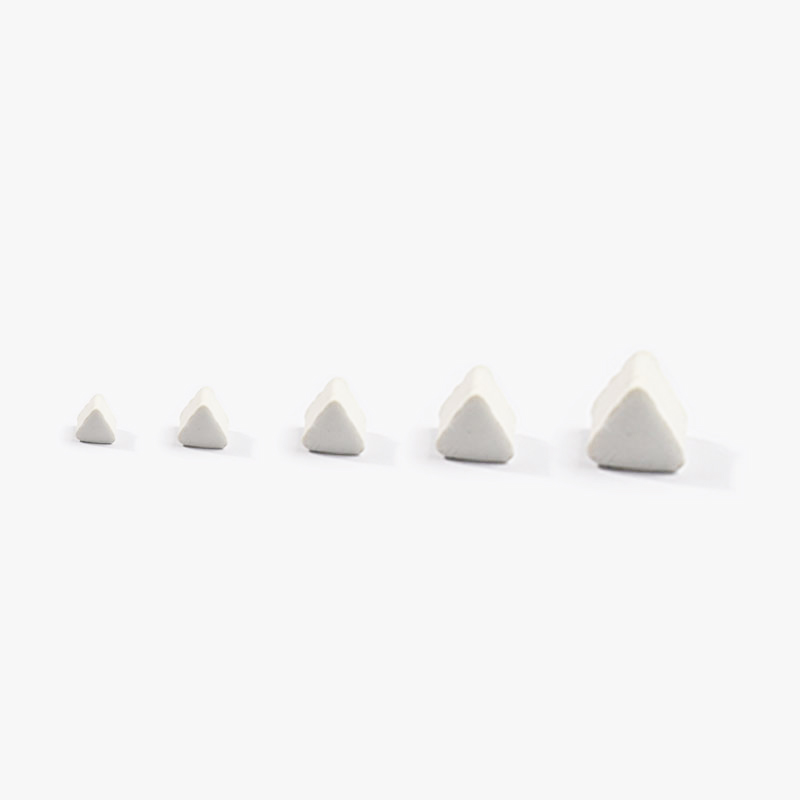
| Media | Best fit | Watch out for |
|---|---|---|
| Steel media, balls and diagonals | Bright surface refinement on robust stainless parts where a dense medium is wanted to work into recesses. | Can transfer iron to stainless, imprint soft or thin features, flatten a deliberate edge radius, and needs magnetic recovery. |
| Dry media, walnut shell and corn cob | Light dry burnishing and cosmetic refinement where retained water in a crevice or assembly is a problem. | Generates dust requiring extraction, removes no oxide, and leaves a surface character different from a wet abrasive cycle. |
| Liquid compound, abrasive cleaning slurry family | Cleaning, descaling and fine abrasive work through the cycle, with dosing and flow matched to the load and the alloy. | Chloride content and pH matter on stainless, foam can cushion the cut, and residue left in a crevice becomes a later defect. |
| Plastic media, cones and triangles | Gentle edge blending and cosmetic refinement on softer non-ferrous fittings, thin sections and delicate parts. | Cannot remove heat tint, mill scale or a weld cap, so it must follow the operation that does that work. |
Magnetic finishing uses small steel pins or fine media driven by a rotating magnetic field, which lets it work inside small bores, slots and blind features that tumbling media cannot enter, and the pin-like medium is less likely to lodge than a shaped ceramic piece. It suits small precise components rather than large panels or long tubes, and it will not remove a proud weld cap. A dry route, using dry media on a dry polishing machine, is chosen when retained water in a crevice or an assembly is a problem, or when a light cosmetic refinement is wanted on a part that must not be wet. Dry processing generates dust and cannot remove heat tint or oxide, so it complements rather than replaces a wet abrasive stage. The dryer after a wet cycle is a process step, not an afterthought.
| Machine route | Where it fits | What it will not do |
|---|---|---|
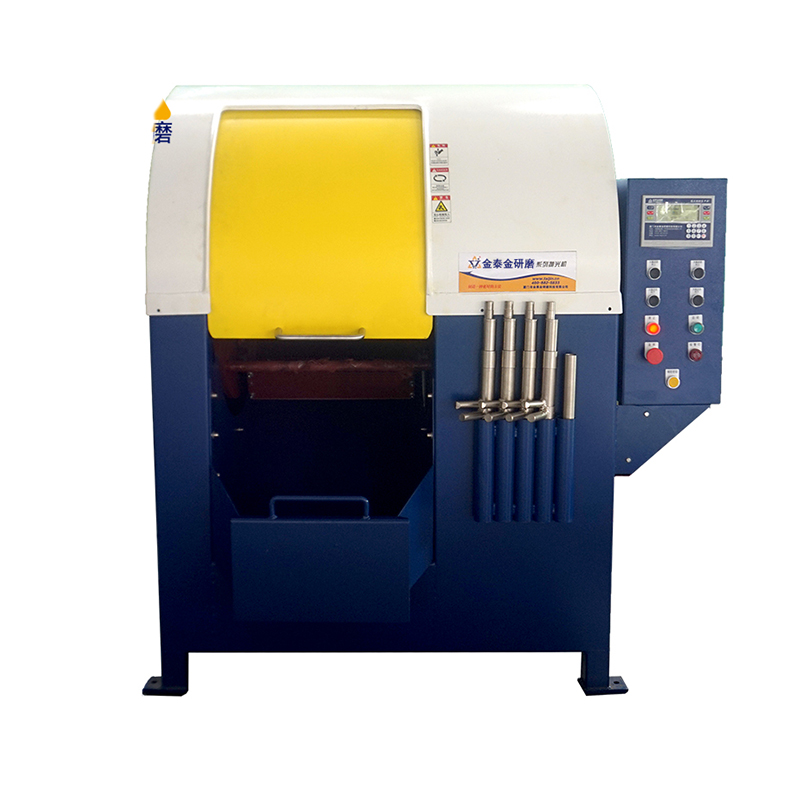
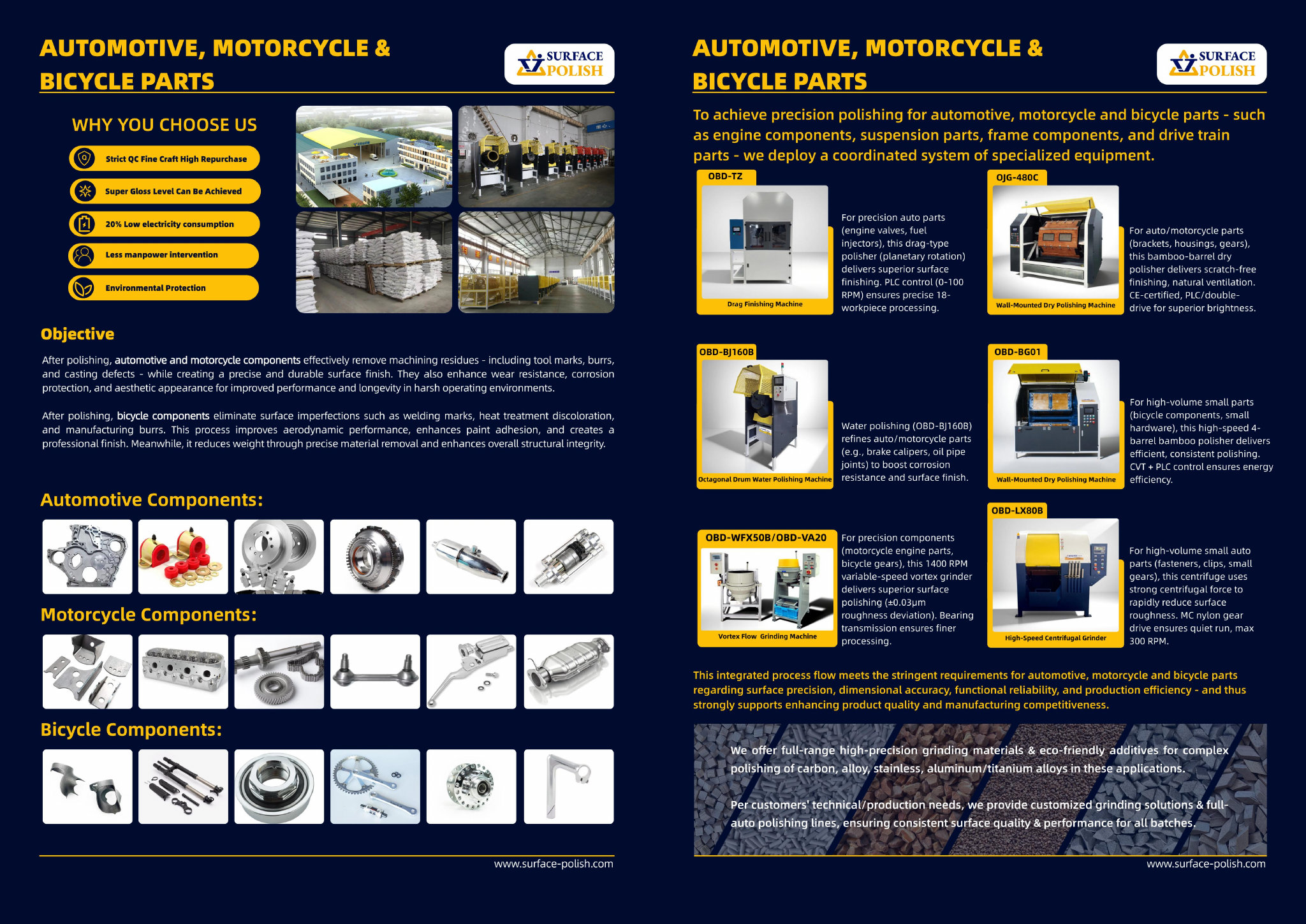
| Centrifugal barrel finishing machine | Higher-energy cycles that shorten the time to blend an edge or refine a small part in quantity. | The added energy increases over-rounding and imprinting risk, and delicate or mixed-size loads need careful planning. |
| Disc finishing machine | High-energy work on flat faces, flanges and convex zones where material removal or fast refinement is wanted. | Poor reach into recesses and around complex geometry, and it can dish a flat face if the cycle is not controlled. |
| Grinding finishing machine | Removing a proud weld cap, heavy scale and heat tint before any tumbling or refinement stage. | Leaves a scratch pattern that needs refining, can smear oxide, and iron-bearing tooling can deposit free iron on stainless. |
| Tub vibrator | Long parts, tube spools, chute sections and small vessels that a bowl cannot accept, with the part repositioned as needed. | Coverage depends on how the part sits in the media mass, so banding and shadow zones are common without a planned fixture. |
Abrasive media working on a tinted weld can smear and burnish the oxide into a smooth, shiny, deceptive layer instead of cutting through it. The surface reads better visually than the starting condition while the chromium-depleted zone underneath is unchanged, and roughness readings may even improve because the profile has been flattened. This is most likely where a cycle is too gentle or too short for the oxide thickness, or where the compound is cleaning rather than cutting. Detection means looking at the transition zone rather than the cap: a dye-based or free-iron check, a cross-section of a sample part, or a controlled comparison between a mechanically worked area and a freshly ground area. Refinement should only follow a stage that genuinely removed the oxide, which is why sequence matters more than final polish.
| Failure mode | Likely cause | How to catch it |
|---|---|---|
| Gasket seat or sealing face dished so it no longer seals | Over-finishing a machined face, part-on-part contact in an unseparated load, or media hammering a face that should have been masked. | Check flatness of the sealing face with a straight edge, a feeler gauge or a surface plate before and after, and confirm against the sealing requirement the buyer's specification states. |
| Rust bloom or free-iron staining appearing after finishing | Carbon steel brushes, iron-bearing media, shared racks or contaminated rinse water depositing free iron on a 304 or 316L surface. | Run a ferroxyl-type test or the buyer's own equivalent at agreed locations including crevices and internal surfaces, after rinsing and drying, and record the result with the batch. |
| Compound residue or dried film trapped in crevices and threads | Insufficient rinse volume, a rinse that does not reach the recess, or draining in an orientation that holds fluid in place. | Wipe or swab the recess with a clean white cloth and inspect, run a water-break or residue check on product-contact surfaces, and re-check after changing rinse volume or orientation. |
| Ceramic or steel media fragments embedded in the surface | Chipped or worn media, excessive cycle energy on a soft or thin feature, or a broken piece recirculating in the load. | Inspect under magnification at low angle, screen the media for broken pieces, and check the surface before and after a refinement stage to see whether fragments were present earlier. |
Leeds is in West Yorkshire and forms part of the Yorkshire and The Humber region, whose manufacturing output Make UK now records as having exceeded 2019 levels along with every other English region, with aerospace and defence investment fuelling growth in the strongest-performing areas. The West & North Yorkshire Chamber of Commerce represents the city through its Leeds Chamber and publishes Local Skills Improvement Plans for West Yorkshire. Leeds Bradford Airport is the city's airport, marketing flights to over 80 destinations from Yorkshire, while Yorkshire's sea freight moves through the Humber ports, where ABP operates Immingham, the UK's largest port by tonnage at around 46 million tonnes a year, and Hull.
The nearest part of that base to this brief is machinery: Make UK records that all English regions have now exceeded 2019 manufacturing output levels, and West Yorkshire sits inside the Yorkshire and The Humber manufacturing base covered by that measure.
Leeds finishing demand is best treated as regional rather than city-specific: Yorkshire and The Humber has an active goods-producing base whose output feeds national assembly and construction supply chains, and machined or formed parts entering those chains still need burrs and edges controlled. The acceptance criterion - surface texture, edge condition or cleanliness - is what determines the process, and it is normally set by the customer's drawing rather than by local convention.
A Leeds buyer should establish first whether the part's acceptance criterion is a surface-texture value, an edge condition or a cleanliness level, then confirm media and compound compatibility with the workpiece material before committing to a machine type.
Freight context: Leeds Bradford Airport, Port of Immingham (ABP) - the UK's largest port by tonnage, on the Humber, Port of Hull (ABP) - container terminal and Humber offshore wind base. Leeds Bradford Airport presents itself as the airport for the heart of Yorkshire, and ABP's Humber ports are the region's deep-sea and short-sea gateways: ABP states that Immingham handles around 46 million tonnes of cargo a year and that Hull is the UK's leading softwood timber port and the focus of the offshore wind sector on the Humber.
Importers need a GB-prefixed Economic Operators Registration and Identification (EORI) number, an import declaration carrying the correct commodity code, and retained commercial invoices plus the Import VAT Certificate (C79) so import VAT can be reclaimed. Machinery placed on the Great Britain market must be marked UKCA or CE: the manufacturer must draw up and retain technical documentation including a Declaration of Conformity, apply the correct marking with identification details, and cooperate with market surveillance; an authorised representative must be established in the UK. Under the Product Safety and Metrology (Amendment) Regulations 2024 the UK continues to recognise CE marking alongside or in place of UKCA for the Great Britain market, so either route can be used for most product types. Duty and import VAT are calculated from the customs value declared, and the commodity code also determines whether an import licence is needed.
BSI is the UK's National Standards Body, and British Standards (BS, including adopted BS EN ISO texts) are the documents a UK buyer's surface-finish, edge and cleanliness specifications are normally written against and purchased through. On the plant side, HSE maintains the work equipment and machinery topic covering the safe supply and use of machinery, and the COSHH regime, which requires employers to identify, assess and control risks from hazardous substances - the regime that applies to finishing compounds, abrasive media and the dust and effluent they generate.
SurfacePolish supplies from Xiamen, China. The buyer's own destination rules, conformity marking, tariff classification and documentation responsibilities stay with the buyer; confirm them against the authorities named above before ordering.
Visual acceptance is only repeatable when the viewing conditions are fixed. Agree the light source, distance, angle and magnification, whether raking light is used to reveal tint and scratches, and whether comparison is made against a physical reference or a photograph taken at the same settings. Define what counts as a defect: a colour band, a scratch, the scratch pattern left by coarse abrasive, a water spot, a handling mark. Internal surfaces need their own method, usually a borescope at an agreed insertion depth and view angle, with images retained so a later batch can be compared. Photographs are the practical record in a cross-border discussion, because a described appearance travels badly while a fixed-angle image travels well. Both sides should work from the same written standard.
Media is a consumable with a working life, and treating it as a fixed asset is a common reason a validated-looking process drifts. Plan for screening fines and broken pieces out, topping up to hold the size class and the load volume, and recording what was added and when. Compound concentration, dosing rate and rinse water quality need the same discipline, including a chloride check where the buyer's own requirements limit it, because concentration that creeps upward changes both the cut and the residue left behind. Sludge and spent compound have to be removed on a schedule, not when the chamber looks bad. Store media and compound so they cannot pick up contamination from a carbon steel fabrication area. Write the routine down, because a process that depends on one experienced operator is not yet a line.
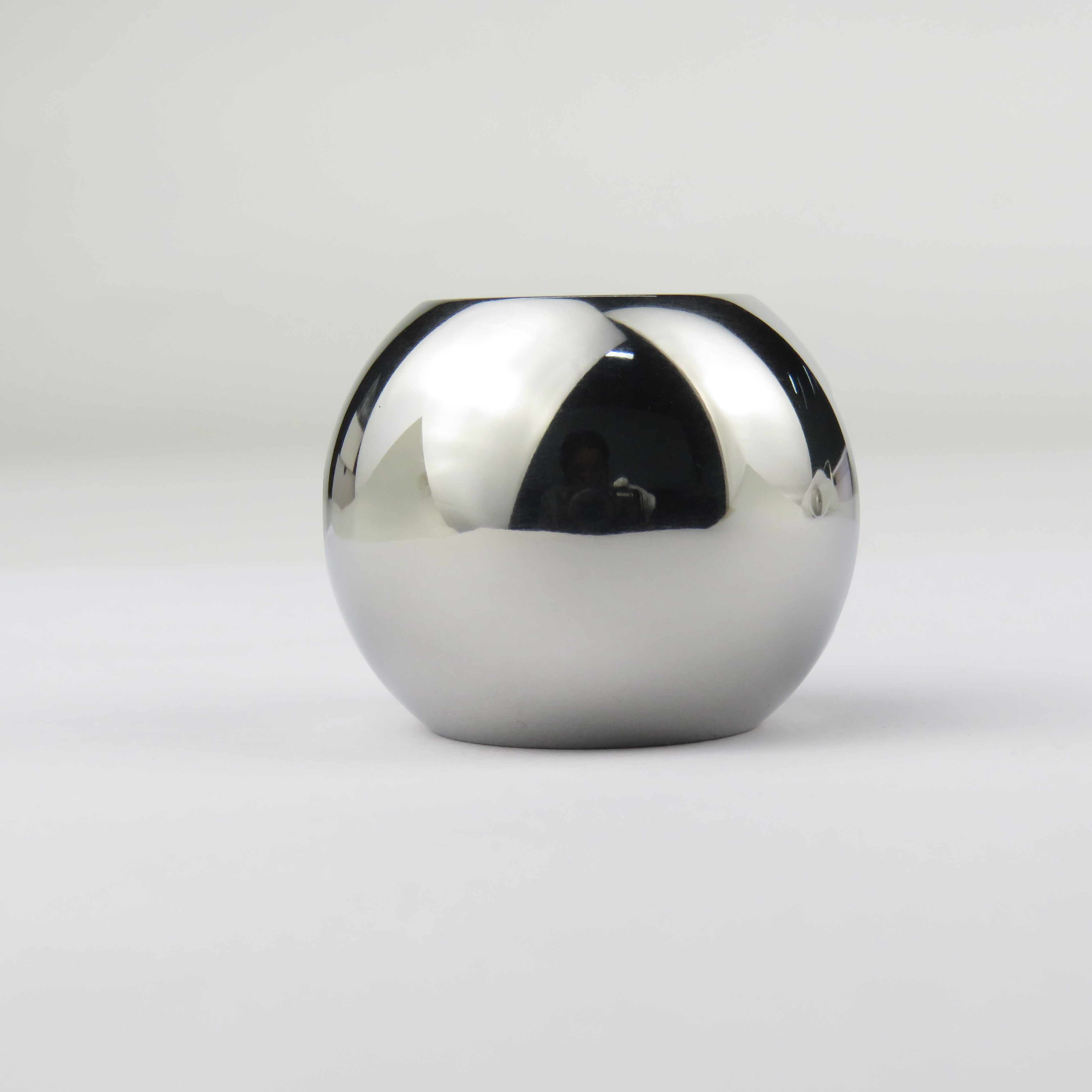
Heat tint is oxide, so it is removed by cut rather than by cleaning. Ceramic media with an aggressive shape and bonding, or a grinding stage followed by refinement, are the usual mechanical answers on accessible weld zones. The limit is reach: a tint line that runs into a toe, a crevice or a small bore may survive a cycle that polishes the cap, which is why the toe should be inspected rather than judged by the shine of the weld face. Media size, shape and cycle energy must suit the oxide thickness. A trial on your own parts shows what was removed on the geometry tested.
It can, and the source is usually the tooling or the consumable rather than the stainless itself. Carbon steel brushes, wire wheels, blasting grit, iron-bearing media, shared racks and contaminated rinse water can all deposit free iron that appears later as a rust bloom. Control means dedicated stainless tooling and racks, documented grades for everything that touches the surface, and a cleaning step after mechanical work. Detection is by a ferroxyl-type test or an equivalent method chosen by your own quality function, applied at agreed locations including crevices. The acceptance decision and its critical locations remain yours.
No. SurfacePolish supplies finishing machines, media and compounds, and no machine, medium, compound or process is presented as approved, certified or qualified for food contact, hygienic service or any regulated application. Certification of that kind depends on the finished equipment, its design, its materials and the way it is operated, and it is defined and verified by your own quality and regulatory functions against the requirements that apply to your market. What a supplier can provide is equipment and consumables information, including composition data for media and compounds, so your own assessment has something to work from. A sample trial is not a certification.
Use Leeds, United Kingdom as the destination on the enquiry and state whether the deliverable is equipment, media and compound, a representative sample review or a line concept. A destination does not imply local stock, a local service point or a local delivery time.
UKCA or CE marking with a Declaration of Conformity is required for machinery placed on the Great Britain market, HSE's work equipment and machinery topic and COSHH cover safe operation and hazardous substances, and buyers in aerospace-linked West Yorkshire supply chains normally receive these requirements already flowed down from the prime contractor's specification.
Sources were retrieved on 2026-09-29 and describe the local industrial and trade context only. They do not evidence any SurfacePolish project, shipment, installation or service in Leeds.
The buyer needs the plate surfaces and groove edges finished without distorting the corrugations or changing groove depth.
Send the material, dimensions, approximate weight, batch quantity, the incoming condition and photographs of the difficult features. Mark which features must not be contacted by media and state how the result will be inspected. This form carries source reference PSEO-0244; quote it if you prefer an additional manual reference.
Open the SurfacePolish enquiry form Email a prepared enquiry
No price, lead time, certification or result is promised here. Confirm whether a sample trial is available for the specific part and what the trial can and cannot show.
Page PSEO-0244 · revised 2026-09-29 · cross-border equipment, media and scoped sample review. City context is sourced and cited above.
Use this local checker to identify missing part and inspection information. It prepares a technical-review brief; it does not approve a machine, process recipe or production result.
Complete the part details to prepare a review brief.
Email : info@surface-polish.com


 IPv6 network supported


 +86-592-2381506