A conveyor maker in New York, United States serving food processing equipment has a thin 304 chute with long weld seams and a folded edge that carries stiffness. Weld dressing is wanted, but a heavy tumbling cycle would thin the sheet and round the fold, so the route must suit the material thickness. SurfacePolish supplies finishing equipment, media and compounds across borders and runs a free sample trial on parts sent in. This brief is written for a buyer in New York working on food processing equipment; it describes equipment, media and a scoped sample review, not a local polishing service.
What must the finished surface survive in service, including cleaning cycles, and how will that be checked without leaning on a finishing trial?
Does the route have to remove heat tint and restore a passive condition, or refine a surface that is already clean, and who verifies that difference?
Which surfaces on this part touch product, and what does each one have to satisfy in roughness, oxide freedom, edge condition and cleanliness?
Before any trial, fix the starting condition in a way that can be compared later. Take roughness readings at agreed locations, photograph the part under consistent lighting, note visible burrs, tint and scratches, and keep one untouched part as a reference. Describe the batch: how many pieces of each size, whether they are identical, and whether mixed sizes will share a chamber. Decide how parts will be separated, racked or compartmented, and which surfaces may touch each other or a fixture. Handling rules matter as much as process settings on stainless, because a bench, a rack or a glove that has touched carbon steel can leave the contamination that later appears as a rust bloom. Write the baseline down, because a trial without an incoming record produces observations nobody can interpret.
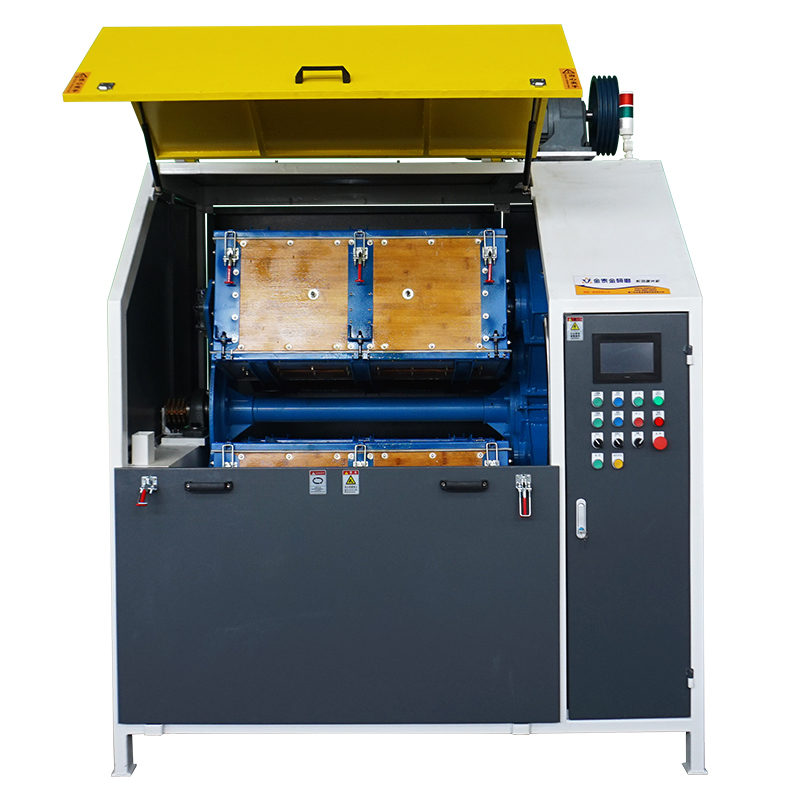
A tub vibrator gives a long, open chamber that accepts parts a bowl cannot, including tube spools, chute sections, small vessels and long fabrications. The part can be repositioned, rotated or left static depending on what has to be reached, and the open design makes it easier to watch what is happening to a weld during the cycle. The trade-off is evenness: coverage depends on how the part sits relative to the media mass, so banding and untouched shadow zones are common unless fixture and part orientation are planned. Internal surfaces of a long small-bore tube remain out of reach regardless of tub size. Tub capacity, media volume, how the part is supported and how it is lifted in and out should be settled before the route is accepted.
| Machine route | Where it fits | What it will not do |
|---|---|---|
| Vibratory finishing machine, bowl type | Edge and weld-toe blending plus surface refinement on mid-sized parts, with a visible load and adjustable energy. | Chamber geometry caps part size, and the inside of a long tube or a narrow crevice stays out of reach. |
| Grinding finishing machine | Removing a proud weld cap, heavy scale and heat tint before any tumbling or refinement stage. | Leaves a scratch pattern that needs refining, can smear oxide, and iron-bearing tooling can deposit free iron on stainless. |
| Centrifugal barrel finishing machine | Higher-energy cycles that shorten the time to blend an edge or refine a small part in quantity. | The added energy increases over-rounding and imprinting risk, and delicate or mixed-size loads need careful planning. |
| Magnetic finishing machine | Small precise parts and short internal features such as slots, small bores and blind recesses. | Part size and surface area are limited, large panels and long tubes are out of scope, and it will not dress a weld cap. |
Media that leaves the chamber with the parts is a defect, not a housekeeping issue, so separation is designed rather than improvised. Screens sized below the smallest medium and above the largest acceptable chip, magnetic separators for steel media, and a counted retrieval step for any feature that can trap a piece all belong in the plan. Media wear management is the other half: as ceramic wears the load loses cut, so a schedule for top-up, screening out fines and removing broken pieces keeps the process from drifting. Compound carryover into threads, gasket grooves and tube ends is controlled by rinse volume, rinse water quality, orientation while draining and drying. Sludge and spent compound disposal is a production cost and a housekeeping discipline that should be costed before a line is specified.
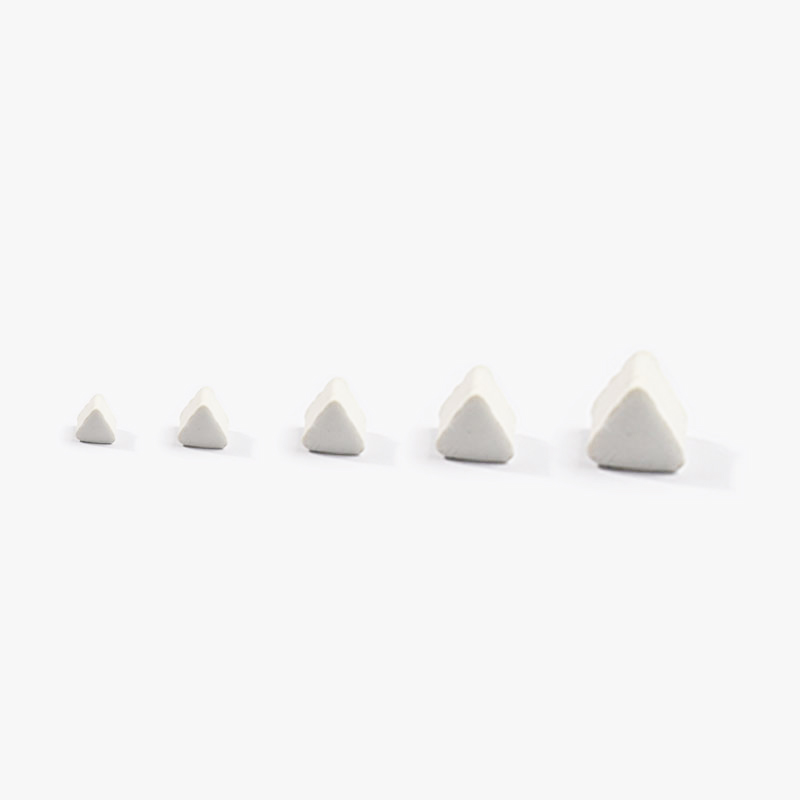
| Media | Best fit | Watch out for |
|---|---|---|
| Steel pins and fine media for magnetic finishing | Small precise components, short bores, slots and blind features that shaped tumbling media cannot enter. | Limited to small parts, will not remove a proud weld cap, and pins must be counted and recovered from every opening. |
| Dry media, walnut shell and corn cob | Light dry burnishing and cosmetic refinement where retained water in a crevice or assembly is a problem. | Generates dust requiring extraction, removes no oxide, and leaves a surface character different from a wet abrasive cycle. |
| Liquid compound, abrasive cleaning slurry family | Cleaning, descaling and fine abrasive work through the cycle, with dosing and flow matched to the load and the alloy. | Chloride content and pH matter on stainless, foam can cushion the cut, and residue left in a crevice becomes a later defect. |
| Steel media, balls and diagonals | Bright surface refinement on robust stainless parts where a dense medium is wanted to work into recesses. | Can transfer iron to stainless, imprint soft or thin features, flatten a deliberate edge radius, and needs magnetic recovery. |
Free iron on stainless usually comes from tooling and consumables rather than from the part: carbon steel brushes, wire wheels, blasting grit or shot, iron-bearing media, shared racks, gloves that have handled mild steel and water from a contaminated line. It appears days or weeks later as a bloom of rust, often localised near a weld or a crevice. Detection uses a ferroxyl-type test or an equivalent method chosen by the buyer's own quality function, applied at the agreed locations including crevices and internal surfaces after finishing and rinsing. Control is separation: dedicated stainless tooling, media and racks; documented grade of every consumable that touches the surface; and a cleaning step after mechanical work. An upstream acid pickle or electrochemical polish brings its own concerns, including hydrogen, and sits outside what finishing equipment does.
| Failure mode | Likely cause | How to catch it |
|---|---|---|
| Uneven finish, banding or untouched shadow zones across one part | Part position in the chamber, a fixture holding a surface out of the media mass, or a load that is too full or too empty for even contact. | Take roughness readings at several marked locations instead of one, photograph at fixed angles around the part, and compare parts from the top and bottom of the same load. |
| Cross-contamination from tooling, racks or media shared with carbon steel | No dedicated stainless area, undocumented consumable grades, or media stored where mild steel fabrication dust settles. | Audit which tools, racks and media touch the part, record their grades, store media covered and segregated, and confirm cleanliness with the buyer's own test after a tooling change. |
| Thin-wall distortion or dishing on tanks, panels and chutes | Heavy media load striking unsupported thin sheet, or a chamber fill level that lets parts fall rather than tumble. | Measure wall flatness and key dimensions before and after, inspect under raking light for oil-canning, and run the test at the production fill level rather than a light one. |
| Compound residue or dried film trapped in crevices and threads | Insufficient rinse volume, a rinse that does not reach the recess, or draining in an orientation that holds fluid in place. | Wipe or swab the recess with a clean white cloth and inspect, run a water-break or residue check on product-contact surfaces, and re-check after changing rinse volume or orientation. |
New York City's industrial base sits in planned industrial parks and industrial business areas rather than heavy plant. The Brooklyn Navy Yard is a 300-acre, city-owned industrial park managed by the Brooklyn Navy Yard Development Corporation, home to more than 550 businesses and approximately 13,000 workers, and the Corporation describes it as one of the City's most important industrial waterfront assets and leases space across industries from the arts to startups and advanced manufacturers. Made in NYC, an initiative of the Pratt Center for Community Development, counts a community of 1,900 New York City makers and manufacturers whose member directory is organised by product and service categories including advanced and specialty manufacturing, metal and jewellery, digital fabrication, wood and furniture, and food and beverage. The region's freight gateway is the Port of New York and New Jersey, which the Port Authority describes as the largest port on the East Coast and the second largest in the nation, and the New York Fed publishes regional economic indicators and monthly surveys covering 22 local areas of the Second District, which includes New York City.
For this brief the relevant part of that base is food: Made in NYC's member directory organises New York City makers and manufacturers by product category and includes Food & Beverage as one of them.
New York's finishing demand is dominated by small and mid-size metalworking, fabrication and machining shops rather than one large plant, so the work is typically high-mix and low-volume: architectural and construction metalwork, food-equipment and food-service stainless, and machined or laser-cut components where deburring and edge control are the difference between a part that passes inspection and one that does not. Space, noise and effluent constraints in a dense city also push shops toward barrel, vibratory and disc finishing over processes with heavy waste streams.
The question to settle first is whether the shop is finishing architectural and construction metalwork, food-service stainless, or precision machined parts, because each needs a different balance of edge radius, burr removal and cleanliness - and in a dense city the choice is also constrained by floor space, noise and effluent limits.
Freight context: Port of New York and New Jersey (Port Newark, Elizabeth, Bayonne, Howland Hook, Red Hook), John F. Kennedy International Airport (JFK), Newark Liberty International Airport (EWR), ExpressRail intermodal terminals. The Port Authority of New York and New Jersey describes its port as the largest on the East Coast and the second largest in the nation, and the port's ExpressRail system provides dedicated on-dock rail for each major container terminal, aimed at inland markets including Chicago, the Ohio Valley and Eastern Canada. Imported machinery and sample parts would be entered through CBP at the seaport or at JFK/EWR, with country-of-origin marking and HTSUS classification as part of the entry file.
Business is conducted in US English. Units matter: US drawings and purchase orders frequently use inches, microinch Ra and US gallons, and a supplier that quotes only metric can be asked to reissue documentation. Buyers are US legal entities with an EIN and expect an identifiable contracting entity, a correct HTSUS classification, a commercial invoice, packing list and bill of lading, country-of-origin marking, and an importer of record for customs. Procurement is normally evidence-driven: process selection is expected to be justified by a trial run on the buyer's own sample parts with measured results (burr height, edge radius, Ra, cleanliness) and by media and compound data sheets, rather than by a capability claim. Payment terms in general US industrial practice are open account with net-30 to net-60 terms for established buyers, with letters of credit or advance payment more common for a first order from a new overseas supplier; no US buyer assumes Incoterms, warranty terms or spare-parts lead times unless they are stated in the quotation.
The customs authority is U.S. Customs and Border Protection (CBP), part of the Department of Homeland Security. The importer of record files an entry and then an entry summary (CBP Form 7501): '"Entry Summary" refers to the documentation necessary to enable U.S. Customs and Border Protection to assess duties, collect statistics, and determine whether other requirements of law have been met.' Classification is made in the Harmonized Tariff Schedule of the United States, and an importer may request a written CBP ruling on the correct HTSUS classification and rate of duty, which is the practical way to confirm the treatment of a finishing machine before shipment. Every article of foreign origin must be marked with the English name of its country of origin 'in a conspicuous place as legibly, indelibly, and permanently as the nature of the article (or container) will permit' under 19 U.S.C. 1304 and 19 CFR 134.11. The $800 de minimis (Section 321) exemption is no longer available for ordinary freight: CBP suspended it indefinitely for all modes other than the international postal network effective 24 June 2026, so even low-value sample parts and media must go through formal or informal entry and pay applicable duty. General US industry practice is that there is no single machinery conformity mark comparable to the EU's CE marking; buyers instead verify electrical components and control panels, machine guarding against workplace-safety requirements, and any customer-specific qualification.
SurfacePolish supplies from Xiamen, China. The buyer's own destination rules, conformity marking, tariff classification and documentation responsibilities stay with the buyer; confirm them against the authorities named above before ordering.
Acceptance has to exist before finishing begins, otherwise every batch becomes a negotiation about appearance. Write the requirement per zone: which surfaces are product-contact, what roughness band applies to each, which edges keep a radius, which faces stay flat, what cleanliness and residue condition is required, and which features come back untouched. Name the inspection method and instrument for each requirement and the person who accepts or rejects. Where a requirement comes from a design code or a customer specification, the buyer's own quality function states and verifies it. A first article fully inspected and retained as the physical reference removes most later argument, particularly on welds, where a kept part says far more than a written description. Re-confirm the requirement whenever drawing, material or upstream fabrication changes.
A sample trial reports what was observed on the parts tested under the settings used, and that is the whole of it. It cannot promise a roughness value, an edge dimension, a cycle time, a throughput, a cost per part or a delivery date, and it does not qualify a machine, medium, compound or process for food contact, hygienic service or any regulated application. A handful of parts does not represent production variation in material, welding or fit-up, and performance in service, including corrosion behaviour after cleaning and any passivation step, is not established by a finishing trial. What a trial does give is evidence: how a route behaved on real geometry, which zones it reached, what the surface looked like, and where a mechanical route runs out of reach. The decisions that follow belong with the buyer.

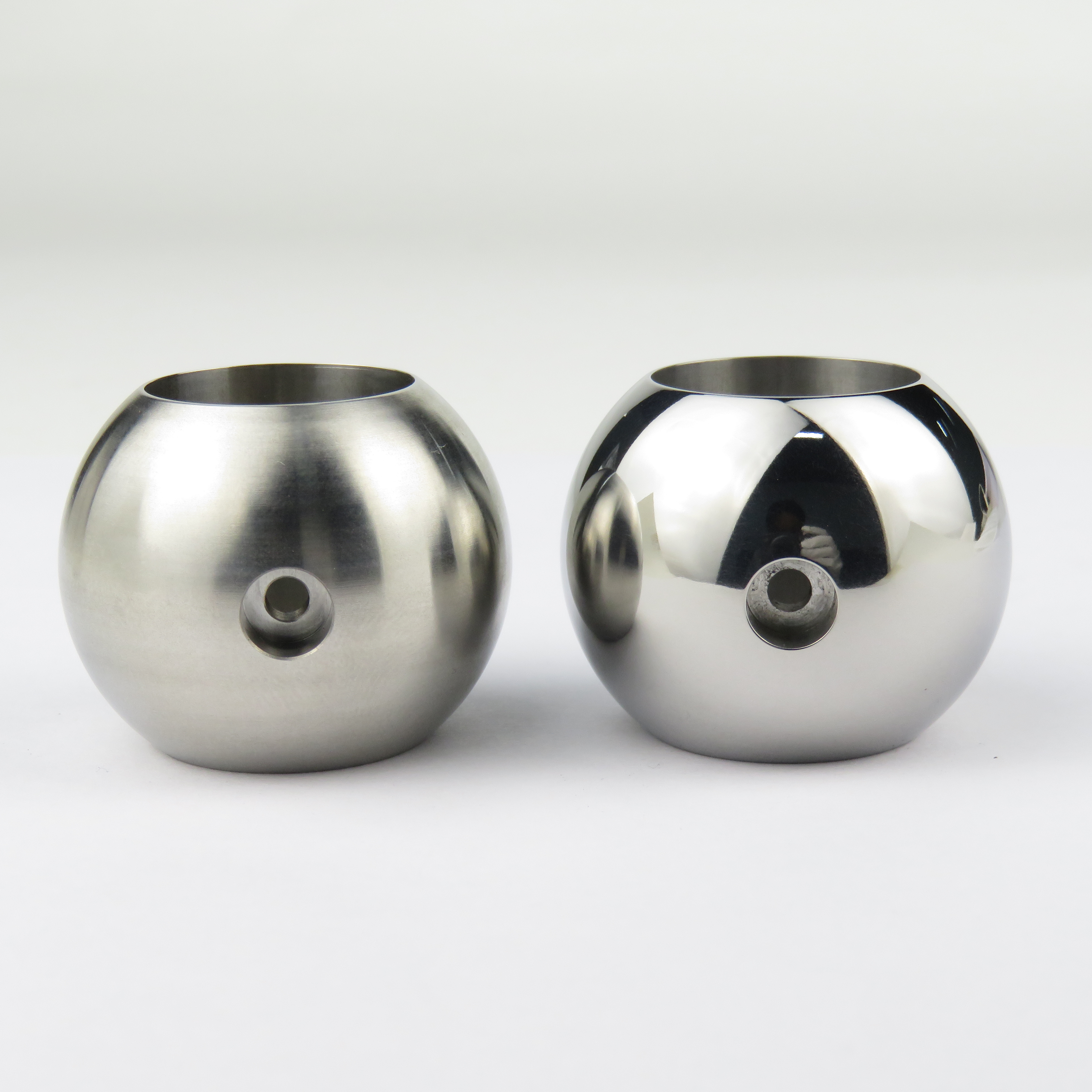
It can, and the source is usually the tooling or the consumable rather than the stainless itself. Carbon steel brushes, wire wheels, blasting grit, iron-bearing media, shared racks and contaminated rinse water can all deposit free iron that appears later as a rust bloom. Control means dedicated stainless tooling and racks, documented grades for everything that touches the surface, and a cleaning step after mechanical work. Detection is by a ferroxyl-type test or an equivalent method chosen by your own quality function, applied at agreed locations including crevices. The acceptance decision and its critical locations remain yours.
No. Mechanical finishing removes material and can strip oxide and free iron from the surfaces it touches, but it does not restore a passive film and it does not perform a chemical passivation step. Passivation, whether by a paste, a bath or an electrochemical process, is a separate operation with its own method and verification that belongs to your own specification and supply chain. Mechanical work can leave a surface in better or worse condition for that step, which is one reason media and compound selection on 316L should consider what comes afterwards rather than only the finish you see at the end of the cycle.
Heat tint is oxide, so it is removed by cut rather than by cleaning. Ceramic media with an aggressive shape and bonding, or a grinding stage followed by refinement, are the usual mechanical answers on accessible weld zones. The limit is reach: a tint line that runs into a toe, a crevice or a small bore may survive a cycle that polishes the cap, which is why the toe should be inspected rather than judged by the shine of the weld face. Media size, shape and cycle energy must suit the oxide thickness. A trial on your own parts shows what was removed on the geometry tested.
Use New York, United States as the destination on the enquiry and state whether the deliverable is equipment, media and compound, a representative sample review or a line concept. A destination does not imply local stock, a local service point or a local delivery time.
A New York buyer works in the US voluntary-consensus system coordinated by ANSI, with surface-finish, cleaning and coating requirements written into the drawing, purchase order or the building/food-service specification. New York City construction and food-service work adds local code and health-department requirements, and food-contact or medical work adds the customer's own material-conformity and cleanliness requirements on top.
Sources were retrieved on 2026-09-29 and describe the local industrial and trade context only. They do not evidence any SurfacePolish project, shipment, installation or service in New York.
The buyer wants the weld seams dressed and the sheet refined without thinning the panel or softening the folded edge.
Send the material, dimensions, approximate weight, batch quantity, the incoming condition and photographs of the difficult features. Mark which features must not be contacted by media and state how the result will be inspected. This form carries source reference PSEO-0044; quote it if you prefer an additional manual reference.
Open the SurfacePolish enquiry form Email a prepared enquiry
No price, lead time, certification or result is promised here. Confirm whether a sample trial is available for the specific part and what the trial can and cannot show.
Page PSEO-0044 · revised 2026-09-29 · cross-border equipment, media and scoped sample review. City context is sourced and cited above.
Use this local checker to identify missing part and inspection information. It prepares a technical-review brief; it does not approve a machine, process recipe or production result.
Complete the part details to prepare a review brief.
Email : info@surface-polish.com


 IPv6 network supported


 +86-592-2381506