A filling equipment builder in Yokohama, Japan working in food processing equipment has a 316L manifold with two dozen small orifices and a sealing face that must stay flat. Media small enough to pass a 1.5 mm hole can also disappear inside the part, so the buyer needs a route that deburrs without creating a retrieval problem. SurfacePolish supplies finishing machines, media and compounds across borders with a free sample trial. This brief is written for a buyer in Yokohama working on food processing equipment; it describes equipment, media and a scoped sample review, not a local polishing service.
What free-iron and chloride exposure does the process itself introduce, and can the buyer's own cleanliness test detect it before the part is released?
Does the route have to remove heat tint and restore a passive condition, or refine a surface that is already clean, and who verifies that difference?
What must the finished surface survive in service, including cleaning cycles, and how will that be checked without leaning on a finishing trial?
Grade and history determine what the surface can tolerate. Confirm whether the part is 304, 304L, 316 or 316L, whether it is annealed or cold worked, and whether a free-machining grade with added sulphur has been used in a product-contact position. Record every operation that has already touched the surface: forming, shot blasting, wire brushing with carbon steel, grinding with iron-bearing tooling, acid pickling, electrochemical polishing or an earlier mechanical polish. Each leaves a different starting condition and a different contamination risk. Note heat treatment and any sensitisation concern from welding or high-temperature service, because material condition affects how the surface behaves later and cannot be changed by finishing. Certificates for the delivered material and a written sequence of operations are the minimum evidence to request.
The compound does the cleaning, descaling, foam control and fine abrasive work that media alone cannot, and its chemistry family has to match the alloy. On stainless the critical questions are pH through the cycle and the chloride content of both the compound and the water used to mix and rinse it, because a chloride-bearing fluid on a sensitised or stressed surface is a pitting risk, and a residue left in a crevice is worse. Concentration and flow rate set how fast the work proceeds and how well the load is kept clean; too little compound leaves swarf and sludge on the part, while too much can foam, cushion the media and slow the cut. Water hardness affects how the compound behaves and how the rinsed surface dries. Ask for composition data and set limits.
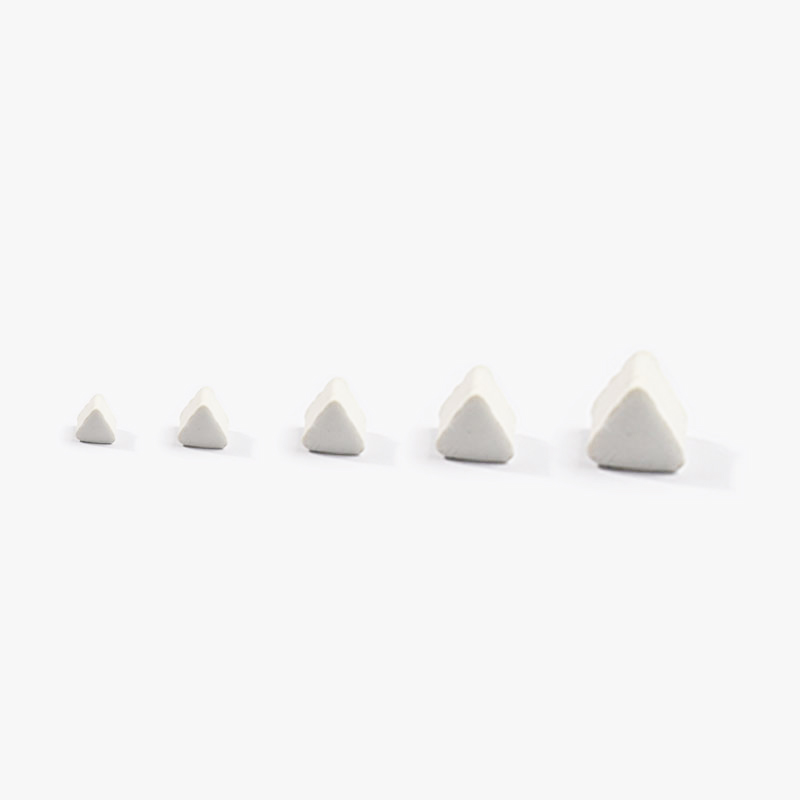
| Media | Best fit | Watch out for |
|---|---|---|
| Steel media, balls and diagonals | Bright surface refinement on robust stainless parts where a dense medium is wanted to work into recesses. | Can transfer iron to stainless, imprint soft or thin features, flatten a deliberate edge radius, and needs magnetic recovery. |
| Ceramic media, angle-cut triangles | Heavier weld-zone refinement and edge blending on 304 and 316L parts where a corner or a toe line has to be reached. | Wears down and changes its effective size class, produces sludge, and can over-round a thin edge or a soft detail. |
| Steel pins and fine media for magnetic finishing | Small precise components, short bores, slots and blind features that shaped tumbling media cannot enter. | Limited to small parts, will not remove a proud weld cap, and pins must be counted and recovered from every opening. |
| Ceramic media, small cylinders and spheres | General deburring and light radius work on hygienic fittings, with less edge cutting than an angle-cut shape. | Small sizes lodge in gasket grooves and drilled openings, and a sphere refines slowly where oxide is thick. |
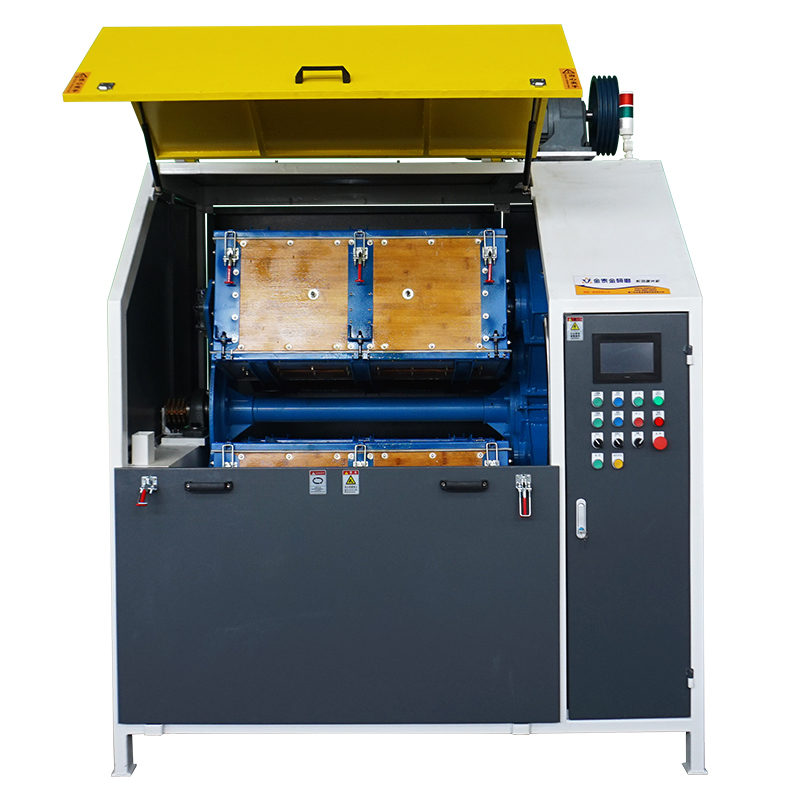
A bowl vibrator keeps a visible, continuously moving load and suits mid-sized parts where edges, weld toes and accessible external surfaces need blending and refinement. Energy is set by amplitude, motor speed and load fill, so one machine can deburr aggressively or refine gently, and the effect on a weld toe is judged by how much cap material the buyer is willing to lose. The bowl reaches external geometry and shallow recesses well, and it can carry compartments or fixtures to limit part-on-part contact on thin or appearance-critical pieces. It does not reach the inside of a long tube or a narrow crevice, and chamber geometry caps part size. Media class and fill level matter more than nominal machine size: an under-filled chamber raises impingement risk, and an over-filled one starves the part of contact.
| Machine route | Where it fits | What it will not do |
|---|---|---|
| Magnetic finishing machine | Small precise parts and short internal features such as slots, small bores and blind recesses. | Part size and surface area are limited, large panels and long tubes are out of scope, and it will not dress a weld cap. |
| Grinding finishing machine | Removing a proud weld cap, heavy scale and heat tint before any tumbling or refinement stage. | Leaves a scratch pattern that needs refining, can smear oxide, and iron-bearing tooling can deposit free iron on stainless. |
| Disc finishing machine | High-energy work on flat faces, flanges and convex zones where material removal or fast refinement is wanted. | Poor reach into recesses and around complex geometry, and it can dish a flat face if the cycle is not controlled. |
| Vibratory finishing machine, bowl type | Edge and weld-toe blending plus surface refinement on mid-sized parts, with a visible load and adjustable energy. | Chamber geometry caps part size, and the inside of a long tube or a narrow crevice stays out of reach. |
Removing material always changes the part, and the change is not always wanted. A weld toe can be rounded past the radius the drawing implies, a sealing lip can lose its bite, a gasket seat can dish enough to leak, and a thin tank panel can deflect under a heavy load. Media size class and density drive this: a large dense piece on a soft detail rounds it quickly, while a small light piece barely touches it. Detection uses an optical comparator or radius gauge on edges, a flatness check on sealing faces, and dimensional measurement of any feature that carries a tolerance. Dye penetrant or a visual check finds an undercut created by over-grinding a weld cap. Thin-wall parts deserve measurement before and after, because distortion in a small load only worsens at production fill levels.
| Failure mode | Likely cause | How to catch it |
|---|---|---|
| Rust bloom or free-iron staining appearing after finishing | Carbon steel brushes, iron-bearing media, shared racks or contaminated rinse water depositing free iron on a 304 or 316L surface. | Run a ferroxyl-type test or the buyer's own equivalent at agreed locations including crevices and internal surfaces, after rinsing and drying, and record the result with the batch. |
| Compound residue or dried film trapped in crevices and threads | Insufficient rinse volume, a rinse that does not reach the recess, or draining in an orientation that holds fluid in place. | Wipe or swab the recess with a clean white cloth and inspect, run a water-break or residue check on product-contact surfaces, and re-check after changing rinse volume or orientation. |
| Discolouration, water spotting or flash rust after the cycle | Contaminated or hard rinse water, incomplete draining of a crevice, or a part left wet before drying. | Inspect after drying under consistent lighting, check the rinse water source and quality, and verify that orientation during draining lets every recess empty. |
| Uneven finish, banding or untouched shadow zones across one part | Part position in the chamber, a fixture holding a surface out of the media mass, or a load that is too full or too empty for even contact. | Take roughness readings at several marked locations instead of one, photograph at fixed angles around the part, and compare parts from the top and bottom of the same load. |
Yokohama combines a waterfront heavy-industry zone with a large base of small and medium manufacturers. The city lists eight separate industrial accumulation areas, including the Keihin coastal zone, which it calls a major industrial region representing the Greater Tokyo area, and LINKAI Yokohama Kanazawa, where more than 1,000 companies and offices are located. The city's investment material states that Yokohama has clusters of automotive and other manufacturing, IT and life-science industries, together with R&D bases of global companies, and that it ranks first among Japan's designated cities for both the number of academic and R&D institutions and the number of engineers and researchers. The port's designated zones are predominantly industrial: of a 2,936.8 ha waterfront district, 1,712.1 ha is classified as an industrial port zone.
The nearest part of that base to this brief is marine: The Port of Yokohama's designated port area is 7,218.3 ha, of which the industrial port zone accounts for 1,712.1 ha, the largest zoning category after the commercial port zone.
Yokohama's manufacturing base mixes automotive and general machinery production, in which deburring and edge quality affect fit, fatigue life and coating adhesion, with life-science and R&D activity, where cleanliness and documented surface condition matter. A dense supplier base across eight accumulation areas means an incoming parts specification is likely to pass through several subcontractors, so a shared, measurable finish requirement reduces rework at hand-offs.
A Yokohama buyer sourcing from an eight-area supplier base should fix one measurable edge and surface specification for the whole chain and agree who inspects it, rather than letting each subcontractor apply its own visual standard.
Freight context: Port of Yokohama (横浜港) — piers including Minami-Honmoku, Honmoku, Daikoku and Osanbashi, Haneda Airport, about 24 minutes from Yokohama Station by the city's own access description. The Port of Yokohama has a 7,218.3 ha port area and a 2,936.8 ha waterfront district, of which 1,712.1 ha is an industrial port zone, so both break-bulk and container movements of machinery sit alongside industrial waterfront users. The city publishes the Yokohama Port Statistics Yearbook and fast-report series for throughput data used in freight planning.
Chinese industrial machinery entering Japan is classified under the Customs Tariff Law, whose harmonised schedule sets the classification and the General Rate; the Temporary Tariff Measures Law sets a Temporary Rate for certain products, and where the WTO rate or an EPA rate for the goods is lower, that lower rate is applied. The applied rate therefore depends on the exact commodity code, and on whether an economic partnership agreement covers the goods and their origin, so a landed-cost figure has to be confirmed against the specific machine before it is quoted. Japan Customs' monthly country table for August 2026 records exports to China of 1,809,133 million yen and imports from China of 2,361,239 million yen, the largest single-country line in the Asian table, with imports from China up 22.5 per cent year on year.
Documentation and technical communication are Japanese-language in practice: JISC states that the documents submitted for JIS certification-body accreditation must be written in Japanese, and drawings, inspection sheets and purchase specifications from Japanese buyers are normally issued in Japanese. Import declarations are filed in triplicate and importers commonly use licensed customs brokers, so the commercial invoice, packing list and origin documents must be complete and consistent with the declared commodity code. As general industry practice in Japan, industrial buyers qualify a supplier on documentation, quality-management evidence and a defined inspection standard before volume orders, and expect a named Japanese-speaking contact for technical and commercial follow-up.
SurfacePolish supplies from Xiamen, China. The buyer's own destination rules, conformity marking, tariff classification and documentation responsibilities stay with the buyer; confirm them against the authorities named above before ordering.
Ask for a record that lets a later batch be compared with the one that was accepted. That means material grade and certificate, the media and compound used with composition data including chloride content, the cycle parameters, load composition and any fixture used, and inspection results with instrument, location and cut-off. Batch identity should be traceable from incoming material through finishing to dispatch, and any deviation should be recorded rather than corrected quietly. Where a sample trial has been run, treat its report as observations on the tested parts, under the settings used, not as a specification or a qualification. First-article discipline applies to production as much as to the trial: fully inspect the first parts of a new batch, retain one, and re-inspect whenever anything upstream changes.
A trial is only as informative as the parts that go into it, so send pieces that carry the deciding geometry rather than whatever is easiest to pack. Include the tightest crevice, the smallest bore, the longest tube, the thinnest wall, the most awkward weld toe and the surface that must stay untouched, even when those features sit on different parts. Send at least one part already rejected for a finishing-related reason so the failure can be examined directly, and note which operations have already been applied. State the grade and provide the material certificate, and mark up the drawing with the zones to be finished, protected and inspected. Package parts so they arrive in the condition they left in, and label each one for identification on return.
No. SurfacePolish supplies mechanical finishing equipment, media and compounds across borders and runs a free sample trial on parts sent to the factory in Xiamen. Electropolishing is an electrochemical operation that is neither supplied nor performed, and no chemical pickling or passivation step is offered either. Where the two routes are compared on this page it is to help a buyer decide what they actually need, not to present a mechanical process as a substitute. If your specification requires an electrochemical finish, that work has to be sourced and verified by you.
Treat every recess as a retrieval point rather than hoping it stays clear. Choose a medium size class well below the smallest opening, mask or plug features that were never meant to see media, count media into and out of a load, and add a defined check such as a borescope at an agreed angle plus a pin gauge on critical holes. Where a groove is too narrow for any medium to enter, it will also be too narrow for oxide removal, so the two facts belong in the same conversation. Buyers in Yokohama shipping parts for a trial should send the tightest feature they have.
No. Mechanical finishing removes material and can strip oxide and free iron from the surfaces it touches, but it does not restore a passive film and it does not perform a chemical passivation step. Passivation, whether by a paste, a bath or an electrochemical process, is a separate operation with its own method and verification that belongs to your own specification and supply chain. Mechanical work can leave a surface in better or worse condition for that step, which is one reason media and compound selection on 316L should consider what comes afterwards rather than only the finish you see at the end of the cycle.
Use Yokohama, Japan as the destination on the enquiry and state whether the deliverable is equipment, media and compound, a representative sample review or a line concept. A destination does not imply local stock, a local service point or a local delivery time.
Yokohama buyers reference JIS, maintained by the Japanese Industrial Standards Committee, with the mechanical engineering and ferrous materials divisions covering machined metal parts, and the JIS Mark scheme available for third-party product certification, including to foreign exporters. For finishing, the customer's drawing and incoming-inspection sheet define burr, edge and roughness acceptance.
Sources were retrieved on 2026-09-29 and describe the local industrial and trade context only. They do not evidence any SurfacePolish project, shipment, installation or service in Yokohama.
The buyer needs burrs removed from the orifice edges without lodging media in holes that are too small for most shapes.
Send the material, dimensions, approximate weight, batch quantity, the incoming condition and photographs of the difficult features. Mark which features must not be contacted by media and state how the result will be inspected. This form carries source reference PSEO-0834; quote it if you prefer an additional manual reference.
Open the SurfacePolish enquiry form Email a prepared enquiry
No price, lead time, certification or result is promised here. Confirm whether a sample trial is available for the specific part and what the trial can and cannot show.
Page PSEO-0834 · revised 2026-09-29 · cross-border equipment, media and scoped sample review. City context is sourced and cited above.
Use this local checker to identify missing part and inspection information. It prepares a technical-review brief; it does not approve a machine, process recipe or production result.
Complete the part details to prepare a review brief.
Email : info@surface-polish.com


 IPv6 network supported


 +86-592-2381506