A buyer in Bergamo, Italy finishing thin-walled waveguide hardware for aerospace components needs an outer surface improvement without distorting 0.9 mm walls and needs evidence that nothing remains inside a closed volume. SurfacePolish supplies finishing equipment and consumables across borders and offers a free sample trial; trial output describes the parts tested and the settings used, and the buyer's own inspection remains the acceptance route. This brief is written for a buyer in Bergamo working on aerospace components; it describes equipment, media and a scoped sample review, not a local polishing service.
At what batch size, load pattern and media wear state does the trial result still describe what production will produce?
How will media be kept out of drilled passages, tapped holes and closed volumes, and what retrieval and verification step proves it?
Which datum and mating surfaces carry assembly geometry, and is a flatness or fit check required on them after finishing?
Incoming condition often decides whether one finishing route is enough or whether the part needs two stages. Machining burrs, mill scale, heat-tint discoloration from welding, an existing polished band and a heavy as-cast skin all behave differently under the same medium, so record the starting surface with a roughness reading, consistent lighting photographs and a note on burr location and size. Batch size and part mix matter as much: a load of thirty small fittings behaves differently from a load of four large housings, and mixing families in one cycle risks damage to the lighter parts. Cleanliness before finishing also counts, because cutting fluid, marking ink and adhesive residue can load the medium and confound comparison. Ask yourself what the part looked like before, because without that baseline a trial result cannot be attributed to the process under test.
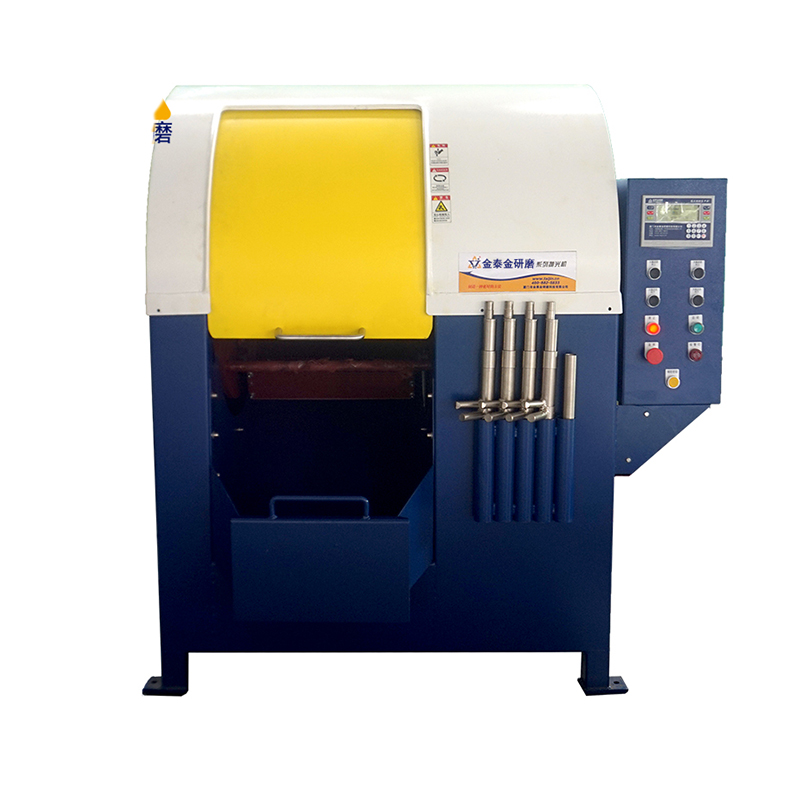
Vibratory finishing is usually the first route to evaluate for aerospace parts because it blends edges and refines surfaces while keeping part-on-part contact moderate and allowing visual access during the cycle. The real differences lie in the chamber: a bowl with a centre column circulates the load continuously, while a tub or long-channel machine moves it more linearly and suits long shafts, tubes and housings that will not turn in a bowl. Drive amplitude, motor setting and the media-to-part ratio decide how much energy reaches the surface, and the machine frame sets the practical part size. For thin-walled or delicate components, ask whether the load can be run in compartments or on fixtures rather than free-tumbling. Also settle unloading and separation early, because a vibratory machine that finishes well but traps media in a closed housing costs more in inspection time than it saves in cycle time.
| Machine route | Where it fits | What it will not do |
|---|---|---|
| Centrifugal barrel finishing machine | Short cycles on small, hard, robust parts where high pressure at the part-media interface is acceptable. | High energy transfers into thin walls and fixtures and wears liners; part size and barrel geometry bound what can be run. |
| Magnetic finishing machine | Small precise parts with internal edges and recesses that loose media cannot enter, using small pins or needles. | Bounded by part size and mass, by workpiece material attraction to the pins, and by the need to retrieve residual pins. |
| Grinding finishing machine | Applications needing higher material removal before a refinement stage, such as heavy burrs or a defined stock removal. | Higher removal raises the risk of edge over-rounding and dimensional change on close-tolerance features. |
| Dry polishing machine and dryer | Post-wet drying and light dry finishing of parts with blind holes and passages where moisture carryover matters. | Dry media cut slowly, require dust extraction and medium condition control, and forced-air drying must be matched to internal geometry. |
Ceramic media is the workhorse for heavier deburring and edge blending on steels, stainless alloys and titanium because its density and hardness let it cut rather than deflect. Shape and size class decide where that cutting happens: triangular and angle-cut shapes reach into corners, cylinders and balls roll into fillets and bores, and smaller sizes reach tighter features at the cost of removal rate. The bill comes in three parts. Ceramic wears down and its effective size class drifts, so the blend that worked in month one behaves differently later. It generates sludge that must be screened and the bath kept under control. And its hardness can chip or over-round edges on thin sections, soft aluminum and already-finished surfaces. Treat media as a consumable with a maintenance schedule and a top-up rate, and check the smallest feature on the part against the media size class before committing to a cycle.
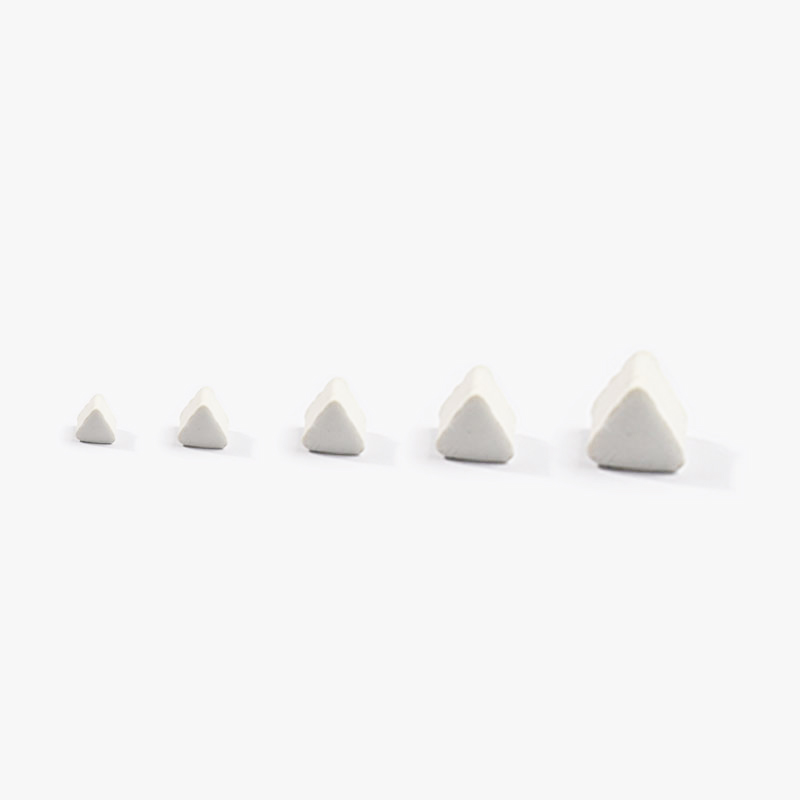
| Media | Best fit | Watch out for |
|---|---|---|
| Compound with corrosion inhibitor for sensitive alloys | Aluminium and stainless parts that must not stain or pit during processing and between-stage handling. | Inhibitor does not compensate for hard or chloride-bearing water, and residue left in recesses can mask later inspection. |
| Plastic media, cones and triangles | Gentle cutting on aluminium, thin-wall sections and surfaces that must not be scored. | Deforms and loads with metal fines so cut rate falls while the blend still looks intact; ineffective in deep recesses and tight radii. |
| Alkaline detergent compound | General cleaning and suspension of removed material on steel, stainless and aluminium where neutral to alkaline chemistry suits the alloy. | Running lean causes loading, heat and discoloration; running rich causes foam and residue that lodges in blind features. |
| Steel media for burnishing | Bright, uniform appearance with minimal dimensional change on parts whose geometry must stay as machined. | Presses debris and hard-water deposits into the surface, concentrates energy on thin sections, and carries iron cross-contamination risk. |
A lodged piece of media is the failure mode that puts a finished aerospace part at greatest risk, because it may survive cleaning and only appear at final inspection or, worse, in service. Lodging happens where a feature's smallest dimension is close to the media size, which is why blind tapped holes, cross-drilled passage intersections, keyways, undercuts, dovetails and small counterbores are the usual sites. It is aggravated by soft or worn media that deform and wedge, by running a broad size-class blend, and by unmasked holes that were never intended to see media. Check with a known pin gauge, a borescope at an agreed viewing angle and a defined count of media in the batch before and after, and add a documented retrieval step such as bar-end magnets, directed air or a flush. The reliable prevention is size discipline: media sized well below the smallest hole to be left clear.
| Failure mode | Likely cause | How to catch it |
|---|---|---|
| Dried compound residue or water spotting in recesses | Rich compound, hard or chloride-bearing rinse water, or a drying method that does not move air through blind features. | Inspect recesses with a borescope, read rinse-water conductivity or hardness, and verify the drying method against the part's internal geometry. |
| Embedded media fragments or metal smeared into the surface | Dirty or overloaded compound, media hardness mismatched to the alloy, or high-pressure burnishing that presses debris into the surface. | Borescope internal features, examine agreed locations at low magnification, and use dye penetrant only where the buyer's own procedure requires it. |
| Thread entry chamfer rounded away or thread crests burnished | Unmasked threaded features run in a burnishing or high-energy cutting load. | Gauge the thread with the buyer's own gauge and inspect the entry chamfer under magnification against the recorded pre-finish condition. |
| Impingement marks or gouges on thin webs and sharp corners | Excess amplitude or speed with too little media in the chamber, or parts free to strike each other in an under-filled load. | Inspect the vulnerable features under magnification before and after, photograph under raking light, and compare the same feature across several parts from the load. |
Bergamo's manufacturing base is concentrated in mechanical engineering and transport technologies. Of 138 European patent applications from provincial applicants published in 2023, 65 (47.1%) were in mechanical engineering and transport technologies, the largest single technology block, followed by chemical and pharmaceutical technologies with 24 applications (s1). The Chamber of Commerce's quarterly survey puts industrial production up +2.0% year on year in the second quarter of 2026 and artisan manufacturing up +3.1%, with the industrial production index at 120.2 (2015=100) and export demand supporting expectations (s2). Provincial exports were EUR 5,417 million in that quarter, led by machinery (EUR 1,219 million), chemical products (EUR 870 million), base metals (EUR 652 million), transport equipment (EUR 578 million, +2.8%), rubber and plastics (EUR 495 million) and food products (EUR 361 million) (s3). An artisan and small-firm tier with at least three employees also grew production by +3.1% (s2).
The nearest part of that base to this brief is machinery: Machinery is the largest export category of the province at EUR 1,219 million in the second quarter of 2026, and mechanical engineering and transport technologies account for 47.1% of provincial European patent applications.
A base built on mechanical engineering, base metals and transport equipment is exactly the kind of production where deburring and edge-radius control determine assembly fit and fatigue behaviour, and where vibratory or centrifugal finishing competes directly with manual benching on machined and stamped parts. Because the same province exports EUR 652 million of base metals and EUR 578 million of transport equipment, surface condition is a customer-visible quality characteristic rather than an internal detail. Artisan-scale machine shops, which the chamber counts separately and which grew production +3.1%, are typically the firms that still finish by hand and are the most likely to look for a batch process.
The question to settle first is whether the requirement is a burr-height and edge-radius limit on machined or stamped metal parts, or a surface-texture value on a functional face, because those two answers lead to different processes and different media. For a province where a large share of output leaves as base metals and transport equipment, it is worth deciding that on the customer's own drawing and inspection plan rather than on a supplier's default recipe.
Freight context: Aeroporto di Milano Bergamo Il Caravaggio (BGY), Intermodal and rail freight on the Milan-Venice corridor. Bergamo's freight position is documented in the sources fetched here by export value rather than by hub statistics: EUR 5,417 million in the second quarter of 2026, slightly below regional and national growth (s3). The airport and intermodal nodes named above are regional geography and were not verified against an authority page in this session, because the Milan Bergamo airport site returned HTTP 403 to every request made from here. For a buyer, the practical consequence is that a delivered machine normally arrives by road from an intermodal terminal or port outside the province, so the delivery term and the point at which unloading responsibility passes should be fixed in the order.
The national standards body is UNI - Ente Italiano di Normazione, a private non-profit association founded over a century ago, which develops, publishes and disseminates voluntary technical standards and adopts the European and international standards as Italian editions. For finishing work the operative references are the surface-texture series UNI EN ISO 21920-1:2022, which fixes how the surface state (roughness, waviness, primary profile) is indicated on technical product documentation, and UNI EN ISO 21920-2:2022, which defines the terms, definitions and parameters used with profile methods. Machinery safety requirements come from the EU machinery legislation rather than from UNI alone: Machinery Directive 2006/42/EC applies to machinery placed on the EU market before 20 January 2027, after which Machinery Regulation (EU) 2023/1230 takes over.
Italy applies the EU's common commercial policy to imports from China, so Chinese industrial machinery enters under the EU Common Customs Tariff, where the duty rate depends on the type and origin of the goods and the working tariff is TARIC. Istat's August 2026 extra-EU trade release records a 16.0% year-on-year increase in Italian purchases from China, alongside strong growth from India, OPEC and Mercosur, so China remains one of the fastest-growing sources of Italian imports. Anti-dumping and other trade-defence measures apply case by case to specific product categories rather than to finishing machinery in general, so the applicable rate must be checked against the specific commodity code before a quotation is finalised.
SurfacePolish supplies from Xiamen, China. The buyer's own destination rules, conformity marking, tariff classification and documentation responsibilities stay with the buyer; confirm them against the authorities named above before ordering.
Appearance should be defined by an agreed physical master or a calibrated image set viewed under specified lighting and magnification, because written adjectives such as bright or uniform are not acceptance criteria. Beside appearance, insist on the checks that reflect how the part actually works. A seal land is checked for sealing condition, a bearing seat for fit and contact pattern, a sliding surface for freedom from raised material and a threaded feature for gauge entry. Edges are measured rather than viewed, using radius gauges, an optical comparator or a cast impression against the recorded pre-finish state. Functional checks should be performed with the buyer's own gauges where the buyer owns the acceptance decision, and the results recorded against the specified requirement instead of a pass or fail opinion. Where a check damages a part, define it as a sampling check on dedicated parts.
Before parts are packed, record the starting state so a result can be attributed to something. Take surface texture readings at agreed locations, photographs under consistent lighting and magnification, a note on edge condition measured or described, and a description of burrs with their location and approximate size. Write down what the trial must answer, in priority order: whether a specified edge requirement can be met without masking a named hole, whether a finish can be reached on a sealed face while a mating surface stays flat, whether a specific residue can be avoided in a blind passage, or whether a defined family can run in one load without marking the small parts. A trial with a written question list produces usable data; a trial sent as a general request tends to produce a general answer that cannot be scaled or repeated.

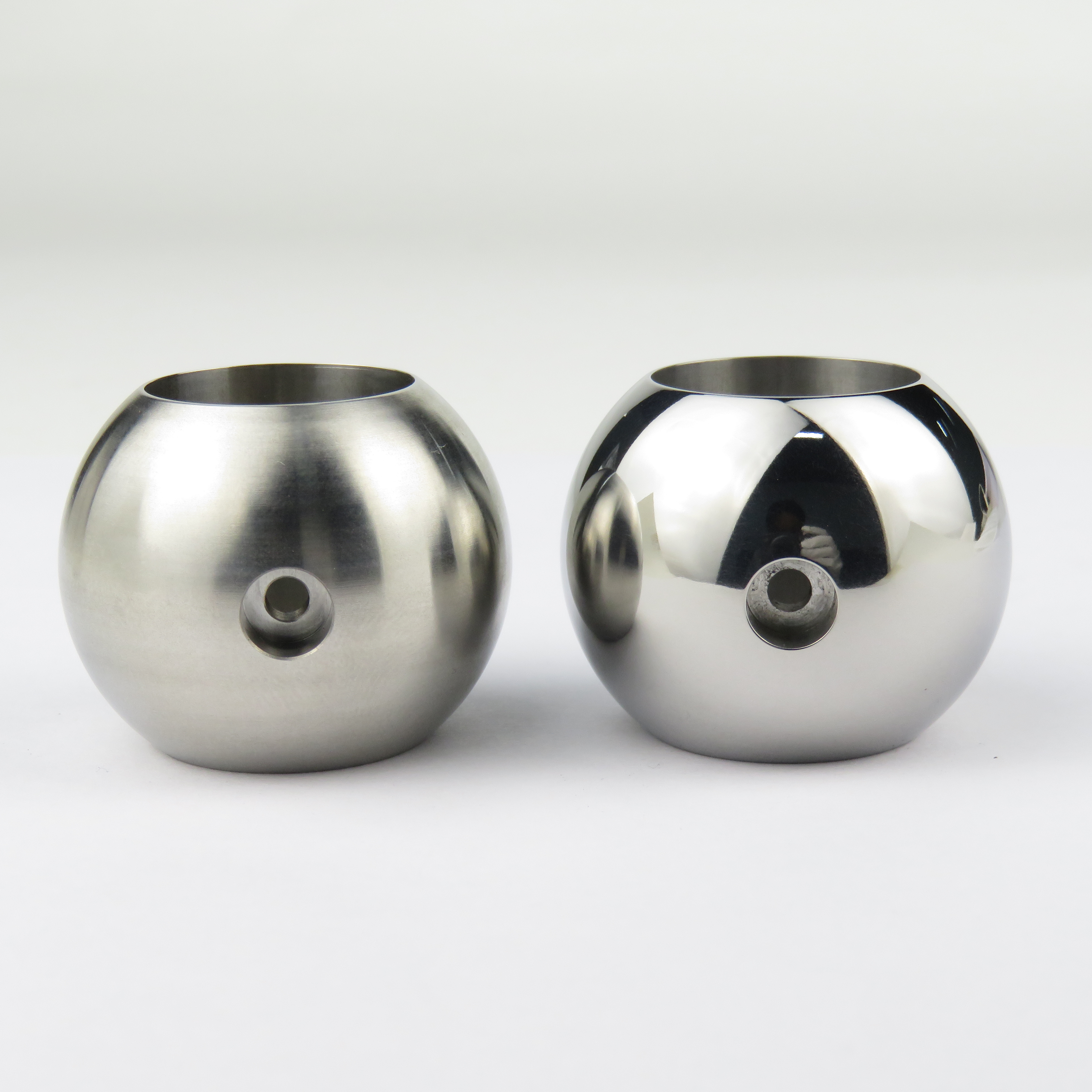
Specify the location, the evaluation length and cutoff, the filter, and whether the requirement is a maximum or an average, then keep that setup unchanged for every batch and comparison. Readings taken with different cutoffs on the same surface will not agree, and readings on interrupted or curved surfaces such as fillets or cast skins need a setup designed for them. Record the instrument and its calibration status with the results. When you compare a trial part from Xiamen with your production parts, Italy and China, use one instrument and one setup so the difference you are reading is the process, not the measurement.
Size the media well below the smallest hole to keep clear, and treat every drilled passage as a retrieval point rather than hoping it stays empty. Mask or plug features that were never meant to see media, count media into and out of the batch, and add a defined check such as a borescope at an agreed angle plus a pin gauge. For Italy buyers shipping parts for a trial, send the part with the tightest hole so the media class is chosen against real geometry rather than an average. SurfacePolish reports what was found on the parts tested; your own cleanliness inspection remains the acceptance decision.
Small robust fittings often suit rotary or centrifugal barrel finishing, which process many pieces per load at low unit cost, while delicate parts may need a gentler vibratory route or magnetic finishing with small pins for internal edges. The deciding factors are the smallest feature to keep clear, the thinnest section, the edge limit and the batch size, not overall part size. Send the extreme cases from the family for a trial rather than a typical part, and ask for a comparison across two media classes with everything else held constant. SurfacePolish supplies all of these machine types across borders and can describe how each behaves on tested parts.
Use Bergamo, Italy as the destination on the enquiry and state whether the deliverable is equipment, media and compound, a representative sample review or a line concept. A destination does not imply local stock, a local service point or a local delivery time.
Bergamo machine builders and their customers normally reference ISO/UNI surface-texture and geometrical-tolerancing standards on drawings, and suppliers into the transport-equipment chain are qualified to IATF 16949 with the cleanliness specifications their own customers impose on fluid-power and driveline parts. Bergamo Sviluppo, the special agency of the Chamber of Commerce, operates a UNI desk and runs standards-project activity for local firms, so the chamber system is the practical route to the applicable UNI reference in this province.
Sources were retrieved on 2026-09-29 and describe the local industrial and trade context only. They do not evidence any SurfacePolish project, shipment, installation or service in Bergamo.
The buyer needs the outer surface improved without distortion, and proof that no media remains inside a closed volume.
Send the material, dimensions, approximate weight, batch quantity, the incoming condition and photographs of the difficult features. Mark which features must not be contacted by media and state how the result will be inspected. This form carries source reference PSEO-0461; quote it if you prefer an additional manual reference.
Open the SurfacePolish enquiry form Email a prepared enquiry
No price, lead time, certification or result is promised here. Confirm whether a sample trial is available for the specific part and what the trial can and cannot show.
Page PSEO-0461 · revised 2026-09-29 · cross-border equipment, media and scoped sample review. City context is sourced and cited above.
Use this local checker to identify missing part and inspection information. It prepares a technical-review brief; it does not approve a machine, process recipe or production result.
Complete the part details to prepare a review brief.
Email : info@surface-polish.com


 IPv6 network supported


 +86-592-2381506