A buyer in Calgary, Canada finishing high-strength steel pins for aerospace components wants a light surface refinement without acid-bearing chemistry and without pushing edge breaks past a tight limit. SurfacePolish is a cross-border source of finishing machines, media and compounds with a free sample trial, so the chemistry and media can be compared on the buyer's parts before specifications are settled. This brief is written for a buyer in Calgary working on aerospace components; it describes equipment, media and a scoped sample review, not a local polishing service.
Does the compound chemistry family create a hydrogen, staining or residue risk for this alloy and heat treatment, and who verifies that?
How will media be kept out of drilled passages, tapped holes and closed volumes, and what retrieval and verification step proves it?
At what batch size, load pattern and media wear state does the trial result still describe what production will produce?
Alloy and temper decide which media and compound families are realistic before any machine is discussed. Unaged aluminum alloys are soft and galling-prone, precipitation-hardening stainless steels are harder and respond to cutting media, and titanium has low thermal conductivity and a tendency to smear rather than cut cleanly. High-strength steels also bring a documented concern about hydrogen picked up from acidic chemistry. Heat treatment matters twice, because the same alloy in a solution-treated and an aged condition finishes differently and a part that has already been aged cannot be straightened after processing. Record alloy, temper, hardness range, prior manufacturing operations such as welding or grinding, and any stress-relief history. Then match media hardness and compound pH to the material instead of reusing a successful recipe from an unrelated part, because the same blend that brightens one alloy can stain another.
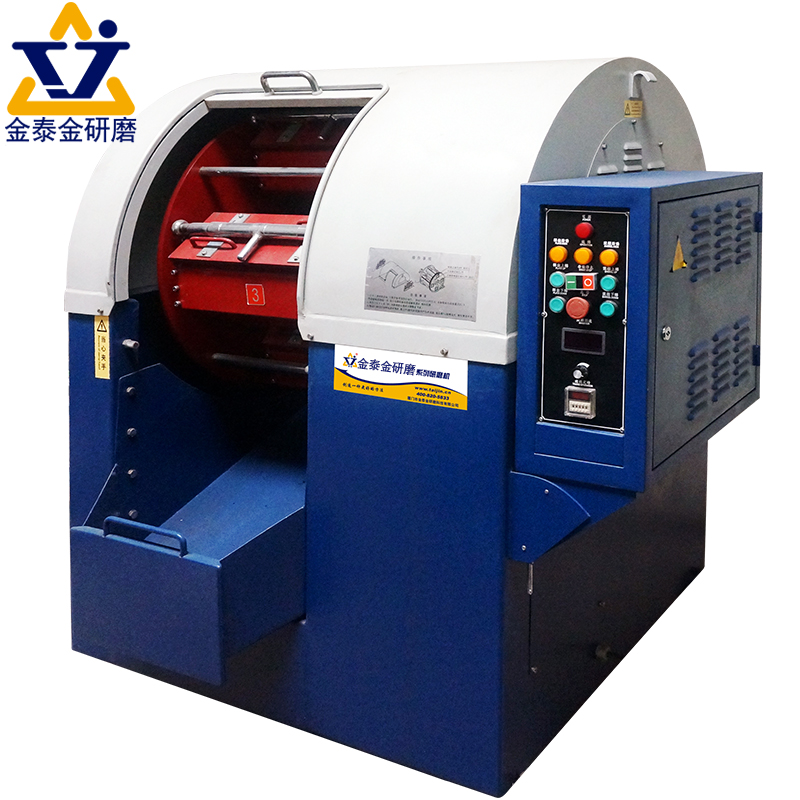
Rotary barrel tumbling is the gentlest of the mechanical routes and rewards parts that can tolerate slow, uniform abrasion: small fittings, spacers, bushings, fasteners and formed hardware that would be marked by higher-energy machines. Centrifugal barrel finishing raises the same principle to high speed, using barrels mounted on a rotating turret so the media presses against the parts with much greater force, which shortens cycles considerably for small, hard, robust components. Both routes share constraints that matter on aerospace work. Thin walls and long unsupported sections are at risk, fixtures and barrel liners wear, and the geometry of the barrel and the pattern of loading determine which faces actually see media. Weight limits per barrel also cap batch size. Evaluate these routes for small parts by the thousand, and treat fixture design and liner condition as first-order process variables rather than workshop detail.
| Machine route | Where it fits | What it will not do |
|---|---|---|
| Disc finishing machine | Fast cycles on flat plates, brackets and robust turned parts with simple geometry. | High energy risks edge roll, distortion of thin sections and part-on-part marking; part size is bounded by the working gap. |
| Magnetic finishing machine | Small precise parts with internal edges and recesses that loose media cannot enter, using small pins or needles. | Bounded by part size and mass, by workpiece material attraction to the pins, and by the need to retrieve residual pins. |
| Vibratory finishing machine, bowl type | General edge blending and surface refinement on medium-sized parts with a continuous, visible load. | Part size is capped by chamber geometry, and thin or delicate parts may need compartments or fixtures to limit part-on-part contact. |
| Vibratory tub or long-channel machine | Long shafts, tubes, housings and large parts that will not turn or circulate in a bowl. | Media circulation is less uniform along a long chamber, and bridging can leave sections of a long bore unprocessed. |
The compound is not a lubricant added at the end of the setup; it is the variable that keeps the process stable. Alkaline builders and detergents keep media and parts clean and suspend removed material, mildly acidic or chelated chemistry brightens certain alloys, and inhibitors are used to limit attack on sensitive surfaces. Concentration and flow rate at the machine are the actual levers: running lean loads the media, slows the cut and lets heat and discoloration develop, while running rich produces foam, residue that lodges in blind holes and unnecessary cost. Water quality belongs in the same discussion because hardness leaves scale and spotting, and chlorides present a pitting risk on stainless and aluminum. Set concentration by a measured dilution routine and a daily check, record it with the batch, and treat any drift as a process deviation rather than an operator preference.
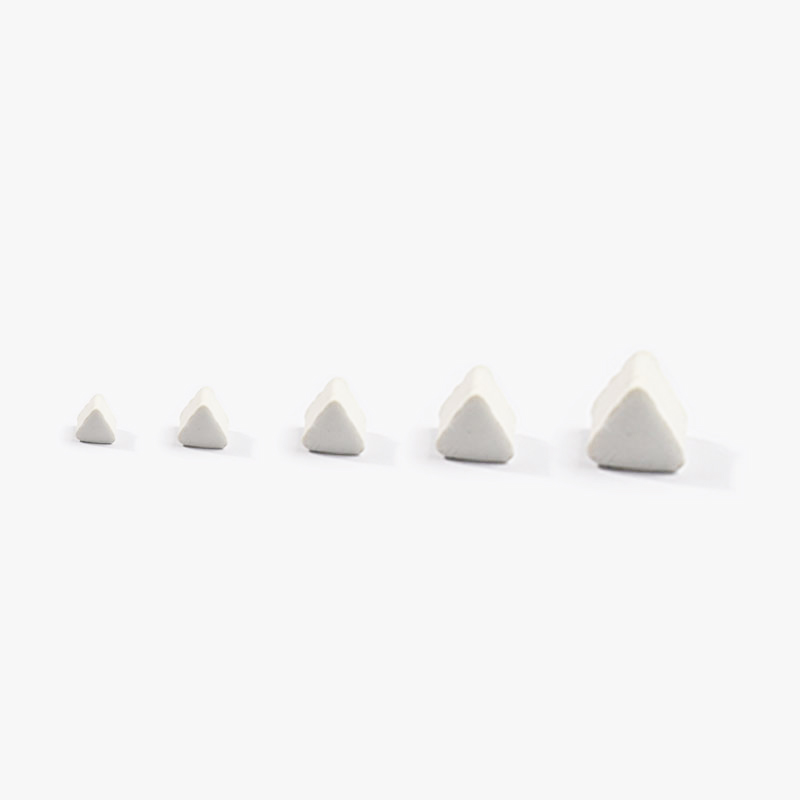
| Media | Best fit | Watch out for |
|---|---|---|
| Plastic media, cones and triangles | Gentle cutting on aluminium, thin-wall sections and surfaces that must not be scored. | Deforms and loads with metal fines so cut rate falls while the blend still looks intact; ineffective in deep recesses and tight radii. |
| Ceramic media, small size class for tight features | Reaching small holes, slots and fillets where a standard size class cannot enter, at reduced removal rate. | Screens differently from larger media, lodges more easily in drilled passages and must be kept below the smallest hole to stay clear. |
| Steel media for burnishing | Bright, uniform appearance with minimal dimensional change on parts whose geometry must stay as machined. | Presses debris and hard-water deposits into the surface, concentrates energy on thin sections, and carries iron cross-contamination risk. |
| Dry media: walnut shell and corn cob | Light deburring, drying support and residue removal on parts where moisture carryover is the governing concern. | Slower cutting, generates dust requiring extraction, and its condition and moisture content must be controlled to stay repeatable. |
Impingement shows up as a local patch of heavier material removal, a gouge or a flattened edge where media or another part struck the surface with too much energy. On aerospace work it appears most often on thin webs, long unsupported sections, sharp external corners and parts run at too high an amplitude in a lightly loaded chamber. The cause is rarely the medium alone; it is the combination of energy setting, media size and mass, load volume and the freedom of parts to move against each other. Check for it by inspecting known vulnerable features under magnification before and after, by photographing under raking light rather than diffuse light, and by comparing the same feature across several parts from the load. Mitigation follows the diagnosis: reduce amplitude, add media, compartmentalise or fixture the part, or move the operation to a gentler route.
| Failure mode | Likely cause | How to catch it |
|---|---|---|
| Uneven finish across a batch or across one part | Load volume outside the chamber's working range, parts blocking one another, mixed part sizes, or inconsistent fixturing and media distribution. | Measure surface texture at several recorded locations on multiple parts from the same load and record the load pattern alongside the results. |
| Thread entry chamfer rounded away or thread crests burnished | Unmasked threaded features run in a burnishing or high-energy cutting load. | Gauge the thread with the buyer's own gauge and inspect the entry chamfer under magnification against the recorded pre-finish condition. |
| Media lodged in a blind tapped hole or counterbore | Media size class too close to the hole diameter, soft or worn media that wedge, or an unmasked hole not intended to see media. | Check with a known pin gauge and a borescope at an agreed angle, and reconcile a counted media batch before and after the cycle. |
| Dark or heat-tinted patch following the media flow | Lean compound concentration or restricted flow, letting metal fines and heat build up in the working mass. | Compare against the agreed appearance master under fixed lighting and check the measured compound concentration and flow rate recorded for the batch. |
Calgary is Canada's energy head-office city and has been building aerospace, life sciences and logistics depth on top of that base. Calgary Economic Development reports that more than 70 major energy companies have head offices in the city and that 462 of Alberta's 940 cleantech companies are headquartered there. The aerospace sector is real but narrower than Montreal's: the region's aerospace ecosystem is anchored by applied research and development, aerospace components and parts manufacturing, maintenance, repair and overhaul (MRO), and unmanned systems, with CAD 3 billion contributed to Alberta's GDP in 2024 and over 100 direct global routes from Calgary International Airport. Life sciences has grown to more than 140 companies in human and animal health, with medical device manufacturing and diagnostics among the growth subsectors. Logistics is a genuine industrial cluster in its own right, with both CPKC and CN headquartered in Calgary and the proposed Prairie Economic Gateway inland port positioned to add manufacturing, processing and distribution capacity.
For this brief the relevant part of that base is aerospace: Calgary Economic Development reports CAD 3 billion contributed to Alberta's GDP by the aerospace sector in 2024, over 100 direct global routes from YYC, and an ecosystem spanning aerospace components and parts manufacturing, MRO and unmanned systems.
Calgary's energy and oilfield service base generates a continuous flow of valve bodies, fittings, pump components, tubular connections and machined parts where burrs at sealing faces and threads are a leak-path and galling risk, and where surface finish on sealing surfaces is a functional specification. Aerospace components and MRO work in the same city adds edge-condition and cleanliness requirements on machined aluminium and steel parts, and the emerging medical device and diagnostics manufacturing base adds small, high-value parts where hand deburring variability is the main quality problem. Because both the energy and aerospace customers operate under formal quality systems, the finishing step usually has to be documented and repeatable rather than operator-dependent.
A Calgary buyer should settle which surface is actually functional before choosing a process: on valve, pump and tubular components the acceptance criterion is usually a specific sealing-face finish and a burr-free thread or edge, and that determines whether vibratory, centrifugal or spindle finishing is even applicable, and whether edge radius rather than surface roughness is the real specification. The second question is repeatability across shifts, because energy and aerospace customers increasingly require documented, repeatable surface condition rather than a finish that depends on which operator ran the part.
Freight context: YYC Calgary International Airport and YYC Global Logistics Park, CPKC headquarters and intermodal terminals, CN intermodal terminals, Prairie Economic Gateway inland port (proposed). Calgary handles 75 per cent of Alberta's air cargo shipments through YYC and has over 100 direct routes into Europe and the Americas, and both Class 1 railways are headquartered in the city, giving access to West Coast ports and to centres in Canada, the United States and Mexico. The proposed Prairie Economic Gateway inland port, a City of Calgary and Rocky View County partnership, is projected to generate over CAD 7 billion in economic activity and more than 30,000 jobs over 10 to 12 years, and is explicitly targeted at manufacturing, logistics, processing and distribution.
The customs authority is the Canada Border Services Agency (CBSA), and importers of commercial goods must work through the CBSA Assessment and Revenue Management (CARM) system, which is where registration, the duties-and-taxes calculator, advance rulings and national customs rulings, and the commercial accounting declaration (CAD) are handled. Documentation expectations are explicit: "You must provide proof of country of origin when you import goods into Canada and, in some cases, your goods must also be clearly marked", the invoice or sales receipt must carry "a complete description of the goods", "the selling price" and "any conditions and terms of the sale", and the value for duty must be declared in Canadian currency only. Duties and taxes are layered rather than single: customs duty on the tariff item, the Goods and Services Tax calculated on the duty-paid value, and potentially excise duty, excise tax, surtax or safeguard measures. Importers must also clear non-tariff gates: goods must be admissible, some goods need permits, certificates or inspections from other federal departments that the CBSA applies on their behalf, controlled goods under the Defence Production Act require consultation with the CBSA and Global Affairs Canada before import, and "Goods manufactured or produced wholly or in part by forced or prison labour are prohibited from entering Canada", with due diligence resting on the importer. For electrical machinery, the practical conformity route in Canada is certification of the product to Canadian electrical safety standards by an accredited certification body rather than a self-declared CE-style mark; buyers should confirm the specific certification body and mark required before shipment. For a first shipment of a finishing machine or a media/compound sample lot, the fastest way to remove classification and valuation uncertainty is to use the CARM portal to request an advance ruling for tariff classification and origin.
China is one of Canada's ten principal merchandise trading partners and the second-largest single-country source of Canadian imports after the United States: Statistics Canada reported CAD 5,369 million of balance-of-payments imports from China in January 2025, against a CAD 2,299 million bilateral merchandise deficit that month. Canada has no free trade agreement with China, so Chinese-origin industrial machinery enters under the Most-Favoured-Nation (MFN) tariff column of the Canadian Customs Tariff; the preferential treatments listed in the tariff (CUSMA/UST and MXT, CETA/CEUT, CPTPP/CPTPT, UKT, KRT and others) do not include China, and preferential rates require proof of origin plus the applicable shipping rules, so a China-origin machine cannot claim them. Tariff classification is mandatory work, not a formality: vibratory, barrel, centrifugal and disc finishing machines are classified in Chapter 84 ("Nuclear reactors, boilers, machinery and mechanical appliances; parts thereof") according to the function of the machine, and the ten-digit Canadian tariff item drives both the duty rate and the statistics. A further landed-cost risk sits outside the tariff schedule: under the Special Import Measures Act (SIMA), the CBSA and the Canadian International Trade Tribunal may apply anti-dumping and countervailing duties to named goods, so a buyer should check the measures-in-force list for the specific product before assuming the MFN rate is the final duty.
SurfacePolish supplies from Xiamen, China. The buyer's own destination rules, conformity marking, tariff classification and documentation responsibilities stay with the buyer; confirm them against the authorities named above before ordering.
Parts can meet every roughness and appearance requirement and still be unusable because of what remains on them. Define the cleanliness check explicitly: which features are examined, with what instrument, at what magnification, and what counts as a reject. Borescope inspection of blind holes and passage intersections, flushing with a measured volume, examining the flush medium, and a defined particulate or residue check are all practical options, but the method must be fixed in advance. Three further checks are commonly omitted. Include media carryover, iron contamination pickup on stainless and aluminum, and residual compound film in recesses, and confirm that rinse water quality is controlled, since hard or chloride-bearing water can leave deposits that later read as corrosion. Keep the cleaning and drying method in the acceptance record, because it is part of the result, not workshop housekeeping.
Send parts that represent the production condition, not the best examples from a setup rack. Include the part with the tightest internal feature, the thinnest wall and the most difficult edge, because those features decide the process more than the largest flat face does. Provide the material and heat treatment, the drawing requirements you can share, and a marked-up photograph that identifies the features which must not change and those which must. Include one or two parts in the incoming condition with no prior finishing, plus, where available, a part finished the way you want the result to look. State the batch size and how parts are separated in your own shop, since load pattern affects outcome as much as media choice. Where a family has variants, send the extremes of the family rather than a middle case.
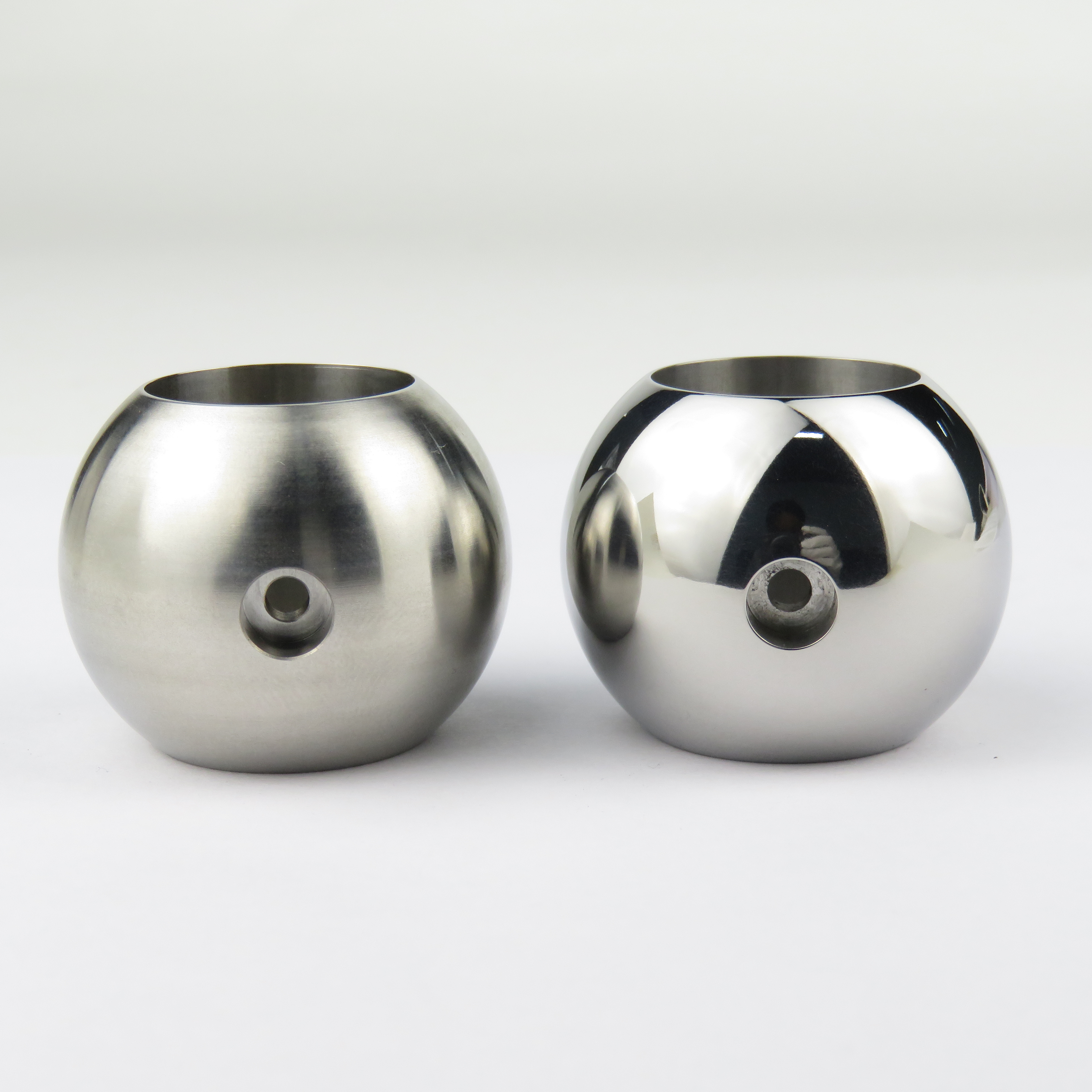
Mechanical finishing can improve surface texture, blend edges and remove burrs, and in some cases it reduces the need for an electrochemical step. It does not reproduce the specific surface chemistry or the material removal mechanism of electropolishing, so the two are not interchangeable without engineering review. SurfacePolish supplies mechanical finishing machines and consumables and does not perform or supply electropolishing. A sensible route for a buyer in Calgary is to define the requirement first, then compare what mechanical methods can observe on the actual part, and treat any substitution decision as the buyer's engineering call rather than a supplier claim.
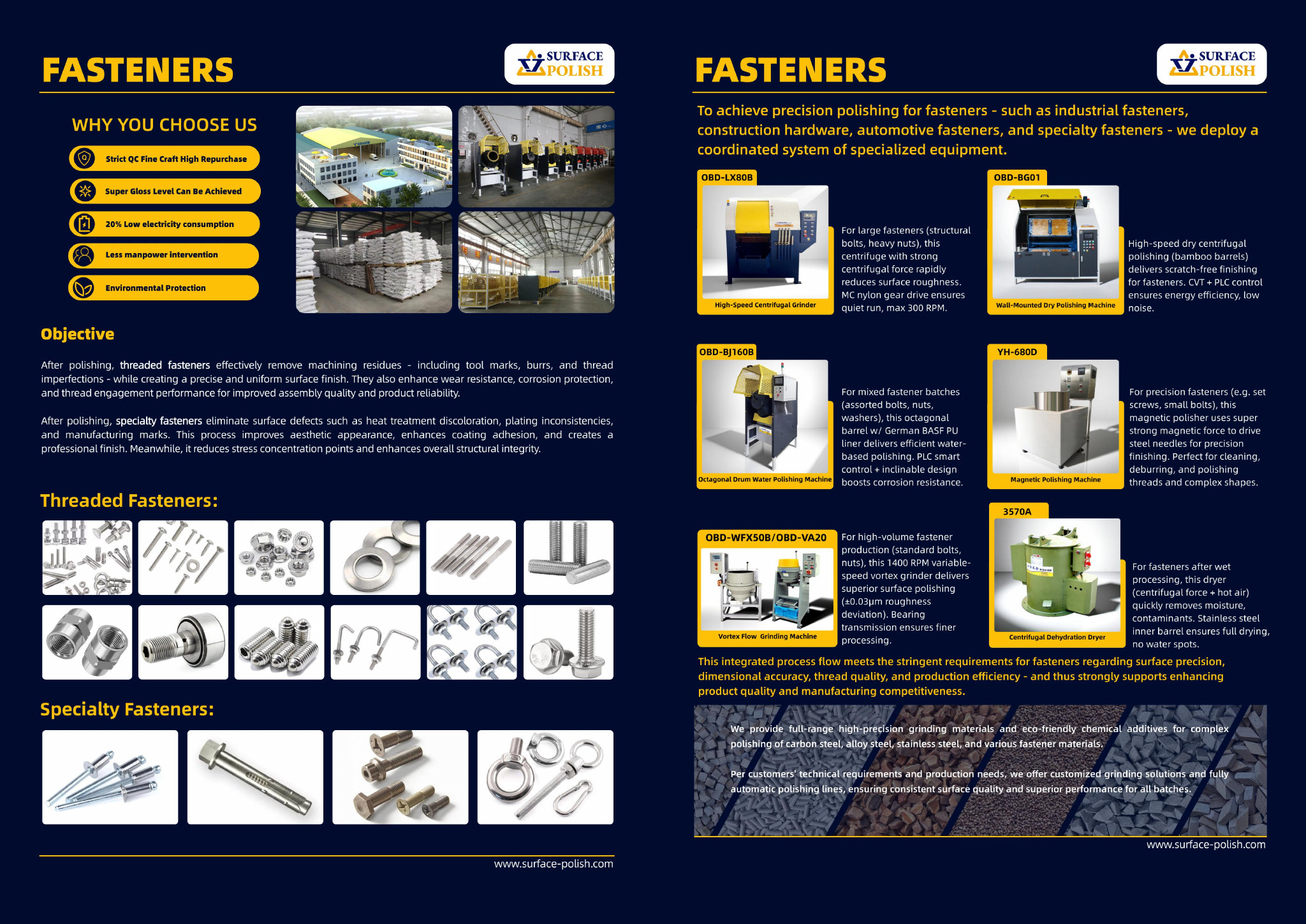
Small robust fittings often suit rotary or centrifugal barrel finishing, which process many pieces per load at low unit cost, while delicate parts may need a gentler vibratory route or magnetic finishing with small pins for internal edges. The deciding factors are the smallest feature to keep clear, the thinnest section, the edge limit and the batch size, not overall part size. Send the extreme cases from the family for a trial rather than a typical part, and ask for a comparison across two media classes with everything else held constant. SurfacePolish supplies all of these machine types across borders and can describe how each behaves on tested parts.
Send parts in the production condition, including the case with the thinnest wall, tightest internal feature and most difficult edge, not a convenient spare. Include material and heat treatment data, the drawing requirements you can share, and a marked-up photograph showing features that must not change. Add one part in the incoming condition and, if available, one finished the way you want the result to look. State the batch size and how you separate parts in your own shop. International shipments should be declared for temporary processing with a parts list, and buyers in Canada can ask us for a packing list format before dispatch.
Use Calgary, Canada as the destination on the enquiry and state whether the deliverable is equipment, media and compound, a representative sample review or a line concept. A destination does not imply local stock, a local service point or a local delivery time.
A Calgary buyer in the energy supply chain normally works to the end-user's material and inspection specification for sealing faces, threads and surface finish, plus the requirements of the applicable pressure-equipment or pipeline standard their customer names. On the plant side, Alberta occupational health and safety rules for guarding and lockout apply, along with Canadian electrical safety certification for the equipment.
Sources were retrieved on 2026-09-29 and describe the local industrial and trade context only. They do not evidence any SurfacePolish project, shipment, installation or service in Calgary.
The buyer needs light surface refinement while avoiding hydrogen-bearing chemistry and staying inside tight edge limits.
Send the material, dimensions, approximate weight, batch quantity, the incoming condition and photographs of the difficult features. Mark which features must not be contacted by media and state how the result will be inspected. This form carries source reference PSEO-0131; quote it if you prefer an additional manual reference.
Open the SurfacePolish enquiry form Email a prepared enquiry
No price, lead time, certification or result is promised here. Confirm whether a sample trial is available for the specific part and what the trial can and cannot show.
Page PSEO-0131 · revised 2026-09-29 · cross-border equipment, media and scoped sample review. City context is sourced and cited above.
Use this local checker to identify missing part and inspection information. It prepares a technical-review brief; it does not approve a machine, process recipe or production result.
Complete the part details to prepare a review brief.
Email : info@surface-polish.com


 IPv6 network supported


 +86-592-2381506