In Bologna, Italy, an industrial machinery buyer needs a hardened die insert brought to a bright cavity finish without rounding the parting-line edges or disturbing the shut-off face. SurfacePolish is a cross-border supplier of finishing machines, media and compounds, and its free sample trial returns the tested parts with observations and a proposed media, compound and cycle direction for the buyer's own evaluation. This brief is written for a buyer in Bologna working on industrial machinery; it describes equipment, media and a scoped sample review, not a local polishing service.
How much stock may the sequence remove before datums, seal faces, flatness or edge form fall outside their allowance?
Which faces must reach a mirror and which only need to be clean and uniform, and how is each one judged?
What batch size, part mix and media maintenance routine will production really run, and does the trial describe that condition?
Every mirror sequence removes metal, and the removal is rarely uniform across a large face. Datum pads, dowel registers, bearing seats and seal lands carry assembly geometry, so measure them before finishing and agree a dimensional and flatness allowance. Where an allowance is tight, mask the feature, finish around it by hand, or plan a light final lapping pass that keeps the face flat. A part that looks correct but has lost flatness on a mounting face will not assemble squarely, and a curved cover panel shows a distorted reflection after only a few hundredths of a millimetre of uneven stock removal. Record incoming values with the same instruments that will accept the finished part, at the same marked locations.
Compound concentration is a process variable that drifts. Dosing on a timer is convenient but ignores carry-out, evaporation and the fines load, so a batch that starts at target can finish well above or below it. Meter dose against water flow, check pH and, where available, conductivity at the start and end of a cycle, and record those values with the batch. Water quality shapes the final image: hard water leaves mineral spots that read as haze, and high chloride or iron content can stain stainless during rinsing. The rinse after each stage deserves the same control as the finishing stage, with enough volume and flow to remove compound and loose fines before the part dries, because dried residue is far harder to remove without disturbing the finish.
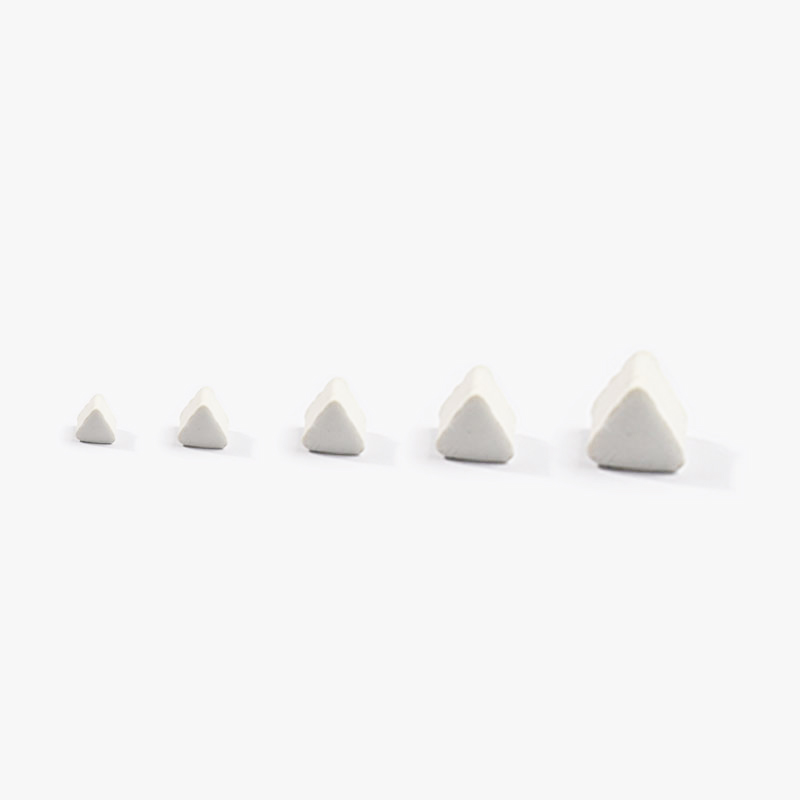
| Media | Best fit | Watch out for |
|---|---|---|
| Dry media - walnut shell | Dry polishing, light deburring and lubricity on parts where a residual oil film is acceptable, and drying or lustre steps after wet processing. | Not a stock-removal medium, generates dust that needs extraction, and can leave an oily film that interferes with a later cleaning or coating requirement. |
| Magnetic finishing pins and needles | Small precise parts with internal edges, cross holes, slots and fine detail that no tumbling medium of usable size can reach. | Limited by working envelope and part mass, removes very little material, and pins can embed in soft metals or remain in cavities if retrieval is not checked. |
| Hardened steel media, balls and shaped shot | Bright burnishing of stainless and hardened steel, and the final wet lustre stage where a dense medium can peen a surface smooth. | Can transfer iron and rust to stainless, dents soft or thin parts, and must be kept in a dedicated charge away from ceramic media. |
| Dry media - corn cob | Softer dry lustre and drying steps, absorbent polishing of small parts, and light work on brass, aluminium and plated-look surfaces. | Breaks down faster than walnut shell and must be replaced regularly; it removes almost no material and cannot correct a surface defect. |
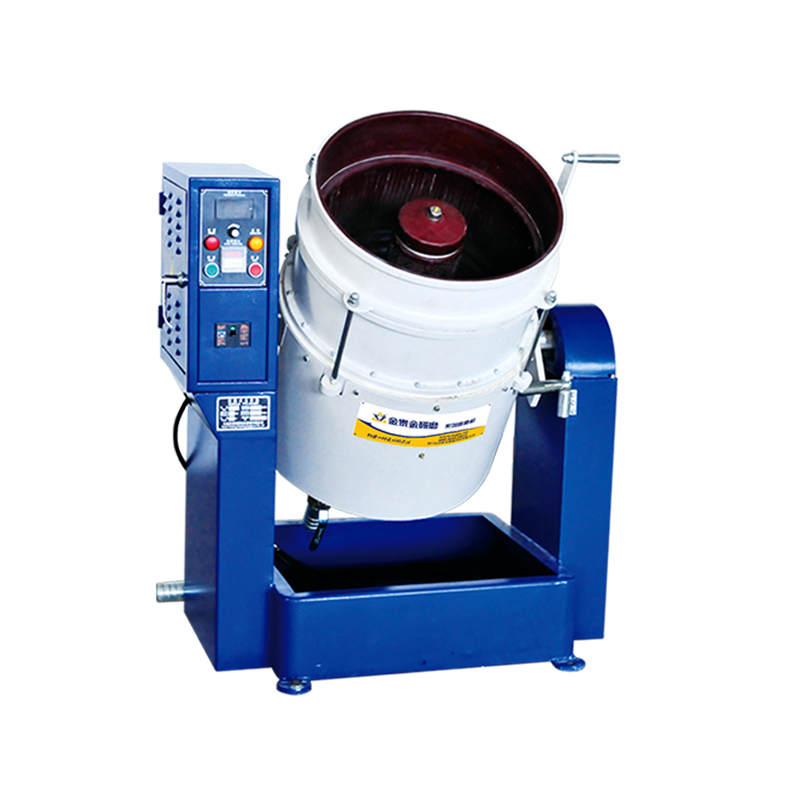
For housings, cover plates, brackets and frames that are rigid and mostly open, a vibratory bowl or tub gives the most forgiving cut-to-colour sequence. The charge moves as a mass, so there is no fixturing to design and no clamping marks, and cycle energy can be tuned through amplitude, media density and load ratio. The limit is reach: media cannot present abrasive uniformly into a pocket whose mouth is narrower than its base, and broad flat faces finish more slowly than edges because contact pressure there is lower. Part-on-part contact also leaves nicks on thin or sharply detailed features, so small, slender or intricate parts usually belong in a gentler route even when their surface requirement is identical.
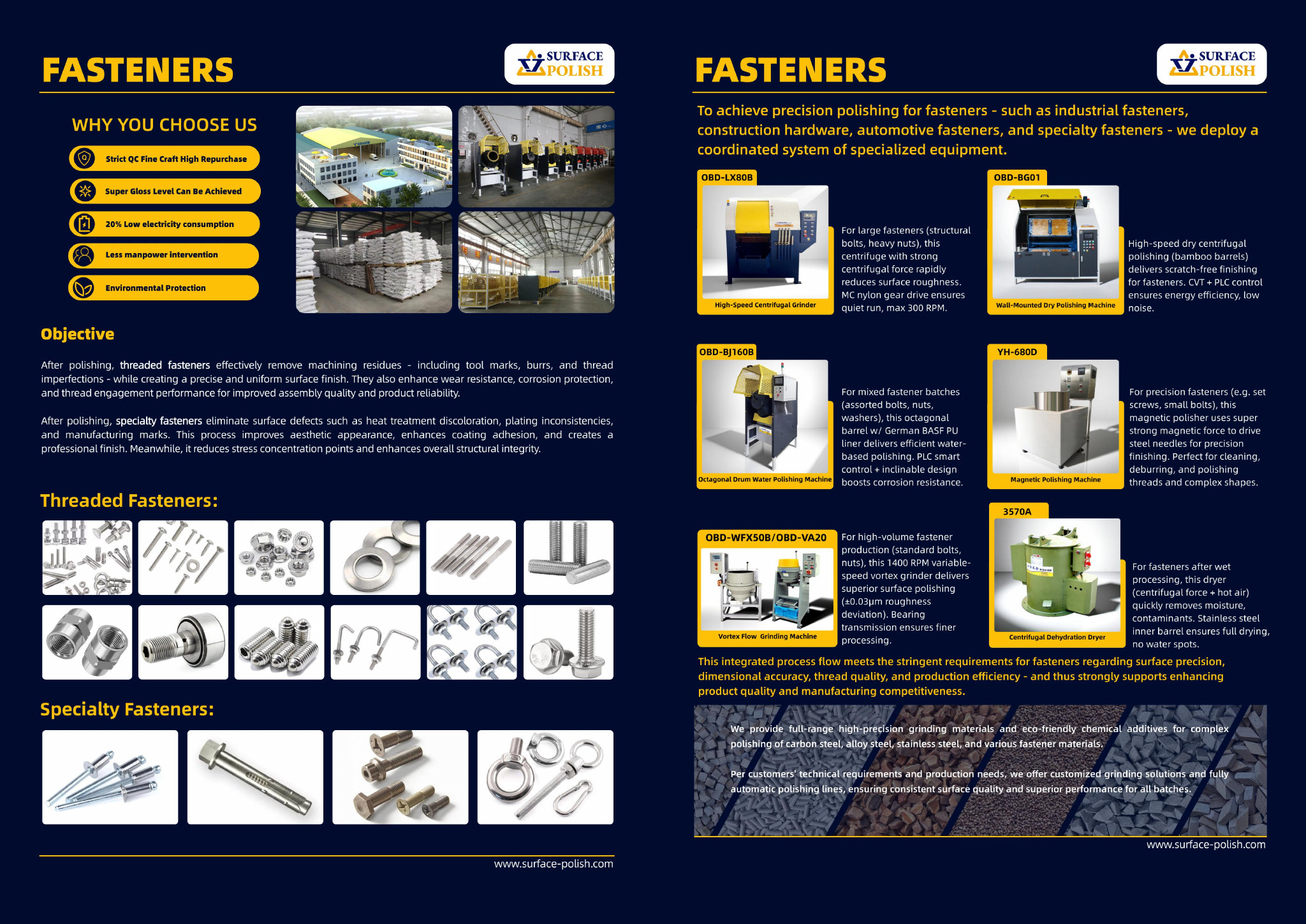
| Machine route | Where it fits | What it will not do |
|---|---|---|
| Centrifugal barrel finishing machine | High-speed cut down and refinement on small to medium parts where a short, energetic cycle is needed before colour stages. | Aggressive on edges and thin sections, requires tight cycle control, and does not replace a finer refinement stage. |
| Grinding finishing machine | The heavier stock-removal stage before a mirror sequence, cutting back grinding damage, scale and recast layers on robust parts. | High removal also rounds edges and can work harden or distort thin sections, so it needs a defined depth target and a sample check. |
| Dry polishing machine and dryer | Final lustre, dry colour and post-wet drying where the last reflected image cannot be produced by a wet mass-finishing stage. | Works on accessible faces only, generates dust and heat that need control, and offers no way to correct a defect left by an earlier stage. |
| Vibratory finishing machine (bowl or tub) | Cut-to-colour sequences on rigid, mostly open parts such as housings, covers, brackets and frames, with adjustable energy and no fixturing. | Cannot present media uniformly into pockets with narrow mouths or deep internal bores, and broad flat faces finish more slowly than edges. |
Orange peel is a slow wave in the surface, visible as a distorted reflected line, and it usually comes from the finishing process rather than the substrate. It develops when a soft or work-hardened layer is deformed rather than cut, when a heavy cut stage is followed by too little refinement, or when a buffing or dry stage runs at high speed with excess pressure and little cooling. Aluminium, copper and annealed stainless are the most prone. Detection belongs in the acceptance routine: reflect a straight edge or a fluorescent tube in the face, look at the shape of the image, and compare against a physical master in the same lighting. Extra fine polishing will not remove peel that sits below the surface; the sequence has to return to a cutting stage.
| Failure mode | Likely cause | How to catch it |
|---|---|---|
| Embedded media particles or finishing pins in a soft surface | High contact pressure on aluminium, brass or copper, worn media with sharp fractured edges, or magnetic-finishing pins driven into a surface that cannot resist them. | Examine at magnification under raking light, wipe with a clean cloth and check for pulled particles, and consider a dye penetrant or etching check on a sample part. |
| Haze, a general loss of image clarity with no directional pattern | Worn media shedding an oversized fine fraction, agglomerated abrasive in the compound line, or fine grit carried into a late stage from screens, machine walls or a shared rinse. | View under raking light at low magnification against a master, then trace the pattern by machine and by rinse line to separate a charge problem from a rinse or transfer problem. |
| Ghost pattern of an earlier coarse stage showing through the final finish | A cut or refinement stage removed too little material, a later stage reused a contaminated charge, or the crosshatch direction was not changed between steps. | Reflect a light source at a shallow angle and rotate the part; a mark that disappears at one angle and returns at another is still in the surface rather than on it. |
| Orange peel, a slow wave that distorts the reflected image | Soft or work-hardened surface deformed rather than cut, a heavy cut stage followed by too little refinement, or a dry or buffing stage at high speed with excess pressure. | Reflect a straight edge or fluorescent tube in the face at a shallow angle, compare the shape of the image against a physical master in the same lighting, and repeat at several viewing angles. |
Bologna's economy is services-heavy but keeps a solid industrial core. The Camera di Commercio di Bologna counted 90,392 firms registered with headquarters in Bologna at the end of 2025, 80,830 of them active; 64% operate in services and 24% in industry, of which 15% in construction and 9% in manufacturing, and the municipality alone holds 40% of the active firms. Confindustria Emilia, the local industry association, organises its members into sector supply chains that include Packaging, Metalli e materiali compositi, Elettronica e Meccatronica and Agroalimentare. The territory is best known for automatic packaging machinery and industrial automation, and its metals and composite-materials supply chain explicitly lists metallurgy, steel, metal treatment, painting, laser cutting, fabrication and stamping among its scopes.
For this brief the relevant part of that base is machinery: Confindustria Emilia's Packaging supply chain covers the production and trade of automatic packaging machines and packaging, and its Metalli e materiali compositi chain covers metallurgy, steel, metal-object manufacture, metal treatment, painting, laser cutting, fabrication and stamping.
Bologna's packaging-machine and mechatronics builders work in stainless steel and aluminium: machine frames, filling and wrapping mechanisms and precision components must be burr-free, edge-controlled and hygienically clean before assembly and before any food-contact qualification. The local Metalli e materiali compositi supply chain names metallurgy, steel, metal-object manufacture, metal treatment, painting, laser cutting, fabrication and stamping as its scope, which is exactly the upstream work whose edges and surfaces determine whether a component can go straight to assembly or coating.
The question to settle first is whether the specification is cosmetic (visible stainless panels and frames) or functional and hygiene-related (burrs, crevices, retained polishing media, cleanability on food-contact parts), because the two answers lead to different media, compounds and - in the packaging-machinery business - different validation evidence for the customer's own acceptance.
Freight context: Interporto di Bologna (rail-road intermodal terminal), Aeroporto di Bologna Guglielmo Marconi. Interporto Bologna integrates rail, road and logistics infrastructure for freight, offers direct connections to the national rail network, warehouses and intermodal terminals, and hosts more than 100 companies on site, which makes it the natural inland receiving point for machinery or heavy media consignments. Incoming non-EU goods clear customs at their EU point of entry before moving on to Bologna by road or rail.
Business is conducted in Italian; quotations, drawings, technical dossiers and declarations of conformity are normally expected in Italian, and correspondence in English is workable but rarely sufficient for a purchase order or for a conformity file. Italian industrial buyers qualify suppliers through a documented process: a part drawing with surface-texture indications, a sample or trial batch, and written acceptance criteria are the usual gate before a machine or media is specified into production. Payment and documentation norms follow Italian/EU practice - the importing entity's VAT and EORI details, invoice data matching the customs declaration, and standard EU commercial terms - so a cross-border seller should expect the conformity documentation (declaration of conformity, technical file, material certificates) to be requested before, not after, delivery.
The customs authority is the Agenzia delle Dogane e dei Monopoli (ADM), which is the regulatory, supervisory and control authority for customs and collects the duties. Goods arriving from China are cleared by customs before they can enter the single market and are released into free circulation by means of a customs declaration; the date of acceptance of that declaration is the date used to calculate and apply the import duty and any VAT or excise duty. Importers should settle in advance who lodges the declaration and under which VAT and EORI arrangements, and must ensure the machine carries CE marking and is supported by the EU declaration of conformity and technical file. Because the CE mark is compulsory for machinery covered by the EU machinery legislation and forbidden for products outside it, the conformity route must be settled before shipment rather than at the border.
SurfacePolish supplies from Xiamen, China. The buyer's own destination rules, conformity marking, tariff classification and documentation responsibilities stay with the buyer; confirm them against the authorities named above before ordering.
Cosmetic acceptance is only half a disposition. Measure the dimensions and flatness that assembly depends on, gauge or thread-check features that media could enter or round, and run the functional check the part actually needs, whether that is seal condition, bearing fit, sliding contact, flow or leak. Cleanliness needs its own verification rather than an assumption: flush blind holes and passage intersections, borescope them at an agreed angle, and examine what the flush carries out. Wipe a defined area with a clean white cloth and record what appears, since compound residue and iron pickup often show only after drying. Confirm cleanliness after drying, not before, and record the method so the next batch is judged on the same basis.
A trial runs a small, hand-selected load on equipment that has just been set up. Production runs mixed batches on a media charge of unknown age, with transfer time between stages, variable rinse quality, operators on different shifts, and parts arriving with different incoming damage. Plan a defined pilot batch that uses the intended line configuration and a full first-article inspection, then compare it with the trial observations before committing volume. Watch the variables that scale badly: drying time in a humid season, water chemistry, load density and the handling between cut, colour and lustre stages. Treat the pilot as the real test of stability and keep its settings record with the parts so any drift can be traced.
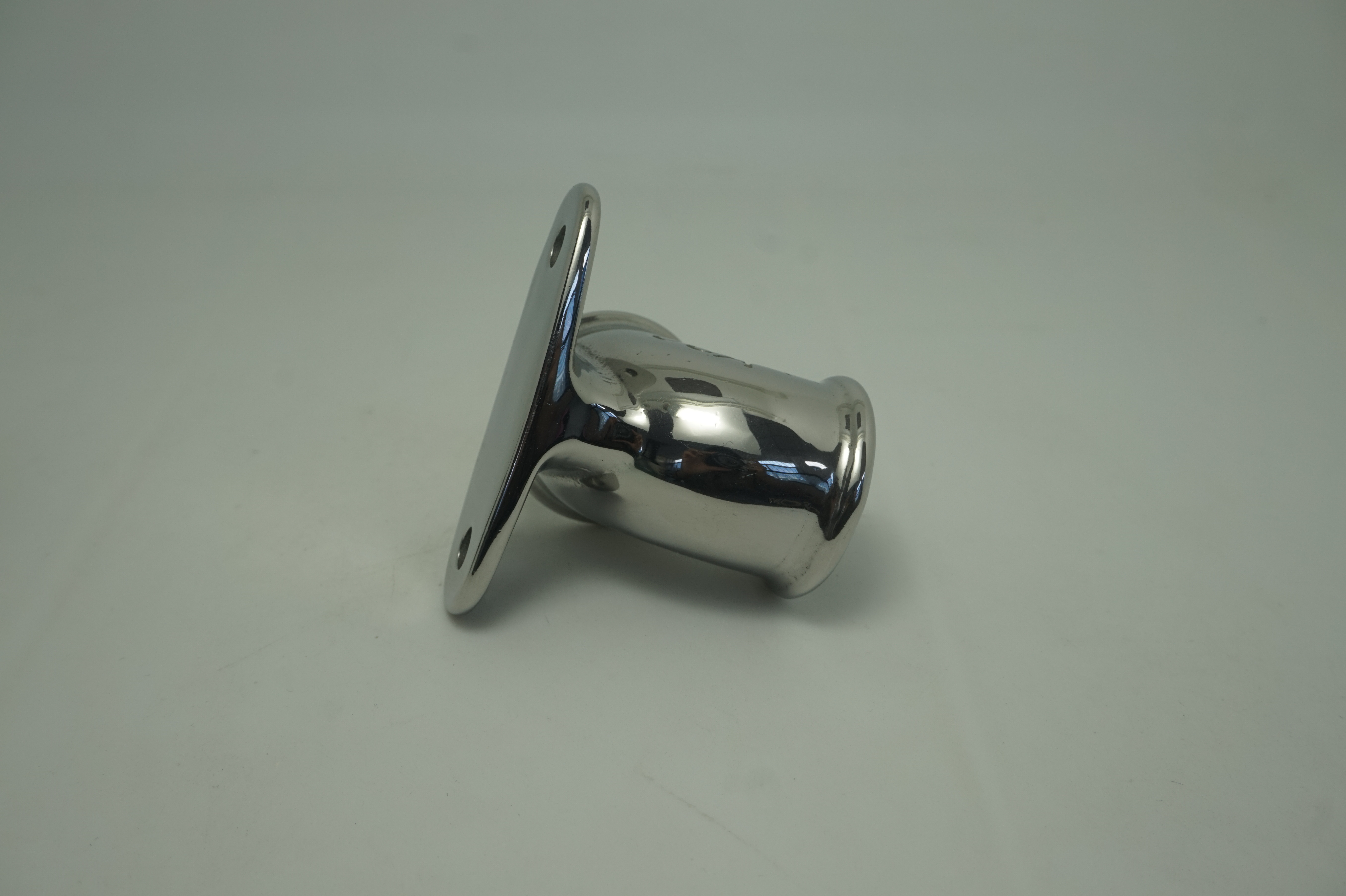
Each stage removes the pattern left by the one before it. A coarse cut removes grinding or machining damage, a refinement stage erases the cut pattern, a colour stage removes the refinement marks, and a lustre stage produces the final reflected image. Skipping or shortening a stage leaves a ghost of it in the surface that finer work only polishes around. Because the steps use different media, compounds and often different machines, a line is planned as a route with a defined finish at each stage, including the rinses and drying between them.
Ra alone is not enough. It is an average over a defined cutoff length, so a surface with a low Ra can still show waviness, orange peel or directional marks that dominate what a viewer sees, while a slightly rougher surface can look brighter if it scatters light evenly. Specify the measurement setup as well as the value, and where appearance is what matters, add a reflectance or gloss reading at a stated angle together with a physical master and viewing conditions. For Bologna buyers working to a functional surface requirement, specify the profile and the appearance requirement separately.
Orange peel is a wave in the surface, produced when metal is deformed rather than cut, usually on softer alloys, on work-hardened layers, or when a heavy cut stage is followed by too little refinement. It shows as a distorted reflected line when you view a straight edge in the face. Polishing with finer media does not remove it, because the wave extends below the depth a fine stage can reach; the sequence has to return to a cutting stage and then refine properly. If the wave comes from the incoming material or a forming operation, it may not be removable at all.
Use Bologna, Italy as the destination on the enquiry and state whether the deliverable is equipment, media and compound, a representative sample review or a line concept. A destination does not imply local stock, a local service point or a local delivery time.
Bologna buyers reference UNI, the Italian standards body, for the EN/ISO surface-texture standards, and the EU machinery legislation now dominates machine procurement: Regulation (EU) 2023/1230 replaces Directive 2006/42/EC for machinery placed on the EU market from 20 January 2027. Food-contact and hygiene requirements on packaging machinery are specified separately from surface roughness and have to be evidenced in the machine's own conformity file.
Sources were retrieved on 2026-09-29 and describe the local industrial and trade context only. They do not evidence any SurfacePolish project, shipment, installation or service in Bologna.
The buyer wants a mirror-like cavity wall for release behaviour but cannot lose the sharp parting-line edges or the shut-off face height.
Send the material, dimensions, approximate weight, batch quantity, the incoming condition and photographs of the difficult features. Mark which features must not be contacted by media and state how the result will be inspected. This form carries source reference PSEO-0429; quote it if you prefer an additional manual reference.
Open the SurfacePolish enquiry form Email a prepared enquiry
No price, lead time, certification or result is promised here. Confirm whether a sample trial is available for the specific part and what the trial can and cannot show.
Page PSEO-0429 · revised 2026-09-29 · cross-border equipment, media and scoped sample review. City context is sourced and cited above.
Use this local checker to identify missing part and inspection information. It prepares a technical-review brief; it does not approve a machine, process recipe or production result.
Complete the part details to prepare a review brief.
Email : info@surface-polish.com


 IPv6 network supported


 +86-592-2381506