An industrial machinery buyer in Canberra, Australia needs a copper electrode plate finished bright and clean, with no embedded media or compound residue left on the contact face. SurfacePolish supplies finishing machines, media and compounds internationally and offers a free sample trial, returning the tested plates with observations and a proposed media, compound and cycle direction rather than a guarantee. This brief is written for a buyer in Canberra working on industrial machinery; it describes equipment, media and a scoped sample review, not a local polishing service.
Which faces must reach a mirror and which only need to be clean and uniform, and how is each one judged?
What batch size, part mix and media maintenance routine will production really run, and does the trial describe that condition?
Can available media actually reach the geometry, and what finish is realistic in the recesses and internal features it cannot reach?
Bright polishing rounds edges, and the more energy and time the sequence needs, the more rounding appears. Some edges are cosmetic and rounding is welcome; others define function, such as a scraper edge on a machine-tool slideway, a knife edge on a metering blade, a thread start, or the lapped lip of a valve seat. Mark those features on the drawing and state a maximum edge radius or a no-touch zone before media is selected. Inspection can use radius gauges, a cast impression or an optical comparator against the incoming edge form. Where a crisp edge and a bright face conflict, the practical order is to finish the face first and restore the edge with a controlled hand operation, or to accept a slightly duller face that preserves the edge.
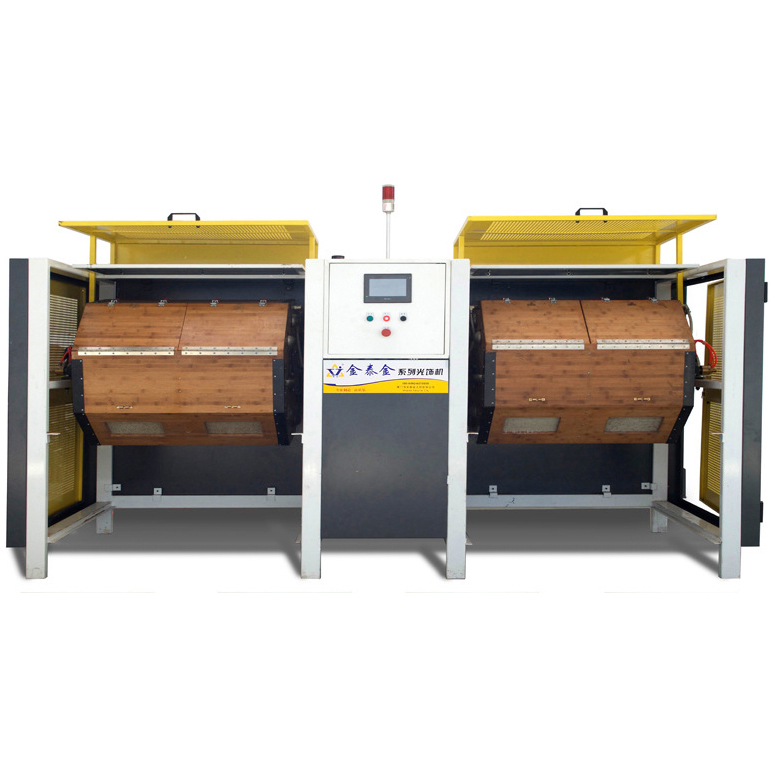
Rotary barrels work by sliding contact and suit parts that tolerate tumbling, giving a dense, uniform colour on small hardware. They cannot process anything longer than the barrel diagonal, so long shafts, extrusions and frame members belong in a tub vibrator, where a part can pass through the mass without being folded. Slender parts need support or careful load balancing, because the same energy that brightens a shaft can bow it or nick it against a neighbour. Barrel and tub routes reach some external areas a bowl cannot, such as a long groove, but they are poor at bores running parallel to the long axis. Verify straightness and roundness after the cycle, not only appearance.
| Machine route | Where it fits | What it will not do |
|---|---|---|
| Magnetic finishing machine | Refinement and edge conditioning of small precise parts with internal edges, cross holes and fine detail that media cannot enter. | Working envelope and part mass restrict size, removal is very small, and coverage falls off wherever the field cannot drive the pins. |
| Grinding finishing machine | The heavier stock-removal stage before a mirror sequence, cutting back grinding damage, scale and recast layers on robust parts. | High removal also rounds edges and can work harden or distort thin sections, so it needs a defined depth target and a sample check. |
| Dry polishing machine and dryer | Final lustre, dry colour and post-wet drying where the last reflected image cannot be produced by a wet mass-finishing stage. | Works on accessible faces only, generates dust and heat that need control, and offers no way to correct a defect left by an earlier stage. |
| Vibratory finishing machine (bowl or tub) | Cut-to-colour sequences on rigid, mostly open parts such as housings, covers, brackets and frames, with adjustable energy and no fixturing. | Cannot present media uniformly into pockets with narrow mouths or deep internal bores, and broad flat faces finish more slowly than edges. |
Media handling is where good sequences are quietly spoiled. Parts must be separated from the charge completely, using screens or a separation deck matched to the smallest media in use, with a counted charge so losses stay visible. Screen out worn media on a schedule and top the charge up, because a blend of very small and original-size media finishes unevenly. Keep steel and ceramic media in dedicated machines or dedicated charges: a few steel pieces in a ceramic load leave bright speckle and iron pickup on stainless, while ceramic fines in a steel charge cause sleeks. Store dry media sealed against moisture, and clean the machine between material families when switching from ferrous to stainless work.
| Media | Best fit | Watch out for |
|---|---|---|
| Medium ceramic triangles or angle-cut shapes | Blending, edge conditioning and the refinement step that removes the coarse cut pattern on housings, brackets, covers and frames. | Media that cannot enter a slot or recess leaves those areas at a different finish, so those faces need a separate operation or a stated lower standard. |
| Dry media - corn cob | Softer dry lustre and drying steps, absorbent polishing of small parts, and light work on brass, aluminium and plated-look surfaces. | Breaks down faster than walnut shell and must be replaced regularly; it removes almost no material and cannot correct a surface defect. |
| Coarse ceramic angle-cut cylinders or triangles | First cut stage on rigid parts with open faces, removing grinding or machining damage on cast iron, steel and stainless before refinement. | Leaves a deep pattern the next stage must fully erase, chips thin edges, and its wear debris carries fine abrasive into later stages if the charge is not screened. |
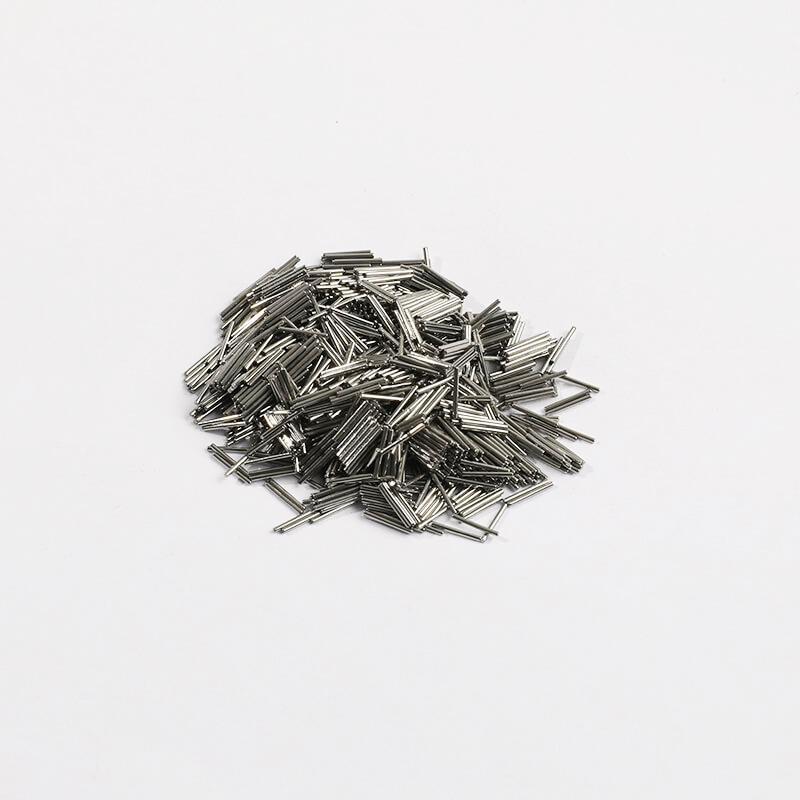
| Magnetic finishing pins and needles | Small precise parts with internal edges, cross holes, slots and fine detail that no tumbling medium of usable size can reach. | Limited by working envelope and part mass, removes very little material, and pins can embed in soft metals or remain in cavities if retrieval is not checked. |
Haze is a general loss of image clarity without a clear directional pattern, and sleeks are the fine unidirectional lines that often accompany it. Both usually come from contamination: worn media shedding an oversized fine fraction, abrasive agglomerating in a compound line, machine walls and screens carrying grit from a previous coarse stage, or parts that were never rinsed between stages. The pattern is diagnostic, because haze appearing in one machine points at the charge while haze on parts from a shared rinse points at the water or the transfer. Check under raking light and low magnification against a master, and verify charge and rinse first: replacing compound before cleaning the machine usually repeats the defect.
| Failure mode | Likely cause | How to catch it |
|---|---|---|
| Compound residue film, water spots or a dull bloom after drying | Incomplete rinsing, hard or contaminated rinse water, a dose above target, or drying that leaves a cavity to bleed residue onto the finished face. | Wipe a defined area with a clean white cloth after drying, inspect cavities for bleed-out, and check rinse water hardness or conductivity at the point of use. |
| Heat tint or discolouration concentrated near edges and thin sections | Friction at a dry or high-speed stage raising local temperature, poor cooling or compound flow, or a load that packs parts against each other with no media between them. | Compare colour against a master in consistent lighting, look for a gradient from edge inward, and check whether the tint follows load contact points or the whole face. |
| Sleeks, fine unidirectional lines across a bright face | Contaminated charge or rinse, a metal particle trapped between media and part, or a polishing direction that was never rotated between successive stages. | Orient the light along and then across the lines, note where each family appears on the part, and inspect the charge and rinse screens for embedded foreign particles. |
| Dimensional drift or lost flatness on datums, seals and bearing seats | Uneven stock removal across a large or asymmetric face, over-long cycles, or unprotected functional features exposed to the full charge energy. | Measure flatness and critical dimensions with a CMM or surface plate at the same marked points used for the incoming survey, and compare the change against the allowance. |
Canberra's industrial base is unusual for Australia: it is built around the Australian Government as the country's largest single buyer of goods and services, plus national research institutions rather than heavy manufacturing. The ACT Government's business and investment site describes a 'future-focused knowledge economy' with defence, space, cyber and quantum, agri-technology and renewable energy as its named key sectors. Local manufacturing does exist and is concentrated in high-value, low-volume work: Skykraft designs and manufactures mini-satellites in Canberra, the Canberra Deep Space Communication Complex is managed for NASA by CSIRO, and the Advanced Instrumentation and Technology Centre at Mount Stromlo provides space test and verification facilities. The Australian National University, the University of Canberra, CSIRO and Geoscience Australia maintain major laboratories and instrument-building capability in the city, and Geoscience Australia operates a purpose-built Canberra headquarters. Canberra Airport's precincts at Brindabella Business Park, Majura Park and Fairbairn, adjoining the RAAF base, concentrate aviation, defence and light industrial tenancies.
For this brief the relevant part of that base is machinery: Geoscience Australia, which operates its purpose-built Canberra headquarters, describes itself as delivering national-scale data, services and infrastructure, and the ACT's advanced instrumentation and satellite manufacturing capability at Skykraft and Mount Stromlo involves precision mechanical and instrument assembly work.
Canberra's manufacturing is precision, low-volume work — satellite structures, space instrument payloads, scientific apparatus and defence electronics — where burr removal, edge break and surface cleanliness affect optical alignment, vacuum compatibility and electrical contact rather than cosmetic appearance. For parts machined from aluminium, stainless and titanium in small batches, the choice between vibratory, barrel and disc finishing methods is driven by part geometry and allowable edge radius, and deburring must not alter critical dimensions or introduce media carry-over into clean assemblies. Buyers in this city typically need a documented, repeatable process for a small number of high-value parts rather than high-throughput finishing.
Before selecting finishing equipment or media, an ACT buyer working on space, defence or scientific hardware should settle whether the required surface condition is specified as a measurable edge radius or surface roughness value, or only as a visual 'deburred' requirement, and whether the process must avoid media embedding and cross-contamination because the part goes into an optical, vacuum or clean assembly.
Freight context: Canberra Airport (terminal, Brindabella Business Park, Majura Park, Fairbairn precinct, adjoining Fairbairn RAAF base), South Jerrabomberra Regional Job Precinct (NSW, 20-minute drive from Queanbeyan, serving the ACT workforce), Port of Eden (NSW south coast deep-water port, regional gateway). Canberra Airport is the city's international gateway and its business precincts handle the light-industrial and aviation tenancies; the airport's own site describes it as having 'thriving business precincts and daily international flights'. Canberra is an inland city with no seaport, so sea freight for machines or sample parts arrives through Port Botany, Port Kembla or the Port of Eden and moves by road, while the South Jerrabomberra Regional Job Precinct gives businesses in the corridor direct access to the ACT workforce and to Commonwealth agencies.
Business is conducted in English and Australian industrial buyers are normally registered companies with an ABN that contract through a local importer or a licensed customs broker rather than directly with an overseas manufacturer. Because the first Australian supplier of in-scope electrical equipment becomes the legally responsible supplier, Chinese manufacturers are typically asked to provide test evidence, a compliance folder and a declaration so that their Australian importer can register and mark the product. Quotation and contracting expectations centre on a clear commercial entity, correct HS/tariff classification, documented country of origin for preferential duty, and an explicit statement of what is included in the delivered price and what is not.
The Australian Border Force (ABF) is the customs authority and clears imported goods through customs; all goods arriving in Australia must be declared unless an exception applies, goods valued at up to A$1,000 can be imported without a formal import declaration, and entry is made through the Integrated Cargo System (Form B650 for sea or air cargo). Generally all goods imported into Australia are liable for duties and taxes unless an exemption or concession applies, and most imports are subject to 10% GST, so classification, customs valuation and any preferential tariff claim drive the landed cost; a licensed customs broker is the normal route for a first-time importer. Electrical equipment can fall under the Electrical Equipment Safety System, under which the first Australian supplier registers as a Responsible Supplier, holds an ABN, makes a Responsible Supplier Declaration and marks the equipment with the Regulatory Compliance Mark (RCM) in accordance with AS/NZS 4417.1 and AS/NZS 4417.2. Imported goods may also require a trade description naming the country of manufacture, and machinery that is not in-scope electrical equipment still has to meet state work health and safety duties covering plant.
SurfacePolish supplies from Xiamen, China. The buyer's own destination rules, conformity marking, tariff classification and documentation responsibilities stay with the buyer; confirm them against the authorities named above before ordering.
A roughness number without its setup is not a specification. Decide the cutoff length, filter, evaluation length, number of traces and their direction relative to the preceding polish direction, then keep every one of those settings unchanged between the incoming survey and the final inspection. Curved and narrow faces need a fixture or a witness coupon processed in the same charge, because a stylus cannot follow a small radius reliably and a hand-held trace on a curved surface is not comparable. Where a face is critical, mark the exact measurement positions on the drawing or with a permanent label and record them. Optical instruments avoid stylus damage on soft polished surfaces but see a different frequency band than a contact profilometer, so do not mix instrument types within one comparison.
A useful trial changes one variable at a time. If two media classes are being compared, hold the machine, load ratio, compound dose and cycle time constant, and identify which returned parts came from which set. Measure the same marked points before and after, with the same instrument and settings, and judge appearance against the same master and lighting. Where two sequences are compared, record each stage separately so any difference can be attributed rather than read only from the final image. Blind the evaluation if two people will judge, and ask for the raw settings and photographs to come back with the parts. A comparison where several variables moved at once produces a direction that cannot be defended later.
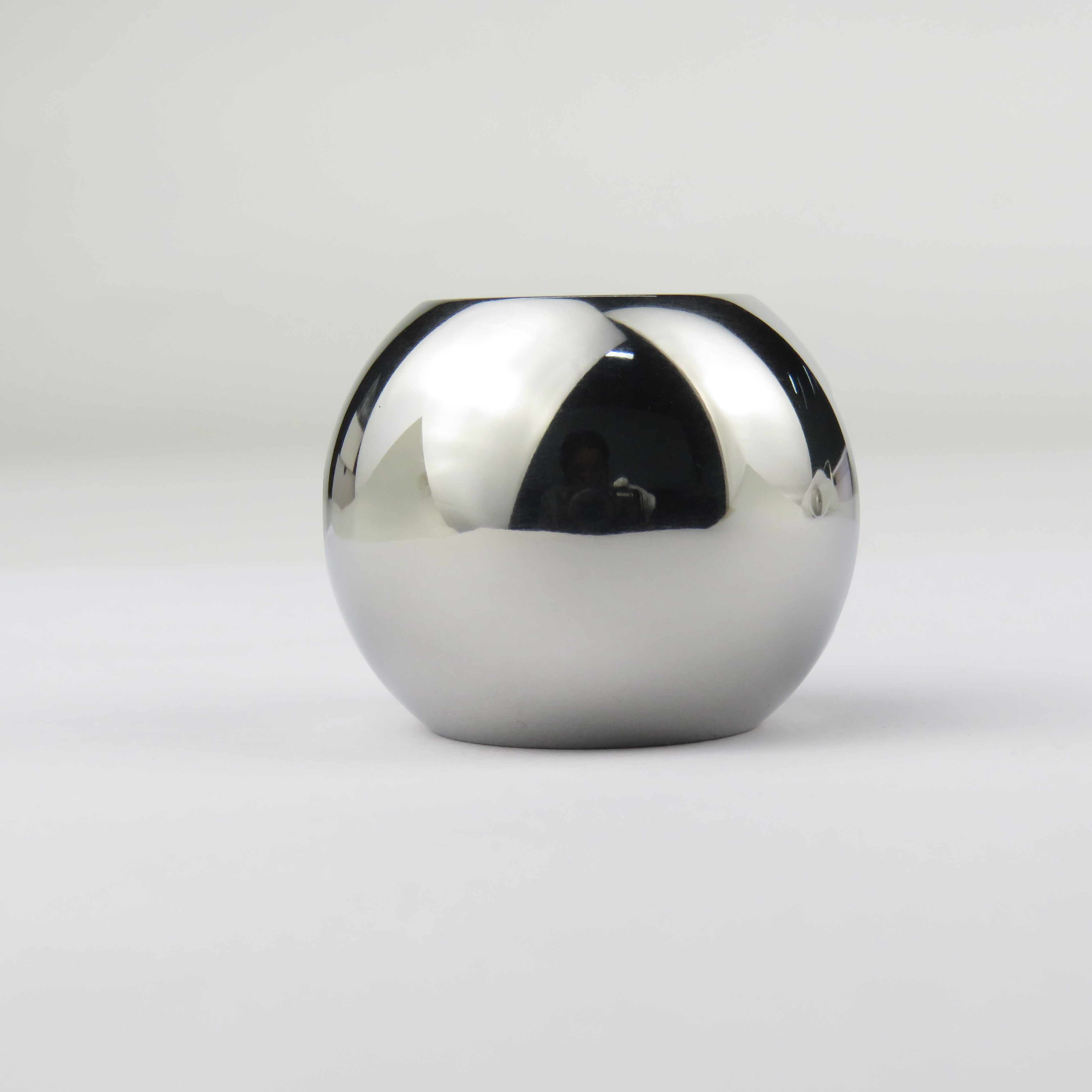
Send representative production parts including the thinnest wall, the tightest feature that must stay clear and the worst edge, plus a witness coupon of the same material and condition, a drawing extract covering the finished faces and the acceptance requirement you intend to apply. Label every piece and note its incoming condition with photographs, readings and measurements. The return is the tested parts with observations and a proposed media, compound and cycle direction for the buyer's own evaluation. A trial on parts shipped from Australia is a comparison, not a qualification, and it establishes no capacity or delivered surface value.
Sometimes, but geometry decides. Media has to sit against the surface and move along it, so recesses with narrow mouths, deep bores, broad flat faces and internal corners may finish unevenly or not at all. A mass-finishing route can still deliver an excellent result on open faces while internal detail reaches a lower, more uniform standard, and it is often sensible to define the requirement per face. Where a small internal edge is the visible feature, a magnetic finishing step or a controlled hand operation may be the only practical route; where a part is too heavy or too long for the envelope, none of it applies.
No to both. SurfacePolish is a cross-border supplier of finishing machines, media and compounds, and it does not supply or perform electropolishing or operate a plant, branch, dealer or technician service in Australia or any other market. What is offered is equipment and consumables, a scoped discussion of a finishing line concept, and a free sample trial in which representative parts are shipped to Xiamen and returned with observations and a proposed process direction. Where an electrochemical finish is under consideration, the discussion stays a comparison with a mechanical route.
Use Canberra, Australia as the destination on the enquiry and state whether the deliverable is equipment, media and compound, a representative sample review or a line concept. A destination does not imply local stock, a local service point or a local delivery time.
Canberra buyers are typically Commonwealth agencies or their suppliers, so work is frequently procured against Australian Standards and, for defence and space work, against the relevant Defence specifications and mission-assurance requirements rather than a purely commercial finish specification. Standards Australia is the national standards body, and AS/NZS 4417.1 and AS/NZS 4417.2 govern use of the Regulatory Compliance Mark for electrical equipment — relevant if a finishing machine is electrically powered.
Sources were retrieved on 2026-09-29 and describe the local industrial and trade context only. They do not evidence any SurfacePolish project, shipment, installation or service in Canberra.
The buyer wants a clean bright face with no embedded abrasive or residue, because contamination would affect the electrical contact.
Send the material, dimensions, approximate weight, batch quantity, the incoming condition and photographs of the difficult features. Mark which features must not be contacted by media and state how the result will be inspected. This form carries source reference PSEO-0759; quote it if you prefer an additional manual reference.
Open the SurfacePolish enquiry form Email a prepared enquiry
No price, lead time, certification or result is promised here. Confirm whether a sample trial is available for the specific part and what the trial can and cannot show.
Page PSEO-0759 · revised 2026-09-29 · cross-border equipment, media and scoped sample review. City context is sourced and cited above.
Use this local checker to identify missing part and inspection information. It prepares a technical-review brief; it does not approve a machine, process recipe or production result.
Complete the part details to prepare a review brief.
Email : info@surface-polish.com


 IPv6 network supported


 +86-592-2381506