A buyer in Hobart, Australia in industrial machinery needs a 2.5 m stainless guard extrusion finished to a uniform bright band while a narrow slot along its face stays clear of media and keeps its edges. SurfacePolish supplies finishing machines, media and compounds across borders and offers a free sample trial, returning tested sections with observations and a proposed direction. This brief is written for a buyer in Hobart working on industrial machinery; it describes equipment, media and a scoped sample review, not a local polishing service.
What batch size, part mix and media maintenance routine will production really run, and does the trial describe that condition?
Can available media actually reach the geometry, and what finish is realistic in the recesses and internal features it cannot reach?
Which faces must reach a mirror and which only need to be clean and uniform, and how is each one judged?
The as-received surface records what earlier operations did, and its deepest damage sets the stock-removal budget. A face ground with a coarse wheel carries scratches far deeper than the visible line, an EDM surface carries a recast layer that must be cut back, and a part previously plated, painted or repaired by welding hides interfaces that respond differently to the same media. Assess scratch depth on a witness coupon or a sacrificial area, then compare it with the total removal the sequence can afford before dimensions or edge form are lost. A part that was brightened once and then re-machined can also carry a ghost pattern of the earlier finish. Reading this before quoting avoids a disappointing trial result that is really a substrate problem.
For housings, cover plates, brackets and frames that are rigid and mostly open, a vibratory bowl or tub gives the most forgiving cut-to-colour sequence. The charge moves as a mass, so there is no fixturing to design and no clamping marks, and cycle energy can be tuned through amplitude, media density and load ratio. The limit is reach: media cannot present abrasive uniformly into a pocket whose mouth is narrower than its base, and broad flat faces finish more slowly than edges because contact pressure there is lower. Part-on-part contact also leaves nicks on thin or sharply detailed features, so small, slender or intricate parts usually belong in a gentler route even when their surface requirement is identical.
| Machine route | Where it fits | What it will not do |
|---|---|---|
| Grinding finishing machine | The heavier stock-removal stage before a mirror sequence, cutting back grinding damage, scale and recast layers on robust parts. | High removal also rounds edges and can work harden or distort thin sections, so it needs a defined depth target and a sample check. |
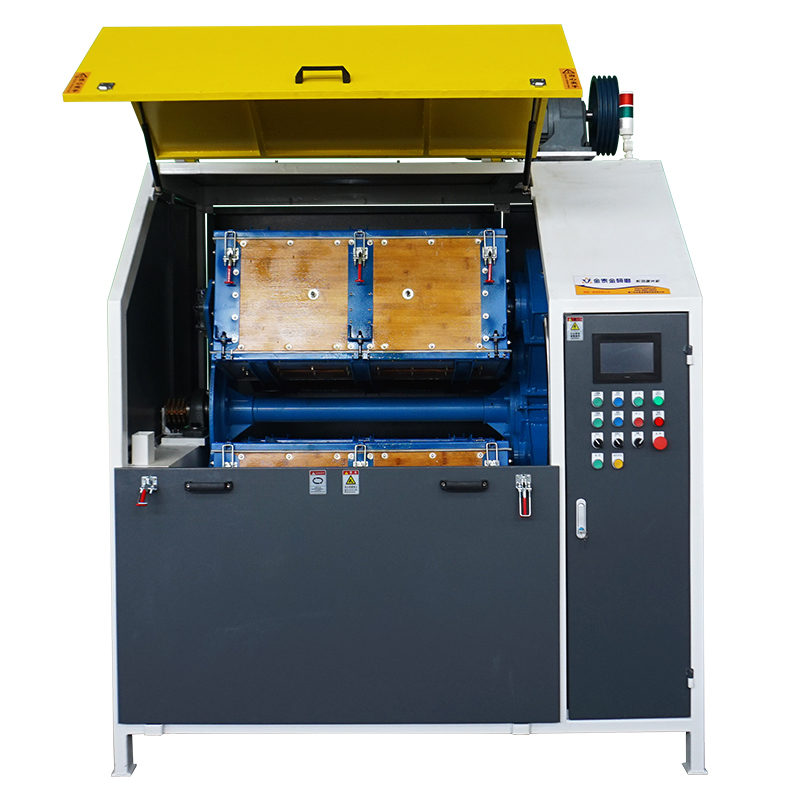
| Vibratory finishing machine (bowl or tub) | Cut-to-colour sequences on rigid, mostly open parts such as housings, covers, brackets and frames, with adjustable energy and no fixturing. | Cannot present media uniformly into pockets with narrow mouths or deep internal bores, and broad flat faces finish more slowly than edges. |
| Tub vibrator | Long and large parts such as shafts, extrusions and frame members that cannot be folded into a barrel, including external grooves. | Poor at bores running parallel to the long axis, and slender parts still need support or balanced loading to hold straightness. |
| Centrifugal barrel finishing machine | High-speed cut down and refinement on small to medium parts where a short, energetic cycle is needed before colour stages. | Aggressive on edges and thin sections, requires tight cycle control, and does not replace a finer refinement stage. |
Media geometry decides what the charge can reach and how hard it works a surface. Large angle-cut cylinders and triangles cut quickly on open faces, but they cannot enter a slot narrower than their section and they leave a deeper pattern for later stages to erase. Small spheres or ovals reach detail and produce a softer, more uniform colour, at the cost of much slower stock removal. As a working rule, keep media below the smallest opening the charge must clear, and confirm that a medium can sit against the surface being finished instead of bridging across it. Media that is too small for the load can also float above the working mass and waste the cycle.
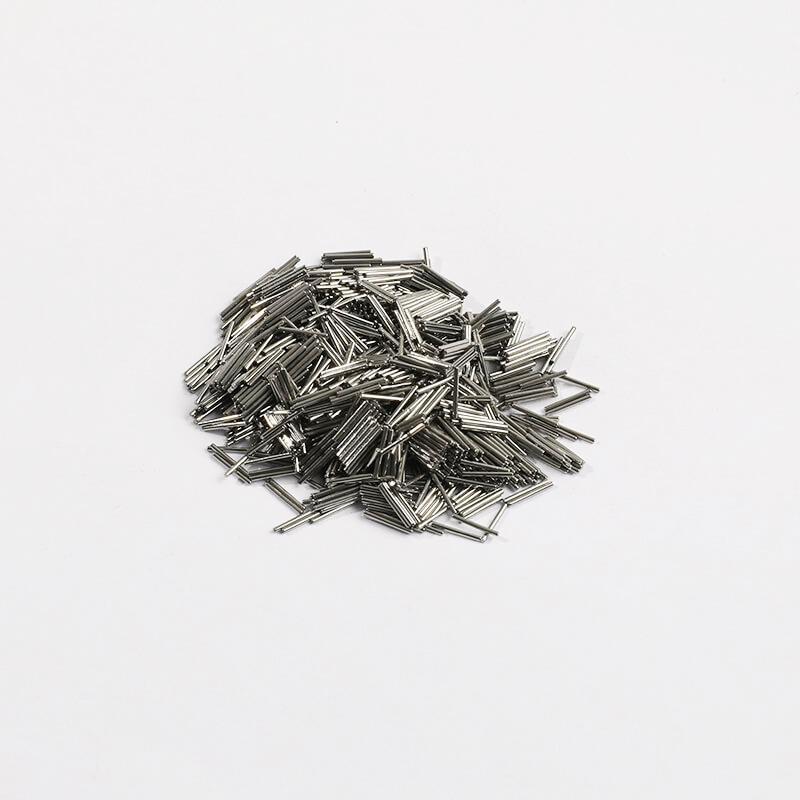
| Media | Best fit | Watch out for |
|---|---|---|
| Magnetic finishing pins and needles | Small precise parts with internal edges, cross holes, slots and fine detail that no tumbling medium of usable size can reach. | Limited by working envelope and part mass, removes very little material, and pins can embed in soft metals or remain in cavities if retrieval is not checked. |
| Dry media - walnut shell | Dry polishing, light deburring and lubricity on parts where a residual oil film is acceptable, and drying or lustre steps after wet processing. | Not a stock-removal medium, generates dust that needs extraction, and can leave an oily film that interferes with a later cleaning or coating requirement. |
| Small high-density ceramic spheres or ovals | Colour and pre-lustre stages where a uniform, soft-looking finish matters more than stock removal, including curved and contoured faces. | Very slow cut, easily lost through screens sized for larger media, and ineffective in deep recesses because it cannot reach or press against the surface. |
| Coarse ceramic angle-cut cylinders or triangles | First cut stage on rigid parts with open faces, removing grinding or machining damage on cast iron, steel and stainless before refinement. | Leaves a deep pattern the next stage must fully erase, chips thin edges, and its wear debris carries fine abrasive into later stages if the charge is not screened. |
Beyond a certain point, more polishing makes a surface worse. Excess cycle time or contact pressure rolls metal over instead of cutting it, burying abrasive and debris under a smeared skin that looks bright until it is disturbed. On dry or high-speed operations, friction raises local temperature enough to tint the surface and soften a hardened layer, and thin sections can distort from the heat. High-energy routes add part-on-part impingement, leaving nicks and small dents that polishing cannot remove. Watch for a bright surface that dulls or streaks when wiped with a clean cloth, for colour variation near edges where contact is highest, and for dimensional or flatness change. The remedy is a shorter or gentler cycle, better cooling and a real end point instead of a longer run.
| Failure mode | Likely cause | How to catch it |
|---|---|---|
| Ghost pattern of an earlier coarse stage showing through the final finish | A cut or refinement stage removed too little material, a later stage reused a contaminated charge, or the crosshatch direction was not changed between steps. | Reflect a light source at a shallow angle and rotate the part; a mark that disappears at one angle and returns at another is still in the surface rather than on it. |
| Iron pickup or rust bloom on a stainless surface | Carbon steel particles or steel media sharing a machine or charge, contaminated rinse water, or a damp surface left in contact with packaging after drying. | Wipe or swab the surface and look for a brown trace, check the charge and machine for ferrous pieces, and inspect parts after a short dwell in the packaging they will ship in. |
| Media lodged in blind holes, slots, undercuts or threaded features | Media size too close to the opening, a slot or cavity that traps the charge, or no defined retrieval step before rinsing and drying. | Reconcile a counted media charge before and after the cycle, borescope each cavity at an agreed angle, and pin or thread gauge the features the charge could enter. |
| Sleeks, fine unidirectional lines across a bright face | Contaminated charge or rinse, a metal particle trapped between media and part, or a polishing direction that was never rotated between successive stages. | Orient the light along and then across the lines, note where each family appears on the part, and inspect the charge and rinse screens for embedded foreign particles. |
Hobart's manufacturing base is smaller than the mainland capitals but unusually specialised, with world-scale capability in a few niches rather than broad heavy industry. The clearest example is shipbuilding: Incat has built high-speed aluminium catamarans at its Hobart shipyard for more than four decades, has built around 100 vessels for operators in 24 countries, employs more than 500 people, and is now building large battery-electric ferries, having been named Tasmanian Exporter of the Year 2026. The city is also the port and service centre for Tasmanian industry: TasPorts, the state-owned ports company, operates the Port of Hobart and reports that across its ports it has facilitated the movement of over 145 million tonnes of freight in the past decade, serving mining, manufacturing, timber and dairy. Hydro Tasmania, based in Hobart, is Australia's largest generator of clean renewable energy, and the state's hydro-industrial base has historically supported energy-intensive processing. Hobart Airport is Australia's southernmost airport and describes itself as curfew free.
For this brief the relevant part of that base is machinery: Incat's Hobart shipyard builds large aluminium vessels including the world's largest battery-electric ferry, which requires substantial in-house metal fabrication, welding and fit-out capability; TasPorts also maintains slipyards and a fleet for marine engineering work.
Aluminium shipbuilding is the defining finishing challenge in Hobart: welded aluminium structures in high-speed ferries require weld dressing, oxide removal and controlled surface preparation before painting or coating, and surface defects matter for fatigue performance and corrosion resistance in a marine environment. Stainless and aluminium components used in marine fit-out, in Hydro Tasmania's generation and water infrastructure, and in food and dairy processing equipment all need burr-free edges and contamination-free surfaces for hygiene, sealing and corrosion reasons. Because volumes are low and parts are large or awkward, finishing method selection is typically driven by part size and geometry rather than throughput.
A Hobart buyer should first establish whether the surface being finished is structural aluminium that will be welded and painted, or a stainless product-contact surface in food, dairy or marine service, because the acceptable media, the cleanliness requirement and the evidence of a correct finish are entirely different in each case.
Freight context: Port of Hobart (Macquarie Wharf and Princes Wharf berths, operated by TasPorts), Hobart Airport (Australia's southernmost airport, curfew free, at Cambridge), Bell Bay (TasPorts' northern deep-water port serving Bass Strait trades). TasPorts reports that over the past decade its ports and people have facilitated the movement of over 145 million tonnes of freight, covering mining, manufacturing, timber and dairy, and it publishes quarterly trade reports by port and commodity. The Port of Hobart handles the state's southern trades through the Macquarie Wharf berths, and Incat's Hobart shipyard relies on heavy-lift vessels calling at Hobart to collect completed hulls for delivery overseas, as shown by its Hull 096 shipment. Hobart Airport is curfew free, which matters for time-critical air freight, while Bass Strait sea freight between Tasmania and the mainland is the principal route for inbound machinery.
Australia and China are parties to the China-Australia Free Trade Agreement (ChAFTA), signed on 17 June 2015 and in force since 20 December 2015; the Australian Border Force maintains a dedicated ChAFTA page and working tariff schedule, and FTAs give importers a route to preferential rates of duty where the rules of origin are met. China was Australia's largest source of imports in 2025 at $130.2b, up 12.5% on 2024, and 56% (69,567) of Australian business importers traded at least once with China in 2020-21. A Chinese supplier of finishing machines, media or compounds is therefore shipping into Australia's single largest import stream, and preferential duty depends on origin documentation rather than on a blanket zero-tariff guarantee for every product line.
The Australian Border Force (ABF) is the customs authority and clears imported goods through customs; all goods arriving in Australia must be declared unless an exception applies, goods valued at up to A$1,000 can be imported without a formal import declaration, and entry is made through the Integrated Cargo System (Form B650 for sea or air cargo). Generally all goods imported into Australia are liable for duties and taxes unless an exemption or concession applies, and most imports are subject to 10% GST, so classification, customs valuation and any preferential tariff claim drive the landed cost; a licensed customs broker is the normal route for a first-time importer. Electrical equipment can fall under the Electrical Equipment Safety System, under which the first Australian supplier registers as a Responsible Supplier, holds an ABN, makes a Responsible Supplier Declaration and marks the equipment with the Regulatory Compliance Mark (RCM) in accordance with AS/NZS 4417.1 and AS/NZS 4417.2. Imported goods may also require a trade description naming the country of manufacture, and machinery that is not in-scope electrical equipment still has to meet state work health and safety duties covering plant.
SurfacePolish supplies from Xiamen, China. The buyer's own destination rules, conformity marking, tariff classification and documentation responsibilities stay with the buyer; confirm them against the authorities named above before ordering.
Ask for a settings record with every batch: machine and stage, media type and size class, charge mass and age, compound product and measured dose, load ratio, cycle time and rinse conditions. Retain a fully inspected first article as the physical reference, together with its measurement data and photographs at fixed scale and lighting. Write the disposition rule in advance, covering what passes, what is reworked and what is scrapped, and name who decides. The record should state plainly that the reported condition applies to the parts tested, at the locations measured, with the settings used; it is a description, not a guarantee of future output or of fitness for any regulated application. Certificate and approval requests belong with the buyer's own quality function.
A trial runs a small, hand-selected load on equipment that has just been set up. Production runs mixed batches on a media charge of unknown age, with transfer time between stages, variable rinse quality, operators on different shifts, and parts arriving with different incoming damage. Plan a defined pilot batch that uses the intended line configuration and a full first-article inspection, then compare it with the trial observations before committing volume. Watch the variables that scale badly: drying time in a humid season, water chemistry, load density and the handling between cut, colour and lustre stages. Treat the pilot as the real test of stability and keep its settings record with the parts so any drift can be traced.
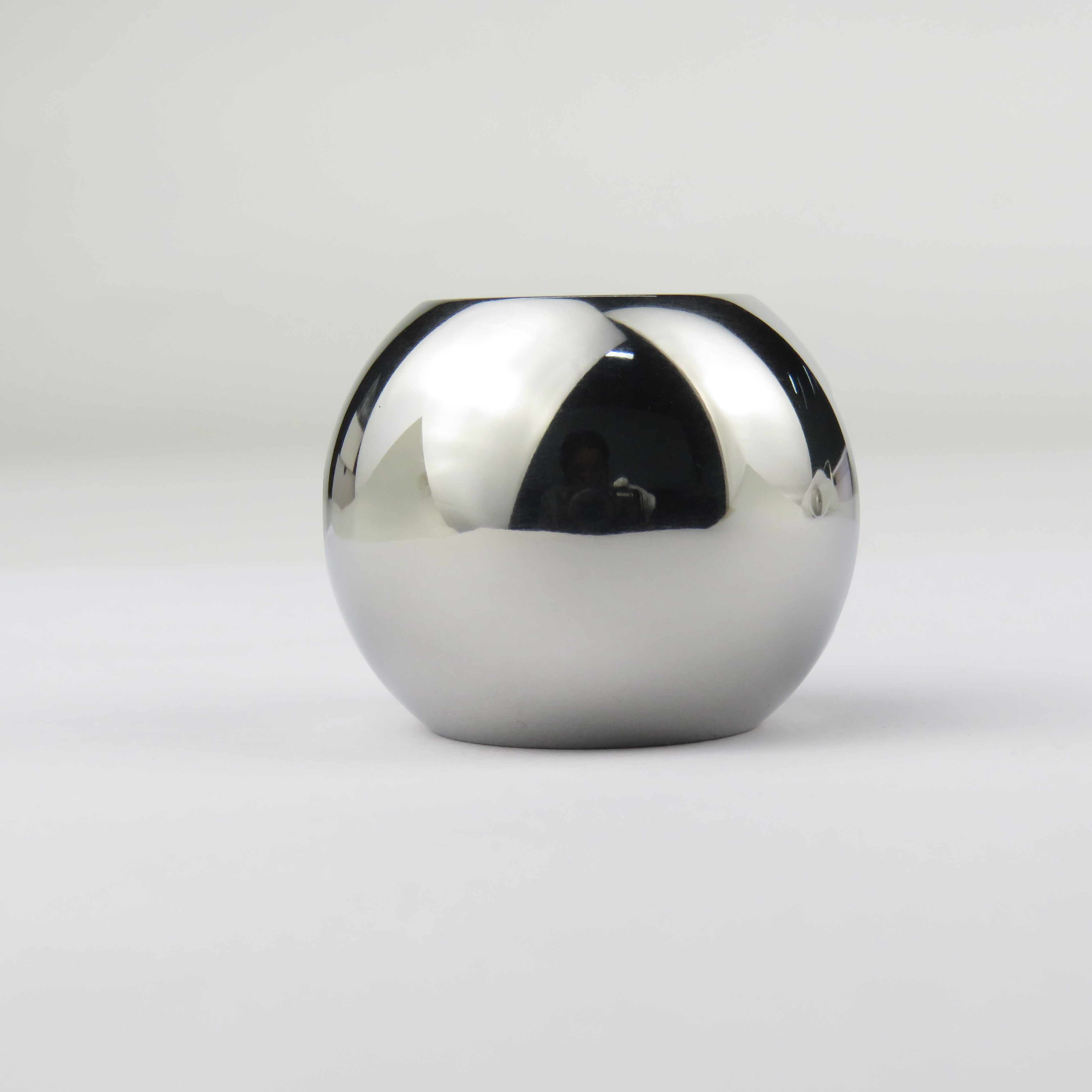
Rounding depends on the energy and duration of the sequence and on how exposed the edge is. A light refinement pass may barely touch it, while a long cut stage on a soft alloy can visibly round it. Mark the edges that must stay crisp, state a maximum radius or a no-touch zone before media is selected, and measure with a radius gauge, an optical comparator or a cast impression against the incoming form. Where a bright face and a crisp edge conflict, the practical order is to finish the face and then restore or protect the edge rather than to keep polishing.
Ra alone is not enough. It is an average over a defined cutoff length, so a surface with a low Ra can still show waviness, orange peel or directional marks that dominate what a viewer sees, while a slightly rougher surface can look brighter if it scatters light evenly. Specify the measurement setup as well as the value, and where appearance is what matters, add a reflectance or gloss reading at a stated angle together with a physical master and viewing conditions. For Hobart buyers working to a functional surface requirement, specify the profile and the appearance requirement separately.
Sometimes, but geometry decides. Media has to sit against the surface and move along it, so recesses with narrow mouths, deep bores, broad flat faces and internal corners may finish unevenly or not at all. A mass-finishing route can still deliver an excellent result on open faces while internal detail reaches a lower, more uniform standard, and it is often sensible to define the requirement per face. Where a small internal edge is the visible feature, a magnetic finishing step or a controlled hand operation may be the only practical route; where a part is too heavy or too long for the envelope, none of it applies.
Use Hobart, Australia as the destination on the enquiry and state whether the deliverable is equipment, media and compound, a representative sample review or a line concept. A destination does not imply local stock, a local service point or a local delivery time.
Hobart manufacturers work to Australian Standards administered by Standards Australia, and Tasmanian marine work additionally references Australian and international maritime classification and survey requirements for vessel construction and repair. Electrically powered machinery must comply with the EESS and carry the Regulatory Compliance Mark under AS/NZS 4417.1 and AS/NZS 4417.2 where in scope.
Sources were retrieved on 2026-09-29 and describe the local industrial and trade context only. They do not evidence any SurfacePolish project, shipment, installation or service in Hobart.
The buyer needs the long bright band finished uniformly while keeping the narrow slot clear of media and preserving its edges.
Send the material, dimensions, approximate weight, batch quantity, the incoming condition and photographs of the difficult features. Mark which features must not be contacted by media and state how the result will be inspected. This form carries source reference PSEO-0799; quote it if you prefer an additional manual reference.
Open the SurfacePolish enquiry form Email a prepared enquiry
No price, lead time, certification or result is promised here. Confirm whether a sample trial is available for the specific part and what the trial can and cannot show.
Page PSEO-0799 · revised 2026-09-29 · cross-border equipment, media and scoped sample review. City context is sourced and cited above.
Use this local checker to identify missing part and inspection information. It prepares a technical-review brief; it does not approve a machine, process recipe or production result.
Complete the part details to prepare a review brief.
Email : info@surface-polish.com


 IPv6 network supported


 +86-592-2381506