A buyer in Leipzig, Germany working in industrial machinery wants a thin steel fascia brightened evenly without thinning the sheet, distorting the folded return or leaving handling scratches visible in the reflection. SurfacePolish supplies finishing machines, media and compounds across borders and runs a free sample trial that returns the tested panels with observations and a proposed media, compound and cycle direction. This brief is written for a buyer in Leipzig working on industrial machinery; it describes equipment, media and a scoped sample review, not a local polishing service.
Which faces must reach a mirror and which only need to be clean and uniform, and how is each one judged?
How will the finish be measured or viewed, with which instrument, angle, cutoff and master, and who holds that master?
What batch size, part mix and media maintenance routine will production really run, and does the trial describe that condition?
Two parts with the same alloy name can behave differently under the same media. Hardened tool steel resists cutting and holds a polish longer, while annealed low-carbon steel cuts quickly and can smear under high contact pressure. Austenitic stainless work hardens, so a heavy first pass can leave a skin harder than the bulk, after which fine media stop removing material and only burnish it. Aluminium and brass are soft enough that media pressure rolls metal instead of cutting it, producing a wave rather than a cut. Ask for the actual condition - hardness range, heat treatment, cold work, and whether the part was cast, forged or machined from bar - then confirm it on a sample rather than trusting a datasheet to describe the surface the media will meet.
Rotary barrels work by sliding contact and suit parts that tolerate tumbling, giving a dense, uniform colour on small hardware. They cannot process anything longer than the barrel diagonal, so long shafts, extrusions and frame members belong in a tub vibrator, where a part can pass through the mass without being folded. Slender parts need support or careful load balancing, because the same energy that brightens a shaft can bow it or nick it against a neighbour. Barrel and tub routes reach some external areas a bowl cannot, such as a long groove, but they are poor at bores running parallel to the long axis. Verify straightness and roundness after the cycle, not only appearance.
| Machine route | Where it fits | What it will not do |
|---|---|---|
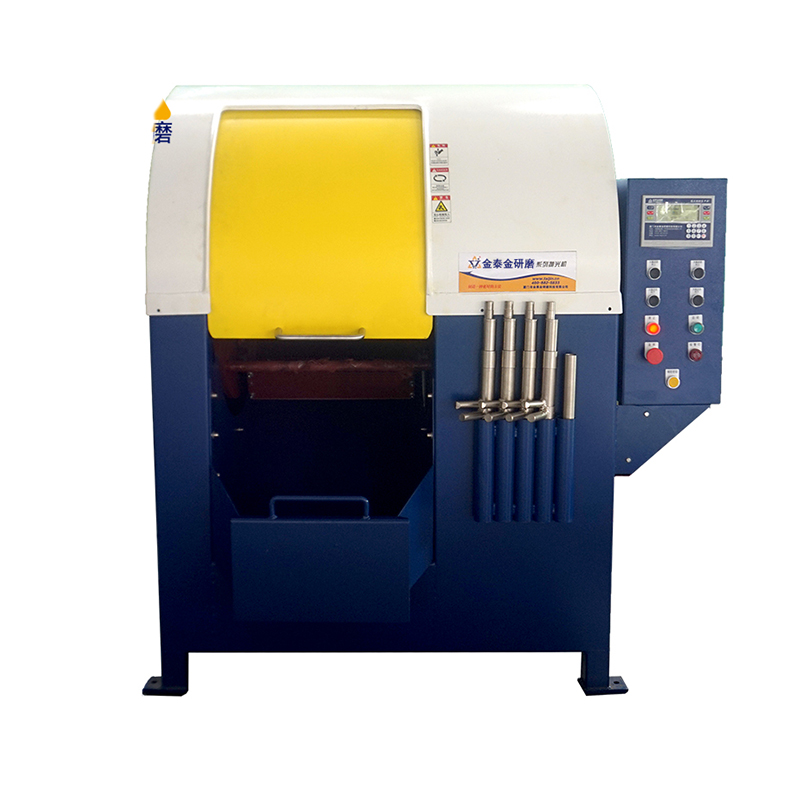
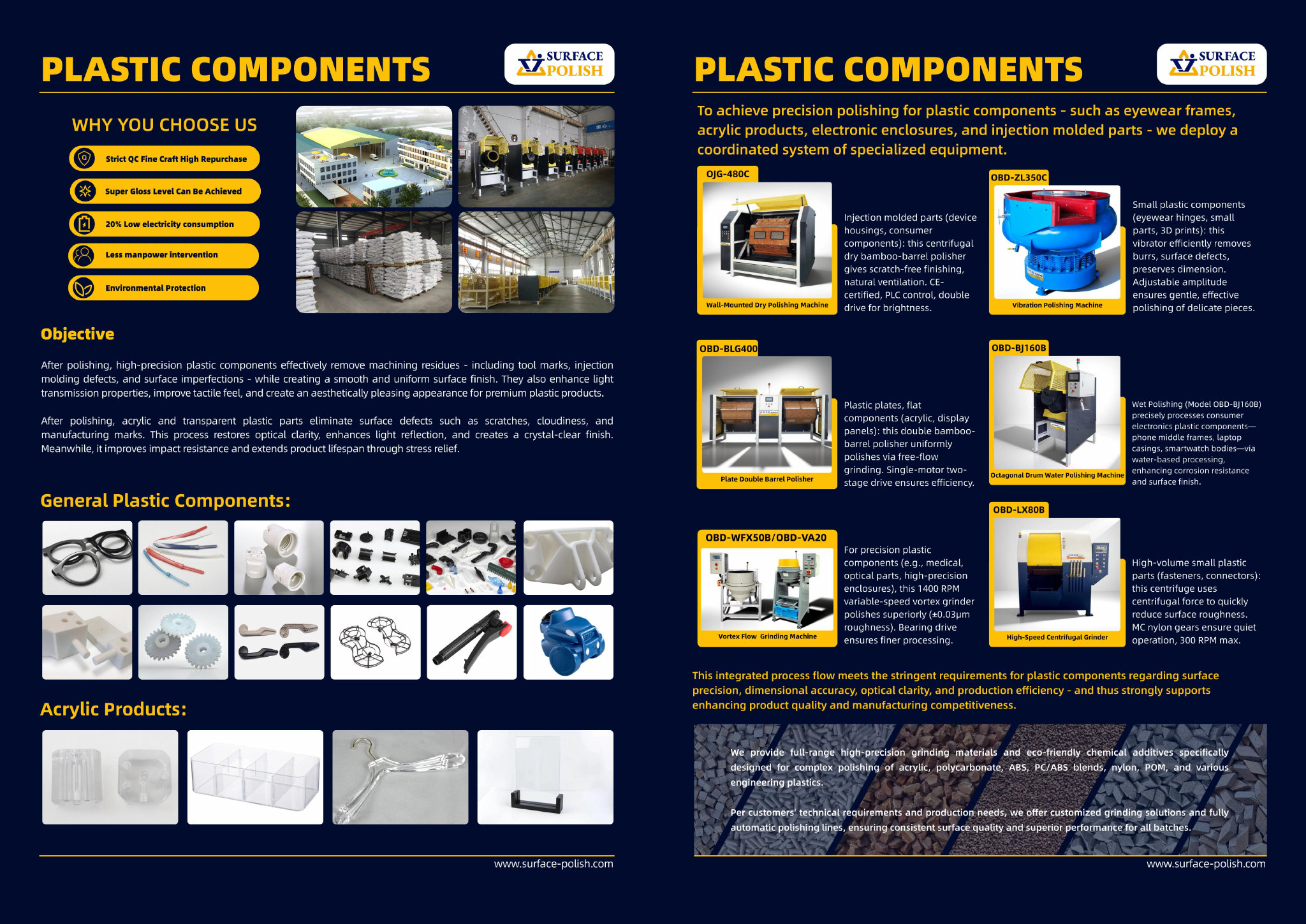
| Dry polishing machine and dryer | Final lustre, dry colour and post-wet drying where the last reflected image cannot be produced by a wet mass-finishing stage. | Works on accessible faces only, generates dust and heat that need control, and offers no way to correct a defect left by an earlier stage. |
| Grinding finishing machine | The heavier stock-removal stage before a mirror sequence, cutting back grinding damage, scale and recast layers on robust parts. | High removal also rounds edges and can work harden or distort thin sections, so it needs a defined depth target and a sample check. |
| Centrifugal barrel finishing machine | High-speed cut down and refinement on small to medium parts where a short, energetic cycle is needed before colour stages. | Aggressive on edges and thin sections, requires tight cycle control, and does not replace a finer refinement stage. |
| Magnetic finishing machine | Refinement and edge conditioning of small precise parts with internal edges, cross holes and fine detail that media cannot enter. | Working envelope and part mass restrict size, removal is very small, and coverage falls off wherever the field cannot drive the pins. |
Compound concentration is a process variable that drifts. Dosing on a timer is convenient but ignores carry-out, evaporation and the fines load, so a batch that starts at target can finish well above or below it. Meter dose against water flow, check pH and, where available, conductivity at the start and end of a cycle, and record those values with the batch. Water quality shapes the final image: hard water leaves mineral spots that read as haze, and high chloride or iron content can stain stainless during rinsing. The rinse after each stage deserves the same control as the finishing stage, with enough volume and flow to remove compound and loose fines before the part dries, because dried residue is far harder to remove without disturbing the finish.
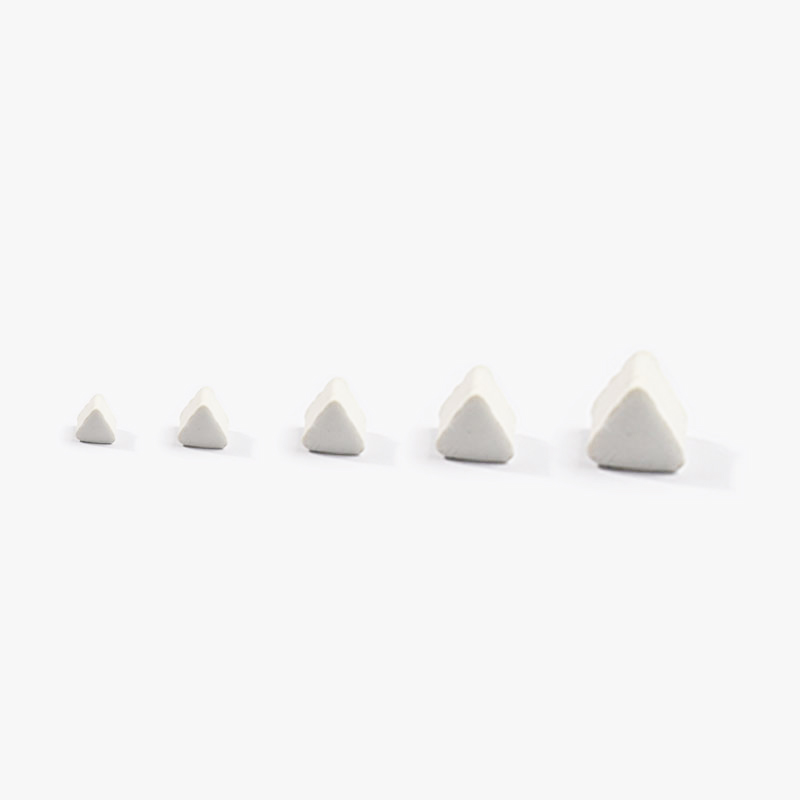
| Media | Best fit | Watch out for |
|---|---|---|
| Plastic or polyester media | Gentle processing of aluminium, brass, copper and thin panels where metal smearing, nicks and distortion must be avoided. | Low density gives little contact force, so cycles run long and heavy grinding marks may survive; plastic also wears quickly and can float above the working mass. |
| Dry media - walnut shell | Dry polishing, light deburring and lubricity on parts where a residual oil film is acceptable, and drying or lustre steps after wet processing. | Not a stock-removal medium, generates dust that needs extraction, and can leave an oily film that interferes with a later cleaning or coating requirement. |
| Small high-density ceramic spheres or ovals | Colour and pre-lustre stages where a uniform, soft-looking finish matters more than stock removal, including curved and contoured faces. | Very slow cut, easily lost through screens sized for larger media, and ineffective in deep recesses because it cannot reach or press against the surface. |
| Hardened steel media, balls and shaped shot | Bright burnishing of stainless and hardened steel, and the final wet lustre stage where a dense medium can peen a surface smooth. | Can transfer iron and rust to stainless, dents soft or thin parts, and must be kept in a dedicated charge away from ceramic media. |
A bright face can carry a ghost of every earlier stage. When a coarse grinding or cut pattern is not fully removed, the finer stages polish the crests and leave the valleys, producing visible lines or a woven crosshatch that reappears as the viewing angle changes. The causes are a stage that removed too little, a refinement step that reused a contaminated charge, or a crosshatch direction that was never rotated between steps. Each successive stage should run across the previous direction at a clear angle, so an operator can see when the earlier pattern is gone. Inspect by reflecting a light source at a shallow angle and rotating the part: a mark that vanishes at one angle and returns at another is still in the surface.
| Failure mode | Likely cause | How to catch it |
|---|---|---|
| Heat tint or discolouration concentrated near edges and thin sections | Friction at a dry or high-speed stage raising local temperature, poor cooling or compound flow, or a load that packs parts against each other with no media between them. | Compare colour against a master in consistent lighting, look for a gradient from edge inward, and check whether the tint follows load contact points or the whole face. |
| Media lodged in blind holes, slots, undercuts or threaded features | Media size too close to the opening, a slot or cavity that traps the charge, or no defined retrieval step before rinsing and drying. | Reconcile a counted media charge before and after the cycle, borescope each cavity at an agreed angle, and pin or thread gauge the features the charge could enter. |
| Embedded media particles or finishing pins in a soft surface | High contact pressure on aluminium, brass or copper, worn media with sharp fractured edges, or magnetic-finishing pins driven into a surface that cannot resist them. | Examine at magnification under raking light, wipe with a clean cloth and check for pulled particles, and consider a dye penetrant or etching check on a sample part. |
| Dimensional drift or lost flatness on datums, seals and bearing seats | Uneven stock removal across a large or asymmetric face, over-long cycles, or unprotected functional features exposed to the full charge energy. | Measure flatness and critical dimensions with a CMM or surface plate at the same marked points used for the incoming survey, and compare the change against the allowance. |
Leipzig has rebuilt a manufacturing base around a small number of very large plants and a cluster policy documented in the city's annual economic report: the city counted 633,592 inhabitants and 297,289 socially insured jobs in 2025. Automotive is the largest industrial cluster with 750 companies and 21,743 employees, built on the BMW Group plant (259,430 BMW and MINI vehicles in 2025, a record for the 20-year-old site) and the Porsche plant, where the city reports a new SUV model will be built. Aerospace is being added at Leipzig/Halle Airport, where Deutsche Aircraft is building a factory for the D328eco regional aircraft with a planned capacity of up to 48 aircraft a year, and life sciences (54,203 employees in 2,840 companies) and green tech (15,809 employees in 1,275 companies) are the two other clusters with published employment figures.
The nearest part of that base to this brief is automotive: Leipzig's automotive cluster has 21,743 employees in 750 companies, with the BMW Group plant producing a record 259,430 BMW and MINI vehicles in 2025 and Porsche building its new SUV model in Leipzig.
The parts that matter in Leipzig are vehicle bodies and powertrains from the BMW and Porsche plants and their 750-strong supplier base, plus aircraft structures and engine components for the D328eco programme, all of which carry deburring, edge and cleanliness requirements. Aerospace and automotive both work to defined edge and surface conditions before painting, sealing or assembly, and 24/7 shift operation at the vehicle plants puts pressure on a supplier's ability to hold those conditions at volume. Life-science and medical-technology firms on the BioCity Campus add a second requirement pattern based on clean, burr-free stainless and aluminium surfaces rather than high removal rates.
Clarify first whether the part belongs to the automotive volume regime (IATF/VDA cleanliness and edge specs, three-shift supply) or to aerospace/medical (EN 9100 or ISO 13485 documentation and traceability), because that choice fixes the media, process control and documentation a Leipzig buyer has to demand from a finishing equipment supplier.
Freight context: Leipzig/Halle Airport (cargo hub, DHL and Deutsche Aircraft site), Leipzig rail freight and industrial sidings (Industriestammgleis serving the BMW plant and Logistikpark Leipzig), A9 and A14 motorway junctions / Leipzig logistics parks. Leipzig's logistics cluster employs 40,020 people in 1,219 companies with EUR 1.05 billion turnover, and the city reports the airport being used as a 24/7 hub by Deutsche Aircraft; logistics firms including Kühne + Nagel and DHL Global Forwarding operate at the location, alongside specialised pharma and biotech logistics. Machines and sample parts can arrive by air freight at Leipzig/Halle or by road/rail via the city's freight sidings and logistics parks.
German is the working language of drawings, contracts, test reports and conformity documentation, and German buyers normally expect English-language technical documentation to be supplied alongside it. Procurement is documentation-driven: the EU declaration of conformity, the technical file, and the identity of the EU-based importer or authorised representative are settled before the order, and the EORI registration and customs declaration are the importer's responsibility rather than the exporter's (c3, c4, c5). Germany is the world's leading machinery and equipment manufacturer, so quotations compete against established domestic builders on technical documentation and measurable process data rather than on price alone (c9). Payment, delivery and risk terms are normally fixed by written contract with a named Incoterm, and classification (commodity code) is commonly confirmed in writing before shipment because it drives the duty and the import declaration.
Germany sits inside the EU customs union, so Chinese-origin industrial machinery enters against the EU's common commercial tariff rather than a German national tariff, and the duty that applies is determined by the commodity code declared on the import declaration. China is one of the EU's largest goods trading partners and the EU has long run a goods deficit with it, while the Commission characterises the relationship as simultaneously partnership, competition and systemic rivalry (c1, c2). The Commission publishes the EU's trade agreements; no agreement with China appears in that overview, so Chinese-origin goods cannot claim a preferential origin rate and are assessed under the standard tariff (c8). German customs is administered by the Zoll under the Generalzolldirektion, and the importer must hold an EORI number - valid throughout the European Union and replacing the former German customs number - before goods can be cleared (c5, c6).
SurfacePolish supplies from Xiamen, China. The buyer's own destination rules, conformity marking, tariff classification and documentation responsibilities stay with the buyer; confirm them against the authorities named above before ordering.
A roughness number without its setup is not a specification. Decide the cutoff length, filter, evaluation length, number of traces and their direction relative to the preceding polish direction, then keep every one of those settings unchanged between the incoming survey and the final inspection. Curved and narrow faces need a fixture or a witness coupon processed in the same charge, because a stylus cannot follow a small radius reliably and a hand-held trace on a curved surface is not comparable. Where a face is critical, mark the exact measurement positions on the drawing or with a permanent label and record them. Optical instruments avoid stylus damage on soft polished surfaces but see a different frequency band than a contact profilometer, so do not mix instrument types within one comparison.
A useful trial changes one variable at a time. If two media classes are being compared, hold the machine, load ratio, compound dose and cycle time constant, and identify which returned parts came from which set. Measure the same marked points before and after, with the same instrument and settings, and judge appearance against the same master and lighting. Where two sequences are compared, record each stage separately so any difference can be attributed rather than read only from the final image. Blind the evaluation if two people will judge, and ask for the raw settings and photographs to come back with the parts. A comparison where several variables moved at once produces a direction that cannot be defended later.
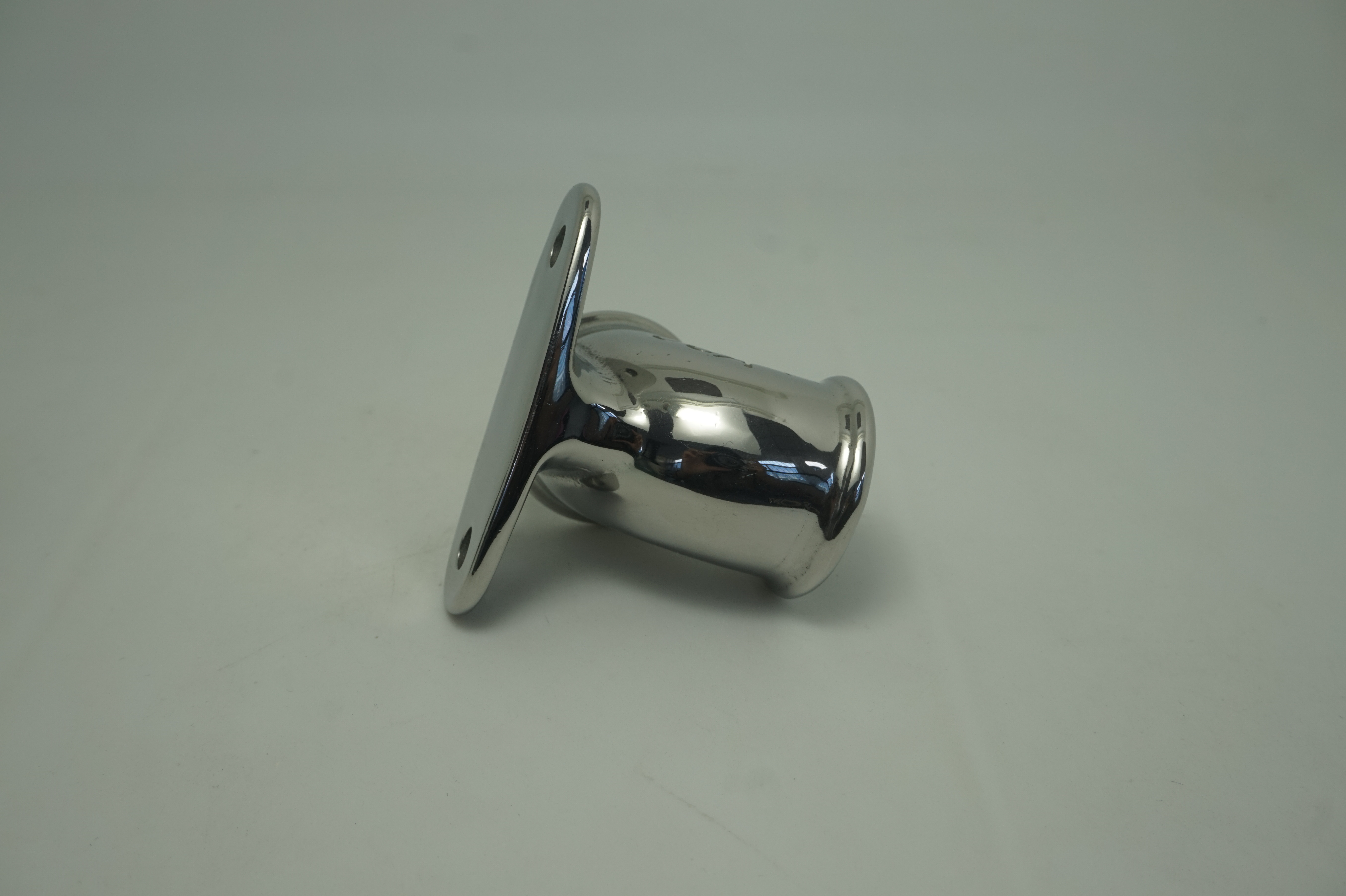
Orange peel is a wave in the surface, produced when metal is deformed rather than cut, usually on softer alloys, on work-hardened layers, or when a heavy cut stage is followed by too little refinement. It shows as a distorted reflected line when you view a straight edge in the face. Polishing with finer media does not remove it, because the wave extends below the depth a fine stage can reach; the sequence has to return to a cutting stage and then refine properly. If the wave comes from the incoming material or a forming operation, it may not be removable at all.
A mirror surface is damaged by contact, so handling begins before the parts leave the machine. Rinse and dry thoroughly to remove compound and fines, because residue trapped in a cavity bleeds out later and a damp surface can stain stainless. Then protect: interleave or sleeve faces that will touch, keep parts separated in trays, avoid sliding them across each other, and use gloves or a clean cloth when they are picked up. Agree packaging with the buyer, including whether parts travel individually wrapped, and inspect on arrival for marks that occurred in transit.
Ra alone is not enough. It is an average over a defined cutoff length, so a surface with a low Ra can still show waviness, orange peel or directional marks that dominate what a viewer sees, while a slightly rougher surface can look brighter if it scatters light evenly. Specify the measurement setup as well as the value, and where appearance is what matters, add a reflectance or gloss reading at a stated angle together with a physical master and viewing conditions. For Leipzig buyers working to a functional surface requirement, specify the profile and the appearance requirement separately.
Use Leipzig, Germany as the destination on the enquiry and state whether the deliverable is equipment, media and compound, a representative sample review or a line concept. A destination does not imply local stock, a local service point or a local delivery time.
Automotive suppliers in Leipzig work to IATF 16949 and VDA 6.3 with VDA 19.1 / ISO 16232 technical-cleanliness limits; aerospace work follows EN 9100-series quality systems with specific surface and edge requirements, and medical-technology and biotech suppliers work to ISO 13485. Surface-texture callouts are normally expressed to ISO 21920 and material conformity to EN 10204 (3.1), with CE marking required for machinery placed on the EEA market.
Sources were retrieved on 2026-09-29 and describe the local industrial and trade context only. They do not evidence any SurfacePolish project, shipment, installation or service in Leipzig.
The buyer needs the fascia reflective and uniform without thinning the panel, distorting the fold or leaving the handling scratches visible.
Send the material, dimensions, approximate weight, batch quantity, the incoming condition and photographs of the difficult features. Mark which features must not be contacted by media and state how the result will be inspected. This form carries source reference PSEO-0379; quote it if you prefer an additional manual reference.
Open the SurfacePolish enquiry form Email a prepared enquiry
No price, lead time, certification or result is promised here. Confirm whether a sample trial is available for the specific part and what the trial can and cannot show.
Page PSEO-0379 · revised 2026-09-29 · cross-border equipment, media and scoped sample review. City context is sourced and cited above.
Use this local checker to identify missing part and inspection information. It prepares a technical-review brief; it does not approve a machine, process recipe or production result.
Complete the part details to prepare a review brief.
Email : info@surface-polish.com


 IPv6 network supported


 +86-592-2381506