A buyer in Pune, India working in industrial machinery wants a thin steel fascia brightened evenly without thinning the sheet, distorting the folded return or leaving handling scratches visible in the reflection. SurfacePolish supplies finishing machines, media and compounds across borders and runs a free sample trial that returns the tested panels with observations and a proposed media, compound and cycle direction. This brief is written for a buyer in Pune working on industrial machinery; it describes equipment, media and a scoped sample review, not a local polishing service.
Can available media actually reach the geometry, and what finish is realistic in the recesses and internal features it cannot reach?
What is the substrate condition - cast, welded, forged or machined - and which defects already in it will become visible once the metal is smooth?
How will the finish be measured or viewed, with which instrument, angle, cutoff and master, and who holds that master?
Bright polishing rounds edges, and the more energy and time the sequence needs, the more rounding appears. Some edges are cosmetic and rounding is welcome; others define function, such as a scraper edge on a machine-tool slideway, a knife edge on a metering blade, a thread start, or the lapped lip of a valve seat. Mark those features on the drawing and state a maximum edge radius or a no-touch zone before media is selected. Inspection can use radius gauges, a cast impression or an optical comparator against the incoming edge form. Where a crisp edge and a bright face conflict, the practical order is to finish the face first and restore the edge with a controlled hand operation, or to accept a slightly duller face that preserves the edge.
Compound concentration is a process variable that drifts. Dosing on a timer is convenient but ignores carry-out, evaporation and the fines load, so a batch that starts at target can finish well above or below it. Meter dose against water flow, check pH and, where available, conductivity at the start and end of a cycle, and record those values with the batch. Water quality shapes the final image: hard water leaves mineral spots that read as haze, and high chloride or iron content can stain stainless during rinsing. The rinse after each stage deserves the same control as the finishing stage, with enough volume and flow to remove compound and loose fines before the part dries, because dried residue is far harder to remove without disturbing the finish.
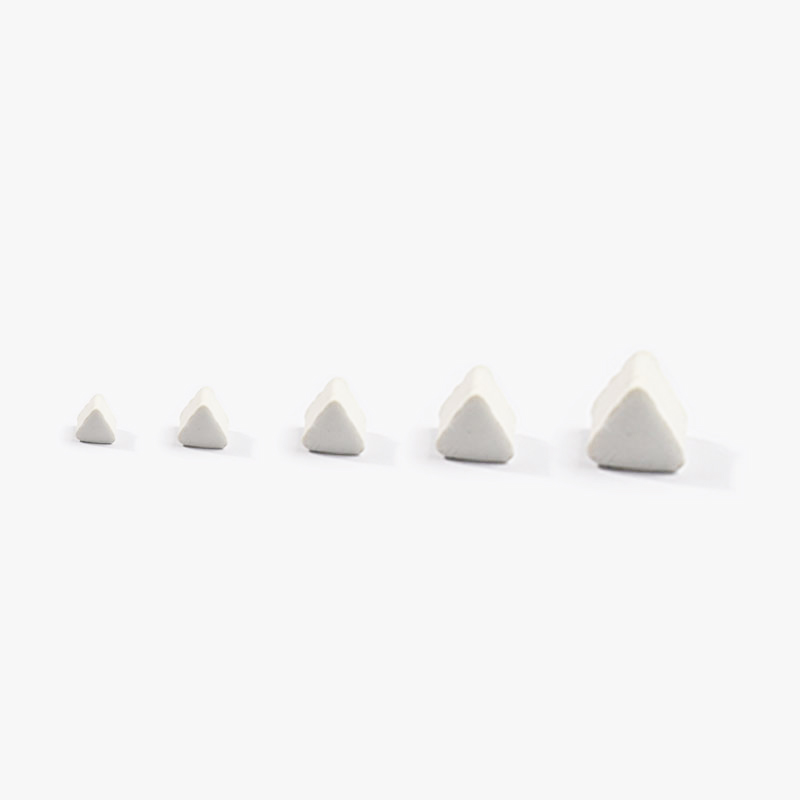
| Media | Best fit | Watch out for |
|---|---|---|
| Small high-density ceramic spheres or ovals | Colour and pre-lustre stages where a uniform, soft-looking finish matters more than stock removal, including curved and contoured faces. | Very slow cut, easily lost through screens sized for larger media, and ineffective in deep recesses because it cannot reach or press against the surface. |
| Hardened steel media, balls and shaped shot | Bright burnishing of stainless and hardened steel, and the final wet lustre stage where a dense medium can peen a surface smooth. | Can transfer iron and rust to stainless, dents soft or thin parts, and must be kept in a dedicated charge away from ceramic media. |
| Medium ceramic triangles or angle-cut shapes | Blending, edge conditioning and the refinement step that removes the coarse cut pattern on housings, brackets, covers and frames. | Media that cannot enter a slot or recess leaves those areas at a different finish, so those faces need a separate operation or a stated lower standard. |
| Coarse ceramic angle-cut cylinders or triangles | First cut stage on rigid parts with open faces, removing grinding or machining damage on cast iron, steel and stainless before refinement. | Leaves a deep pattern the next stage must fully erase, chips thin edges, and its wear debris carries fine abrasive into later stages if the charge is not screened. |
Magnetic finishing drives small pins or needles with a moving magnetic field, so the abrasive follows internal edges, cross holes, slots and fine detail that no tumbling medium of usable size can enter. It is the practical route for small precise parts such as valve spools, small gears, nozzle bodies and instrument components where a bright edge or a cleaned intersection matters. It removes very little material, so it is a refinement and edge-conditioning step rather than a way to erase coarse grinding marks. Working envelope and part mass are the main limits: large faces and heavy parts do not fit, and the effect falls off where the field cannot drive the pins. Check coverage on a sample with magnification and a borescope.
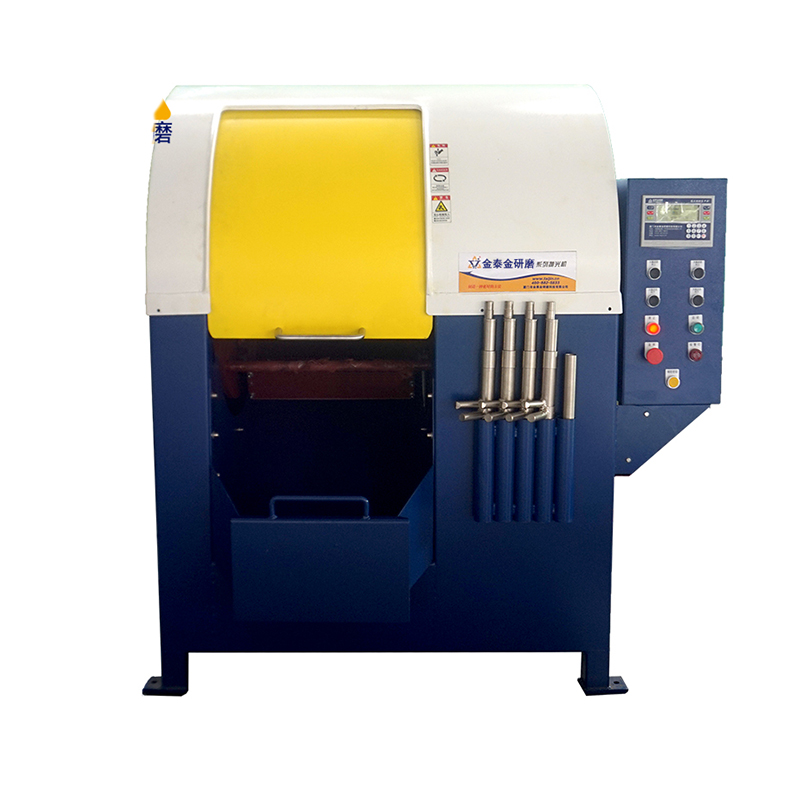
| Machine route | Where it fits | What it will not do |
|---|---|---|
| Dry polishing machine and dryer | Final lustre, dry colour and post-wet drying where the last reflected image cannot be produced by a wet mass-finishing stage. | Works on accessible faces only, generates dust and heat that need control, and offers no way to correct a defect left by an earlier stage. |
| Tub vibrator | Long and large parts such as shafts, extrusions and frame members that cannot be folded into a barrel, including external grooves. | Poor at bores running parallel to the long axis, and slender parts still need support or balanced loading to hold straightness. |
| Disc finishing machine | Fast, high-energy cut down on small to medium parts with simple geometry where cycle time matters and edge rounding is tolerable. | Part-on-part contact and wall pressure can chip or deform parts, and the difference between sufficient and excessive removal is narrow. |
| Magnetic finishing machine | Refinement and edge conditioning of small precise parts with internal edges, cross holes and fine detail that media cannot enter. | Working envelope and part mass restrict size, removal is very small, and coverage falls off wherever the field cannot drive the pins. |
Beyond a certain point, more polishing makes a surface worse. Excess cycle time or contact pressure rolls metal over instead of cutting it, burying abrasive and debris under a smeared skin that looks bright until it is disturbed. On dry or high-speed operations, friction raises local temperature enough to tint the surface and soften a hardened layer, and thin sections can distort from the heat. High-energy routes add part-on-part impingement, leaving nicks and small dents that polishing cannot remove. Watch for a bright surface that dulls or streaks when wiped with a clean cloth, for colour variation near edges where contact is highest, and for dimensional or flatness change. The remedy is a shorter or gentler cycle, better cooling and a real end point instead of a longer run.
| Failure mode | Likely cause | How to catch it |
|---|---|---|
| Dimensional drift or lost flatness on datums, seals and bearing seats | Uneven stock removal across a large or asymmetric face, over-long cycles, or unprotected functional features exposed to the full charge energy. | Measure flatness and critical dimensions with a CMM or surface plate at the same marked points used for the incoming survey, and compare the change against the allowance. |
| Compound residue film, water spots or a dull bloom after drying | Incomplete rinsing, hard or contaminated rinse water, a dose above target, or drying that leaves a cavity to bleed residue onto the finished face. | Wipe a defined area with a clean white cloth after drying, inspect cavities for bleed-out, and check rinse water hardness or conductivity at the point of use. |
| Ghost pattern of an earlier coarse stage showing through the final finish | A cut or refinement stage removed too little material, a later stage reused a contaminated charge, or the crosshatch direction was not changed between steps. | Reflect a light source at a shallow angle and rotate the part; a mark that disappears at one angle and returns at another is still in the surface rather than on it. |
| Media lodged in blind holes, slots, undercuts or threaded features | Media size too close to the opening, a slot or cavity that traps the charge, or no defined retrieval step before rinsing and drying. | Reconcile a counted media charge before and after the cycle, borescope each cavity at an agreed angle, and pin or thread gauge the features the charge could enter. |
Pune is one of the industrial and commercial centres that Invest India names, alongside Mumbai and Chhatrapati Sambhajinagar, on Maharashtra's road network of more than 6.7 lakh km (s1). The district carries a major concentration of the state's approved private industrial parks - 669 private IT parks statewide, concentrated in Pune, Mumbai City & Suburban and Thane - on top of the 289-292 industrial areas developed statewide by the Maharashtra Industrial Development Corporation (s1). The city's industry association is the Mahratta Chamber of Commerce, Industries and Agriculture, which presents itself as Maharashtra's Largest Industry Network and runs sector committees including food processing and defence from its Senapati Bapat Road office in Pune (s2). The Delhi-Mumbai Industrial Corridor, spanning about 1,504 km across six states, is the wider industrial-growth driver for this belt (s1).
For this brief the relevant part of that base is machinery: India's capital goods sector accounts for 21.5% of total manufacturing (s4), and Pune's chamber runs MSME and innovation committees serving the region's component and machinery manufacturers (s2).
Pune's component and machinery manufacturing base produces machined castings, forgings, gears, shafts and sheet-metal parts whose edges, burrs and surface condition are inspected by the receiving OEM or tier-one customer, so deburring and controlled surface finish are routine process steps rather than cosmetic extras. Food-processing equipment adds a cleanliness and passivation dimension where product-contact surfaces must be free of burrs, scale and residue after fabrication.
A Pune buyer should decide whether the acceptance criterion is a measured surface roughness and burr-free edge on a defined alloy, or a visual finish, and whether the part family is high-mix/low-volume job work or a single high-volume line - that choice, not machine size alone, determines whether batch barrel/vibratory finishing or a more controlled process is the right answer.
Freight context: Jawaharlal Nehru Port (JNPT) / Nhava Sheva, Delhi-Mumbai Industrial Corridor (DMIC) road corridor, Mumbai-Pune expressway and national highway corridor. Pune is connected to Mumbai and Chhatrapati Sambhajinagar by one of India's largest road networks and sits on the Delhi-Mumbai Industrial Corridor (s1). Containerised imports are normally cleared through the JNPT/Vadhvan port complex and trucked down the Mumbai-Pune corridor, so inland transit and unloading access at the plant should be planned together with the bill of entry timeline (s1).
India classifies every imported item in the ITC(HS) schedule, a compilation of codes for all merchandise for export and import whose Schedule I lays down the import policy regime for each item, maintained at 8-digit level under the First Schedule of the Customs Tariff Act, 1975 and aligned at 6 digits with the WCO Harmonized System (c1, c3). Importability is judged by the policy in force on the date of import, and when a policy moves from free to restricted, goods already committed through an irrevocable commercial letter of credit opened before the change can still be imported up to the balance quantity, value and period in that ICLC (c4). Preferential customs treatment is available only through the preferential trade agreements, free trade agreements, CECAs and CEPAs that India notifies and that are in operation (c5), so Chinese-origin industrial machinery is assessed at the applicable rate of the customs tariff rather than under any India-China preferential rate; India's commerce leadership has separately pointed to exports under free trade pacts growing faster than imports (c12). For capital goods specifically, DGFT operates the Export Promotion Capital Goods (EPCG) scheme, whose stated objective is to facilitate import of capital goods for producing quality goods and services (c7), which Indian firms use when they want duty relief on imported plant against an export obligation.
India's foreign-trade, customs and standards machinery works in English: the Foreign Trade Policy, DGFT's IEC and scheme material, the BIS standards catalogue and Invest India's investor guide are all published in English, and the mandatory import documents are the internationally conventional bill of lading, commercial invoice cum packing list and bill of entry (c1, c3, c6, c10). Payment in the import channel is bank-intermediated; the Foreign Trade Policy treats the irrevocable commercial letter of credit as the instrument that fixes an importer's commitment when import policy changes (c4), so a supplier should expect LC or advance terms rather than open-account credit on a first order. Indian industry associations are explicit about import substitution: the Bombay Chamber of Commerce and Industry states that one of its major focuses today is how to expand manufacturing setups and substitute imported products (c13), so a cross-border equipment seller should expect questions about local support, spares, training and total cost of ownership rather than price alone, and should hold the IEC, GST registration, bill of entry documentation and any BIS obligation as part of the commercial discussion.
SurfacePolish supplies from Xiamen, China. The buyer's own destination rules, conformity marking, tariff classification and documentation responsibilities stay with the buyer; confirm them against the authorities named above before ordering.
Ask for a settings record with every batch: machine and stage, media type and size class, charge mass and age, compound product and measured dose, load ratio, cycle time and rinse conditions. Retain a fully inspected first article as the physical reference, together with its measurement data and photographs at fixed scale and lighting. Write the disposition rule in advance, covering what passes, what is reworked and what is scrapped, and name who decides. The record should state plainly that the reported condition applies to the parts tested, at the locations measured, with the settings used; it is a description, not a guarantee of future output or of fitness for any regulated application. Certificate and approval requests belong with the buyer's own quality function.
A trial reports what was observed on the parts it received, under the settings used. It cannot prove that every casting in a lot will respond the same way, that a worn media charge will behave identically over months, or that the finish satisfies a regulated or safety-critical requirement; those are questions for the buyer's own engineering and quality functions, using their own verification. It also cannot promise a reflectance value, an Ra value, a cycle time, a price or a capacity. Before shipping parts, decide whether a mirror finish is plausible at all: check the substrate for porosity and inclusions, confirm that available media can reach the geometry, and define the acceptance method first. If the requirement cannot be measured or viewed consistently, no trial result will settle it.

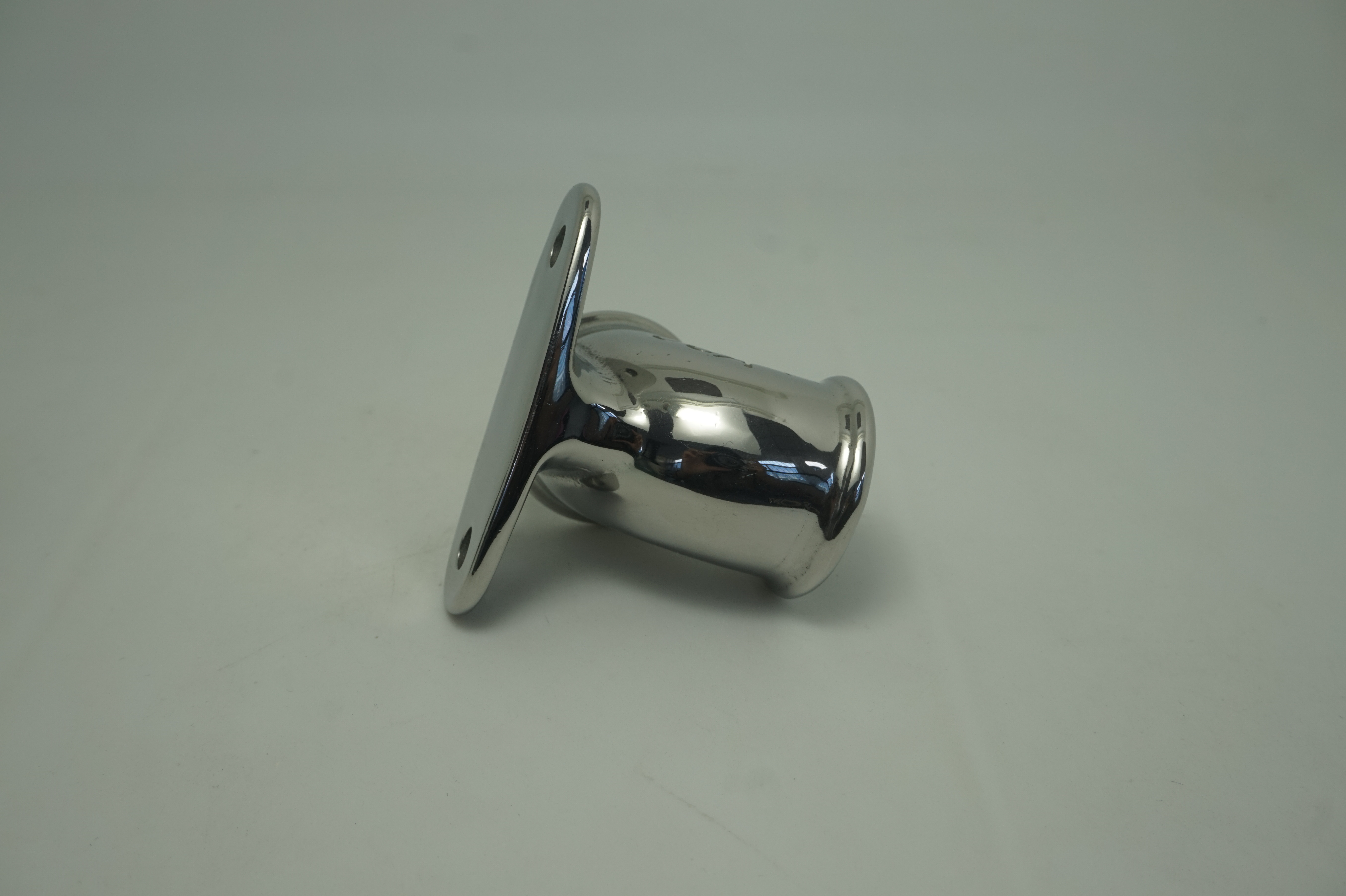
Rounding depends on the energy and duration of the sequence and on how exposed the edge is. A light refinement pass may barely touch it, while a long cut stage on a soft alloy can visibly round it. Mark the edges that must stay crisp, state a maximum radius or a no-touch zone before media is selected, and measure with a radius gauge, an optical comparator or a cast impression against the incoming form. Where a bright face and a crisp edge conflict, the practical order is to finish the face and then restore or protect the edge rather than to keep polishing.
Ra alone is not enough. It is an average over a defined cutoff length, so a surface with a low Ra can still show waviness, orange peel or directional marks that dominate what a viewer sees, while a slightly rougher surface can look brighter if it scatters light evenly. Specify the measurement setup as well as the value, and where appearance is what matters, add a reflectance or gloss reading at a stated angle together with a physical master and viewing conditions. For Pune buyers working to a functional surface requirement, specify the profile and the appearance requirement separately.
Sometimes, but geometry decides. Media has to sit against the surface and move along it, so recesses with narrow mouths, deep bores, broad flat faces and internal corners may finish unevenly or not at all. A mass-finishing route can still deliver an excellent result on open faces while internal detail reaches a lower, more uniform standard, and it is often sensible to define the requirement per face. Where a small internal edge is the visible feature, a magnetic finishing step or a controlled hand operation may be the only practical route; where a part is too heavy or too long for the envelope, none of it applies.
Use Pune, India as the destination on the enquiry and state whether the deliverable is equipment, media and compound, a representative sample review or a line concept. A destination does not imply local stock, a local service point or a local delivery time.
Finish, edge and material conformity requirements for a Pune buyer are specified against Indian Standards (IS) issued by the Bureau of Indian Standards, the National Standards Body of India (s3). Where a finished part or the finishing consumable falls under a BIS quality-control order, the licence or registration requirement applies to the product on the Indian market, so the applicable IS reference should be agreed with the customer's quality function up front (s3).
Sources were retrieved on 2026-09-29 and describe the local industrial and trade context only. They do not evidence any SurfacePolish project, shipment, installation or service in Pune.
The buyer needs the fascia reflective and uniform without thinning the panel, distorting the fold or leaving the handling scratches visible.
Send the material, dimensions, approximate weight, batch quantity, the incoming condition and photographs of the difficult features. Mark which features must not be contacted by media and state how the result will be inspected. This form carries source reference PSEO-0949; quote it if you prefer an additional manual reference.
Open the SurfacePolish enquiry form Email a prepared enquiry
No price, lead time, certification or result is promised here. Confirm whether a sample trial is available for the specific part and what the trial can and cannot show.
Page PSEO-0949 · revised 2026-09-29 · cross-border equipment, media and scoped sample review. City context is sourced and cited above.
Use this local checker to identify missing part and inspection information. It prepares a technical-review brief; it does not approve a machine, process recipe or production result.
Complete the part details to prepare a review brief.
Email : info@surface-polish.com


 IPv6 network supported


 +86-592-2381506