A buyer producing industrial machinery in Saitama, Japan has a long stainless pump shaft that must be brightened without bowing, losing roundness at the bearing seat or rounding the keyway edges. SurfacePolish supplies finishing machines, media and compounds internationally and runs a free sample trial on parts shipped to Xiamen, returning observations and a proposed direction rather than a promised result. This brief is written for a buyer in Saitama working on industrial machinery; it describes equipment, media and a scoped sample review, not a local polishing service.
How will the finish be measured or viewed, with which instrument, angle, cutoff and master, and who holds that master?
How much stock may the sequence remove before datums, seal faces, flatness or edge form fall outside their allowance?
Can available media actually reach the geometry, and what finish is realistic in the recesses and internal features it cannot reach?
The as-received surface records what earlier operations did, and its deepest damage sets the stock-removal budget. A face ground with a coarse wheel carries scratches far deeper than the visible line, an EDM surface carries a recast layer that must be cut back, and a part previously plated, painted or repaired by welding hides interfaces that respond differently to the same media. Assess scratch depth on a witness coupon or a sacrificial area, then compare it with the total removal the sequence can afford before dimensions or edge form are lost. A part that was brightened once and then re-machined can also carry a ghost pattern of the earlier finish. Reading this before quoting avoids a disappointing trial result that is really a substrate problem.
Compound concentration is a process variable that drifts. Dosing on a timer is convenient but ignores carry-out, evaporation and the fines load, so a batch that starts at target can finish well above or below it. Meter dose against water flow, check pH and, where available, conductivity at the start and end of a cycle, and record those values with the batch. Water quality shapes the final image: hard water leaves mineral spots that read as haze, and high chloride or iron content can stain stainless during rinsing. The rinse after each stage deserves the same control as the finishing stage, with enough volume and flow to remove compound and loose fines before the part dries, because dried residue is far harder to remove without disturbing the finish.
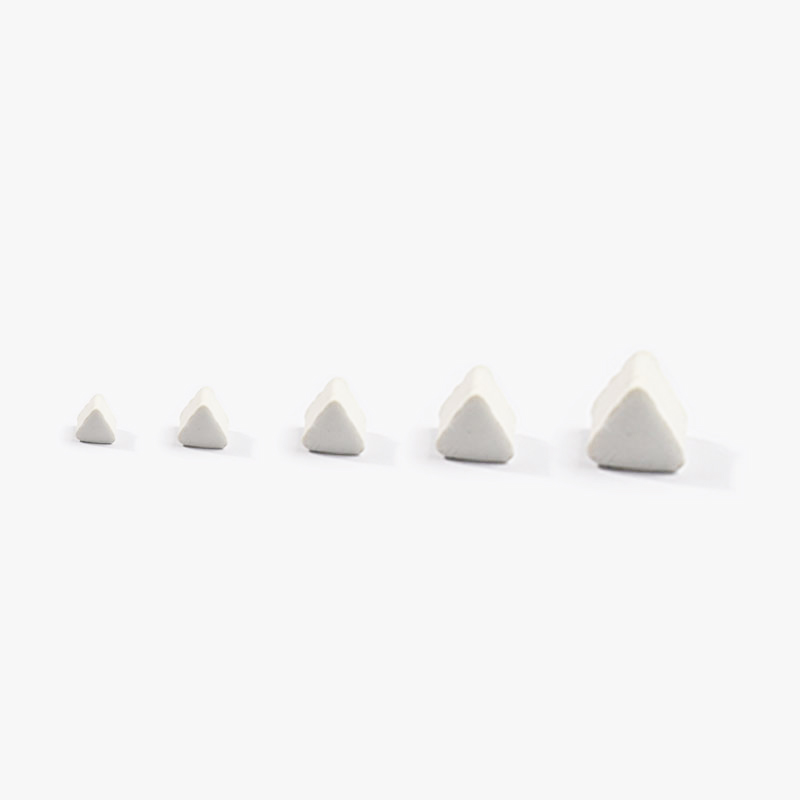
| Media | Best fit | Watch out for |
|---|---|---|
| Plastic or polyester media | Gentle processing of aluminium, brass, copper and thin panels where metal smearing, nicks and distortion must be avoided. | Low density gives little contact force, so cycles run long and heavy grinding marks may survive; plastic also wears quickly and can float above the working mass. |
| Magnetic finishing pins and needles | Small precise parts with internal edges, cross holes, slots and fine detail that no tumbling medium of usable size can reach. | Limited by working envelope and part mass, removes very little material, and pins can embed in soft metals or remain in cavities if retrieval is not checked. |
| Small high-density ceramic spheres or ovals | Colour and pre-lustre stages where a uniform, soft-looking finish matters more than stock removal, including curved and contoured faces. | Very slow cut, easily lost through screens sized for larger media, and ineffective in deep recesses because it cannot reach or press against the surface. |
| Medium ceramic triangles or angle-cut shapes | Blending, edge conditioning and the refinement step that removes the coarse cut pattern on housings, brackets, covers and frames. | Media that cannot enter a slot or recess leaves those areas at a different finish, so those faces need a separate operation or a stated lower standard. |
For housings, cover plates, brackets and frames that are rigid and mostly open, a vibratory bowl or tub gives the most forgiving cut-to-colour sequence. The charge moves as a mass, so there is no fixturing to design and no clamping marks, and cycle energy can be tuned through amplitude, media density and load ratio. The limit is reach: media cannot present abrasive uniformly into a pocket whose mouth is narrower than its base, and broad flat faces finish more slowly than edges because contact pressure there is lower. Part-on-part contact also leaves nicks on thin or sharply detailed features, so small, slender or intricate parts usually belong in a gentler route even when their surface requirement is identical.
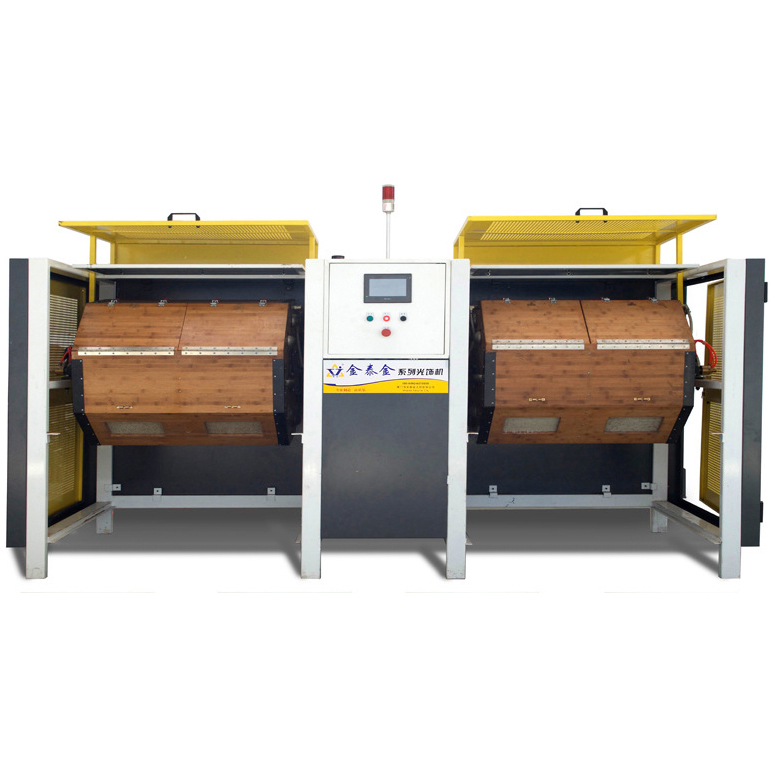
| Machine route | Where it fits | What it will not do |
|---|---|---|
| Grinding finishing machine | The heavier stock-removal stage before a mirror sequence, cutting back grinding damage, scale and recast layers on robust parts. | High removal also rounds edges and can work harden or distort thin sections, so it needs a defined depth target and a sample check. |
| Magnetic finishing machine | Refinement and edge conditioning of small precise parts with internal edges, cross holes and fine detail that media cannot enter. | Working envelope and part mass restrict size, removal is very small, and coverage falls off wherever the field cannot drive the pins. |
| Dry polishing machine and dryer | Final lustre, dry colour and post-wet drying where the last reflected image cannot be produced by a wet mass-finishing stage. | Works on accessible faces only, generates dust and heat that need control, and offers no way to correct a defect left by an earlier stage. |
| Barrel finishing machine / rotary barrel tumbler | Dense, uniform colour on small hardware that tolerates sliding contact, especially with steel media for a burnished appearance. | Nothing longer than the barrel diagonal can be processed, and slender parts can bend or nick against neighbours in the load. |
Orange peel is a slow wave in the surface, visible as a distorted reflected line, and it usually comes from the finishing process rather than the substrate. It develops when a soft or work-hardened layer is deformed rather than cut, when a heavy cut stage is followed by too little refinement, or when a buffing or dry stage runs at high speed with excess pressure and little cooling. Aluminium, copper and annealed stainless are the most prone. Detection belongs in the acceptance routine: reflect a straight edge or a fluorescent tube in the face, look at the shape of the image, and compare against a physical master in the same lighting. Extra fine polishing will not remove peel that sits below the surface; the sequence has to return to a cutting stage.
| Failure mode | Likely cause | How to catch it |
|---|---|---|
| Ghost pattern of an earlier coarse stage showing through the final finish | A cut or refinement stage removed too little material, a later stage reused a contaminated charge, or the crosshatch direction was not changed between steps. | Reflect a light source at a shallow angle and rotate the part; a mark that disappears at one angle and returns at another is still in the surface rather than on it. |
| Haze, a general loss of image clarity with no directional pattern | Worn media shedding an oversized fine fraction, agglomerated abrasive in the compound line, or fine grit carried into a late stage from screens, machine walls or a shared rinse. | View under raking light at low magnification against a master, then trace the pattern by machine and by rinse line to separate a charge problem from a rinse or transfer problem. |
| Embedded media particles or finishing pins in a soft surface | High contact pressure on aluminium, brass or copper, worn media with sharp fractured edges, or magnetic-finishing pins driven into a surface that cannot resist them. | Examine at magnification under raking light, wipe with a clean cloth and check for pulled particles, and consider a dye penetrant or etching check on a sample part. |
| Edge radius beyond the allowed limit | A cut stage longer or more energetic than the edge allowance supports, insufficient masking or fixturing, or a sequence repeated to remove a defect and run past the edge allowance. | Measure with a radius gauge, a cast impression or an optical comparator at the marked edges, and compare against the edge form and dimensions recorded before finishing. |
Saitama City positions itself as a Greater Tokyo business and logistics location: its official investment guide states that the city supports the siting of research facilities, manufacturing plants and distribution facilities with one-stop administrative service, and that it is preparing new industrial accumulation sites as receptacles for incoming companies in ten districts. The guide also cites the city's medical-device manufacturing initiative (さいたま医療ものづくり都市構想) as part of its location support. The city has a dedicated policy for creating logistics-facility induction districts, justified in part by securing supplies and logistics during disasters. A separate municipal project relocates and rebuilds the central meat wholesale market together with a roadside-station-based agri-food distribution and tourism hub.
For this brief the relevant part of that base is machinery: The city's investment guide states that it supports the siting of research facilities, manufacturing plants and distribution facilities with one-stop administrative service, and that it is preparing new industrial accumulation sites in ten districts as receptacles for incoming companies.
Medical-device manufacturing in the area puts cleanliness, edge quality and surface integrity on the critical path, because burrs or embedded media on a diagnostic or device component are a quality and documentation issue rather than a cosmetic one. General machinery and sheet-metal fabrication in the city's industrial parks needs consistent deburring and edge break before coating, welding or assembly, so one process specification rarely fits both groups.
A Saitama buyer should first decide which regime the part falls under - medical-device-related work where cleanliness and surface integrity must be documented, or general machinery where edge break and roughness callouts dominate - because that choice determines whether the sample trial has to include cleanliness verification as well as dimensional and visual checks.
Freight context: Designated 物流施設誘導地区 (logistics-facility induction districts) in Saitama City. Saitama City creates logistics-facility induction districts for facilities meeting the legal definition of a specified distribution business facility (特定流通業務施設), and it requires disaster-resilience measures and a disaster-time cooperation agreement - a sign of the city's role as a metropolitan distribution base. The city has no seaport, so freight for machines and samples moves by road and rail.
Chinese industrial machinery entering Japan is classified under the Customs Tariff Law, whose harmonised schedule sets the classification and the General Rate; the Temporary Tariff Measures Law sets a Temporary Rate for certain products, and where the WTO rate or an EPA rate for the goods is lower, that lower rate is applied. The applied rate therefore depends on the exact commodity code, and on whether an economic partnership agreement covers the goods and their origin, so a landed-cost figure has to be confirmed against the specific machine before it is quoted. Japan Customs' monthly country table for August 2026 records exports to China of 1,809,133 million yen and imports from China of 2,361,239 million yen, the largest single-country line in the Asian table, with imports from China up 22.5 per cent year on year.
The customs authority is Japan Customs, the Customs and Tariff Bureau of the Ministry of Finance, with regional customs at Tokyo, Yokohama, Nagoya, Osaka and Kobe. Any person importing goods must declare them to the Director-General of Customs and obtain an import permit after examination and payment of customs duty and consumption tax. The declaration is normally filed by the importer or by a customs broker acting as proxy, on a triplicate import (customs duty payment) declaration form (Customs form C-5020) supported by the invoice, the bill of lading or air waybill, a certificate of origin where a WTO rate applies, certificates of origin for preferential rates, packing lists and freight and insurance documents where required, plus any licence or certificate demanded by laws other than the Customs Law. More than 90 per cent of import procedures are computerised. A JIS Mark certificate is a separate, voluntary third-party scheme; foreign exporters are eligible to apply, and certification bodies must comply with ISO/IEC 17065.
SurfacePolish supplies from Xiamen, China. The buyer's own destination rules, conformity marking, tariff classification and documentation responsibilities stay with the buyer; confirm them against the authorities named above before ordering.
Ask for a settings record with every batch: machine and stage, media type and size class, charge mass and age, compound product and measured dose, load ratio, cycle time and rinse conditions. Retain a fully inspected first article as the physical reference, together with its measurement data and photographs at fixed scale and lighting. Write the disposition rule in advance, covering what passes, what is reworked and what is scrapped, and name who decides. The record should state plainly that the reported condition applies to the parts tested, at the locations measured, with the settings used; it is a description, not a guarantee of future output or of fitness for any regulated application. Certificate and approval requests belong with the buyer's own quality function.
A trial reports what was observed on the parts it received, under the settings used. It cannot prove that every casting in a lot will respond the same way, that a worn media charge will behave identically over months, or that the finish satisfies a regulated or safety-critical requirement; those are questions for the buyer's own engineering and quality functions, using their own verification. It also cannot promise a reflectance value, an Ra value, a cycle time, a price or a capacity. Before shipping parts, decide whether a mirror finish is plausible at all: check the substrate for porosity and inclusions, confirm that available media can reach the geometry, and define the acceptance method first. If the requirement cannot be measured or viewed consistently, no trial result will settle it.

Ra alone is not enough. It is an average over a defined cutoff length, so a surface with a low Ra can still show waviness, orange peel or directional marks that dominate what a viewer sees, while a slightly rougher surface can look brighter if it scatters light evenly. Specify the measurement setup as well as the value, and where appearance is what matters, add a reflectance or gloss reading at a stated angle together with a physical master and viewing conditions. For Saitama buyers working to a functional surface requirement, specify the profile and the appearance requirement separately.
Send representative production parts including the thinnest wall, the tightest feature that must stay clear and the worst edge, plus a witness coupon of the same material and condition, a drawing extract covering the finished faces and the acceptance requirement you intend to apply. Label every piece and note its incoming condition with photographs, readings and measurements. The return is the tested parts with observations and a proposed media, compound and cycle direction for the buyer's own evaluation. A trial on parts shipped from Japan is a comparison, not a qualification, and it establishes no capacity or delivered surface value.
Rounding depends on the energy and duration of the sequence and on how exposed the edge is. A light refinement pass may barely touch it, while a long cut stage on a soft alloy can visibly round it. Mark the edges that must stay crisp, state a maximum radius or a no-touch zone before media is selected, and measure with a radius gauge, an optical comparator or a cast impression against the incoming form. Where a bright face and a crisp edge conflict, the practical order is to finish the face and then restore or protect the edge rather than to keep polishing.
Use Saitama, Japan as the destination on the enquiry and state whether the deliverable is equipment, media and compound, a representative sample review or a line concept. A destination does not imply local stock, a local service point or a local delivery time.
Japanese buyers work to JIS (Japanese Industrial Standards) administered through the Japanese Industrial Standards Committee (JISC), which also maintains the market-creation standardisation scheme run with METI; drawings normally cite JIS or customer standards for surface finish and material conformity. For medical-device-related work, customers add their own cleanliness and quality-system requirements on top of ISO 9001 as general industry practice.
Sources were retrieved on 2026-09-29 and describe the local industrial and trade context only. They do not evidence any SurfacePolish project, shipment, installation or service in Saitama.
The buyer needs a bright shaft without bowing it in the charge and without losing roundness or the bearing seat fit.
Send the material, dimensions, approximate weight, batch quantity, the incoming condition and photographs of the difficult features. Mark which features must not be contacted by media and state how the result will be inspected. This form carries source reference PSEO-0889; quote it if you prefer an additional manual reference.
Open the SurfacePolish enquiry form Email a prepared enquiry
No price, lead time, certification or result is promised here. Confirm whether a sample trial is available for the specific part and what the trial can and cannot show.
Page PSEO-0889 · revised 2026-09-29 · cross-border equipment, media and scoped sample review. City context is sourced and cited above.
Use this local checker to identify missing part and inspection information. It prepares a technical-review brief; it does not approve a machine, process recipe or production result.
Complete the part details to prepare a review brief.
Email : info@surface-polish.com


 IPv6 network supported


 +86-592-2381506