A buyer in Strasbourg, France working in industrial machinery wants a thin steel fascia brightened evenly without thinning the sheet, distorting the folded return or leaving handling scratches visible in the reflection. SurfacePolish supplies finishing machines, media and compounds across borders and runs a free sample trial that returns the tested panels with observations and a proposed media, compound and cycle direction. This brief is written for a buyer in Strasbourg working on industrial machinery; it describes equipment, media and a scoped sample review, not a local polishing service.
How much stock may the sequence remove before datums, seal faces, flatness or edge form fall outside their allowance?
What is the substrate condition - cast, welded, forged or machined - and which defects already in it will become visible once the metal is smooth?
How will the finish be measured or viewed, with which instrument, angle, cutoff and master, and who holds that master?
Bright finishing does not fill a defect, it magnifies it. A reflection compresses the whole surface into a narrow viewing angle, so a gas pore in a casting, a slag inclusion at a weld toe or a non-metallic stringer in free-machining bar becomes a visible comet trail once the surrounding metal is smooth. Screen the incoming substrate before any media is chosen: examine under glancing light, wipe the surface clean of oil, and where the drawing allows, run a dye penetrant check across weld toes and machined transitions. If the defect density is high, no sequence of cut, colour and lustre stages will produce a uniform image, and the honest answer is that the casting, the weld or the requirement itself has to change.
When a part must lose a measurable amount of stock before colour stages, disc finishing and centrifugal barrel machines deliver far more energy than a conventional vibrator. That energy shortens the cut stage but also rounds edges, work hardens soft alloys and can distort thin sections. Load the parts so they cannot jam against the disc wall, and bracket cycle time tightly, because the difference between enough removal and too much is small. Centrifugal barrels suit small to medium parts with simple geometry. Neither route removes the need for refinement: the surface they leave still needs finer media and a polishing compound before a reflected image becomes coherent, and the depth achieved has to be verified on a sample rather than assumed from a setting.
| Machine route | Where it fits | What it will not do |
|---|---|---|
| Disc finishing machine | Fast, high-energy cut down on small to medium parts with simple geometry where cycle time matters and edge rounding is tolerable. | Part-on-part contact and wall pressure can chip or deform parts, and the difference between sufficient and excessive removal is narrow. |
| Tub vibrator | Long and large parts such as shafts, extrusions and frame members that cannot be folded into a barrel, including external grooves. | Poor at bores running parallel to the long axis, and slender parts still need support or balanced loading to hold straightness. |
| Grinding finishing machine | The heavier stock-removal stage before a mirror sequence, cutting back grinding damage, scale and recast layers on robust parts. | High removal also rounds edges and can work harden or distort thin sections, so it needs a defined depth target and a sample check. |
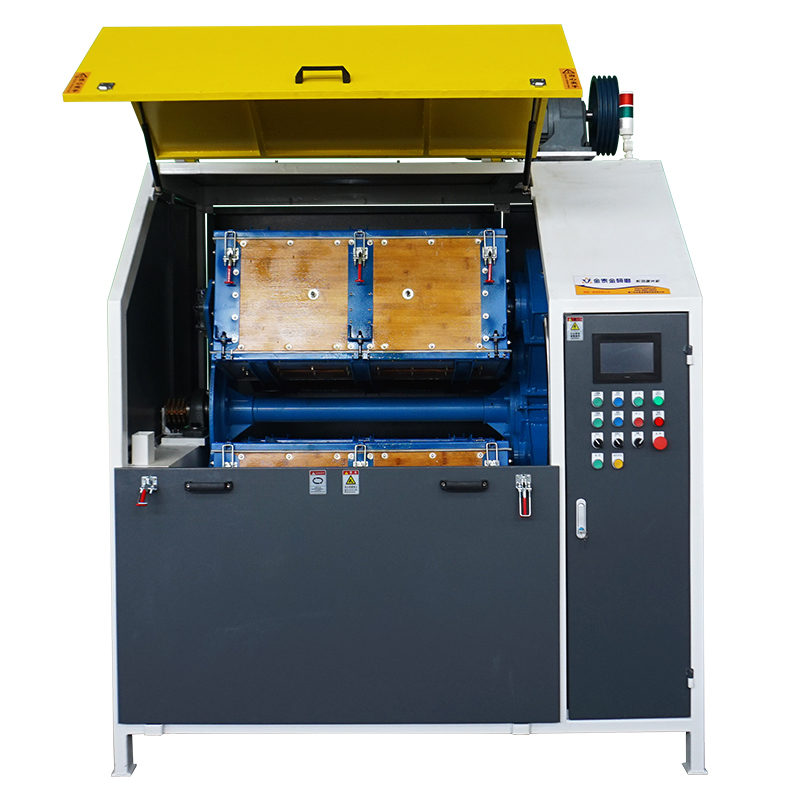
| Centrifugal barrel finishing machine | High-speed cut down and refinement on small to medium parts where a short, energetic cycle is needed before colour stages. | Aggressive on edges and thin sections, requires tight cycle control, and does not replace a finer refinement stage. |
Compound does more than lubricate: it carries abrasive, controls pH, keeps fines in suspension, prevents rust and determines how cleanly a part leaves the machine. Cutting stages usually run a more aggressive abrasive-bearing compound, while colour and lustre stages run a cleaner, higher-lubricity product with little or no abrasive so the surface is refined rather than scratched. pH matters by material family, since strongly alkaline compounds attack aluminium and acidic conditions can stain some steels, so match the family to the alloy and rinse promptly. Foam control matters too, because a foaming charge cushions contact and slows cutting unpredictably. Treat the compound specification and dose as part of the process recipe rather than as a consumable line item.
| Media | Best fit | Watch out for |
|---|---|---|
| Hardened steel media, balls and shaped shot | Bright burnishing of stainless and hardened steel, and the final wet lustre stage where a dense medium can peen a surface smooth. | Can transfer iron and rust to stainless, dents soft or thin parts, and must be kept in a dedicated charge away from ceramic media. |
| Plastic or polyester media | Gentle processing of aluminium, brass, copper and thin panels where metal smearing, nicks and distortion must be avoided. | Low density gives little contact force, so cycles run long and heavy grinding marks may survive; plastic also wears quickly and can float above the working mass. |
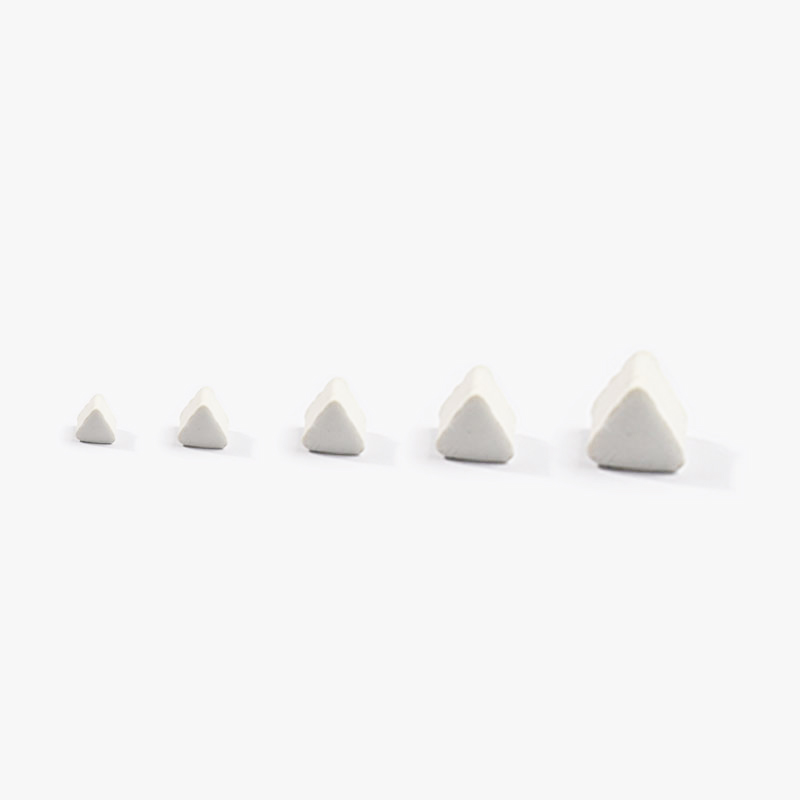
| Medium ceramic triangles or angle-cut shapes | Blending, edge conditioning and the refinement step that removes the coarse cut pattern on housings, brackets, covers and frames. | Media that cannot enter a slot or recess leaves those areas at a different finish, so those faces need a separate operation or a stated lower standard. |
| Dry media - corn cob | Softer dry lustre and drying steps, absorbent polishing of small parts, and light work on brass, aluminium and plated-look surfaces. | Breaks down faster than walnut shell and must be replaced regularly; it removes almost no material and cannot correct a surface defect. |
Orange peel is a slow wave in the surface, visible as a distorted reflected line, and it usually comes from the finishing process rather than the substrate. It develops when a soft or work-hardened layer is deformed rather than cut, when a heavy cut stage is followed by too little refinement, or when a buffing or dry stage runs at high speed with excess pressure and little cooling. Aluminium, copper and annealed stainless are the most prone. Detection belongs in the acceptance routine: reflect a straight edge or a fluorescent tube in the face, look at the shape of the image, and compare against a physical master in the same lighting. Extra fine polishing will not remove peel that sits below the surface; the sequence has to return to a cutting stage.
| Failure mode | Likely cause | How to catch it |
|---|---|---|
| Media lodged in blind holes, slots, undercuts or threaded features | Media size too close to the opening, a slot or cavity that traps the charge, or no defined retrieval step before rinsing and drying. | Reconcile a counted media charge before and after the cycle, borescope each cavity at an agreed angle, and pin or thread gauge the features the charge could enter. |
| Embedded media particles or finishing pins in a soft surface | High contact pressure on aluminium, brass or copper, worn media with sharp fractured edges, or magnetic-finishing pins driven into a surface that cannot resist them. | Examine at magnification under raking light, wipe with a clean cloth and check for pulled particles, and consider a dye penetrant or etching check on a sample part. |
| Haze, a general loss of image clarity with no directional pattern | Worn media shedding an oversized fine fraction, agglomerated abrasive in the compound line, or fine grit carried into a late stage from screens, machine walls or a shared rinse. | View under raking light at low magnification against a master, then trace the pattern by machine and by rinse line to separate a charge problem from a rinse or transfer problem. |
| Heat tint or discolouration concentrated near edges and thin sections | Friction at a dry or high-speed stage raising local temperature, poor cooling or compound flow, or a load that packs parts against each other with no media between them. | Compare colour against a master in consistent lighting, look for a gradient from edge inward, and check whether the tint follows load contact points or the whole face. |
Strasbourg's industrial economy is a Rhine one: the Ports de Strasbourg (Groupe PAS) state the port is the second largest French river port, operate 40 hectares of available land and a new trimodal platform on the Rhine, and the port authority's own news flow is dominated by industrial and heavy-industry development on its estates, including development plans by Kawasaki Heavy Industries for the Grand Est region. INSEE counted 11 376 establishments in the commune at the end of 2024 with a 3,8 % industry share and 178 849 jobs at the place of work in 2023. The Alsace industrial base around the city is a mixed one - automotive equipment suppliers, mechanical engineering, pharmaceuticals and medical devices, and food processing - supported by the ADIRA regional development agency, which reports 418 business development projects handled in 2025 and more than EUR 1,376 billion invested by the companies it supported in Alsace.
For this brief the relevant part of that base is machinery: The Ports de Strasbourg report that the port handles industrial companies on its estates and that Kawasaki Heavy Industries is developing its activities in the Grand Est region, on a site offering 40 hectares of available land and a new trimodal platform on the Rhine.
Alsace's automotive equipment and mechanical engineering base deburrs high-volume machined and stamped parts, where burr removal and edge quality are specified by the vehicle-maker and verified by cleanliness testing rather than visual inspection. The region's pharmaceutical and medical-device plants add stainless and hygienic-surface requirements in which surface roughness and residue-free cleaning are functional, and the port's heavy-industry estates generate large fabricated steelwork where weld dressing and coating preparation are the finishing tasks. The Rhine location also means German and Swiss customer specifications frequently apply alongside the French ones.
A Strasbourg buyer should settle which customer's specification governs - French, German or Swiss - before fixing edge and cleanliness acceptance criteria, because documentation, surface-roughness callouts and acceptance tests can differ between those customer chains for the same part.
Freight context: Ports de Strasbourg (Groupe PAS, Rhine river port), Strasbourg-Entzheim Airport, Strasbourg trimodal (road-rail-water) platform. The Ports de Strasbourg state the port is the second largest French river port and offer 40 hectares of available land plus a new trimodal platform on the Rhine, giving direct barge access to the Rhine corridor and the North Sea ports as well as rail and road links to Germany and Switzerland. That is the practical route for receiving containerised machines and media and for shipping sample parts into the German-speaking industrial belt.
For imports from outside the EU the declarant must file a customs declaration whose form and content are fixed by the Union Customs Code and its implementing provisions; French Customs identifies classification, origin and value as the three fundamental notions and makes the common/national tariff consultable via RITA. The customs authority is the Direction generale des douanes et droits indirects (DGDDI), which also runs the Info Douane Service for formalities questions. Buyers should expect to need an EORI number and an EU VAT treatment, because customs and tax authorisations are handled together (SOPRANO). For machinery, the CE marking and the applicable EU product-safety directives are the compliance gate items to settle before shipment, and the French market surveillance authority is the DGCCRF; the tariff rate itself must be confirmed per HS code in RITA or the EU Access2Markets tariff tool, since it varies by machine type.
The French national standards body is AFNOR (Association francaise de normalisation), which coordinates French participation in standardisation and publishes the NF and NF EN standards that transpose ISO and CEN work; AFNOR also runs the certification activity attached to many of those standards. A French buyer of finishing equipment would normally reference ISO/NF EN surface-texture standards for roughness and profile parameters, ISO/NF EN cleanliness or residue specifications for critical parts, and management-system or sector schemes such as ISO 9001, IATF 16949 for automotive and EN 9100 for aerospace.
SurfacePolish supplies from Xiamen, China. The buyer's own destination rules, conformity marking, tariff classification and documentation responsibilities stay with the buyer; confirm them against the authorities named above before ordering.
Ra and gloss are not interchangeable and should not be traded for one another. Ra is a two-dimensional profile average over a defined cutoff, so a face can hold a low Ra while still showing waviness, orange peel or directional marks that dominate the reflected image; conversely, a surface with a slightly higher Ra can look brighter because its texture scatters light uniformly. If the requirement is appearance, specify appearance: a reflectance or gloss reading at a stated angle and instrument geometry, plus a physical master and viewing conditions. If the requirement is texture or function, specify the profile parameter, the cutoff and the evaluation length. Ask for both where both matter, and record which one governs acceptance at each location.
Scaling up changes the charge faster than it changes the machine. Media wears, so the working size distribution drifts and a charge that cut well in a trial may burnish instead after a few hundred hours; screen and top up on a schedule, and record charge age with each batch. Compound dose should be metered against flow and checked, not assumed. Keep the load ratio inside the range the trial established, weigh or count parts rather than eyeballing the load, and separate material families so stainless does not pick up iron from carbon steel. Verify the rinse and dry stages as carefully as the finishing stage, because residue tolerated in small trial batches often becomes a visible film at production volume.
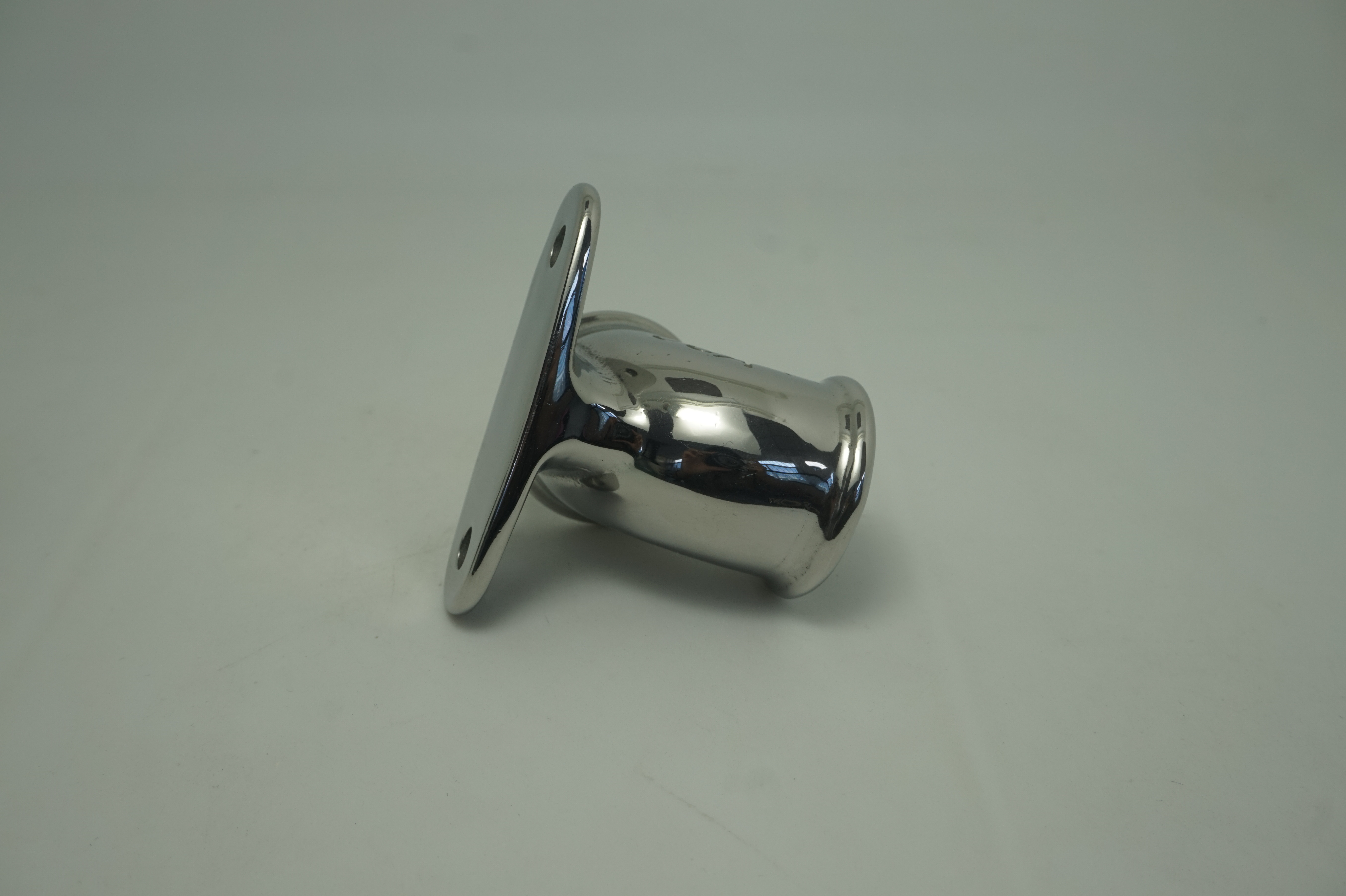
Sometimes, but geometry decides. Media has to sit against the surface and move along it, so recesses with narrow mouths, deep bores, broad flat faces and internal corners may finish unevenly or not at all. A mass-finishing route can still deliver an excellent result on open faces while internal detail reaches a lower, more uniform standard, and it is often sensible to define the requirement per face. Where a small internal edge is the visible feature, a magnetic finishing step or a controlled hand operation may be the only practical route; where a part is too heavy or too long for the envelope, none of it applies.
Each stage removes the pattern left by the one before it. A coarse cut removes grinding or machining damage, a refinement stage erases the cut pattern, a colour stage removes the refinement marks, and a lustre stage produces the final reflected image. Skipping or shortening a stage leaves a ghost of it in the surface that finer work only polishes around. Because the steps use different media, compounds and often different machines, a line is planned as a route with a defined finish at each stage, including the rinses and drying between them.
Send representative production parts including the thinnest wall, the tightest feature that must stay clear and the worst edge, plus a witness coupon of the same material and condition, a drawing extract covering the finished faces and the acceptance requirement you intend to apply. Label every piece and note its incoming condition with photographs, readings and measurements. The return is the tested parts with observations and a proposed media, compound and cycle direction for the buyer's own evaluation. A trial on parts shipped from France is a comparison, not a qualification, and it establishes no capacity or delivered surface value.
Use Strasbourg, France as the destination on the enquiry and state whether the deliverable is equipment, media and compound, a representative sample review or a line concept. A destination does not imply local stock, a local service point or a local delivery time.
A Strasbourg buyer would reference ISO/NF EN surface-texture standards and, for automotive supply, IATF 16949 with customer-specific edge and cleanliness requirements; medical and pharmaceutical equipment brings ISO 13485 or hygienic-design requirements with defined surface roughness. Because Alsace suppliers frequently deliver into Germany and Switzerland, DIN/EN standard versions and German-language documentation are commonly required alongside the French.
Sources were retrieved on 2026-09-29 and describe the local industrial and trade context only. They do not evidence any SurfacePolish project, shipment, installation or service in Strasbourg.
The buyer needs the fascia reflective and uniform without thinning the panel, distorting the fold or leaving the handling scratches visible.
Send the material, dimensions, approximate weight, batch quantity, the incoming condition and photographs of the difficult features. Mark which features must not be contacted by media and state how the result will be inspected. This form carries source reference PSEO-0589; quote it if you prefer an additional manual reference.
Open the SurfacePolish enquiry form Email a prepared enquiry
No price, lead time, certification or result is promised here. Confirm whether a sample trial is available for the specific part and what the trial can and cannot show.
Page PSEO-0589 · revised 2026-09-29 · cross-border equipment, media and scoped sample review. City context is sourced and cited above.
Use this local checker to identify missing part and inspection information. It prepares a technical-review brief; it does not approve a machine, process recipe or production result.
Complete the part details to prepare a review brief.
Email : info@surface-polish.com


 IPv6 network supported


 +86-592-2381506