An industrial machinery buyer in Toronto, Canada is dressing a welded stainless frame and wants the weld toes blended into a bright tube face without a visible shadow line. SurfacePolish supplies finishing machines, media and compounds across borders and offers a free sample trial: parts are shipped to Xiamen and returned with observations on the tested welds plus a proposed media, compound and cycle direction. This brief is written for a buyer in Toronto working on industrial machinery; it describes equipment, media and a scoped sample review, not a local polishing service.
What is the substrate condition - cast, welded, forged or machined - and which defects already in it will become visible once the metal is smooth?
Can available media actually reach the geometry, and what finish is realistic in the recesses and internal features it cannot reach?
What batch size, part mix and media maintenance routine will production really run, and does the trial describe that condition?
Two parts with the same alloy name can behave differently under the same media. Hardened tool steel resists cutting and holds a polish longer, while annealed low-carbon steel cuts quickly and can smear under high contact pressure. Austenitic stainless work hardens, so a heavy first pass can leave a skin harder than the bulk, after which fine media stop removing material and only burnish it. Aluminium and brass are soft enough that media pressure rolls metal instead of cutting it, producing a wave rather than a cut. Ask for the actual condition - hardness range, heat treatment, cold work, and whether the part was cast, forged or machined from bar - then confirm it on a sample rather than trusting a datasheet to describe the surface the media will meet.
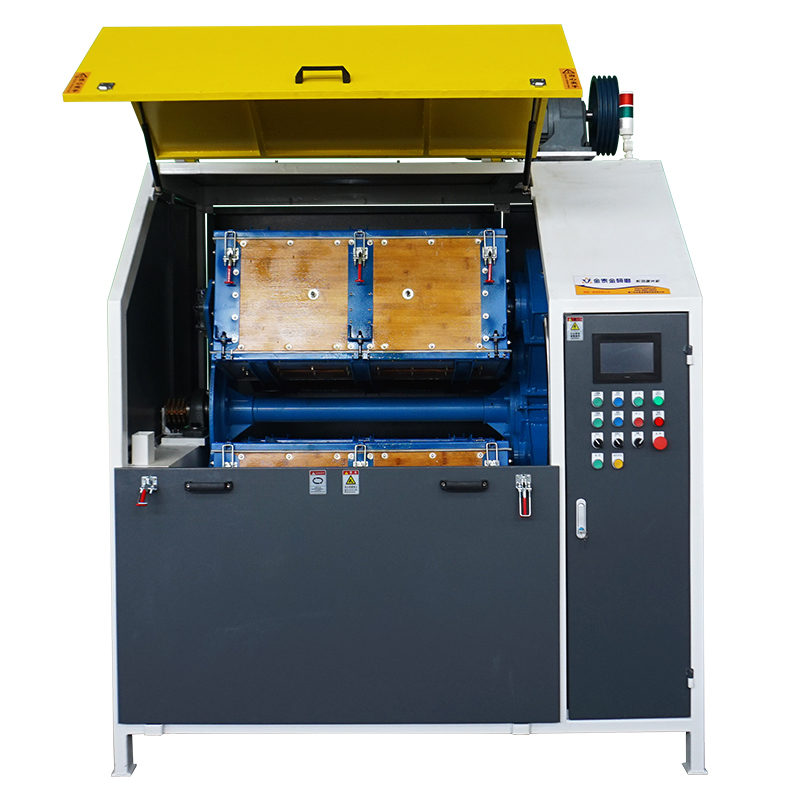
Rotary barrels work by sliding contact and suit parts that tolerate tumbling, giving a dense, uniform colour on small hardware. They cannot process anything longer than the barrel diagonal, so long shafts, extrusions and frame members belong in a tub vibrator, where a part can pass through the mass without being folded. Slender parts need support or careful load balancing, because the same energy that brightens a shaft can bow it or nick it against a neighbour. Barrel and tub routes reach some external areas a bowl cannot, such as a long groove, but they are poor at bores running parallel to the long axis. Verify straightness and roundness after the cycle, not only appearance.
| Machine route | Where it fits | What it will not do |
|---|---|---|
| Magnetic finishing machine | Refinement and edge conditioning of small precise parts with internal edges, cross holes and fine detail that media cannot enter. | Working envelope and part mass restrict size, removal is very small, and coverage falls off wherever the field cannot drive the pins. |
| Barrel finishing machine / rotary barrel tumbler | Dense, uniform colour on small hardware that tolerates sliding contact, especially with steel media for a burnished appearance. | Nothing longer than the barrel diagonal can be processed, and slender parts can bend or nick against neighbours in the load. |
| Disc finishing machine | Fast, high-energy cut down on small to medium parts with simple geometry where cycle time matters and edge rounding is tolerable. | Part-on-part contact and wall pressure can chip or deform parts, and the difference between sufficient and excessive removal is narrow. |
| Vibratory finishing machine (bowl or tub) | Cut-to-colour sequences on rigid, mostly open parts such as housings, covers, brackets and frames, with adjustable energy and no fixturing. | Cannot present media uniformly into pockets with narrow mouths or deep internal bores, and broad flat faces finish more slowly than edges. |
Media geometry decides what the charge can reach and how hard it works a surface. Large angle-cut cylinders and triangles cut quickly on open faces, but they cannot enter a slot narrower than their section and they leave a deeper pattern for later stages to erase. Small spheres or ovals reach detail and produce a softer, more uniform colour, at the cost of much slower stock removal. As a working rule, keep media below the smallest opening the charge must clear, and confirm that a medium can sit against the surface being finished instead of bridging across it. Media that is too small for the load can also float above the working mass and waste the cycle.
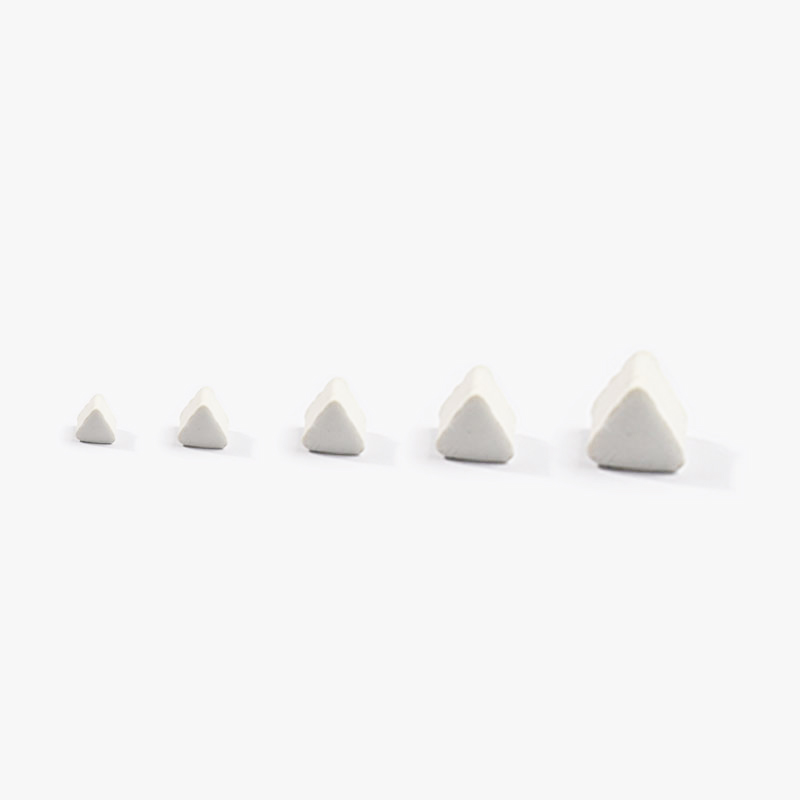
| Media | Best fit | Watch out for |
|---|---|---|
| Plastic or polyester media | Gentle processing of aluminium, brass, copper and thin panels where metal smearing, nicks and distortion must be avoided. | Low density gives little contact force, so cycles run long and heavy grinding marks may survive; plastic also wears quickly and can float above the working mass. |
| Magnetic finishing pins and needles | Small precise parts with internal edges, cross holes, slots and fine detail that no tumbling medium of usable size can reach. | Limited by working envelope and part mass, removes very little material, and pins can embed in soft metals or remain in cavities if retrieval is not checked. |
| Dry media - corn cob | Softer dry lustre and drying steps, absorbent polishing of small parts, and light work on brass, aluminium and plated-look surfaces. | Breaks down faster than walnut shell and must be replaced regularly; it removes almost no material and cannot correct a surface defect. |
| Hardened steel media, balls and shaped shot | Bright burnishing of stainless and hardened steel, and the final wet lustre stage where a dense medium can peen a surface smooth. | Can transfer iron and rust to stainless, dents soft or thin parts, and must be kept in a dedicated charge away from ceramic media. |
Haze is a general loss of image clarity without a clear directional pattern, and sleeks are the fine unidirectional lines that often accompany it. Both usually come from contamination: worn media shedding an oversized fine fraction, abrasive agglomerating in a compound line, machine walls and screens carrying grit from a previous coarse stage, or parts that were never rinsed between stages. The pattern is diagnostic, because haze appearing in one machine points at the charge while haze on parts from a shared rinse points at the water or the transfer. Check under raking light and low magnification against a master, and verify charge and rinse first: replacing compound before cleaning the machine usually repeats the defect.
| Failure mode | Likely cause | How to catch it |
|---|---|---|
| Compound residue film, water spots or a dull bloom after drying | Incomplete rinsing, hard or contaminated rinse water, a dose above target, or drying that leaves a cavity to bleed residue onto the finished face. | Wipe a defined area with a clean white cloth after drying, inspect cavities for bleed-out, and check rinse water hardness or conductivity at the point of use. |
| Ghost pattern of an earlier coarse stage showing through the final finish | A cut or refinement stage removed too little material, a later stage reused a contaminated charge, or the crosshatch direction was not changed between steps. | Reflect a light source at a shallow angle and rotate the part; a mark that disappears at one angle and returns at another is still in the surface rather than on it. |
| Smearing or a rolled surface with abrasive and debris buried in it | Excessive cycle time or contact pressure, insufficient compound lubricity, or a final stage run at energy the material cannot absorb without deforming. | Wipe a defined area with a clean white cloth and look for streaks or dulling, then examine at magnification and compare microhardness or etch response against an unmachined reference. |
| Edge radius beyond the allowed limit | A cut stage longer or more energetic than the edge allowance supports, insufficient masking or fixturing, or a sequence repeated to remove a defect and run past the edge allowance. | Measure with a radius gauge, a cast impression or an optical comparator at the marked edges, and compare against the edge form and dimensions recorded before finishing. |
Toronto is Canada's largest city economy and its industrial base is concentrated in food and beverage manufacturing, life sciences and medical manufacturing, and a very large technology sector, with municipal industrial land policy actively directed at keeping manufacturing in the city. The Toronto region houses what the City describes as the greatest concentration of food and beverage manufacturers in Canada, employing more than 64,000 workers, and the city itself accounts for more than half of that workforce. The life sciences base is research- and hospital-anchored: the sector employed 30,490 people in Toronto in 2023 and contributed CAD 3.6 billion to GDP, with pharmaceuticals and medical instrument and equipment manufacturing making up a substantial share of the jobs. The City supports industrial investment through the Economic Development and Growth in Employment (EDGE) Incentive program, whose first recipient was a beverage manufacturer expanding by 62,000 square feet with CAD 18.1 million of construction investment, and it also maintains a discounted Industrial Water Rate program for manufacturers. Technology is the other pillar, with the City citing 289,000 technology workers and describing Toronto as the largest technology hub in Canada and third largest in North America.
For this brief the relevant part of that base is machinery: Toronto's technology base includes 289,000 technology workers and 273 AI firms in the Toronto region, which supports the machine-building, control and vision-supplier side of the equipment sector.
Food and beverage manufacturing in the Toronto region runs stainless steel filling, mixing, conveying and packaging lines where surface finish and cleanability are functional requirements, not cosmetic ones, and where weld dressing and edge break on fabricated stainless are recurring production steps. The life sciences base includes medical instrument, equipment and supplies manufacturing and implant-adjacent device work, which drives burr-free edges, controlled surface roughness and documented cleaning of parts. Add the automotive-tier and machine-building suppliers that sit in the same industrial land base, and Toronto's deburring demand is concentrated in stainless process equipment, device components and machined parts rather than in heavy capital-intensive finishing lines.
Before buying, a Toronto buyer should settle who carries the equipment certification for Canadian electrical safety and who verifies that the machine's guarding and dust or fume control meet Ontario requirements, because a machine that is compliant in its country of manufacture is not automatically acceptable on an Ontario plant floor. The second question is whether a wet process is even appropriate: if the plant holds a discounted Industrial Water Rate or is inside a food-grade environment, the choice between wet and dry finishing media, and the associated effluent and drying steps, should be decided against the utility and sanitation constraints, not only against cycle time.
Freight context: Port of Toronto (Toronto Port Authority), Billy Bishop Toronto City Airport, Toronto Pearson International Airport, CN and CPKC rail corridors. The Port of Toronto is a working inland port directly adjacent to downtown, running 50 acres of bonded, 24-hour-secured paved terminal space with about 1,800 metres of berthing and Seaway-depth berths, and it handled more than 2.16 million metric tonnes of cargo on 167 vessels in 2025. Its 2025 inbound bulk mix included 751,353 tonnes of road salt, 575,898 tonnes of sugar, 714,843 tonnes of cement and 79,079 tonnes of steel products, which shows the port is a bulk gateway rather than a container gateway; a finishing machine arriving from Asia would more plausibly be containerised through a coastal port and moved inland by rail or truck, while sample parts and media can move by air.
The customs authority is the Canada Border Services Agency (CBSA), and importers of commercial goods must work through the CBSA Assessment and Revenue Management (CARM) system, which is where registration, the duties-and-taxes calculator, advance rulings and national customs rulings, and the commercial accounting declaration (CAD) are handled. Documentation expectations are explicit: "You must provide proof of country of origin when you import goods into Canada and, in some cases, your goods must also be clearly marked", the invoice or sales receipt must carry "a complete description of the goods", "the selling price" and "any conditions and terms of the sale", and the value for duty must be declared in Canadian currency only. Duties and taxes are layered rather than single: customs duty on the tariff item, the Goods and Services Tax calculated on the duty-paid value, and potentially excise duty, excise tax, surtax or safeguard measures. Importers must also clear non-tariff gates: goods must be admissible, some goods need permits, certificates or inspections from other federal departments that the CBSA applies on their behalf, controlled goods under the Defence Production Act require consultation with the CBSA and Global Affairs Canada before import, and "Goods manufactured or produced wholly or in part by forced or prison labour are prohibited from entering Canada", with due diligence resting on the importer. For electrical machinery, the practical conformity route in Canada is certification of the product to Canadian electrical safety standards by an accredited certification body rather than a self-declared CE-style mark; buyers should confirm the specific certification body and mark required before shipment. For a first shipment of a finishing machine or a media/compound sample lot, the fastest way to remove classification and valuation uncertainty is to use the CARM portal to request an advance ruling for tariff classification and origin.
China is one of Canada's ten principal merchandise trading partners and the second-largest single-country source of Canadian imports after the United States: Statistics Canada reported CAD 5,369 million of balance-of-payments imports from China in January 2025, against a CAD 2,299 million bilateral merchandise deficit that month. Canada has no free trade agreement with China, so Chinese-origin industrial machinery enters under the Most-Favoured-Nation (MFN) tariff column of the Canadian Customs Tariff; the preferential treatments listed in the tariff (CUSMA/UST and MXT, CETA/CEUT, CPTPP/CPTPT, UKT, KRT and others) do not include China, and preferential rates require proof of origin plus the applicable shipping rules, so a China-origin machine cannot claim them. Tariff classification is mandatory work, not a formality: vibratory, barrel, centrifugal and disc finishing machines are classified in Chapter 84 ("Nuclear reactors, boilers, machinery and mechanical appliances; parts thereof") according to the function of the machine, and the ten-digit Canadian tariff item drives both the duty rate and the statistics. A further landed-cost risk sits outside the tariff schedule: under the Special Import Measures Act (SIMA), the CBSA and the Canadian International Trade Tribunal may apply anti-dumping and countervailing duties to named goods, so a buyer should check the measures-in-force list for the specific product before assuming the MFN rate is the final duty.
SurfacePolish supplies from Xiamen, China. The buyer's own destination rules, conformity marking, tariff classification and documentation responsibilities stay with the buyer; confirm them against the authorities named above before ordering.
A roughness number without its setup is not a specification. Decide the cutoff length, filter, evaluation length, number of traces and their direction relative to the preceding polish direction, then keep every one of those settings unchanged between the incoming survey and the final inspection. Curved and narrow faces need a fixture or a witness coupon processed in the same charge, because a stylus cannot follow a small radius reliably and a hand-held trace on a curved surface is not comparable. Where a face is critical, mark the exact measurement positions on the drawing or with a permanent label and record them. Optical instruments avoid stylus damage on soft polished surfaces but see a different frequency band than a contact profilometer, so do not mix instrument types within one comparison.
A trial reports what was observed on the parts it received, under the settings used. It cannot prove that every casting in a lot will respond the same way, that a worn media charge will behave identically over months, or that the finish satisfies a regulated or safety-critical requirement; those are questions for the buyer's own engineering and quality functions, using their own verification. It also cannot promise a reflectance value, an Ra value, a cycle time, a price or a capacity. Before shipping parts, decide whether a mirror finish is plausible at all: check the substrate for porosity and inclusions, confirm that available media can reach the geometry, and define the acceptance method first. If the requirement cannot be measured or viewed consistently, no trial result will settle it.

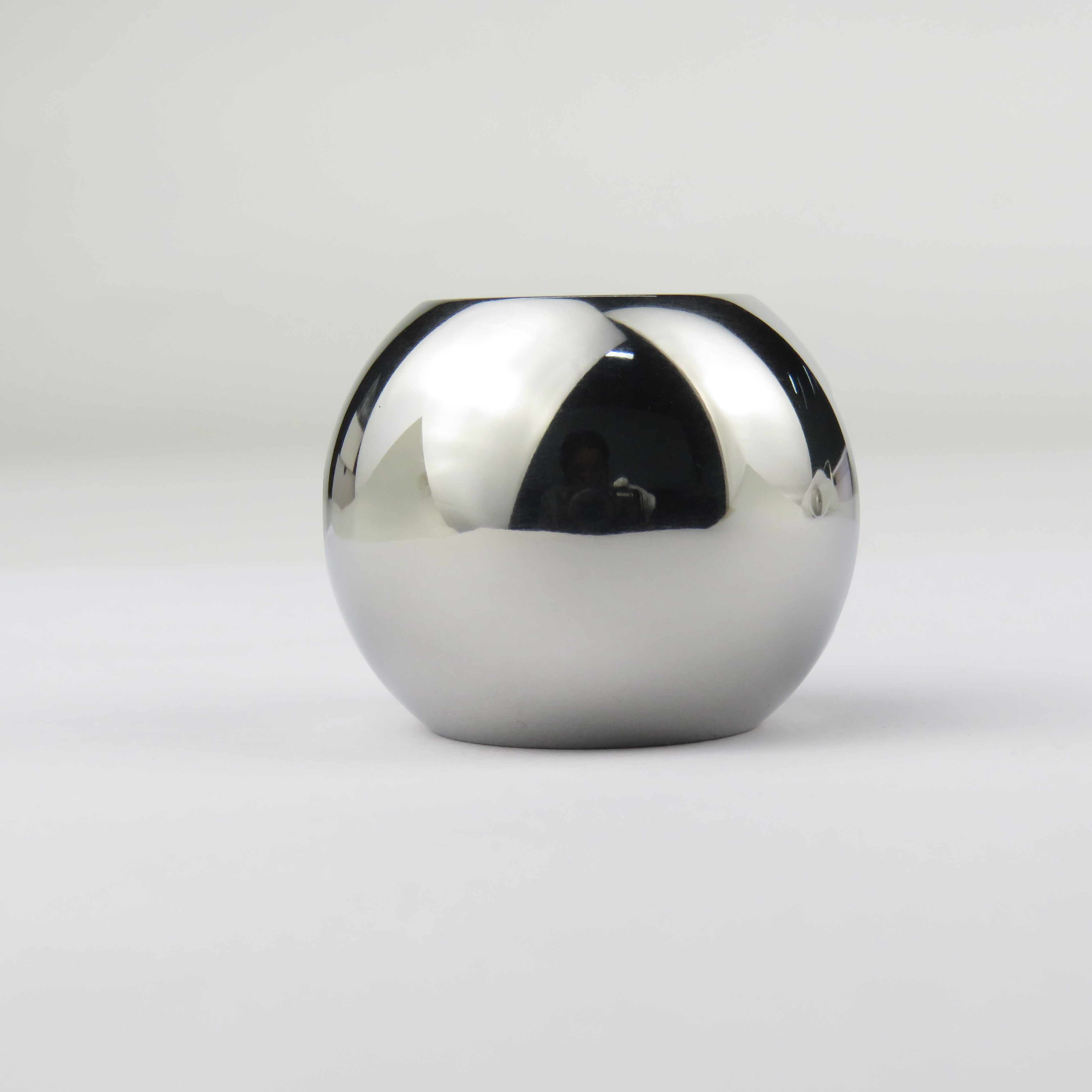
Orange peel is a wave in the surface, produced when metal is deformed rather than cut, usually on softer alloys, on work-hardened layers, or when a heavy cut stage is followed by too little refinement. It shows as a distorted reflected line when you view a straight edge in the face. Polishing with finer media does not remove it, because the wave extends below the depth a fine stage can reach; the sequence has to return to a cutting stage and then refine properly. If the wave comes from the incoming material or a forming operation, it may not be removable at all.
Haze and sleeks usually come from contamination rather than from a wrong final medium. Worn media shed an oversized fine fraction, abrasive can agglomerate in the compound line, screens and machine walls carry grit from an earlier coarse stage, and a shared or under-controlled rinse moves particles forward. Inspect under raking light against a master and trace the pattern: defects that appear in one machine point to the charge, while those spread across machines point to rinsing or handling. Clean the charge, screen the media and re-establish the rinse before changing the compound.
No, and any supplier offering one before seeing the parts is guessing. A trial produces observations on the specific parts tested, under the settings used, and those observations are described rather than warranted. Achievable reflectivity depends on the substrate, the geometry, the edge allowance and the incoming damage, and it can vary across a single face and between parts in one batch. Define how you will measure or view the finish, agree a physical master, and treat the trial result plus your own verification as the basis for a decision.
Use Toronto, Canada as the destination on the enquiry and state whether the deliverable is equipment, media and compound, a representative sample review or a line concept. A destination does not imply local stock, a local service point or a local delivery time.
A Toronto buyer will normally anchor on Canadian electrical safety certification of the machine and control panel, Ontario's Occupational Health and Safety Act and its industrial regulations for guarding and lockout, and the buyer's own customer specifications for surface roughness and cleanliness. The City of Toronto's own industrial water rate and incentive programs also show that process utility and environmental constraints feature in local manufacturing decisions.
Sources were retrieved on 2026-09-29 and describe the local industrial and trade context only. They do not evidence any SurfacePolish project, shipment, installation or service in Toronto.
The buyer wants the frame dressed and brightened so the weld toes blend into the tube face without leaving a shadow line.
Send the material, dimensions, approximate weight, batch quantity, the incoming condition and photographs of the difficult features. Mark which features must not be contacted by media and state how the result will be inspected. This form carries source reference PSEO-0109; quote it if you prefer an additional manual reference.
Open the SurfacePolish enquiry form Email a prepared enquiry
No price, lead time, certification or result is promised here. Confirm whether a sample trial is available for the specific part and what the trial can and cannot show.
Page PSEO-0109 · revised 2026-09-29 · cross-border equipment, media and scoped sample review. City context is sourced and cited above.
Use this local checker to identify missing part and inspection information. It prepares a technical-review brief; it does not approve a machine, process recipe or production result.
Complete the part details to prepare a review brief.
Email : info@surface-polish.com


 IPv6 network supported


 +86-592-2381506