A buyer in Calgary, Canada in energy equipment has a 316L manifold block whose cross-drilling intersections and blind tapped holes must be deburred while staying clear of media. SurfacePolish supplies finishing machines, media and compounds across borders, and its free sample trial returns representative parts from Xiamen with an observation record and a proposed media, compound and cycle direction to evaluate. This brief is written for a buyer in Calgary working on energy equipment; it describes equipment, media and a scoped sample review, not a local polishing service.
What must the part be clean of, and what method and limit does the buyer use to verify cleanliness before assembly, welding, coating or a leak test?
What is the smallest internal passage, cross-drilling or tapped hole the charge must never plug, and how would a lodged medium be found and removed?
Is deburring done before or after heat treatment, and in what metallurgical and surface condition does the part arrive at the finishing step?
Read the drawing surface by surface before any medium is discussed. On an energy-equipment part the surfaces that decide acceptance are rarely the largest: a raised-face gasket land, a valve seat bore, a stem guide diameter, a cross-drilling intersection, a thread entry and a locating spigot each behave differently under an abrasive charge. Separate them into surfaces that seal or locate, surfaces that only carry flow, and surfaces that are cosmetic. A pump housing and a manifold block may share a material grade and still need opposite treatment because one carries a machined gasket land and the other only drilled passages. Mark the protected list on the buyer's own drawing revision, then decide for each item whether it is masked, fixtured out of the mass, finished to a band, or left as-machined. That list also governs handling between operations.
Internal intersections are a different problem from external surface refinement, and no amount of extra energy in a bowl fixes them. A cross-drilling meeting a main bore creates a burr on the inside wall that external media rarely reaches. Access routes include a small media size class that can enter the passage, magnetic finishing where a pin or needle charge is driven into the feature on small parts, or a targeted mechanical method outside mass finishing. Each has a boundary: a size class small enough to enter a passage is also small enough to lodge in it, magnetic pins are limited by part size and by retrieval, and blind features with no exit cannot be flushed clean. Decide per feature which access route is credible, and how the result will be seen.
| Machine route | Where it fits | What it will not do |
|---|---|---|
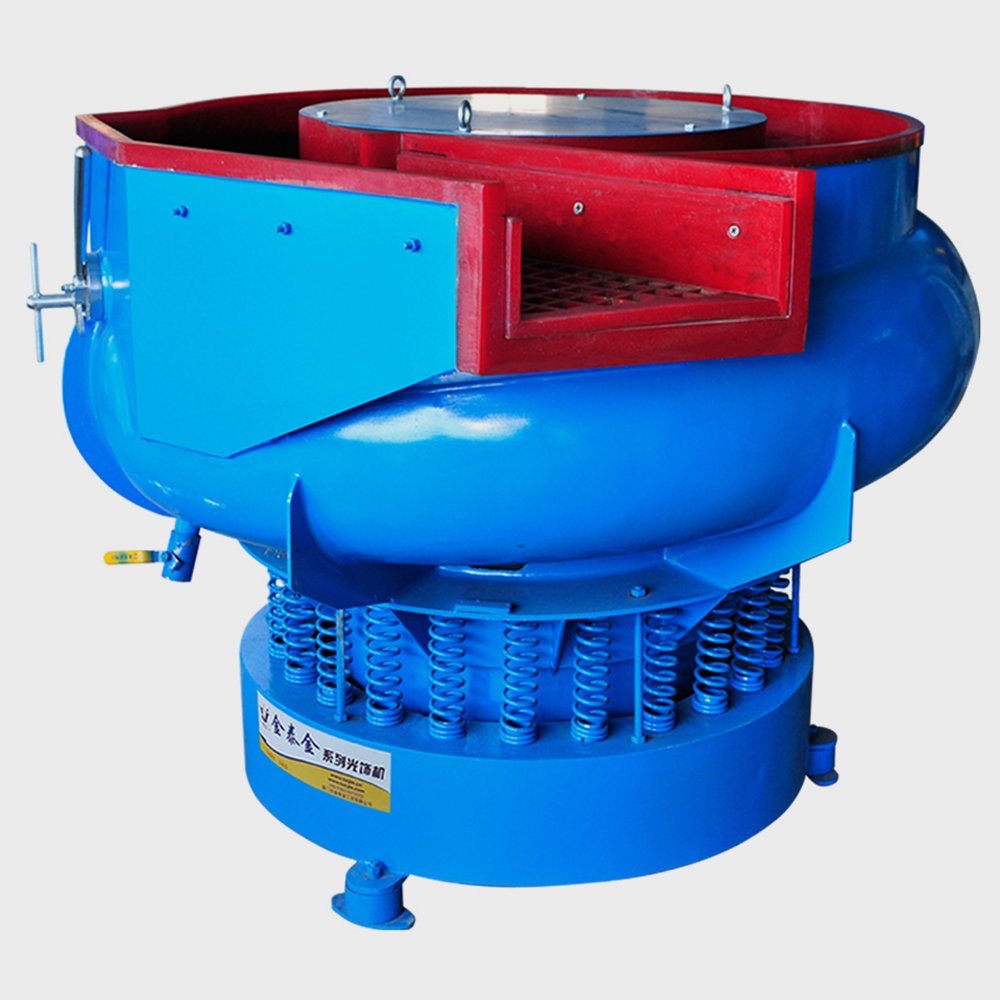
| Vibratory finishing machine (bowl) | General deburring and refinement of valve bodies, flange plates, pump components and fittings that fit the bowl and can move freely in the charge | No access to deep internal passages, constant part-on-part contact, and finished faces need separation or fixture protection |
| Tub vibrator | Long parts such as manifold rails, shafts, long housings and stacked plate sets that cannot tumble in a bowl, with support or rotation along their length | Lower energy per unit area so heavy burrs take longer, and the tub needs floor space plus a defined part support method |
| Disc finishing machine | Fast, high-energy cycles on small to medium robust parts, including batches of fittings and small housings that need a quick cut | High contact pressure rounds edges quickly and can mark or deform thin and soft parts, with results sensitive to load and disc condition |
| Dry polishing machine and dryer | Drying after a wet cycle and dry light polishing or deburring of small parts, including features where residual moisture is a problem | Removes little or no material, needs dust extraction when dry media is used, and does not replace a cutting stage for a substantial burr |
The compound is a chemistry decision that outlives the finishing cycle. It controls cutting behaviour, keeps the media and the part clean, suspends fines, and determines what film remains on the part when it leaves the machine. Acidic families clean and brighten some stainless grades but leave a surface that must be rinsed and neutralised carefully, and they are the wrong choice where a hardened, high-strength steel later sees a plating or coating step. Alkaline and neutral cleaning families are gentler on mixed loads but may not hold the same cutting performance. Silicate-bearing or film-forming compounds can leave a tenacious residue in a gasket groove or a blind hole. Check compatibility in both directions: the material being finished, and the residue against the buyer's next operation.
| Media | Best fit | Watch out for |
|---|---|---|
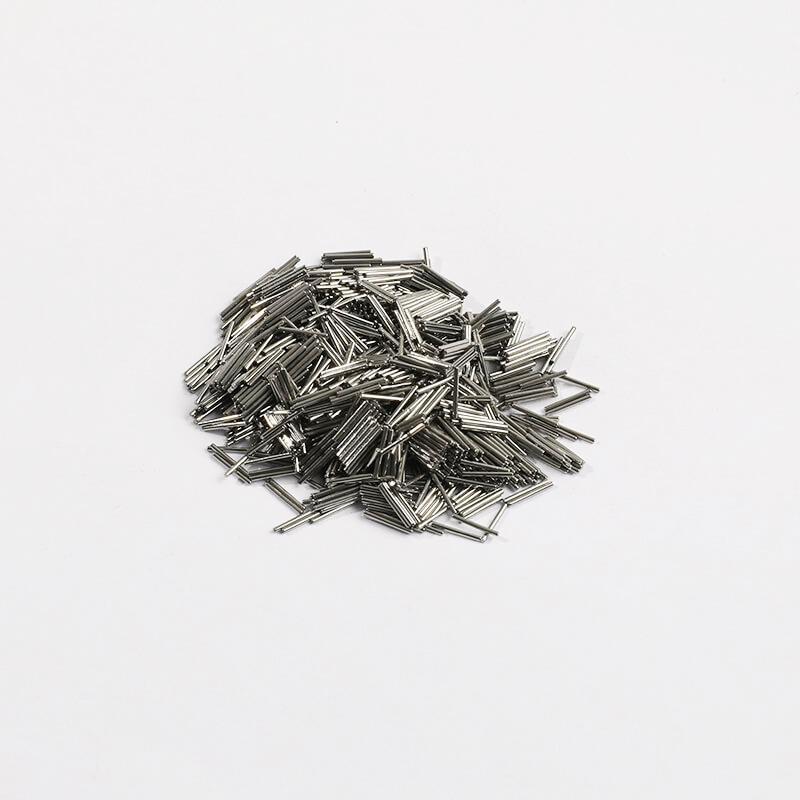
| Fine ceramic spheres or small porcelain shapes in a light size class | Refinement and edge blending after a cutting stage, and light deburring of small fittings, thread entries and tighter external geometry | Small sizes enter and retain in fine passages and cross-drillings, and the charge changes size and cut rate as it wears |
| Hardened steel media, balls and pins | Burnishing and bright finishing of stainless and hardened parts, and light edge consolidation where a cutting action is not wanted | Changes the surface by deformation rather than cutting, can work-harden or smear a soft surface, and needs corrosion protection and separation from acidic compounds |
| Heavy-cut ceramic, angle-cut triangles in a coarse size class | Removing a substantial or thick burr root from open external edges, flange corners, cast bosses and large tapped entries on steel and stainless parts | Cuts controlled edges and gasket lands as readily as burrs, leaves a coarse surface, and lodges in slots whose width approaches the media section |
| Dry media, corn cob granules with a polishing compound | Final dry polish, light edge blending and drying after a wet stage on small parts and fittings | Almost no cutting action, absorbs compound and contaminates quickly, and must be kept separate per material family to avoid carry-over |
Mass finishing acts on the whole section, not only on the edge, so flatness and wall thickness deserve their own screening on thin and slender parts. Heat-exchanger plates, thin diaphragms, long unsupported shafts and thin-wall pump components can bend, dish or lose flatness under part-on-part impacts and fixture pressure even when the surface result looks correct. The distortion is often small and shows up later as an assembly problem, a gasket that will not seat, or a plate stack with uneven contact. Fixtures and masking solve some of it but introduce their own marks: a masked face keeps its as-machined condition and may show a boundary where the media reached, and a rack can leave contact witness marks. Screen those outcomes on the drawing.
| Failure mode | Likely cause | How to catch it |
|---|---|---|
| Uneven result across a batch, with over-finished edges in one zone and untouched areas in another | Part position in the charge, shielding by fixtures or other parts, a worn charge that cuts differently from a fresh one, or masking that leaked | Mark fixed measurement and inspection points on several parts, compare parts from the top, middle and bottom of the load, and record charge age against the result |
| Ferrous specking, rust staining or graphite smearing on stainless parts after a shared run | Carbon steel or cast iron fines carried over in the charge, machine, rinse tank or drying cloth, or a purge that was too short between material families | Compare against a retained reference part, inspect suspect areas at magnification, examine the charge and rinse for embedded ferrous fines, and review the changeover record against the batch history |
| Media fragments or abrasive fines embedded in a soft surface or machined groove | Impingement from excessive energy or charge mass, fractured media left in the working charge, or cross-contamination from a previous material family | Inspect at magnification under angled light, use a tape lift or solvent wipe on the suspect area, and screen the charge for broken media and accumulated fines |
| Staining, pitting or a corrosion question on a hardened high-strength part after a wet cycle | Acid-bearing compound or contaminated rinse water, long dwell between finishing and drying, or no protective rinse for the interval before the buyer's next operation | Inspect within an agreed interval after drying, wipe a defined area with a white cloth, compare against a retained reference, and route any embrittlement question to whoever owns the downstream coating or plating specification |
Calgary is Canada's energy head-office city and has been building aerospace, life sciences and logistics depth on top of that base. Calgary Economic Development reports that more than 70 major energy companies have head offices in the city and that 462 of Alberta's 940 cleantech companies are headquartered there. The aerospace sector is real but narrower than Montreal's: the region's aerospace ecosystem is anchored by applied research and development, aerospace components and parts manufacturing, maintenance, repair and overhaul (MRO), and unmanned systems, with CAD 3 billion contributed to Alberta's GDP in 2024 and over 100 direct global routes from Calgary International Airport. Life sciences has grown to more than 140 companies in human and animal health, with medical device manufacturing and diagnostics among the growth subsectors. Logistics is a genuine industrial cluster in its own right, with both CPKC and CN headquartered in Calgary and the proposed Prairie Economic Gateway inland port positioned to add manufacturing, processing and distribution capacity.
For this brief the relevant part of that base is energy: Calgary Economic Development reports that more than 70 major energy companies have head offices in Calgary, that 462 of Alberta's 940 cleantech companies are headquartered in the city, and that Calgary has a CAD 4.6 billion per year hydrogen market potential connected to the Calgary Region Hydrogen Hub announced in 2025.
Calgary's energy and oilfield service base generates a continuous flow of valve bodies, fittings, pump components, tubular connections and machined parts where burrs at sealing faces and threads are a leak-path and galling risk, and where surface finish on sealing surfaces is a functional specification. Aerospace components and MRO work in the same city adds edge-condition and cleanliness requirements on machined aluminium and steel parts, and the emerging medical device and diagnostics manufacturing base adds small, high-value parts where hand deburring variability is the main quality problem. Because both the energy and aerospace customers operate under formal quality systems, the finishing step usually has to be documented and repeatable rather than operator-dependent.
A Calgary buyer should settle which surface is actually functional before choosing a process: on valve, pump and tubular components the acceptance criterion is usually a specific sealing-face finish and a burr-free thread or edge, and that determines whether vibratory, centrifugal or spindle finishing is even applicable, and whether edge radius rather than surface roughness is the real specification. The second question is repeatability across shifts, because energy and aerospace customers increasingly require documented, repeatable surface condition rather than a finish that depends on which operator ran the part.
Freight context: YYC Calgary International Airport and YYC Global Logistics Park, CPKC headquarters and intermodal terminals, CN intermodal terminals, Prairie Economic Gateway inland port (proposed). Calgary handles 75 per cent of Alberta's air cargo shipments through YYC and has over 100 direct routes into Europe and the Americas, and both Class 1 railways are headquartered in the city, giving access to West Coast ports and to centres in Canada, the United States and Mexico. The proposed Prairie Economic Gateway inland port, a City of Calgary and Rocky View County partnership, is projected to generate over CAD 7 billion in economic activity and more than 30,000 jobs over 10 to 12 years, and is explicitly targeted at manufacturing, logistics, processing and distribution.
Canada is a bilingual market for selling purposes: English is the working language of procurement outside Quebec, while Quebec buyers (Montreal, Quebec City) normally expect French-language quotations, technical documentation and after-sales support, and Quebec's Charter of the French Language makes French the default for commercial documentation in the province. Procurement expectations are formal and auditable: a Canadian industrial buyer will typically ask for the tariff classification and country of origin up front, expect a commercial invoice that satisfies the CBSA invoice requirements, and expect the seller to provide proof of origin for any preferential claim. Payment norms are bank-to-bank, with wire transfer or letter of credit rather than platform payment, and Canadian buyers commonly net-30 to net-60 from invoice, so a cross-border seller should price the working-capital gap into the offer. Certificates of origin for export documentation are issued through chambers of commerce, which is why chambers such as the Hamilton Chamber of Commerce and the Winnipeg Chamber of Commerce offer document certification. The current trade environment adds policy risk to landed cost: Canadian federal programs are explicitly framed around responding to U.S. tariffs, with the FedDev Ontario Regional Tariff Response Initiative described as supporting "businesses to respond to tariff pressures" in southern Ontario, and tariff and surtax measures can change by Order in Council, so quotations should state the tariff basis and the date on which the landed-cost calculation was made.
The customs authority is the Canada Border Services Agency (CBSA), and importers of commercial goods must work through the CBSA Assessment and Revenue Management (CARM) system, which is where registration, the duties-and-taxes calculator, advance rulings and national customs rulings, and the commercial accounting declaration (CAD) are handled. Documentation expectations are explicit: "You must provide proof of country of origin when you import goods into Canada and, in some cases, your goods must also be clearly marked", the invoice or sales receipt must carry "a complete description of the goods", "the selling price" and "any conditions and terms of the sale", and the value for duty must be declared in Canadian currency only. Duties and taxes are layered rather than single: customs duty on the tariff item, the Goods and Services Tax calculated on the duty-paid value, and potentially excise duty, excise tax, surtax or safeguard measures. Importers must also clear non-tariff gates: goods must be admissible, some goods need permits, certificates or inspections from other federal departments that the CBSA applies on their behalf, controlled goods under the Defence Production Act require consultation with the CBSA and Global Affairs Canada before import, and "Goods manufactured or produced wholly or in part by forced or prison labour are prohibited from entering Canada", with due diligence resting on the importer. For electrical machinery, the practical conformity route in Canada is certification of the product to Canadian electrical safety standards by an accredited certification body rather than a self-declared CE-style mark; buyers should confirm the specific certification body and mark required before shipment. For a first shipment of a finishing machine or a media/compound sample lot, the fastest way to remove classification and valuation uncertainty is to use the CARM portal to request an advance ruling for tariff classification and origin.
SurfacePolish supplies from Xiamen, China. The buyer's own destination rules, conformity marking, tariff classification and documentation responsibilities stay with the buyer; confirm them against the authorities named above before ordering.
Write acceptance around measurement locations, not around a single number for the part. Mass finishing produces a gradient: an edge or a corner receives far more work than a flat face, and a recessed or shielded area receives less. A roughness value quoted without a location, a parameter, a cut-off length and an evaluation direction cannot be reproduced by anyone else and cannot be defended later. For each controlled surface, name the feature, the position on it, the parameter, the cut-off, the evaluation length and the direction relative to the machining lay. Reference the surface texture convention the buyer already uses, such as the ISO 4287 and ISO 4288 families or ASME B46.1, rather than inventing a house definition. Agree the instrument before the first part is measured.
A sample trial reports what happened to the parts that were tested under the settings that were used. It cannot establish capability across other heats, casting lots or machining sources; it cannot demonstrate uniformity across a full production charge, because a trial load is small; and it cannot show how the process behaves after a charge has worn, how a coating or weld will take to the finished surface, how the part will behave in a corrosive or high-cycle service environment, or whether any cleanliness, hydrogen or regulatory requirement is met. Those questions belong to the buyer's own qualification. Close the gap deliberately: define a verification batch on production equipment, decide how many charges will be monitored, and state in advance what result would stop the route.
Protect it deliberately rather than relying on a gentle setting. Options include masking or plugging the face, fixturing the part so the land is held out of the mass, orienting the part so the land sees less contact, or choosing a media shape and size that blends rather than digs. Each has a cost: a masked face keeps its as-machined condition and can show a boundary line, a fixture shields the area behind it, and fixturing reduces how many parts fit in a load. Mark the land on the drawing, give it a maximum edge radius, and agree how it will be checked. Test the arrangement on the real part.
Both positions are used, and the choice follows the burr and the edge requirement. Deburring before hardening removes the machining burr while the material is still soft and the charge cuts predictably, but hardening can then introduce scale and slight distortion, and edges may need a light blend afterwards. Deburring only after the final thermal step keeps every edge operation in one place and works on the finished metallurgical state, at the cost of a harder material that cuts more slowly and a risk of brittle edge chipping. Discuss the sequence with the heat treater and the process engineer, and record the condition the part arrives in for finishing.
The visible lip is the part of the burr that is easy to see and easy to blend flat. The root is the material still connected to the parent surface underneath it, and it is the part that can break free later as a particle, especially in a flowing gas or hydraulic circuit. A light refinement pass can roll the lip over and make the edge look finished while leaving the root attached. Deburring is therefore judged on whether the root has been removed, which usually means removing a small amount of parent material at the edge rather than only wiping the surface. Agree how that judgement will be made.
Use Calgary, Canada as the destination on the enquiry and state whether the deliverable is equipment, media and compound, a representative sample review or a line concept. A destination does not imply local stock, a local service point or a local delivery time.
A Calgary buyer in the energy supply chain normally works to the end-user's material and inspection specification for sealing faces, threads and surface finish, plus the requirements of the applicable pressure-equipment or pipeline standard their customer names. On the plant side, Alberta occupational health and safety rules for guarding and lockout apply, along with Canadian electrical safety certification for the equipment.
Sources were retrieved on 2026-09-29 and describe the local industrial and trade context only. They do not evidence any SurfacePolish project, shipment, installation or service in Calgary.
The buyer needs the machined burrs removed from the intersection edges and thread entries while keeping every passage clear and the face seal groove undamaged.
Send the material, dimensions, approximate weight, batch quantity, the incoming condition and photographs of the difficult features. Mark which features must not be contacted by media and state how the result will be inspected. This form carries source reference PSEO-0138; quote it if you prefer an additional manual reference.
Open the SurfacePolish enquiry form Email a prepared enquiry
No price, lead time, certification or result is promised here. Confirm whether a sample trial is available for the specific part and what the trial can and cannot show.
Page PSEO-0138 · revised 2026-09-29 · cross-border equipment, media and scoped sample review. City context is sourced and cited above.
Use this local checker to identify missing part and inspection information. It prepares a technical-review brief; it does not approve a machine, process recipe or production result.
Complete the part details to prepare a review brief.
Email : info@surface-polish.com


 IPv6 network supported


 +86-592-2381506