A buyer in Lyon, France in energy equipment has a cast stainless pump housing where the machined bore lip, split flange gasket face and drain port need deburring while the as-cast texture stays as specified. SurfacePolish supplies finishing machines, media and compounds across borders, and a free sample trial sends representative parts to Xiamen and returns them with an observation record and a proposed media, compound and cycle direction. This brief is written for a buyer in Lyon working on energy equipment; it describes equipment, media and a scoped sample review, not a local polishing service.
Does the drawing state an edge break or an edge round at each controlled edge, and what maximum radius applies where over-rounding is the risk?
Which edges on this part are functional, such as gasket lands, seat bands, stem guides, metering lands and thread entries, and which only need to be free of a sharp edge?
Is deburring done before or after heat treatment, and in what metallurgical and surface condition does the part arrive at the finishing step?
Treat the batch, not the individual part, as the unit that gets controlled. A charge holds a defined mass of parts sharing a material family, a burr condition and an edge requirement. Mix a thin heat-exchanger plate with a heavy valve body and the light part absorbs energy it did not need while the heavy part shields its own critical edges. Batch definition also fixes traceability. If two heats of duplex stainless or two casting lots run together, a defect found later cannot be tied back to a charge, a media age or a compound batch. Keep part numbers, material grades and heat-treatment states in separate runs, label the charge, and record how many parts were loaded and in what orientation.
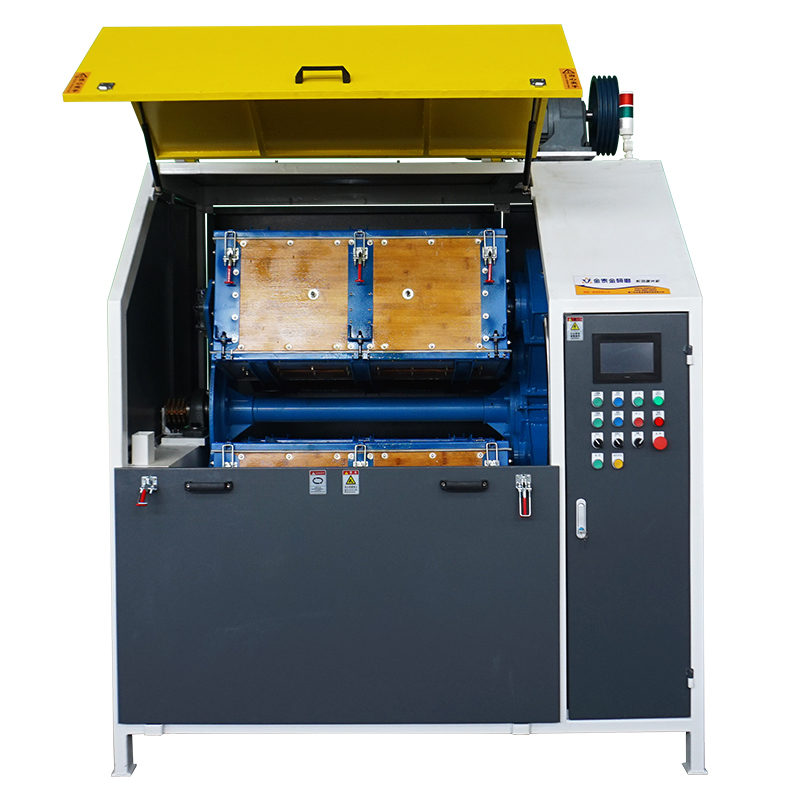
High-pressure routes, disc machines, grinding finishing machines and centrifugal barrels, earn their place when a heavy burr or a large batch makes the gentle options impractical. The trade is paid in three currencies. Edge rounding accelerates, so controlled edges need masking, orientation control or a shorter cycle. Distortion risk rises on thin walls, thin plates and unsupported sections, because the same pressure that cuts a burr can also move material. And the charge has to be balanced: centrifugal barrels in particular need an even barrel weight and a planned stop time, or the load shifts and results vary between barrels. Ask whether the part family has enough edge tolerance and section stiffness to absorb that energy. If it does not, the gentler route usually costs less overall.
| Machine route | Where it fits | What it will not do |
|---|---|---|
| Tub vibrator | Long parts such as manifold rails, shafts, long housings and stacked plate sets that cannot tumble in a bowl, with support or rotation along their length | Lower energy per unit area so heavy burrs take longer, and the tub needs floor space plus a defined part support method |
| Vibratory finishing machine (bowl) | General deburring and refinement of valve bodies, flange plates, pump components and fittings that fit the bowl and can move freely in the charge | No access to deep internal passages, constant part-on-part contact, and finished faces need separation or fixture protection |
| Centrifugal barrel finishing machine | Short high-pressure cycles on small precision parts such as spools, sleeves, small valve bodies and drilled fittings | Rounds edges and can distort thin unsupported sections quickly, and needs balanced barrel loading, controlled stop time and careful fixturing |
| Magnetic finishing machine | Small precision parts with internal intersections, radial holes and thread entries that a bulk charge cannot reach | Limited by part size and material, pins must be retrieved and checked, and it does not level or refine large flat surfaces |
A working charge is a consumable with a life curve, and most batch inconsistency is a media condition problem rather than a machine problem. Media wears down, changes size and shape, loses its cutting edge, and eventually fractures into smaller pieces and fines. As it wears, the cut rate falls and the finish improves, so a setting that was correct on a fresh charge drifts over a few hundred cycles. The charge mass also falls as media breaks, which changes the load ratio and the energy per part. Screen out broken pieces and fines, measure a sample against the size class originally specified, top up to a defined mass, and replace on a wear trigger rather than on appearance. Keep the media history with the batch record.
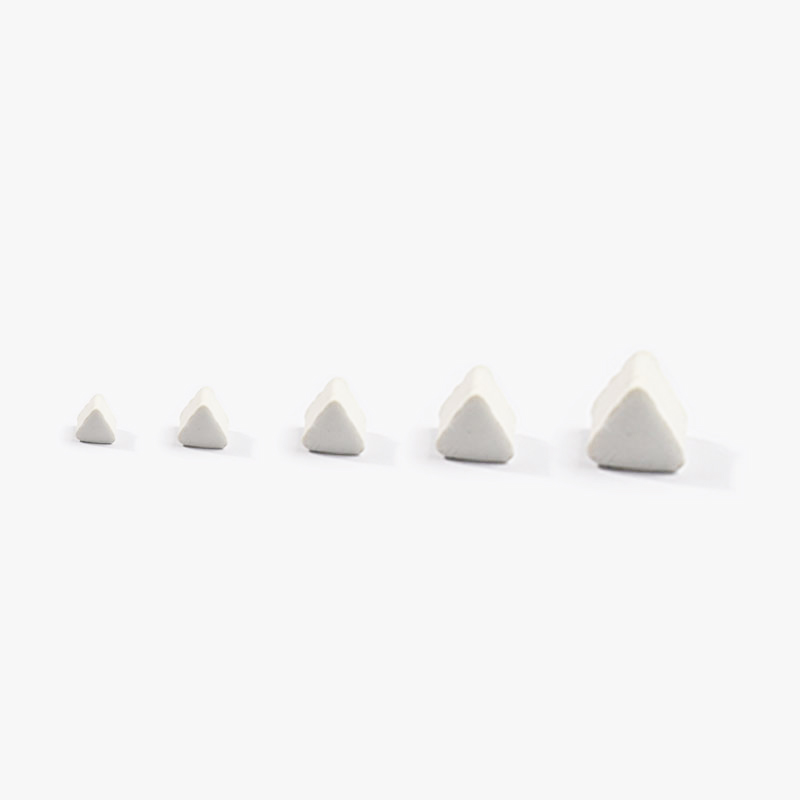
| Media | Best fit | Watch out for |
|---|---|---|
| Dry media, corn cob granules with a polishing compound | Final dry polish, light edge blending and drying after a wet stage on small parts and fittings | Almost no cutting action, absorbs compound and contaminates quickly, and must be kept separate per material family to avoid carry-over |
| Dry media, walnut shell with an abrasive or polishing compound | Light dry deburring, deflashing, drying and low-residue finishing of small parts and of features where a wet bath is difficult to remove | Low cutting energy so it cannot remove a substantial burr root, produces dust needing extraction, and consumption is high |
| Heavy-cut ceramic, angle-cut triangles in a coarse size class | Removing a substantial or thick burr root from open external edges, flange corners, cast bosses and large tapped entries on steel and stainless parts | Cuts controlled edges and gasket lands as readily as burrs, leaves a coarse surface, and lodges in slots whose width approaches the media section |
| Plastic media triangles and pyramids in a soft to medium grade | Deburring aluminium, brass and other soft or thin-walled parts where surface marking and edge rounding must stay minimal | Slow cut rate, media deforms and wears out of shape, and a worn charge behaves noticeably differently from a fresh one |
Media lodging is a geometry and media-condition problem, and it concentrates at intersections. A cross-drilling breaking into a bore, a blind tapped hole, a keyway, a snap-ring groove and a slot whose width approaches the medium section are all traps. The usual causes are a size class chosen against an average feature rather than the smallest one, a charge that has fractured into smaller pieces, and a secondary burr or fold that closes part of the opening while the part is running. Retrieval often costs more than the deburring itself, especially where the trap is inside a body that cannot be opened. Plan detection before the run: which passages are borescoped at an agreed angle, which holes are pin gauged, how a flush through a filter is collected, and how the part mass is compared.
| Failure mode | Likely cause | How to catch it |
|---|---|---|
| Media lodged in a cross-drilling, blind tapped hole, keyway, groove or internal passage | Size class chosen against an average feature rather than the smallest one, media fractured into smaller pieces during the cycle, or a secondary burr that closed part of the opening | Borescope agreed passages at a fixed angle, pin gauge every tapped hole, count the charge in and out where practical, flush through a filter and inspect the residue, and compare part mass before and after |
| Ferrous specking, rust staining or graphite smearing on stainless parts after a shared run | Carbon steel or cast iron fines carried over in the charge, machine, rinse tank or drying cloth, or a purge that was too short between material families | Compare against a retained reference part, inspect suspect areas at magnification, examine the charge and rinse for embedded ferrous fines, and review the changeover record against the batch history |
| Loss of flatness or a dimensional shift on thin plates, thin walls and long unsupported sections | Part-on-part impacts and fixture pressure in a high-energy route, too high a load ratio, or insufficient support along a slender part | Check flatness on a surface plate or a coordinate measuring machine at marked points before and after finishing, and check the same points across parts from different load positions |
| Thread entry deformation, a damaged lead thread or a burr folded into the first threads | Aggressive media at an unprotected thread entry, media lodging in the thread and working against it, or handling damage at load and unload | Run a go and no-go thread gauge on every tapped feature in the sample, inspect the first threads under magnification, and check the entry chamfer against the drawing |
The Lyon conurbation is the chemical and process-industry capital of France: AXELERA, the national competitiveness cluster for chemistry, process industries and environment, is headquartered at Solaize in the Lyon chemical corridor and reports 411 member organisations, 700 labelled and financed projects and EUR 2,5 billion of project financing, with founding members Arkema, CNRS, Engie, IFP Energies nouvelles, Suez and Syensqo. The city itself counted 27 316 establishments at the end of 2024 (3,4 % in industry) and 343 084 jobs at the place of work in 2023, so the operating plants sit in the surrounding industrial-port corridor on the Rhone while Lyon concentrates engineering, R&D and headquarters functions. The Rhone axis is also France's second largest industrial river corridor, running south to the Grand Port Maritime de Marseille, whose 2024 container traffic grew 9 % to 1,45 MEVP.
For this brief the relevant part of that base is energy: AXELERA, the chemistry/process/environment competitiveness cluster based at Solaize in the Lyon area, lists Engie and IFP Energies nouvelles among its founding members and runs structured programmes on decarbonation and e-fuels.
Process-industry and equipment manufacturing in the Lyon corridor involve large welded and machined components - pump and valve bodies, heat-exchanger parts, reactor and vessel internals, and stainless assemblies - where weld dressing, edge rounding and pickling-free surface preparation directly affect corrosion behaviour and cleanability. Because much of the output is stainless and alloy steel, surface contamination and residual heat tint are functional concerns, not cosmetic ones. Lyon's mechanical subcontracting and machine-building base also deburrs high-mix small parts, so media selection and process repeatability matter as much as machine throughput.
A buyer in Lyon should first decide whether the finishing step is a weld-dressing/corrosion-preparation operation on large assemblies or a high-volume small-part deburring operation, because those two answers lead to different machine types, media and - most importantly - different fixture and handling requirements.
Freight context: Port Edouard Herriot (Lyon, Rhone-Saone axis), Lyon-Saint Exupery Airport, Grand Port Maritime de Marseille (Fos) as the sea gateway. Lyon is served by the Rhone-Saone waterway and its own river terminal at Port Edouard Herriot, and by Lyon-Saint Exupery airport; sea freight for the region typically lands at Marseille-Fos or via the northern ports and moves up by rail or road, so inland-container logistics is the planning item. The Marseille port authority reported container traffic up 9 % in 2024 to 1,45 MEVP, confirming the southern gateway's capacity for containerised machinery.
The French national standards body is AFNOR (Association francaise de normalisation), which coordinates French participation in standardisation and publishes the NF and NF EN standards that transpose ISO and CEN work; AFNOR also runs the certification activity attached to many of those standards. A French buyer of finishing equipment would normally reference ISO/NF EN surface-texture standards for roughness and profile parameters, ISO/NF EN cleanliness or residue specifications for critical parts, and management-system or sector schemes such as ISO 9001, IATF 16949 for automotive and EN 9100 for aerospace.
France applies the EU common commercial policy, so industrial machinery arriving from China enters under the Union Customs Code and the Common Customs Tariff rather than under any bilateral French regime; the EU has no free-trade agreement with China, so no preferential duty rate applies and normal third-country duties are due on the customs value. Importers classify the machine in the tariff nomenclature and lodge a customs declaration; French Customs publishes the common and national tariff through its RITA online service and states that three notions are fundamental: the tariff classification of the product, its origin or destination, and the value of the goods.
SurfacePolish supplies from Xiamen, China. The buyer's own destination rules, conformity marking, tariff classification and documentation responsibilities stay with the buyer; confirm them against the authorities named above before ordering.
Edge acceptance needs a reference object, because words like lightly broken or slightly rounded mean different things to different inspectors. Build a physical or photographic master at a stated magnification: a part or coupon showing the acceptable edge, the borderline case and the reject. For each controlled edge, express the requirement as either an edge break, meaning the sharp corner is removed to a small defined size, or an edge round, meaning a controlled radius band the edge must sit inside. Give a maximum where over-rounding is the risk, and a minimum where the edge must not stay sharp. State how the edge will be checked, whether by radius gauge, optical comparator, moulded replica or tactile comparison against the master, and at what frequency.
Results from a small trial machine do not transfer linearly to a production machine. A larger bowl, a longer tub or a bigger barrel changes the energy per part, the path a part travels and the ratio of media to part mass. Cycle time is not a simple scale factor: doubling the load does not double the time, and running the same time in a larger machine usually removes more material from the edges than expected. The load ratio, the media-to-part volume, the compound flow per unit of charge and the unloading method all shift. Treat scale-up as its own first-article exercise on the production machine, stepping up in load while checking the same features. A trial result is a direction to test at scale.


Sometimes, and only through a defined access route. A burr on the inside wall of a cross-drilling can be reached by a small media size class that enters the passage, by a magnetic pin charge on parts small enough for that machine, or by a targeted mechanical method rather than bulk mass finishing. What decides it is the smallest opening, whether the passage has an exit, and how the result will be inspected. For a France buyer, send the part with its tightest intersection and agree how the internal edge will be borescoped or gauged. SurfacePolish reports observations on the parts tested; the requirement stays the buyer's to define.
Both positions are used, and the choice follows the burr and the edge requirement. Deburring before hardening removes the machining burr while the material is still soft and the charge cuts predictably, but hardening can then introduce scale and slight distortion, and edges may need a light blend afterwards. Deburring only after the final thermal step keeps every edge operation in one place and works on the finished metallurgical state, at the cost of a harder material that cuts more slowly and a risk of brittle edge chipping. Discuss the sequence with the heat treater and the process engineer, and record the condition the part arrives in for finishing.
They can be run in the same equipment, but not safely in the same charge without a cleaning discipline. Carbon steel and cast iron leave fines and graphite that transfer to stainless parts, show up as rust staining or embedded particles, and are difficult to see at the machine. The practical approach is a dedicated charge per material family where volume allows, or a purge between families: run the machine with media and clean compound, flush the rinse tank, change or clean the drying medium and cloths, and inspect the media for embedded ferrous fines. Tell the finishing route which families will alternate, because changeover time is a real cost.
Use Lyon, France as the destination on the enquiry and state whether the deliverable is equipment, media and compound, a representative sample review or a line concept. A destination does not imply local stock, a local service point or a local delivery time.
A Lyon buyer would specify surface condition against ISO/NF EN surface-texture standards and the EN 13445 / EN 1090 and pressure-equipment regimes where vessels and steel structures are involved, with ISO 9001 or IATF 16949 depending on the customer chain. In the chemical and energy supply chain, material conformity and traceability (3.1/3.2 inspection certificates) are usually demanded alongside roughness and cleanliness limits.
Sources were retrieved on 2026-09-29 and describe the local industrial and trade context only. They do not evidence any SurfacePolish project, shipment, installation or service in Lyon.
The buyer wants the machining burrs at the bore lip, split flange gasket face and drain port removed without polishing away the as-cast texture the specification protects.
Send the material, dimensions, approximate weight, batch quantity, the incoming condition and photographs of the difficult features. Mark which features must not be contacted by media and state how the result will be inspected. This form carries source reference PSEO-0518; quote it if you prefer an additional manual reference.
Open the SurfacePolish enquiry form Email a prepared enquiry
No price, lead time, certification or result is promised here. Confirm whether a sample trial is available for the specific part and what the trial can and cannot show.
Page PSEO-0518 · revised 2026-09-29 · cross-border equipment, media and scoped sample review. City context is sourced and cited above.
Use this local checker to identify missing part and inspection information. It prepares a technical-review brief; it does not approve a machine, process recipe or production result.
Complete the part details to prepare a review brief.
Email : info@surface-polish.com


 IPv6 network supported


 +86-592-2381506