A buyer in Montreal, Canada working on energy equipment has an Inconel turbine disk whose broached rim slot edges need a consistent break without disturbing the profile. SurfacePolish supplies finishing machines, media and compounds across borders and runs a free sample trial, sending representative parts to Xiamen and returning them with an observation record plus a proposed media, compound and cycle direction for the buyer's engineers. This brief is written for a buyer in Montreal working on energy equipment; it describes equipment, media and a scoped sample review, not a local polishing service.
What is the smallest internal passage, cross-drilling or tapped hole the charge must never plug, and how would a lodged medium be found and removed?
Which material families and heat-treatment states share the equipment, and what separation is needed to avoid ferrous or graphite carry-over onto stainless parts?
Is deburring done before or after heat treatment, and in what metallurgical and surface condition does the part arrive at the finishing step?
Deburring sits in a sequence, and its position relative to heat treatment changes the job. Material in the soft, as-machined state tears and smears, so a burr on a low-carbon flange or an austenitic body tends to roll rather than fracture. The same feature in a hardened or precipitation-hardened condition behaves differently: edges chip, and the burr root can be brittle enough to flake rather than peel. Heat treatment also brings scale, a decarburised skin or a changed surface that has to be removed before any finish is meaningful. Decide whether the part is deburred before hardening and receives a light edge blend afterwards, or whether all edge work happens after the final thermal step. That decision belongs with the buyer's process engineer, because it moves the operation between departments and can change which features are accessible.
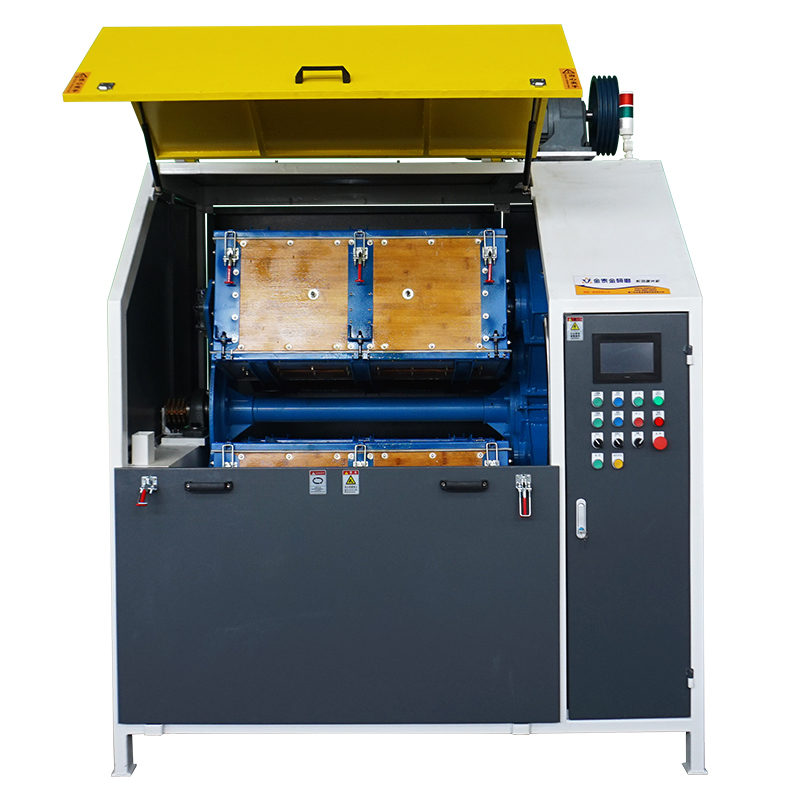
Geometry decides the machine frame before any setting does. A bowl vibrator needs the part to move freely in the charge; a long manifold body, a shaft or a stacked plate set cannot tumble that way and belongs in a tub where it can be carried, rotated or supported along its length. Mass matters as much as length: a heavy valve body sinks in a small charge and stalls the part-on-media motion, so either the charge grows or the machine size grows. Thin plates need the opposite treatment, a low load ratio and separation so they are not driven into each other. Before comparing machines, list the largest and smallest envelope in the batch, the heaviest single part, the longest unsupported span and any feature that cannot bear load. Those four numbers eliminate most of the catalogue.
| Machine route | Where it fits | What it will not do |
|---|---|---|
| Barrel finishing machine and rotary barrel tumbler | Gentle, low-impingement deburring of small, fragile or precision parts and mixed fitting batches where edge protection matters more than speed | Long cycles, no visibility while the barrel runs, and internal features can collect media and compound that must be retrieved at unload |
| Grinding finishing machine | Heavier stock removal and thick burr roots on robust parts where clearing material in a shorter cycle matters more than the surface result | Aggressive edge rounding and a coarser surface, so it fits lapped seats, thin sections and tight edge bands poorly |
| Disc finishing machine | Fast, high-energy cycles on small to medium robust parts, including batches of fittings and small housings that need a quick cut | High contact pressure rounds edges quickly and can mark or deform thin and soft parts, with results sensitive to load and disc condition |
| Vibratory finishing machine (bowl) | General deburring and refinement of valve bodies, flange plates, pump components and fittings that fit the bowl and can move freely in the charge | No access to deep internal passages, constant part-on-part contact, and finished faces need separation or fixture protection |
A working charge is a consumable with a life curve, and most batch inconsistency is a media condition problem rather than a machine problem. Media wears down, changes size and shape, loses its cutting edge, and eventually fractures into smaller pieces and fines. As it wears, the cut rate falls and the finish improves, so a setting that was correct on a fresh charge drifts over a few hundred cycles. The charge mass also falls as media breaks, which changes the load ratio and the energy per part. Screen out broken pieces and fines, measure a sample against the size class originally specified, top up to a defined mass, and replace on a wear trigger rather than on appearance. Keep the media history with the batch record.
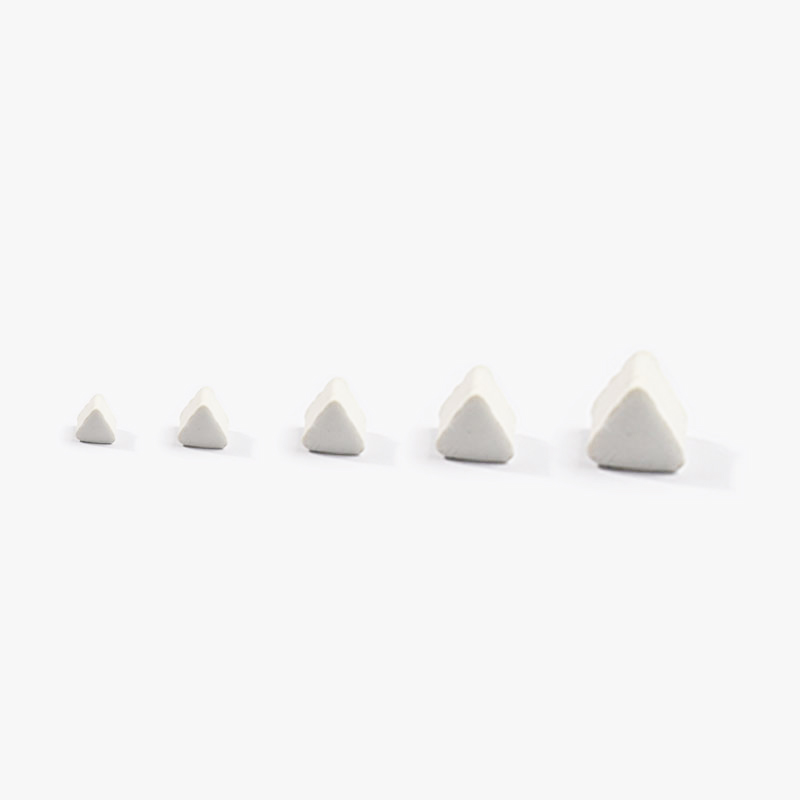
| Media | Best fit | Watch out for |
|---|---|---|
| Dry media, corn cob granules with a polishing compound | Final dry polish, light edge blending and drying after a wet stage on small parts and fittings | Almost no cutting action, absorbs compound and contaminates quickly, and must be kept separate per material family to avoid carry-over |
| Magnetic pin or needle charge | Reaching small internal intersections, radial holes and thread entries on small precision parts such as spools, sleeves and drilled fittings | Limited by part size and shape, pins must be retrieved and inspected for breakage, and the result depends heavily on fixture and field design |
| Dry media, walnut shell with an abrasive or polishing compound | Light dry deburring, deflashing, drying and low-residue finishing of small parts and of features where a wet bath is difficult to remove | Low cutting energy so it cannot remove a substantial burr root, produces dust needing extraction, and consumption is high |
| Plastic media triangles and pyramids in a soft to medium grade | Deburring aluminium, brass and other soft or thin-walled parts where surface marking and edge rounding must stay minimal | Slow cut rate, media deforms and wears out of shape, and a worn charge behaves noticeably differently from a fresh one |
Mass finishing acts on the whole section, not only on the edge, so flatness and wall thickness deserve their own screening on thin and slender parts. Heat-exchanger plates, thin diaphragms, long unsupported shafts and thin-wall pump components can bend, dish or lose flatness under part-on-part impacts and fixture pressure even when the surface result looks correct. The distortion is often small and shows up later as an assembly problem, a gasket that will not seat, or a plate stack with uneven contact. Fixtures and masking solve some of it but introduce their own marks: a masked face keeps its as-machined condition and may show a boundary where the media reached, and a rack can leave contact witness marks. Screen those outcomes on the drawing.
| Failure mode | Likely cause | How to catch it |
|---|---|---|
| Uneven result across a batch, with over-finished edges in one zone and untouched areas in another | Part position in the charge, shielding by fixtures or other parts, a worn charge that cuts differently from a fresh one, or masking that leaked | Mark fixed measurement and inspection points on several parts, compare parts from the top, middle and bottom of the load, and record charge age against the result |
| Media lodged in a cross-drilling, blind tapped hole, keyway, groove or internal passage | Size class chosen against an average feature rather than the smallest one, media fractured into smaller pieces during the cycle, or a secondary burr that closed part of the opening | Borescope agreed passages at a fixed angle, pin gauge every tapped hole, count the charge in and out where practical, flush through a filter and inspect the residue, and compare part mass before and after |
| Thread entry deformation, a damaged lead thread or a burr folded into the first threads | Aggressive media at an unprotected thread entry, media lodging in the thread and working against it, or handling damage at load and unload | Run a go and no-go thread gauge on every tapped feature in the sample, inspect the first threads under magnification, and check the entry chamfer against the drawing |
| Loss of flatness or a dimensional shift on thin plates, thin walls and long unsupported sections | Part-on-part impacts and fixture pressure in a high-energy route, too high a load ratio, or insufficient support along a slender part | Check flatness on a surface plate or a coordinate measuring machine at marked points before and after finishing, and check the same points across parts from different load positions |
Montreal's industrial identity is anchored in aerospace, and the province-level cluster is organised, funded and internationally visible: when announcing defence-supply-chain funding at Aéro Montréal's 2026 International Aerospace Innovation Forum, the federal government described Aéro Montréal as the "Quebec aerospace industrial cluster" and paired it with Propulsion Québec for electric and smart transportation and with Sous-traitance industrielle Québec (STIQ) for manufacturing businesses. The same announcement shows how deliberately the region builds supplier capability, with CAD 4,495,000 of non-repayable federal funding to prepare Quebec SMEs for defence-sector requirements, and STIQ's share explicitly targeted at "manufacturing businesses in order to prepare them to meet defence sector requirements". Manufacturing is broad beyond aerospace, and the federal funding is deliberately aimed at the supplier tier: STIQ's contribution is targeted at manufacturing businesses across Quebec to prepare them to meet defence sector requirements, which is the metal-fabrication, machining and process-equipment base that Greater Montreal depends on for aerospace and transport-equipment work. The region's economic development agency also runs formal industrial clusters, including a green and smart buildings cluster whose members develop and manufacture architectural products and innovative building technologies, plus a life sciences and health technologies cluster.
For this brief the relevant part of that base is energy: Propulsion Québec, the electric and smart vehicle industrial cluster named in the same federal announcement, received a share of CAD 2.5 million to guide businesses in the electric and smart transportation sector, which is the regional electrification and energy-conversion base.
Aerospace and defence supply chains are the sharpest finishing driver in Montreal: structural and engine components, hydraulic and pneumatic fittings, and machined aluminium and titanium parts are specified with controlled edge condition, surface integrity and cleanliness because burrs and residual media create foreign-object-debris and fatigue risks. The cluster funding is explicitly aimed at moving SMEs into defence supply chains, and defence primes impose documented process control, which pushes suppliers toward repeatable, verifiable deburring and surface conditioning rather than manual operator judgement. Architectural-products and metal fabrication work in the same region adds a second, more cosmetic requirement set, where a uniform brushed or satin finish on visible stainless and aluminium is the acceptance criterion.
A Montreal aerospace or defence supplier should first settle whether the finishing step has to be a controlled, traceable process that can survive a prime-contractor audit, including media lot control, compound chemistry control and records, because adding those controls after machine selection is expensive. The second question is language and documentation: quotations, machine labelling, manuals and training material for a Quebec plant normally have to be usable in French, and that should be settled before order rather than during commissioning.
Freight context: Port of Montreal, Montréal-Trudeau International Airport, Mirabel (Mirabel airport and industrial park), CN and CPKC rail corridors. Montreal sits on the St. Lawrence corridor and combines a container and bulk seaport with a major international airport and a dedicated aerospace industrial park at Mirabel, which is what makes the region workable for both importing a machine and shipping sample parts to a supplier. For a cross-border equipment sale, the practical sequence is that machines move as sea freight into a St. Lawrence or coastal container port and are trucked or railed to the plant, while test parts and media samples can move by air through Montréal-Trudeau.
China is one of Canada's ten principal merchandise trading partners and the second-largest single-country source of Canadian imports after the United States: Statistics Canada reported CAD 5,369 million of balance-of-payments imports from China in January 2025, against a CAD 2,299 million bilateral merchandise deficit that month. Canada has no free trade agreement with China, so Chinese-origin industrial machinery enters under the Most-Favoured-Nation (MFN) tariff column of the Canadian Customs Tariff; the preferential treatments listed in the tariff (CUSMA/UST and MXT, CETA/CEUT, CPTPP/CPTPT, UKT, KRT and others) do not include China, and preferential rates require proof of origin plus the applicable shipping rules, so a China-origin machine cannot claim them. Tariff classification is mandatory work, not a formality: vibratory, barrel, centrifugal and disc finishing machines are classified in Chapter 84 ("Nuclear reactors, boilers, machinery and mechanical appliances; parts thereof") according to the function of the machine, and the ten-digit Canadian tariff item drives both the duty rate and the statistics. A further landed-cost risk sits outside the tariff schedule: under the Special Import Measures Act (SIMA), the CBSA and the Canadian International Trade Tribunal may apply anti-dumping and countervailing duties to named goods, so a buyer should check the measures-in-force list for the specific product before assuming the MFN rate is the final duty.
Canada is a bilingual market for selling purposes: English is the working language of procurement outside Quebec, while Quebec buyers (Montreal, Quebec City) normally expect French-language quotations, technical documentation and after-sales support, and Quebec's Charter of the French Language makes French the default for commercial documentation in the province. Procurement expectations are formal and auditable: a Canadian industrial buyer will typically ask for the tariff classification and country of origin up front, expect a commercial invoice that satisfies the CBSA invoice requirements, and expect the seller to provide proof of origin for any preferential claim. Payment norms are bank-to-bank, with wire transfer or letter of credit rather than platform payment, and Canadian buyers commonly net-30 to net-60 from invoice, so a cross-border seller should price the working-capital gap into the offer. Certificates of origin for export documentation are issued through chambers of commerce, which is why chambers such as the Hamilton Chamber of Commerce and the Winnipeg Chamber of Commerce offer document certification. The current trade environment adds policy risk to landed cost: Canadian federal programs are explicitly framed around responding to U.S. tariffs, with the FedDev Ontario Regional Tariff Response Initiative described as supporting "businesses to respond to tariff pressures" in southern Ontario, and tariff and surtax measures can change by Order in Council, so quotations should state the tariff basis and the date on which the landed-cost calculation was made.
SurfacePolish supplies from Xiamen, China. The buyer's own destination rules, conformity marking, tariff classification and documentation responsibilities stay with the buyer; confirm them against the authorities named above before ordering.
Edge acceptance needs a reference object, because words like lightly broken or slightly rounded mean different things to different inspectors. Build a physical or photographic master at a stated magnification: a part or coupon showing the acceptable edge, the borderline case and the reject. For each controlled edge, express the requirement as either an edge break, meaning the sharp corner is removed to a small defined size, or an edge round, meaning a controlled radius band the edge must sit inside. Give a maximum where over-rounding is the risk, and a minimum where the edge must not stay sharp. State how the edge will be checked, whether by radius gauge, optical comparator, moulded replica or tactile comparison against the master, and at what frequency.
The value of a sample trial comes from the range of parts sent, not from the quantity. A box of identical nominal parts tests one geometry and one burr condition; it cannot show how the proposed route behaves on the tightest passage, the thinnest wall or the hardest material in the family. Send a small set chosen to cover the extremes: the part with the smallest internal opening, the part with the longest unsupported section, the part with the most protected edge, one part in the hardest heat-treatment state the family sees, and one as-received reject that already fails. Label every part so its identity survives the trip, and send enough pieces that some can be sectioned or measured destructively.
No. A trial reports what was observed on the parts that were sent, under the settings that were used on the machine that ran them. It does not establish what will happen across other heats, casting lots, machining sources or a full production charge, and it does not demonstrate how the process behaves once the media has worn. Treat the returned parts and the observation record as a direction to test at production scale. The next step is a production-representative batch on the machine the buyer will use, with the buyer's own first-article discipline, agreed sampling and the features that matter measured against the recorded baseline.
They solve different access problems. Thermal deburring oxidises thin burrs in a chamber and reaches internal intersections that no media can touch, but it acts on a whole part at once, needs a sealed chamber, and does not produce a controlled edge radius. Abrasive flow pushes a viscous abrasive medium through a passage and targets specific internal features, with dedicated fixturing per part. Mechanical mass finishing removes the burr root and blends the edge, and its limit is access. Many energy-equipment parts use more than one route: mechanical for external and reachable edges, another method for enclosed intersections. SurfacePolish supplies mechanical equipment and discusses the comparison only.
The visible lip is the part of the burr that is easy to see and easy to blend flat. The root is the material still connected to the parent surface underneath it, and it is the part that can break free later as a particle, especially in a flowing gas or hydraulic circuit. A light refinement pass can roll the lip over and make the edge look finished while leaving the root attached. Deburring is therefore judged on whether the root has been removed, which usually means removing a small amount of parent material at the edge rather than only wiping the surface. Agree how that judgement will be made.
Use Montreal, Canada as the destination on the enquiry and state whether the deliverable is equipment, media and compound, a representative sample review or a line concept. A destination does not imply local stock, a local service point or a local delivery time.
A Montreal buyer works in French for documentation and in the Quebec occupational health and safety regime, which is administered separately from the other provinces, alongside Canadian electrical safety certification of the machine. Where the buyer is in the aerospace or defence supply chain, the governing requirement set is the prime contractor's process specification and its audit of the finishing operation, including traceability of media and compounds, rather than a single national finishing standard.
Sources were retrieved on 2026-09-29 and describe the local industrial and trade context only. They do not evidence any SurfacePolish project, shipment, installation or service in Montreal.
The buyer must break the sharp slot edges consistently around the disk without reworking the broached profile or rounding the bolted flange face.
Send the material, dimensions, approximate weight, batch quantity, the incoming condition and photographs of the difficult features. Mark which features must not be contacted by media and state how the result will be inspected. This form carries source reference PSEO-0118; quote it if you prefer an additional manual reference.
Open the SurfacePolish enquiry form Email a prepared enquiry
No price, lead time, certification or result is promised here. Confirm whether a sample trial is available for the specific part and what the trial can and cannot show.
Page PSEO-0118 · revised 2026-09-29 · cross-border equipment, media and scoped sample review. City context is sourced and cited above.
Use this local checker to identify missing part and inspection information. It prepares a technical-review brief; it does not approve a machine, process recipe or production result.
Complete the part details to prepare a review brief.
Email : info@surface-polish.com


 IPv6 network supported


 +86-592-2381506