A buyer in Canberra, Australia working on marine components has a 316L manifold whose cross-drillings must be deburred without lodging media in blind ports or peening the seal faces. SurfacePolish supplies finishing machines, media and compounds across borders and runs a free sample trial: the part goes to Xiamen and returns with an observed condition and a proposed media, compound and cycle direction for the buyer to verify. This brief is written for a buyer in Canberra working on marine components; it describes equipment, media and a scoped sample review, not a local polishing service.
Which acceptance criteria, measurement locations and functional checks must exist before any route, robot or otherwise, can be compared fairly?
Can the charge or the tool reach the surfaces that matter, and which enclosed passages and blind holes can never be reached at all?
Does the part family repeat often enough, with stable geometry, to justify a cell rather than a batch machine or hand work?
Automation needs repetition more than it needs difficulty. A family with stable geometry, a fixed set of controlled features and demand that recurs every week is a candidate; a one-off fabrication with a different weld layout each time is not, however much hand work it consumes. Establish the annual and monthly quantity, how many variants sit in the family, the size difference between the largest and smallest variant, and the takt a cell would have to meet. Then count the manual hours honestly: finishing, setup and fixture change, handling, inspection and rework. If setup and changeover dominate those hours, a robot may reproduce the same inefficiency with more capital behind it. If a few stable variants consume predictable hours, the arithmetic changes and a feasibility discussion is worth having.
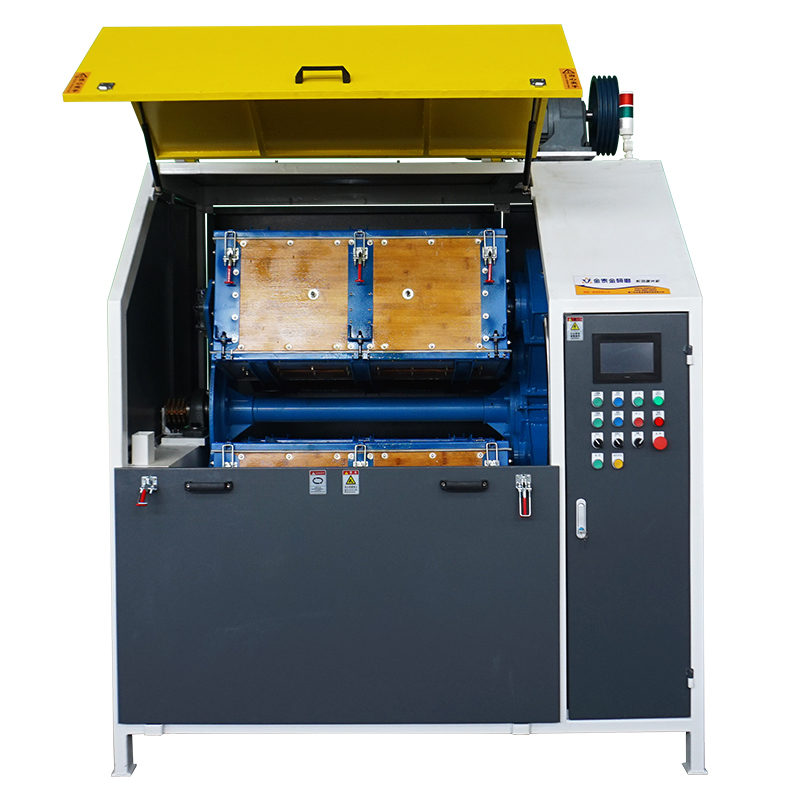
Vibratory finishing usually deserves the first look, because it removes the hand work a robot would otherwise have to reproduce. A bowl takes small and medium fittings, cast cleats, brackets, fasteners and machined valve internals and processes them in bulk with no part-specific path to teach. A tub takes long parts that cannot turn inside a bowl, such as rail sections, pipe spools and linear weldments, provided they can be supported along their length. Both routes trade part-on-part contact for simplicity, so visible faces need separation or racking. Their limits are geometric: no access to internal passages, no way to hold one radius precisely, and no tolerance for parts whose weight would crush the charge or be crushed by it. Where a bowl or tub reaches the surface, automating load and unload is a smaller problem than automating the finishing motion.
| Machine route | Where it fits | What it will not do |
|---|---|---|
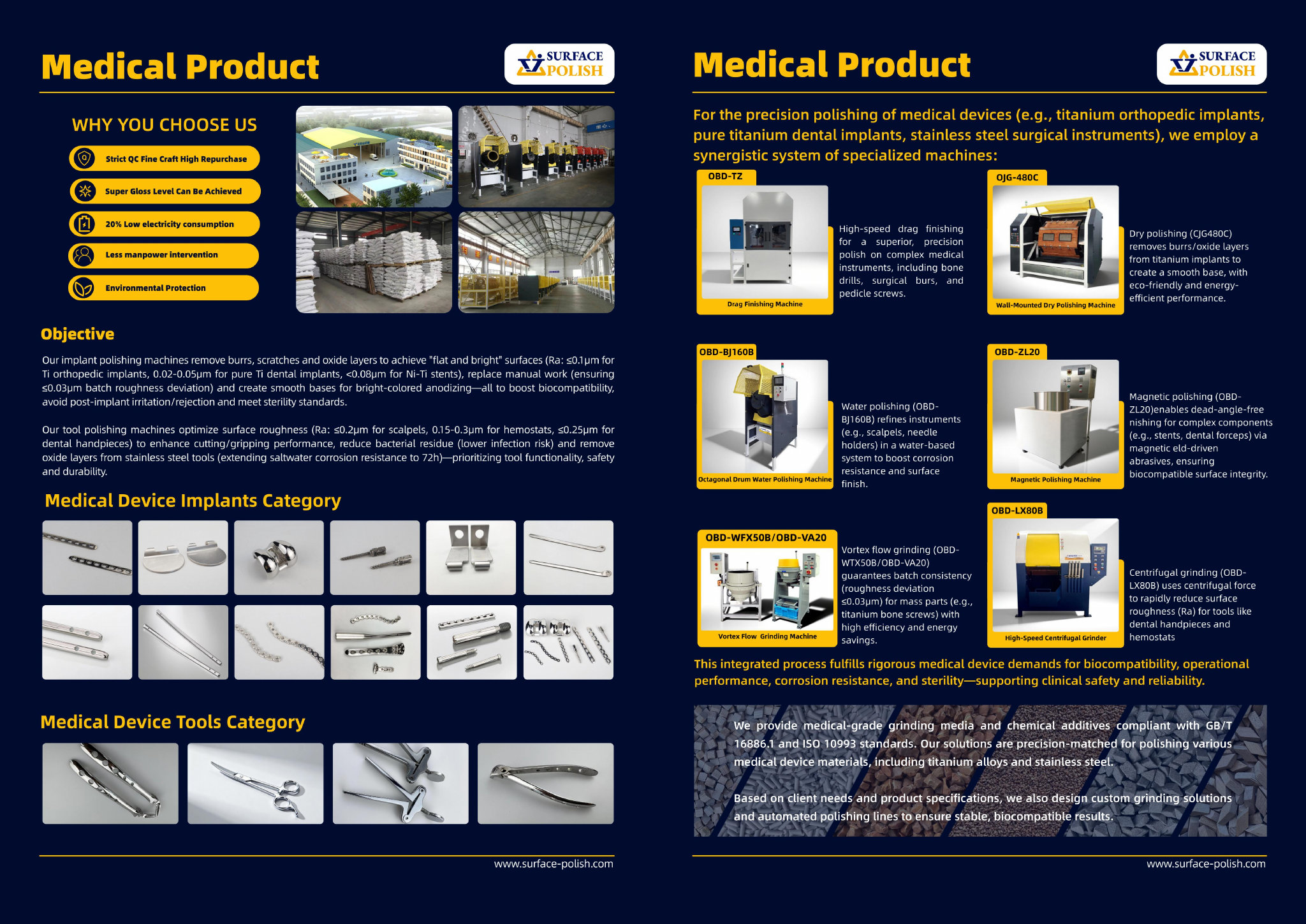
| Centrifugal barrel finishing machine | Short, aggressive cycles on small precision items such as valve trim, inserts and small stainless components with fine edge requirements | Rounds edges and can distort thin unsupported sections quickly, and results are sensitive to charge weight, speed and stop time |
| Magnetic finishing machine | Fine deburring and light refinement of small precise features such as narrow slots, small bores and stainless fittings | A small working envelope that excludes large fabrications, with pin media that can lodge in fine passages and must be retrieved |
| Dry polishing machine and dryer | Drying parts after a wet stage and producing a dry polished surface with organic media where a wet residue would be hard to remove | No cutting action, needs dust extraction, and organic media must be kept dry and clean or it transfers contamination to the part |
| Rotary barrel finishing machine | Gentle deburring of small fragile components and mixed fitting batches with generous compound flow and low part-on-part energy | Long cycles with no visibility while running, and internal passages collect media and compound that must be retrieved at unload |
Plastic media suits parts whose surfaces must not be peened, marked or rounded aggressively. Aluminium brackets, bronze and nickel-aluminium-bronze castings, thin sheet components and any part with a cosmetic face respond better to plastic triangles, cones or pyramids in a soft to medium grade than to ceramic. The trade is removal rate: plastic cuts slowly, deforms as it wears, and a worn charge behaves noticeably differently from a fresh one, so cycles set on new media drift. Some shapes float or segregate in a bowl and starve part of the load. In marine work plastic media is often the right first stage where a light machining burr, an adhesive residue or a paint-adjacent edge has to come off without changing the geometry a gasket or a seal depends on.
| Media | Best fit | Watch out for |
|---|---|---|
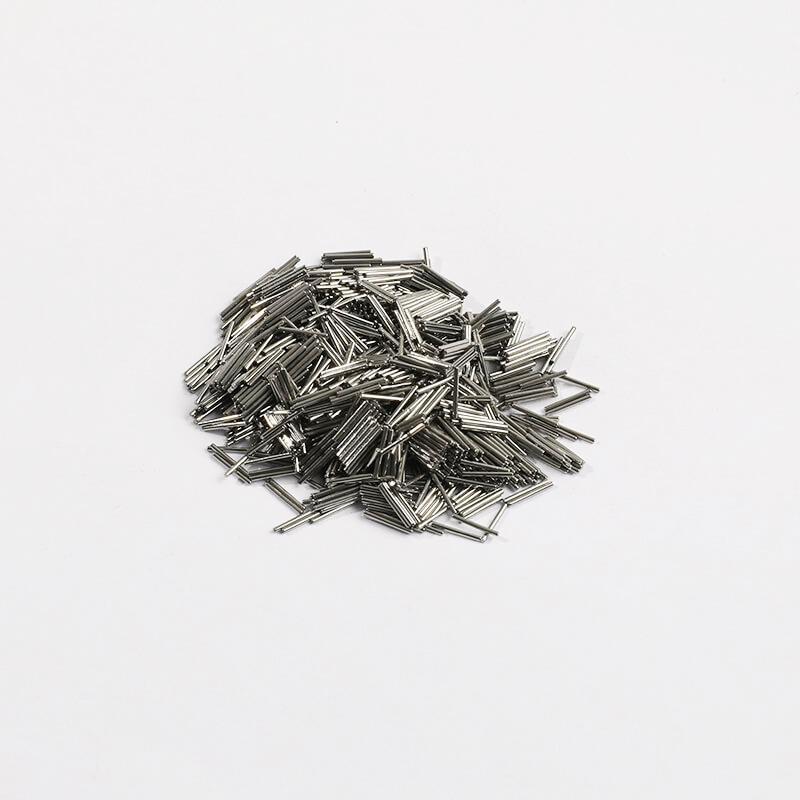
| Aluminium oxide grinding media in a dense ceramic bond | Heavier stock removal or a more consistent cut on robust stainless and duplex parts with thick edges and cast skin | High removal energy rounds functional edges quickly and is a poor match for thin panels or a knife-edge seat |
| Heavy-cut ceramic angle-cut triangles in a coarse size class | Breaking the edge of a machined or cast marine fitting and removing a substantial burr on robust stainless before a refinement stage | Cuts corners and weld toes aggressively and can round a seat or keyway, and the coarse section may not enter narrow passages at all |
| Fine ceramic or porcelain shapes in a small size class | Refinement and light edge blending after a cutting stage, and reaching tighter external geometry on small valve parts and fittings | Small sizes enter and lodge in cross-drillings and fine slots, and media wear shrinks the charge so the finish drifts over its life |
| Steel media including balls, pins and shaped shot | Bright burnished finishing and edge blending on stainless components where appearance matters and stock removal must stay low | Transfers iron to stainless and leaves free iron that blooms in chloride service, so it needs a dedicated charge, an inhibiting compound and magnetic or screen separation |
Automation introduces a family of defects that hand work hides. Where an arm slows at a corner, dwells at a waypoint or waits for a tool change, the tool removes more material and leaves a flat spot or a visible step. Where two passes meet, a slight mismatch shows as a band. Tool wear makes the last third of a long path cut differently from the first third unless the cell compensates, and a loaded belt heats the surface instead of cutting it. These show up as texture variation rather than a measurable defect, so they are often accepted at the bench and rejected by the customer. Photograph the surface under raking light, compare the first and last part of a run, measure at fixed points along the path, and treat any visible change at a transition as a signal to review the path or the compensation.
| Failure mode | Likely cause | How to catch it |
|---|---|---|
| Abrasive grain embedded in a soft or gummy surface | Coated abrasive or bonded wheel used on bronze, aluminium or a work-hardened surface at excessive pressure, or a loaded belt that has stopped cutting and started smearing | Inspect under low-angle light and a magnifier, wipe with a solvent-soaked cloth, and check the part after a light refinement pass rather than only as it leaves the coarse operation |
| Rust bloom and tea staining appearing on a finished stainless surface within days | Free iron from carbon steel media or brushes, a machine shared with carbon steel work, airborne grinding dust on a wet surface, bare-hand handling, or chloride carried in rinse water | Wipe a defined area with a white cloth and record what it shows, run a free-iron check if the buyer wants one, and inspect welds, pits and thread roots under good light after the part has stood for a period |
| Clamping indentations and part-on-part impact marks on a visible face | Gripper or fixture force applied on a finished or visible surface, no protective interface at the contact point, or parts left free to collide in a batch charge | Inspect all contact points and visible faces under raking light against a reference part, and record the fixture contact scheme used so marks can be traced to a specific clamp or pocket |
| Keyway, spline or taper geometry lost to edge rounding | The feature was exposed to the charge without masking, or a tool-carrier path ran along the flank of the feature instead of stopping short of it | Check width, flank angle and edge break with a gauge or comparator at marked stations before and after, and confirm the protected feature against the drawing tolerance |
Canberra's industrial base is unusual for Australia: it is built around the Australian Government as the country's largest single buyer of goods and services, plus national research institutions rather than heavy manufacturing. The ACT Government's business and investment site describes a 'future-focused knowledge economy' with defence, space, cyber and quantum, agri-technology and renewable energy as its named key sectors. Local manufacturing does exist and is concentrated in high-value, low-volume work: Skykraft designs and manufactures mini-satellites in Canberra, the Canberra Deep Space Communication Complex is managed for NASA by CSIRO, and the Advanced Instrumentation and Technology Centre at Mount Stromlo provides space test and verification facilities. The Australian National University, the University of Canberra, CSIRO and Geoscience Australia maintain major laboratories and instrument-building capability in the city, and Geoscience Australia operates a purpose-built Canberra headquarters. Canberra Airport's precincts at Brindabella Business Park, Majura Park and Fairbairn, adjoining the RAAF base, concentrate aviation, defence and light industrial tenancies.
The nearest part of that base to this brief is automation: The ACT business and investment site promotes Canberra as an incubator where 'concepts go from pilot to proven more quickly here than anywhere else in the country', spanning next-generation quantum computing and 100% renewable electricity, and the ACT has a zero emissions public transport programme including an electrified bus fleet and light rail; this evidences automation and control-system activity rather than a discrete automation manufacturing cluster.
Canberra's manufacturing is precision, low-volume work — satellite structures, space instrument payloads, scientific apparatus and defence electronics — where burr removal, edge break and surface cleanliness affect optical alignment, vacuum compatibility and electrical contact rather than cosmetic appearance. For parts machined from aluminium, stainless and titanium in small batches, the choice between vibratory, barrel and disc finishing methods is driven by part geometry and allowable edge radius, and deburring must not alter critical dimensions or introduce media carry-over into clean assemblies. Buyers in this city typically need a documented, repeatable process for a small number of high-value parts rather than high-throughput finishing.
Before selecting finishing equipment or media, an ACT buyer working on space, defence or scientific hardware should settle whether the required surface condition is specified as a measurable edge radius or surface roughness value, or only as a visual 'deburred' requirement, and whether the process must avoid media embedding and cross-contamination because the part goes into an optical, vacuum or clean assembly.
Freight context: Canberra Airport (terminal, Brindabella Business Park, Majura Park, Fairbairn precinct, adjoining Fairbairn RAAF base), South Jerrabomberra Regional Job Precinct (NSW, 20-minute drive from Queanbeyan, serving the ACT workforce), Port of Eden (NSW south coast deep-water port, regional gateway). Canberra Airport is the city's international gateway and its business precincts handle the light-industrial and aviation tenancies; the airport's own site describes it as having 'thriving business precincts and daily international flights'. Canberra is an inland city with no seaport, so sea freight for machines or sample parts arrives through Port Botany, Port Kembla or the Port of Eden and moves by road, while the South Jerrabomberra Regional Job Precinct gives businesses in the corridor direct access to the ACT workforce and to Commonwealth agencies.
Business is conducted in English and Australian industrial buyers are normally registered companies with an ABN that contract through a local importer or a licensed customs broker rather than directly with an overseas manufacturer. Because the first Australian supplier of in-scope electrical equipment becomes the legally responsible supplier, Chinese manufacturers are typically asked to provide test evidence, a compliance folder and a declaration so that their Australian importer can register and mark the product. Quotation and contracting expectations centre on a clear commercial entity, correct HS/tariff classification, documented country of origin for preferential duty, and an explicit statement of what is included in the delivered price and what is not.
Australia and China are parties to the China-Australia Free Trade Agreement (ChAFTA), signed on 17 June 2015 and in force since 20 December 2015; the Australian Border Force maintains a dedicated ChAFTA page and working tariff schedule, and FTAs give importers a route to preferential rates of duty where the rules of origin are met. China was Australia's largest source of imports in 2025 at $130.2b, up 12.5% on 2024, and 56% (69,567) of Australian business importers traded at least once with China in 2020-21. A Chinese supplier of finishing machines, media or compounds is therefore shipping into Australia's single largest import stream, and preferential duty depends on origin documentation rather than on a blanket zero-tariff guarantee for every product line.
SurfacePolish supplies from Xiamen, China. The buyer's own destination rules, conformity marking, tariff classification and documentation responsibilities stay with the buyer; confirm them against the authorities named above before ordering.
Some checks decide whether the part works, and those belong to the buyer's engineering and quality functions. A pressure or leak test on a valve or pump body, a flow check through a passage, a fit check of a shaft in its bearing or a flange against its mate, a dye penetrant inspection of a dressed weld, and any corrosion or coating adhesion evaluation are buyer-side calls. The same applies to cleanliness: the buyer defines the method and the limit, and decides whether a mechanically finished part needs a passivation treatment afterwards. SurfacePolish can describe what was done to a part and what was observed on it, but it does not qualify a part for a class society, a coating specification or a service environment. Ask what evidence is needed before work starts, then plan the trial records to match.
A sample trial reports what was observed on the parts tested under the settings used, and that is the limit of it. It cannot promise a roughness value, an edge radius, a tolerance, a cycle time, a capacity or a cost. It cannot verify the reach, payload or path accuracy of a robot the buyer has not yet chosen, nor the behaviour of a gripper, fixture or positioner that does not exist. It cannot qualify a process for a classification society, a coating specification or a service environment, and it cannot demonstrate corrosion performance or coating adhesion. Nor can it show production uniformity, because a few parts do not describe variation across a lot, a shift or a media charge. Those gaps close only through the buyer's own line trials, first-article discipline and acceptance testing.
A positioner is often the cheaper answer to reach. Turning the part to present a new face to a fixed tool or to a smaller machine can remove the need for a long-reach arm and reduce the payload the arm must carry. The trade is an extra axis with its own repeatability, and a fixture that has to locate on every face it turns to. A robot arm earns its place where the tool must travel over a surface that cannot practicably be turned, or where the same motion repeats on many parts. Decide from geometry and volume, not from technology, and prove the surface before either is bought.
Partly, and the split is the useful part of the question. A robot can hold a grinder, sander or polishing head over a repeatable path with controlled pressure, which suits long weld runs, flat panels and consistent edges. It struggles where access is restricted, where the surface is free-form and required pressure changes continuously, and where a person compensates for part-to-part variation by feel. Work out which features recur in the same place on every part and which move; automate the first group and leave the second with an operator, or send parts to a machine route that already produces the surface in bulk.
The part has to arrive in a repeatable position and condition. That means a defined locating datum, a fixture or positioner that holds the part without distorting it, a starting condition that varies within a stated band, and a family whose geometry does not change on every job. The controlled features should be the same on every variant, and the part should be clean enough that oil or marking ink does not change how a tool cuts. If the part arrives different each time, the cell will spend its hours being adjusted rather than finishing, and the cost per part will not behave the way the original estimate assumed.
Use Canberra, Australia as the destination on the enquiry and state whether the deliverable is equipment, media and compound, a representative sample review or a line concept. A destination does not imply local stock, a local service point or a local delivery time.
Canberra buyers are typically Commonwealth agencies or their suppliers, so work is frequently procured against Australian Standards and, for defence and space work, against the relevant Defence specifications and mission-assurance requirements rather than a purely commercial finish specification. Standards Australia is the national standards body, and AS/NZS 4417.1 and AS/NZS 4417.2 govern use of the Regulatory Compliance Mark for electrical equipment — relevant if a finishing machine is electrically powered.
Sources were retrieved on 2026-09-29 and describe the local industrial and trade context only. They do not evidence any SurfacePolish project, shipment, installation or service in Canberra.
The buyer needs internal burrs removed from the cross-drillings while the seal faces and thread flanks stay clean and free of lodged media.
Send the material, dimensions, approximate weight, batch quantity, the incoming condition and photographs of the difficult features. Mark which features must not be contacted by media and state how the result will be inspected. This form carries source reference PSEO-0756; quote it if you prefer an additional manual reference.
Open the SurfacePolish enquiry form Email a prepared enquiry
No price, lead time, certification or result is promised here. Confirm whether a sample trial is available for the specific part and what the trial can and cannot show.
Page PSEO-0756 · revised 2026-09-29 · cross-border equipment, media and scoped sample review. City context is sourced and cited above.
Use this local checker to identify missing part and inspection information. It prepares a technical-review brief; it does not approve a machine, process recipe or production result.
Complete the part details to prepare a review brief.
Email : info@surface-polish.com


 IPv6 network supported


 +86-592-2381506