A buyer in Chicago, United States working on automotive parts has an exhaust flange that needs a brighter visible face while its sealing bead stays flat and free of iron contamination. SurfacePolish supplies finishing machines and consumables across borders and runs a free sample trial: the parts travel to Xiamen and come back with observations plus a proposed media, compound and cycle direction for the buyer's own engineering review. This brief is written for a buyer in Chicago working on automotive parts; it describes equipment, media and a scoped sample review, not a local polishing service.
Which alloy family is the part, and has cold work, welding or heat treatment already changed its hardness, magnetic response or corrosion behaviour?
Which surfaces on this part carry a visible appearance grade, which are hidden, and which edges have a functional requirement rather than a cosmetic one?
At what batch size, load fill ratio and media wear state does a trial observation still describe what series production will produce?
Beyond appearance, certain features establish how the part assembles, and media acts on them whether or not the drawing calls them out. Machined flange faces, O-ring and seal grooves, bearing bores, threaded holes, sensor mounting pads and dowel bores all carry that role. Media contact can shift flatness, open a bore slightly, round a thread crest or change a sensor gap, and normal shop inspection will not notice. Identify which surfaces are datums and which mate with another component, then treat the finish requirement on them separately from cosmetic areas. Protect them by masking, fixturing against a support, or finishing them with a gentler medium, and write down a maximum stock removal per cycle for every feature whose geometry could be consumed by the process. Ask the designer to confirm those limits rather than promising a blanket surface condition.
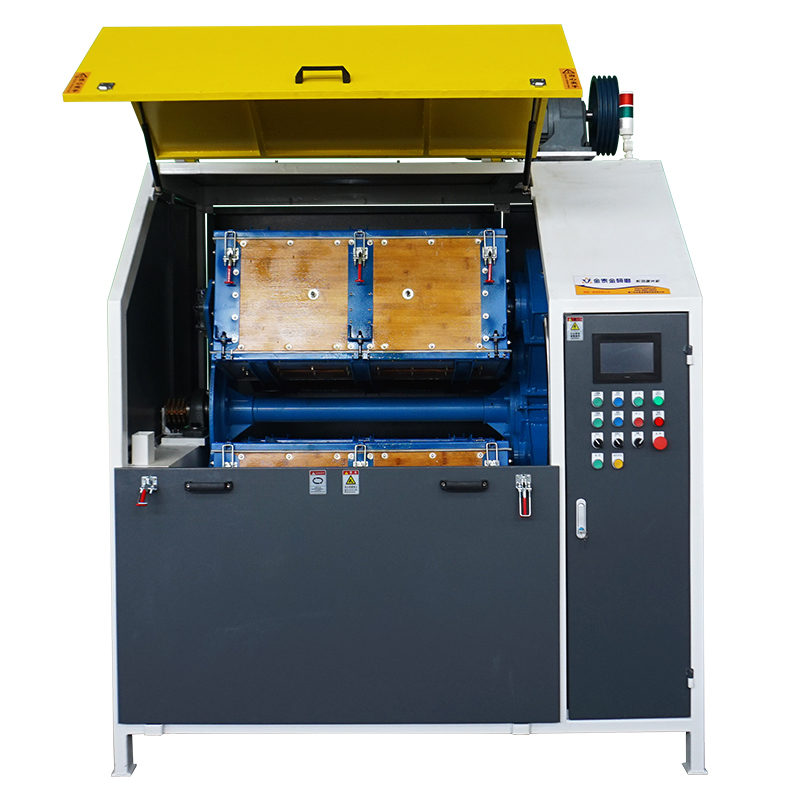
A vibratory bowl handles a broad middle band of stainless automotive parts: brackets, housings, flange blanks, handles, trim sections and small fittings. The load stays visible, amplitude, frequency and media blend can be adjusted, and the same machine serves both deburring and surface refinement when the media progression is planned. Limits are real, though. Part size and shape are capped by chamber geometry, and long or slender parts bridge and stall unless a tub or a fixture is used. Thin and threaded parts need compartments or fixtures to limit part-on-part contact. Watch fill ratio and the ratio of media to parts, because an over-filled or under-filled chamber changes both edge results and finish consistency, and keep the fill ratio stable from trial to production rather than filling to whatever the shift finds convenient.
| Machine route | Where it fits | What it will not do |
|---|---|---|
| Tub vibrator | Long stainless parts such as trim sections, exhaust profiles and shafts that cannot be loaded into a bowl without being cut down. | Media velocity varies along the length, so finish evenness must be verified at both ends, and the machine occupies more floor space and compound volume. |
| Dry polishing machine with heated dryer | Post-wet drying, residue control and light dry finishing of stainless parts that must leave the line dry and free of moisture in blind features. | Dry media does not cut stainless, and moisture trapped in a blind hole, hem or tight joint can cause staining if drying is not effective. |
| Centrifugal barrel finishing machine | Very high energy deburring and edge radiusing of small, hard stainless parts in short cycles. | Rounds edges quickly and can exceed a tight radius within a short run; part size and shape are restricted and a substantial load is needed to justify the cycle. |
| Magnetic finishing machine | Small precise stainless parts with internal features, slots and blind holes that must be deburred without media lodging in the passages. | Works within a small part envelope, and the route has to be tested per grade because it depends on the part's magnetic response. |
The compound does more than clean: it carries debris, controls pH and temperature, and inhibits corrosion during and after the cycle. Chemistry has to suit the alloy family, because a compound that brightens one stainless grade can stain another or leave a film that shows as a defect. Alkaline and near-neutral formulations are common for general cleaning and finishing where brightness is secondary. Products described as brightening or burnishing formulations are selected by the media and compound supplier for austenitic and duplex work, and they are tested on the actual part before being adopted. Chloride content is a hard consideration for austenitic and duplex grades, since chloride-bearing chemistry and chloride-bearing water are associated with pitting and staining. Contamination risk also rises when a line is shared with carbon steel, so compound choice and line segregation need to be settled together.
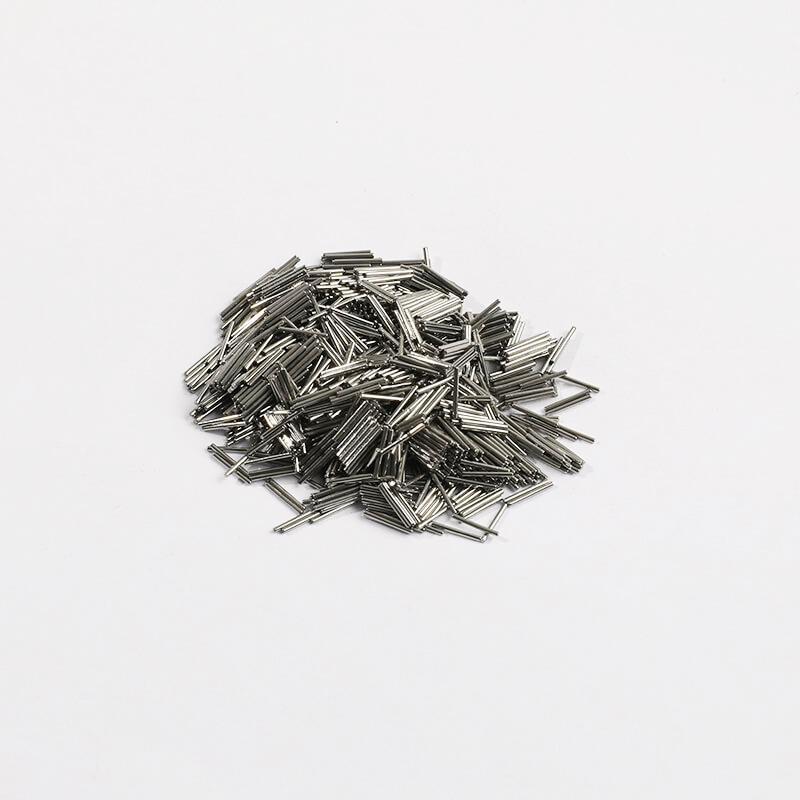
| Media | Best fit | Watch out for |
|---|---|---|
| Magnetic stainless pins and fine needles for magnetic finishing | Deburring and brightening of intricate small stainless features, slots, gear teeth and blind holes where media cannot be allowed to lodge. | Suits small part envelopes only, and the route needs testing on magnetic grades before it is assumed to apply to a given part. |
| Alumina-based ceramic triangles and angle-cut forms | Heavy deburring, edge blending and machine-mark removal on stainless brackets, flanges and housings where corners and recesses must be reached. | Wears down in size and sharpness, so cutting rate falls without any setting change; broken pieces and fines can lodge in small features and must be screened out. |
| Grinding and cutting media, fused alumina and silicon carbide based | Aggressive stock removal on heavy stainless burrs, weld dressing and rough cast surfaces before a refining stage. | Removes edge material quickly, can embed abrasive fragments in soft or gummy surfaces, and is usually too coarse for a final appearance stage. |
| Steel media, including balls and shaped steel forms | Brightening and burnishing of austenitic stainless appearance parts where the highest available gloss is the objective. | Deforms and generates metallic fines, adds weight to the load, and can transfer iron if used in a line shared with carbon steel work. |
The defect that ends most stainless finishing trials is not a bad appearance but an edge that moved further than the drawing allows. Threads and gear teeth are the classic casualties, because mechanical action removes material from crests quickly, changing effective pitch diameter and flank form; a part can still thread by hand and still fail a gage. Radiused or chamfered edges behave similarly, since the process removes stock precisely at the edge where a callout is tightest. Start the trial with an edge record and repeat it afterwards: thread and gear gages before and after, edge radius at marked locations with an optical comparator or a cast impression, and a written allowable band agreed before any cycle runs. Treat the shortest cycle that achieves the required appearance as the control condition, and be suspicious of any proposal that adds cycle time to improve a finish that was already acceptable.
| Failure mode | Likely cause | How to catch it |
|---|---|---|
| Thread crests rounded and thread gages failing after finishing | Mechanical action removing material from crests during an energetic or extended cycle, sometimes with media large enough to strike the thread form directly. | Gage every threaded feature before and after the cycle with the drawing's gages, inspect crest form with an optical comparator, and keep the shortest cycle that still achieves the required appearance. |
| Embedded particles or grey smut on the finished surface | Media fines, broken ceramic fragments or metallic debris from the charge becoming trapped or smeared into the surface during the finishing cycle. | Examine under magnification with raking light and on a wipe test, check the compound bath and media charge for fines and broken pieces, and screen a media sample to identify the source. |
| Edge rounding beyond the specified radius on a functional edge | Cycle energy, time or media size class chosen for appearance rather than for the tightest edge callout on the drawing. | Measure edge radius at marked locations with an optical comparator or a cast impression before and after, and record the result against a written allowable band rather than judging it visually. |
| Rust blooms or speckling on austenitic or duplex parts after finishing | Free iron transferred from carbon steel, ferritic stainless or worn steel machine parts sharing the same media, chamber, racks or bench area. | Run a ferroxyl-type test for free iron at agreed locations, compare against an untouched part from the same batch, and repeat the check after a defined exposure period to catch delayed blooms. |
Chicago plans its industrial base through a designated corridor and Planned Manufacturing District (PMD) system rather than a single industrial estate: the Pilsen Industrial Corridor is one of Chicago's 26 designated industrial corridors, covers 1,070 acres and contains PMD 11, and it is home to food distributors, manufacturers and industrial operators as well as segments of the South Branch of the Chicago River and the Sanitary and Ship Canal. World Business Chicago, the city's economic-development organisation, describes Chicago as having one of the largest manufacturing industries in the nation, with 400,000+ manufacturing and logistics workers across the metro area and $100B+ in annual manufacturing output, and names Manufacturing, Food Manufacturing, Transportation/Distribution/Logistics and Life Sciences among the region's priority sectors. The same source describes the local base as spanning advanced robotics, clean energy systems, aerospace, food production and precision engineering, with mHUB and UI Labs named as manufacturing innovation centres. The Seventh Federal Reserve District, which includes Chicago, is characterised by the Chicago Fed as featuring significant agricultural production, automotive and other manufacturing, and financial and insurance industries.
The nearest part of that base to this brief is food: The Pilsen Industrial Corridor is home to food distributors, manufacturers and industrial operators, and World Business Chicago lists Food Manufacturing as one of the region's priority sectors.
The corridor mix puts two different finishing problems side by side: food-processing and packaging equipment, where stainless wetted surfaces are judged on weld dressing, passivation and cleanability, and general machinery, automation and metalworking parts, where edge radius, burr height and Ra are checked before assembly. Because the work is spread across 26 industrial corridors and is largely batch and job-shop in nature, media and compound selection usually has to cover mixed stainless, aluminium and carbon-steel parts rather than a single alloy family.
The first question to settle is whether the parts are food/life-science stainless requiring validated cleanability and passivation, or structural and machinery parts requiring only edge radius and burr-height control, because that answer fixes media type, compound chemistry and cycle time far more than machine size does.
Freight context: Illinois International Port District (Iroquois Landing and Lake Calumet terminals), O'Hare International Airport, Class I rail terminals serving BNSF, CN, CP, CSX, NS and UP. The Illinois International Port District operates its own rail infrastructure connecting to six of the seven North American Class I railroads - BNSF, CN, CP, CSX, NS and UP - and its Iroquois Landing facility takes international ship traffic through the St. Lawrence Seaway; the District states it moves more general cargo than any other Great Lakes port, at over 19 million tons waterborne a year. CBP maintains a Chicago customs presence for imported and exported shipping, so machinery and sample parts would be entered and marked for country of origin at the port of entry.
The United States has no single mandatory national finishing standard. The national standards system is voluntary and consensus-based, coordinated at national level by the American National Standards Institute (ANSI): ANSI published the United States Standards Strategy (USSS) 2025 on 6 January 2026, a strategy that 'guides how the U.S. develops standards and participates in international standardization', while the National Institute of Standards and Technology (NIST) is the federal measurement and standards agency and states that 'Technical standards keep us safe, enable technology to advance, and help businesses succeed.' In practice a buyer specifies surface finish, deburring, cleaning and coating requirements on the drawing or in the purchase order using the voluntary consensus standards maintained by bodies such as ASME and ASTM International and their ISO equivalents, and the acceptance criterion is the buyer's own specification rather than a government-issued finishing standard. Where a part is destined for a regulated product - pressure equipment, food-contact equipment, aerospace or medical devices - the relevant industry code or the customer's qualification requirement governs instead.
The United States has no free-trade agreement with China, so Chinese industrial machinery enters under normal-trade-relations (MFN) duty rates in the Harmonized Tariff Schedule of the United States plus any Section 301 duty that applies to the specific HTSUS subheading. USTR's four-year-review modification of the Section 301 China technology-transfer investigation imposed additional Section 301 duties or increased existing rates on certain Chinese products in strategic sectors, and created a temporary exclusion process for machinery used in domestic manufacturing: chapters 84 and 85 of the HTSUS, which cover most machinery used in manufacturing processes, are the chapters that were made eligible for exclusion requests. CBP still administers Section 301 China duties, the four-year-review increases and product exclusions. The IEEPA-based additional ad valorem duties of 2025 - including the reciprocal-tariff actions and the China synthetic-opioid supply-chain duties imposed under Executive Orders 14195 and 14257 - were ordered terminated by Executive Order 14389 of 20 February 2026 and, as soon as practicable, are no longer collected. A buyer should therefore price the MFN rate plus any applicable Section 301 rate and check whether the machine's exact subheading is covered by a current exclusion, rather than assuming either the 2025 IEEPA tariffs or a blanket China rate still applies.
SurfacePolish supplies from Xiamen, China. The buyer's own destination rules, conformity marking, tariff classification and documentation responsibilities stay with the buyer; confirm them against the authorities named above before ordering.
Acceptance for a stainless automotive part should be settled before a machine or medium is proposed, because the acceptance rule determines which route is even capable. If the finish callout is a word like bright, inspection is whoever looks last; if it is a roughness range at a named location plus a physical visual master viewed under stated lighting, inspection becomes repeatable and the argument moves to the part. Set the sampling plan, the inspection method and the instrument or gage for each characteristic, and decide separately which features get a functional check as opposed to a cosmetic one. Write the rule into the purchase documentation along with the material grade, the marked measurement locations and the acceptance limits for edge condition. A supplier can then report observations against a defined rule instead of being asked to judge its own work.
Parts returned from a trial are only half the deliverable; the record of what was done is the other half. A usable trial report describes the machine route, media specification and size class including its condition, compound family and concentration, water source, cycle duration, load fill ratio, and the measured results at the marked locations. Read it against your own before-and-after record, and check that the settings are described completely enough to be repeated by a different operator on a different day. Where a result is strong but the mechanism is unexplained, ask what changed rather than accepting the outcome, because an unexplained good result is hard to reproduce. Where a trial produced a good appearance and a poor edge measurement, treat the edge measurement as the governing result for a functional automotive part.
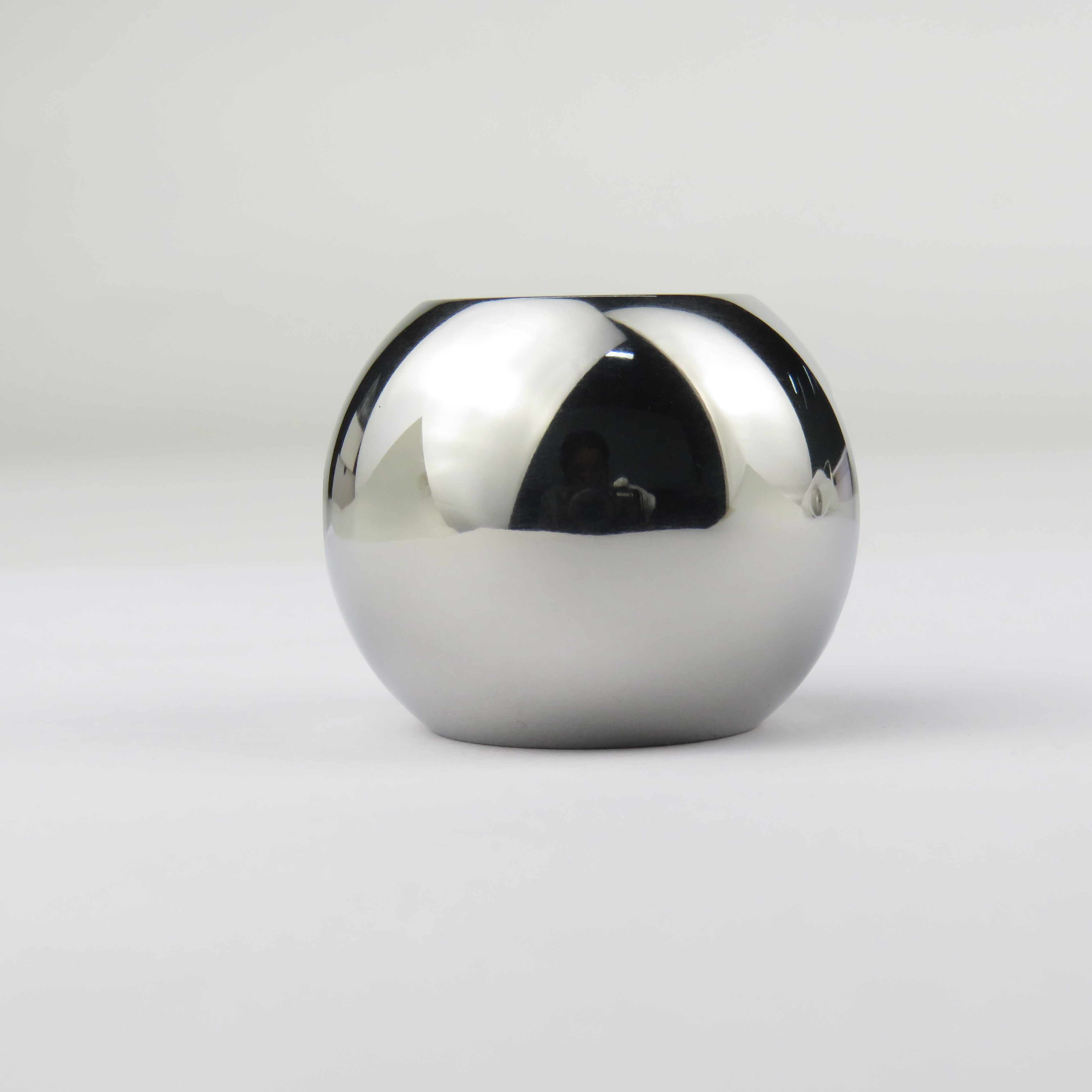
Steel media generally produces the brightest result on austenitic stainless, but brightness depends on the whole progression rather than one medium. A common sequence is a hard ceramic stage that removes burrs and machine marks, a finer stage that refines the texture, then a low-amplitude stage that brightens. Media that is too soft for the work-hardened surface burnishes and dulls instead of cutting. The shape and size class also matter, because small media reaches tight features but leaves a different texture from larger forms. Treat any proposed progression as a comparison to test on real parts with your own measurement setup.
Speckled rust usually means free iron contamination rather than a material fault. Common sources are carbon steel parts run in the same machine or media, worn steel components in the chamber, steel racks and baskets, grinding dust settling on wet parts, and tools used elsewhere in the shop. A ferroxyl-type test at agreed locations confirms free iron, and a comparison against an untouched part from the same batch makes the result usable. Prevention is segregation: dedicated media and handling for stainless, covered storage, and a check on incoming media for metallic debris.
Use a test that detects iron rather than one that detects appearance. A ferroxyl-type reagent applied at agreed locations, left for the specified time, and read against its own reference is the usual method, and it detects free iron before a rust bloom becomes visible. Test the same locations on every sample, keep an untouched control part from the same batch for comparison, and record the result with the date and the part identification. Because a bloom may appear only after days of exposure, agree a defined evaluation window and storage condition. SurfacePolish reports what a trial observed; test method and acceptance level remain the buyer's decision.
Use Chicago, United States as the destination on the enquiry and state whether the deliverable is equipment, media and compound, a representative sample review or a line concept. A destination does not imply local stock, a local service point or a local delivery time.
A Chicago buyer works inside the US voluntary-consensus system coordinated by ANSI rather than against a single national finishing standard, with surface-texture, cleaning and coating requirements normally written into the drawing or purchase order. Food, life-science and medical customers add their own hygiene, material-conformity and cleanability requirements, and any machine installed in a US plant must also satisfy the applicable OSHA machine-guarding and electrical requirements.
Sources were retrieved on 2026-09-29 and describe the local industrial and trade context only. They do not evidence any SurfacePolish project, shipment, installation or service in Chicago.
The buyer needs the visible face brightened and the bore burr removed without touching the flatness of the sealing bead, and without iron contamination that would bloom in service.
Send the material, dimensions, approximate weight, batch quantity, the incoming condition and photographs of the difficult features. Mark which features must not be contacted by media and state how the result will be inspected. This form carries source reference PSEO-0002; quote it if you prefer an additional manual reference.
Open the SurfacePolish enquiry form Email a prepared enquiry
No price, lead time, certification or result is promised here. Confirm whether a sample trial is available for the specific part and what the trial can and cannot show.
Page PSEO-0002 · revised 2026-09-29 · cross-border equipment, media and scoped sample review. City context is sourced and cited above.
Use this local checker to identify missing part and inspection information. It prepares a technical-review brief; it does not approve a machine, process recipe or production result.
Complete the part details to prepare a review brief.
Email : info@surface-polish.com


 IPv6 network supported


 +86-592-2381506