An automotive parts buyer in Edmonton, Canada has a cast stainless housing whose cross-drilled burrs must come off with no media left behind and no change to a precision bore or gasket face. SurfacePolish supplies finishing equipment and consumables across borders and offers a free sample trial on parts shipped to Xiamen, returning observations and a proposed media, compound and cycle direction for the buyer's own verification. This brief is written for a buyer in Edmonton working on automotive parts; it describes equipment, media and a scoped sample review, not a local polishing service.
Which dimensions, seal faces and thread forms carry functional geometry, and what limit on stock removal per cycle can those features tolerate?
Which surfaces on this part carry a visible appearance grade, which are hidden, and which edges have a functional requirement rather than a cosmetic one?
At what batch size, load fill ratio and media wear state does a trial observation still describe what series production will produce?
Magnetic response is a sorting aid, not a material identification. Ferritic exhaust grades are strongly attracted, martensitic wear grades are magnetic, austenitic grades are effectively non-magnetic in the annealed state but become weakly magnetic after cold work, and duplex grades sit in between depending on composition and condition. A mixed load is therefore a real risk on two counts: a ferritic part can transfer free iron onto an austenitic neighbour during a shared cycle, and a magnetic retrieval or separation step can quietly fail on a grade that was assumed to be magnetic. Identify parts positively before finishing using material certificates, heat numbers and markings, and keep loads segregated by grade. Where a part is small or unmarked, settle the identification question before any consumable is chosen, because the answer changes both media chemistry and separation design.
Tub vibrators exist for parts that a bowl cannot hold: long trim rails, exhaust sections, shafts and formed profiles that must be processed without being cut down. The open tub allows awkward geometry, and the long, large parts common in stainless automotive work often fit only here. The engineering consequence is that media velocity and dwell differ along the length, so one end of a long part can finish differently from the other. Verify evenness at both ends of the longest part rather than at one representative location. Media size class has to suit the tub cross-section so the charge moves as a mass instead of settling. A tub also consumes more floor space and compound volume than a bowl of similar throughput, which is part of the line concept a buyer should settle before quoting a cell.
| Machine route | Where it fits | What it will not do |
|---|---|---|
| Centrifugal barrel finishing machine | Very high energy deburring and edge radiusing of small, hard stainless parts in short cycles. | Rounds edges quickly and can exceed a tight radius within a short run; part size and shape are restricted and a substantial load is needed to justify the cycle. |
| Disc finishing machine | Fast deburring and blending of heavier machined stainless parts whose edges can accept a higher removal rate. | The higher energy can damage thin walls and delicate features, so tooling or compartments are often needed to protect them. |
| Dry polishing machine with heated dryer | Post-wet drying, residue control and light dry finishing of stainless parts that must leave the line dry and free of moisture in blind features. | Dry media does not cut stainless, and moisture trapped in a blind hole, hem or tight joint can cause staining if drying is not effective. |
| Continuous or indexed wet line with staged media charges | Multi-stage stainless finishing where deburring, refining and brightening are separated to control edge loss and texture progression. | Needs clear segregation between stages to prevent carry-over of coarse media or iron contamination, and adds handling and floor space. |
A medium can only cut what is softer than itself, and stainless work hardens at the surface during mechanical action, so a medium that is too soft burnishes and dulls instead of brightening. Alumina-based ceramic is the general-purpose choice for deburring, blending and satin finishes on stainless; steel media produces the brightest results on austenitic parts; plastic media suits softer or more delicate components and is usually the wrong tool for stainless cutting; dry media such as walnut shell or corn cob removes residue and moisture but does not generate a true stainless finish. The usual progression for an appearance part is a hard ceramic stage that removes the burr and machine marks, a finer stage that refines the texture, then a low-amplitude brightening stage. Whichever progression is proposed, treat it as a comparison to test on the real part rather than as a fixed recipe.
| Media | Best fit | Watch out for |
|---|---|---|
| Grinding and cutting media, fused alumina and silicon carbide based | Aggressive stock removal on heavy stainless burrs, weld dressing and rough cast surfaces before a refining stage. | Removes edge material quickly, can embed abrasive fragments in soft or gummy surfaces, and is usually too coarse for a final appearance stage. |
| Dry media, walnut shell and corn cob | Post-wet drying, light residue and scale removal, and dry polishing of surfaces that must not be re-wetted. | Does not cut stainless, generates dust, and leaves organic residue on parts if the medium is not kept clean and dry. |
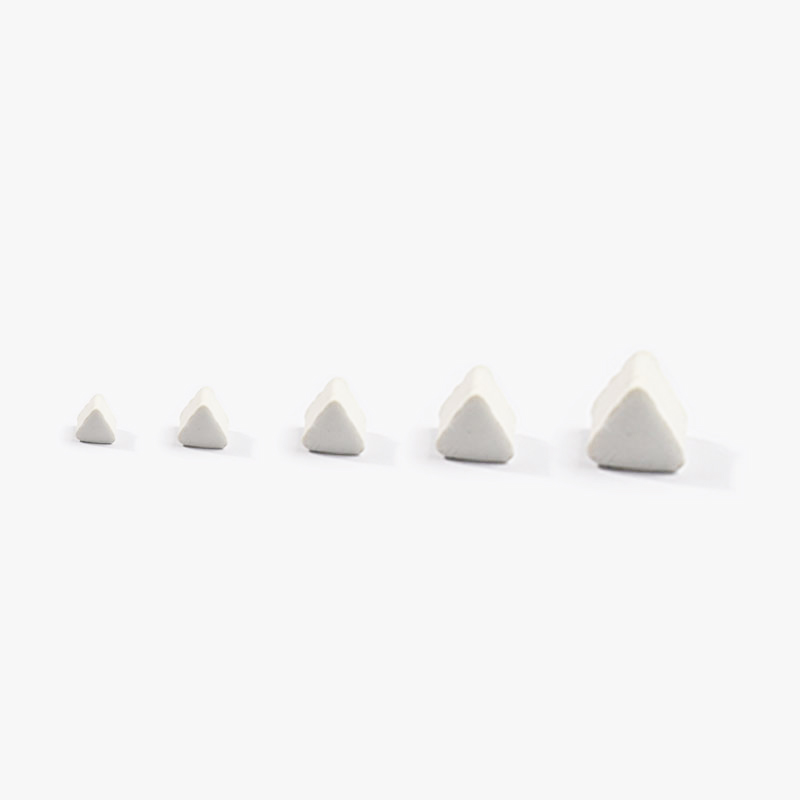
| Alumina-based ceramic triangles and angle-cut forms | Heavy deburring, edge blending and machine-mark removal on stainless brackets, flanges and housings where corners and recesses must be reached. | Wears down in size and sharpness, so cutting rate falls without any setting change; broken pieces and fines can lodge in small features and must be screened out. |
| Steel media, including balls and shaped steel forms | Brightening and burnishing of austenitic stainless appearance parts where the highest available gloss is the objective. | Deforms and generates metallic fines, adds weight to the load, and can transfer iron if used in a line shared with carbon steel work. |
Stainless parts that emerge with speckled rust, a brown bloom or a grey smut have usually picked up foreign metal, and the source is often the shop rather than the alloy. Free iron can arrive from carbon steel parts run in the same machine or media, from worn steel components in the chamber, from steel racks and containers, from a wire brush used elsewhere, or from airborne grinding dust settling on a wet part. A ferroxyl-type test at agreed locations detects free iron, and a comparison against an untouched control part from the same batch makes the result interpretable. Because the visible bloom may take days to appear, agree an evaluation window and keep sample parts in defined conditions before judging. Prevention is segregation: dedicated media and machines for stainless, non-metallic or stainless handling, covered storage, and a check on incoming media for metallic debris.
| Failure mode | Likely cause | How to catch it |
|---|---|---|
| Discolouration or mottling that appears only after drying | Mineral or compound residue carried in the final rinse, hard or chloride-bearing water, or slow drying that leaves a film on the brightened surface. | Compare wet and dry appearance under fixed lighting on the same parts, wipe a sample with a white lint-free cloth and solvent, and check the site water supply for hardness and chloride content. |
| Impingement marks, nicks or gouges on thin stainless panels and webs | Part-on-part contact in an under-filled chamber, excessive amplitude, or free parts striking each other where no compartment or fixture controls them. | Inspect the suspect feature under magnification and raking light before and after processing, and compare its location across several parts from the same load to confirm the defect is random rather than systematic. |
| Rust blooms or speckling on austenitic or duplex parts after finishing | Free iron transferred from carbon steel, ferritic stainless or worn steel machine parts sharing the same media, chamber, racks or bench area. | Run a ferroxyl-type test for free iron at agreed locations, compare against an untouched part from the same batch, and repeat the check after a defined exposure period to catch delayed blooms. |
| Hazing or waviness on a part specified as mirror or bright | An intermediate refining stage skipped or cut short, media too coarse for the final texture, or a media charge that has worn out of its working size range. | View under defined lighting against a physical master at the acceptable and marginal limits, measure roughness across the lay with a fixed instrument setup, and screen the media charge for size and condition. |
Edmonton's industrial base is built on hydrocarbons and the processing industries that grew around them, combined with a substantial aerospace and aviation maintenance presence at the provincial level. The Government of Alberta describes Alberta's Industrial Heartland as the province's designated industrial zone and an emerging international hub for petrochemicals, home to global companies including Dow Chemical and Shell, and it cites Dow's CAD 11.6 billion net-zero petrochemical plant as one of the largest private investments in provincial history. Aerospace and aviation is the other measurable cluster: the province states that Alberta is becoming a premier aviation and aircraft manufacturing hub, with De Havilland selecting Alberta for an aircraft assembly facility, parts manufacturing and distribution centre, training centre and museum, and Lufthansa Technik Canada establishing a maintenance and repair facility at Calgary International Airport. The Edmonton region also hosts defence and security manufacturing: the national defence industry association reports that Western and Northern Canada accounts for 21 per cent of Canada's defence and security industry, with aircraft maintenance, repair and overhaul among the key regional activities. The City of Edmonton tracks and publishes its own economic reporting through the Corporate Economics function, including quarterly economic updates and long-term outlook documents.
The nearest part of that base to this brief is aerospace: The Government of Alberta states that Alberta is becoming a premier aviation and aircraft manufacturing hub, citing De Havilland's aircraft assembly facility, parts manufacturing and distribution centre and training centre, and Lufthansa Technik Canada's maintenance and repair facility at Calgary International Airport.
Petrochemical and hydrocarbon processing plants in the Edmonton region depend on valves, pumps, compressors, heat-exchanger components and piping spools whose sealing surfaces, gasket faces and machined bores must be burr-free and finished to specification, and turnaround work creates a recurring demand for reconditioning those components. Aviation maintenance, repair and overhaul adds engine and airframe component work where edge condition, surface integrity and cleanliness carry airworthiness implications, and where the finishing process has to be documented. Both customer groups buy on specification and inspection records rather than on appearance, so the practical requirement in Edmonton is process repeatability and the ability to prove what was done to a part.
An Edmonton buyer should settle whether the finishing requirement is driven by seal integrity or by fatigue and cleanliness, because those two answers point to different processes and different acceptance testing; on petrochemical hardware the specification is usually a defined gasket-face or sealing-surface finish, while in aviation MRO it is edge condition and cleanliness. The second question is whether the shop can produce and retain the process records that a petrochemical operator or an aviation quality system will ask for, since a finishing cell that cannot produce evidence of repeatability will not pass either customer's audit.
Freight context: Edmonton International Airport and Alberta Aerospace and Technology Centre, CN and CPKC rail corridors, Alberta's Industrial Heartland industrial zone (Fort Saskatchewan / Strathcona County), Edmonton's inland rail and industrial parks. Edmonton combines an international airport with an adjacent aerospace and technology industrial cluster, direct Class 1 rail service, and the large contiguous heavy-industry land base of Alberta's Industrial Heartland, which is why Alberta can site petrochemical plants of the scale of the Dow investment there. For equipment import, a machine would normally arrive through a coastal container port and be railed into Edmonton, while urgent parts can move by air; heavy modules and oversized components can also move by rail directly to industrial sites.
China is one of Canada's ten principal merchandise trading partners and the second-largest single-country source of Canadian imports after the United States: Statistics Canada reported CAD 5,369 million of balance-of-payments imports from China in January 2025, against a CAD 2,299 million bilateral merchandise deficit that month. Canada has no free trade agreement with China, so Chinese-origin industrial machinery enters under the Most-Favoured-Nation (MFN) tariff column of the Canadian Customs Tariff; the preferential treatments listed in the tariff (CUSMA/UST and MXT, CETA/CEUT, CPTPP/CPTPT, UKT, KRT and others) do not include China, and preferential rates require proof of origin plus the applicable shipping rules, so a China-origin machine cannot claim them. Tariff classification is mandatory work, not a formality: vibratory, barrel, centrifugal and disc finishing machines are classified in Chapter 84 ("Nuclear reactors, boilers, machinery and mechanical appliances; parts thereof") according to the function of the machine, and the ten-digit Canadian tariff item drives both the duty rate and the statistics. A further landed-cost risk sits outside the tariff schedule: under the Special Import Measures Act (SIMA), the CBSA and the Canadian International Trade Tribunal may apply anti-dumping and countervailing duties to named goods, so a buyer should check the measures-in-force list for the specific product before assuming the MFN rate is the final duty.
Canada is a bilingual market for selling purposes: English is the working language of procurement outside Quebec, while Quebec buyers (Montreal, Quebec City) normally expect French-language quotations, technical documentation and after-sales support, and Quebec's Charter of the French Language makes French the default for commercial documentation in the province. Procurement expectations are formal and auditable: a Canadian industrial buyer will typically ask for the tariff classification and country of origin up front, expect a commercial invoice that satisfies the CBSA invoice requirements, and expect the seller to provide proof of origin for any preferential claim. Payment norms are bank-to-bank, with wire transfer or letter of credit rather than platform payment, and Canadian buyers commonly net-30 to net-60 from invoice, so a cross-border seller should price the working-capital gap into the offer. Certificates of origin for export documentation are issued through chambers of commerce, which is why chambers such as the Hamilton Chamber of Commerce and the Winnipeg Chamber of Commerce offer document certification. The current trade environment adds policy risk to landed cost: Canadian federal programs are explicitly framed around responding to U.S. tariffs, with the FedDev Ontario Regional Tariff Response Initiative described as supporting "businesses to respond to tariff pressures" in southern Ontario, and tariff and surtax measures can change by Order in Council, so quotations should state the tariff basis and the date on which the landed-cost calculation was made.
SurfacePolish supplies from Xiamen, China. The buyer's own destination rules, conformity marking, tariff classification and documentation responsibilities stay with the buyer; confirm them against the authorities named above before ordering.
Ask for a record that lets a finished part be traced to what produced it: material certificates and heat numbers, the batch identification used during processing, media specification and size class, compound family and concentration, cycle parameters, and the measured results with locations. The distinction worth insisting on is between observations and acceptance, because a supplier reports what it saw while the buyer decides what is acceptable. First-article discipline is the practical form of this. For each part family, alloy and finish, process one article and inspect it fully against the drawing before any batch is released, retain it as a physical reference, and write down the settings that produced it. Then treat any change to media, compound, machine parameters or sources as a trigger to repeat the first-article inspection, because that is where a stable process is usually lost.
Once a line is producing, batch control protects both the finish and the traceability. Identify each load with the material heat or lot, keep grades separate through the chamber and the dry stage, record the media charge identification and compound batch, and keep the inspection record attached to the same batch identifier so a later complaint can be traced to what actually ran. For stainless, batch separation also means physical separation from carbon steel processing, including shared baskets, dryers and benches. What a trial cannot prove is worth stating plainly: it observes the parts tested under one set of conditions, it does not guarantee a surface value, cycle time, capacity or cost in production, and it does not qualify a process for any regulated application. Treat it as a way to reduce uncertainty before capital is committed, and let the buyer's own verification settle acceptance.
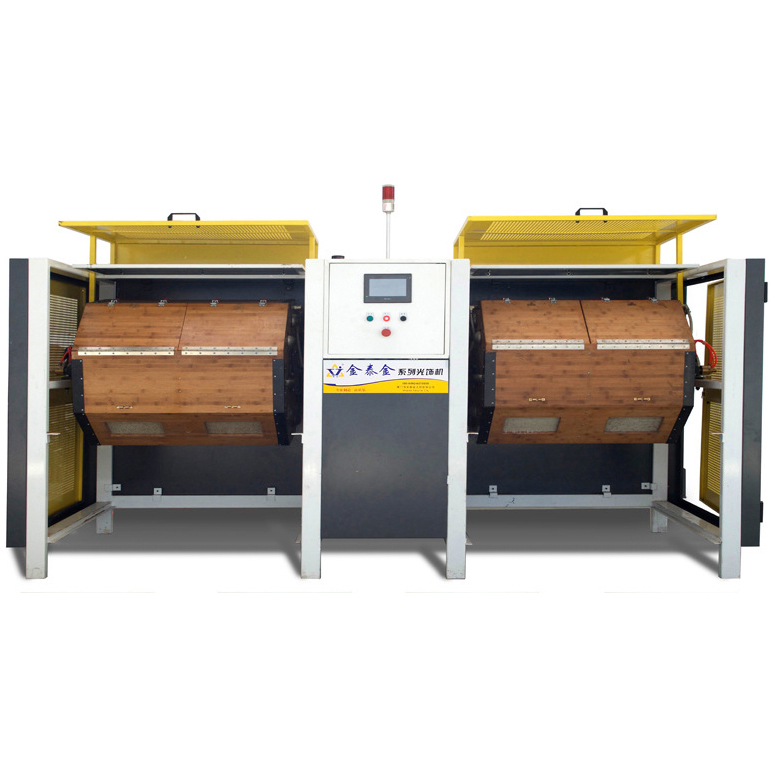
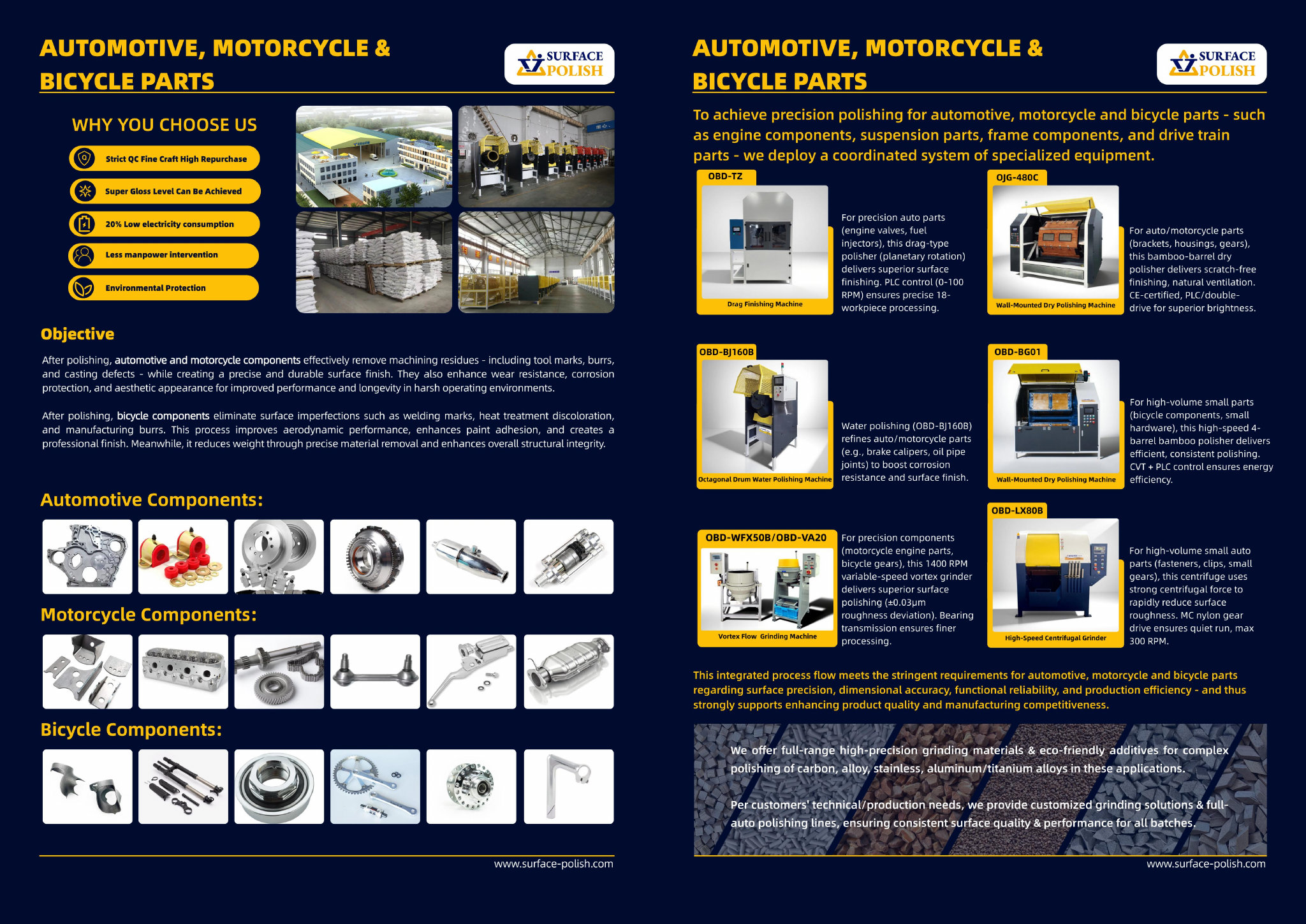
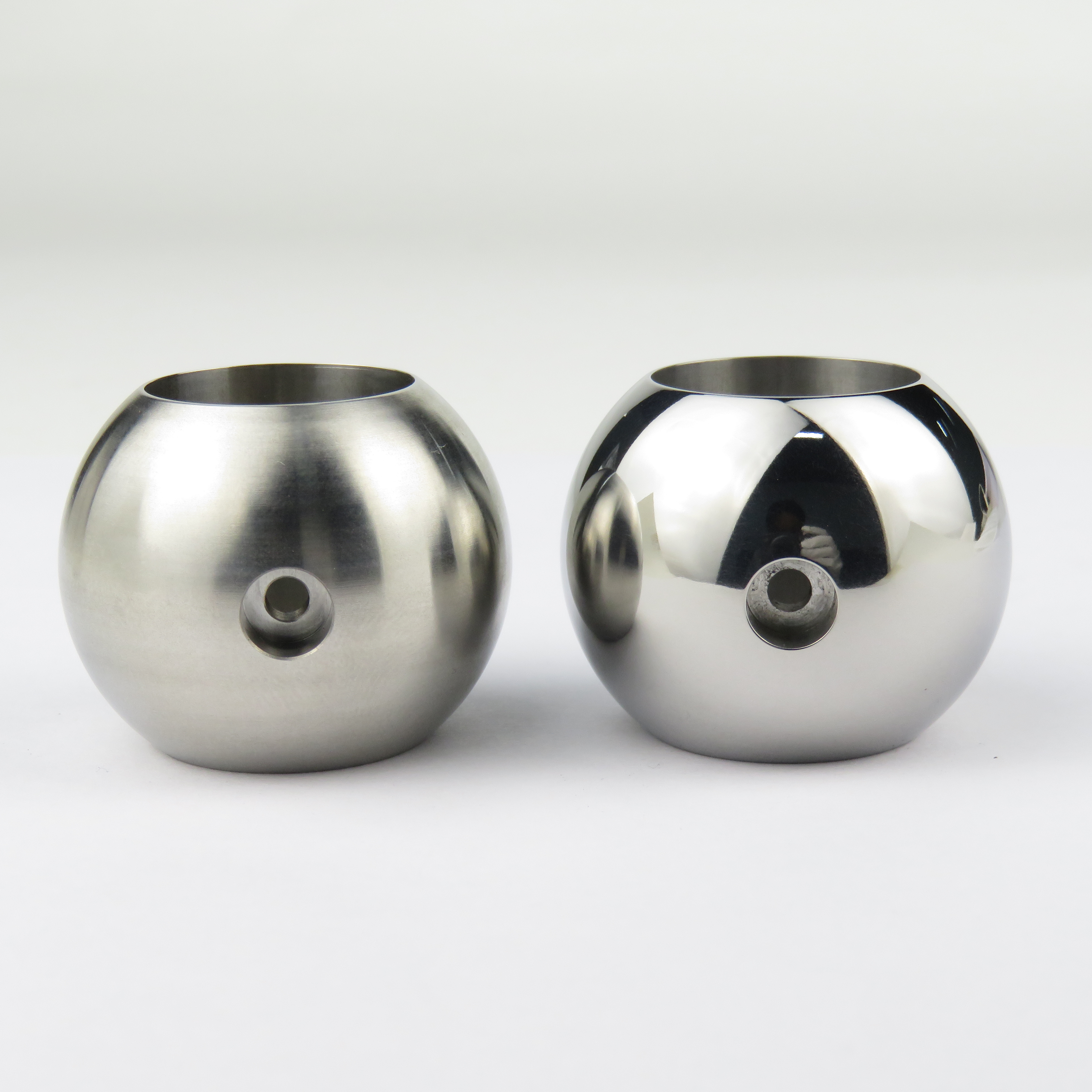
Steel media generally produces the brightest result on austenitic stainless, but brightness depends on the whole progression rather than one medium. A common sequence is a hard ceramic stage that removes burrs and machine marks, a finer stage that refines the texture, then a low-amplitude stage that brightens. Media that is too soft for the work-hardened surface burnishes and dulls instead of cutting. The shape and size class also matter, because small media reaches tight features but leaves a different texture from larger forms. Treat any proposed progression as a comparison to test on real parts with your own measurement setup.
Hydrogen uptake is a documented concern for high-strength martensitic stainless steels when acid chemistry and mechanical work are combined, and it is not visible on the surface. The practical route is to state the material and hardness in the enquiry, ask which compound families are proposed and at what concentration, and confirm with your own engineering function whether any post-finishing treatment is required and within what window. SurfacePolish can describe the compound family and the process conditions used on a trial, but fitness for a given strength level, and any treatment specification that follows, must be defined and verified by the buyer.
Uneven finish comes from position in the load, dead zones in the media mass, shielding by neighbouring parts and part-on-part contact, so evenness is a loading and handling question as much as a machine question. Mark reference locations on the part, photograph under fixed raking light, and measure the same feature at both ends and in the middle rather than at one convenient spot. If the variation is positional, rotating parts between cycles, changing the load pattern, or shortening cycles with repositioning usually helps more than adding time. Tubs suit long parts but need evenness verified along the length.
Use Edmonton, Canada as the destination on the enquiry and state whether the deliverable is equipment, media and compound, a representative sample review or a line concept. A destination does not imply local stock, a local service point or a local delivery time.
An Edmonton buyer in the petrochemical and oil and gas chain works to the applicable pressure-equipment and piping standards their engineering contractor names, together with Alberta occupational health and safety requirements and Canadian electrical certification for equipment installed in the plant. In aviation MRO, the requirements come from the transport-aircraft maintenance regime and the customer's approved process specifications rather than from a finishing-specific national standard.
Sources were retrieved on 2026-09-29 and describe the local industrial and trade context only. They do not evidence any SurfacePolish project, shipment, installation or service in Edmonton.
The buyer needs machining burrs removed at the cross-drillings with no media left in the passages and no measurable change to the bore or gasket face.
Send the material, dimensions, approximate weight, batch quantity, the incoming condition and photographs of the difficult features. Mark which features must not be contacted by media and state how the result will be inspected. This form carries source reference PSEO-0142; quote it if you prefer an additional manual reference.
Open the SurfacePolish enquiry form Email a prepared enquiry
No price, lead time, certification or result is promised here. Confirm whether a sample trial is available for the specific part and what the trial can and cannot show.
Page PSEO-0142 · revised 2026-09-29 · cross-border equipment, media and scoped sample review. City context is sourced and cited above.
Use this local checker to identify missing part and inspection information. It prepares a technical-review brief; it does not approve a machine, process recipe or production result.
Complete the part details to prepare a review brief.
Email : info@surface-polish.com


 IPv6 network supported


 +86-592-2381506