A buyer in Nottingham, United Kingdom working on automotive parts has an exhaust flange that needs a brighter visible face while its sealing bead stays flat and free of iron contamination. SurfacePolish supplies finishing machines and consumables across borders and runs a free sample trial: the parts travel to Xiamen and come back with observations plus a proposed media, compound and cycle direction for the buyer's own engineering review. This brief is written for a buyer in Nottingham working on automotive parts; it describes equipment, media and a scoped sample review, not a local polishing service.
Which surfaces on this part carry a visible appearance grade, which are hidden, and which edges have a functional requirement rather than a cosmetic one?
How will free iron, embedded particles and cross-contamination from carbon steel be prevented, and how will each be detected on the finished part?
Which internal features must be deburred without lodging media, and what retrieval and verification step proves the passage and thread form are clean?
What arrives at finishing often predicts the route better than the drawing does. Burrs sit at cross-drilling intersections, sheared edges and machined contours, heat tint comes from welding and laser cutting, and stamping flash, grinding marks, existing polished bands and handling scratches all behave differently under the same medium and compound. Baseline the incoming surface with roughness readings and consistent-lighting photographs at agreed locations, plus a written note on where the largest burrs sit. Cleanliness before processing also matters, because cutting fluid, marking ink, adhesive residue and shop dust load the medium and confound comparison. Batch size and mix enter here too: a load of thirty small brackets behaves differently from four large housings, and mixing families of different weight in one chamber risks damage to the lighter parts and cross-contamination between grades.
Once media and machine are fixed, the variables a buyer can actually control are compound concentration, flow rate and water quality. Concentration influences cut rate, foam and residue; running lean to save money usually costs more in finish variation than it saves in consumable. Flow rate removes swarf and heat from the mass, and an under-flowed chamber loads up, smells, and starts depositing sludge on the parts. Water hardness, chloride content and suspended solids matter directly on stainless, because hard water leaves mineral films and chloride-bearing supply raises pitting risk on austenitic grades. Get a water analysis for the site, dose by measured concentration rather than by eye, and monitor pH and clarity at the machine. Record the actual water source used during a trial, because a good result obtained on one supply may not survive a change.
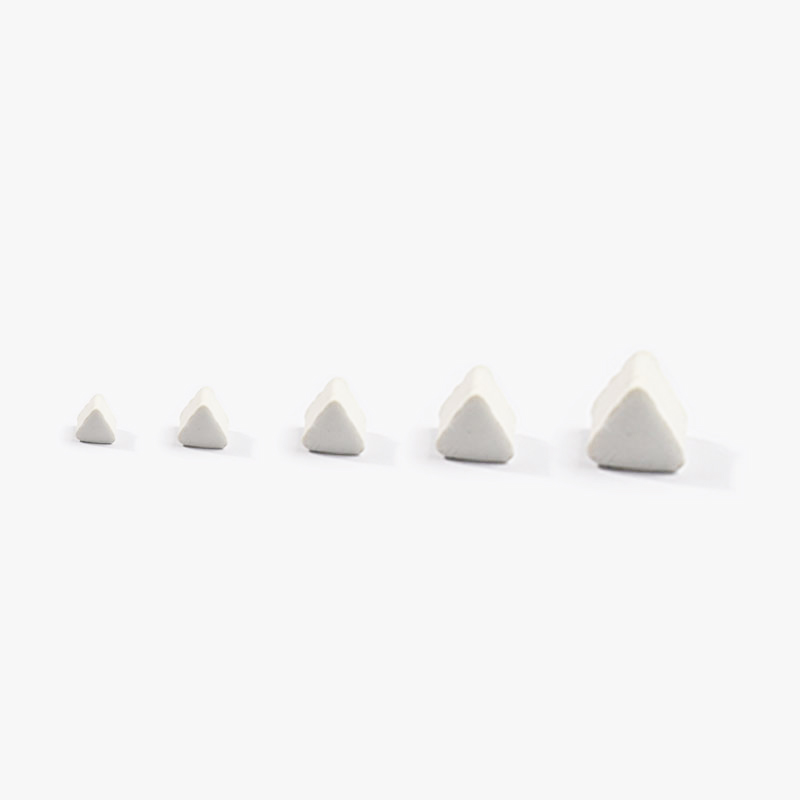
| Media | Best fit | Watch out for |
|---|---|---|
| Magnetic stainless pins and fine needles for magnetic finishing | Deburring and brightening of intricate small stainless features, slots, gear teeth and blind holes where media cannot be allowed to lodge. | Suits small part envelopes only, and the route needs testing on magnetic grades before it is assumed to apply to a given part. |
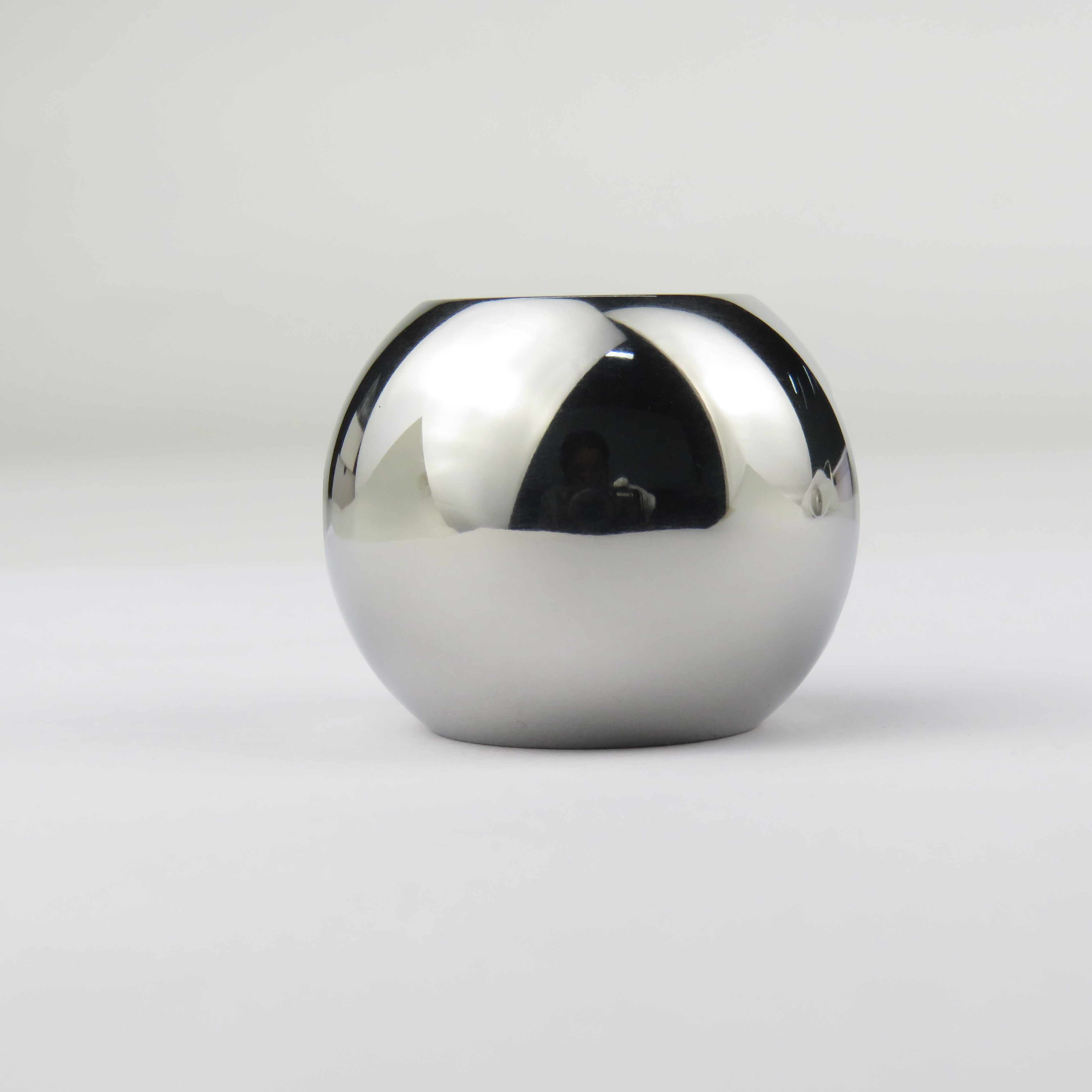
| Steel media, including balls and shaped steel forms | Brightening and burnishing of austenitic stainless appearance parts where the highest available gloss is the objective. | Deforms and generates metallic fines, adds weight to the load, and can transfer iron if used in a line shared with carbon steel work. |
| Porcelain and fine high-density ceramic media | Pre-polish refining stages on austenitic stainless appearance parts before a brightening stage, where a finer texture is the objective. | Limited cutting power on hard or work-hardened surfaces, and wear changes the charge gradually, so finish can drift between batches. |
| Grinding and cutting media, fused alumina and silicon carbide based | Aggressive stock removal on heavy stainless burrs, weld dressing and rough cast surfaces before a refining stage. | Removes edge material quickly, can embed abrasive fragments in soft or gummy surfaces, and is usually too coarse for a final appearance stage. |
Tub vibrators exist for parts that a bowl cannot hold: long trim rails, exhaust sections, shafts and formed profiles that must be processed without being cut down. The open tub allows awkward geometry, and the long, large parts common in stainless automotive work often fit only here. The engineering consequence is that media velocity and dwell differ along the length, so one end of a long part can finish differently from the other. Verify evenness at both ends of the longest part rather than at one representative location. Media size class has to suit the tub cross-section so the charge moves as a mass instead of settling. A tub also consumes more floor space and compound volume than a bowl of similar throughput, which is part of the line concept a buyer should settle before quoting a cell.
| Machine route | Where it fits | What it will not do |
|---|---|---|
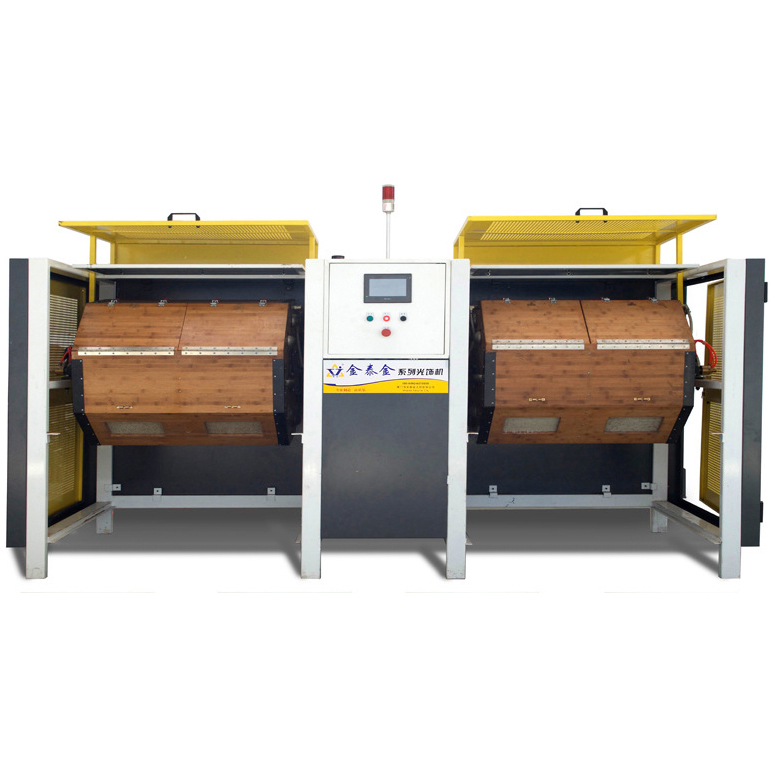
| Magnetic finishing machine | Small precise stainless parts with internal features, slots and blind holes that must be deburred without media lodging in the passages. | Works within a small part envelope, and the route has to be tested per grade because it depends on the part's magnetic response. |
| Barrel finishing machine, rotary barrel tumbler | Gentle deburring and finishing of delicate, thin or threaded stainless parts such as small fittings, sensor bodies and precision pins. | Cycles run longer than in higher-energy machines, and coverage can be uneven on large or complex parts. |
| Centrifugal barrel finishing machine | Very high energy deburring and edge radiusing of small, hard stainless parts in short cycles. | Rounds edges quickly and can exceed a tight radius within a short run; part size and shape are restricted and a substantial load is needed to justify the cycle. |
| Continuous or indexed wet line with staged media charges | Multi-stage stainless finishing where deburring, refining and brightening are separated to control edge loss and texture progression. | Needs clear segregation between stages to prevent carry-over of coarse media or iron contamination, and adds handling and floor space. |
Two failure modes produce a damaged edge and are often confused. Impingement, sometimes called a gouge or a nick, is local damage from part-on-part contact or media striking a feature at excessive energy, and it typically appears on thin stamped covers, large flat panels and unsupported webs. Its signature is randomness: the defect site moves from part to part and does not follow the geometry of the edge. Over-rounding is systematic, follows the edge itself, and repeats at the same location on every part in the load. Both are found with raking-light photographs, magnification on the suspect feature and comparison across several parts from the same batch. The remedy differs too, because impingement is addressed by load fill ratio, amplitude, compartments or fixtures, while over-rounding is addressed by cycle intensity, media size class and media hardness.
| Failure mode | Likely cause | How to catch it |
|---|---|---|
| Uneven finish, with one region bright and another dull on the same part | Positional effects in the media mass, dead zones in the chamber, shielding by neighbouring parts, or a poor fill ratio in the load. | Mark reference locations, photograph under fixed raking light, and measure the same feature at multiple points on the part and across parts in the load to separate positional variation from process variation. |
| Dimensional drift, including bores opening slightly and thin walls thinning | Sustained media contact removing material from every accessible surface, with cycle time or media size class beyond what the feature tolerances can absorb. | Measure critical dimensions with micrometers, bore gages or a CMM before and after on a fixed sample size, and track a maximum stock removal per cycle for each feature at risk. |
| Edge rounding beyond the specified radius on a functional edge | Cycle energy, time or media size class chosen for appearance rather than for the tightest edge callout on the drawing. | Measure edge radius at marked locations with an optical comparator or a cast impression before and after, and record the result against a written allowable band rather than judging it visually. |
| Embedded particles or grey smut on the finished surface | Media fines, broken ceramic fragments or metallic debris from the charge becoming trapped or smeared into the surface during the finishing cycle. | Examine under magnification with raking light and on a wipe test, check the compound bath and media charge for fines and broken pieces, and screen a media sample to identify the source. |
Nottingham is a Nottinghamshire authority inside the East Midlands Freeport, the only inland UK freeport, whose three sites are East Midlands Airport and Gateway Industrial Cluster (EMAGIC) in Leicestershire, the Ratcliffe-on-Soar power station site in Nottinghamshire, and the East Midlands Intermodal Park in Derbyshire. The freeport states its sites are connected by road, rail and air and within easy reach of East Midlands Airport, which it calls the UK's largest dedicated airfreight airport, and it reports that a share of the UK's major freight rail lines are serviced through the East Midlands. Nottingham City Council provides the city's business licensing, trading standards and procurement services, and the East Midlands Chamber is the regional chamber of commerce.
The nearest part of that base to this brief is aerospace: East Midlands Freeport describes its sites as connected by road, rail and air and within easy reach of East Midlands Airport, which it calls the UK's largest dedicated airfreight airport.
The East Midlands Freeport is built around freight and low-carbon industry sites rather than a legacy machining cluster, so finishing requirements in the Nottingham area follow the parts being made and moved rather than any single local process tradition. Because the freeport's sites connect by road, rail and air and the East Midlands is a major goods-importing region, deburring, edge and cleanliness specifications should be taken from the component drawing and its downstream assembly rather than from a general local practice.
A Nottingham buyer should tie the finishing specification to the part's actual route out of a freeport or industrial site - air, rail or road - and confirm media and compound handling and waste arrangements before the machine is ordered.
Freight context: East Midlands Airport (described by East Midlands Freeport as the UK's largest dedicated airfreight airport), East Midlands Intermodal Park, Derbyshire, Ratcliffe-on-Soar power station site, Nottinghamshire. East Midlands Freeport describes itself as the only inland UK Freeport, with sites connected by road, rail and air and within easy reach of East Midlands Airport; it states that a share of the UK's major freight rail lines are serviced through the East Midlands.
BSI is the UK's National Standards Body, and British Standards (BS, including adopted BS EN ISO texts) are the documents a UK buyer's surface-finish, edge and cleanliness specifications are normally written against and purchased through. On the plant side, HSE maintains the work equipment and machinery topic covering the safe supply and use of machinery, and the COSHH regime, which requires employers to identify, assess and control risks from hazardous substances - the regime that applies to finishing compounds, abrasive media and the dust and effluent they generate.
English is the working language of contracts, drawings and conformity paperwork, so quotations, technical files and Declarations of Conformity should be supplied in English. UK manufacturers have now recovered above 2019 output levels in every English region and devolved nation except Northern Ireland, and the sector is concentrated in food and drink and transport equipment, with the North West the largest manufacturing region by total output. Buyers typically expect the UKCA/CE route, a Declaration of Conformity and a UK-established economic operator to be identified before order, and they need commercial invoices, customs declarations and the C79 retained in a form their finance team can use for import VAT recovery. No source verified in this research establishes a mandated payment instrument, so payment structure should be treated as commercial negotiation rather than a regulatory requirement.
SurfacePolish supplies from Xiamen, China. The buyer's own destination rules, conformity marking, tariff classification and documentation responsibilities stay with the buyer; confirm them against the authorities named above before ordering.
Measurement of appearance does not detect a functional loss, so acceptance needs checks aimed at what the part does. Thread and gear gages on the features named by the drawing, pin or plug gages on cross-drilled passages, a flatness check on sealing faces, a fit or press trial on a bearing bore, and continuity or gap checks on sensor surfaces all address function directly. Edge condition deserves a dimension rather than an opinion, because a rounding of a fraction of a millimetre at the mouth of an O-ring groove changes how the seal seats, and a deburred edge on a fatigue-relevant hole behaves differently from a polished one. Cleanliness is part of this set: wipe tests for residue, free-iron testing, and a borescope check of internal passages catch defects that appearance grading cannot. Agree every check and its instrument before the first production batch.
Once a line is producing, batch control protects both the finish and the traceability. Identify each load with the material heat or lot, keep grades separate through the chamber and the dry stage, record the media charge identification and compound batch, and keep the inspection record attached to the same batch identifier so a later complaint can be traced to what actually ran. For stainless, batch separation also means physical separation from carbon steel processing, including shared baskets, dryers and benches. What a trial cannot prove is worth stating plainly: it observes the parts tested under one set of conditions, it does not guarantee a surface value, cycle time, capacity or cost in production, and it does not qualify a process for any regulated application. Treat it as a way to reduce uncertainty before capital is committed, and let the buyer's own verification settle acceptance.
Start from the drawing. Size the media class against the smallest opening so it flows rather than wedges, and where a passage cannot be inspected reliably, plug or mask it before the cycle instead of adding inspection afterwards. Build a retrieval routine with media counts into and out of the batch, borescope checks at agreed angles, and pin or plug gages on each passage. Weigh parts where the tolerance for retained chips is tight. For a United Kingdom buyer planning a trial, send the part with the tightest passage so the media class is selected against real geometry. SurfacePolish reports what the trial found; your own cleanliness inspection remains the acceptance decision.
Steel media generally produces the brightest result on austenitic stainless, but brightness depends on the whole progression rather than one medium. A common sequence is a hard ceramic stage that removes burrs and machine marks, a finer stage that refines the texture, then a low-amplitude stage that brightens. Media that is too soft for the work-hardened surface burnishes and dulls instead of cutting. The shape and size class also matter, because small media reaches tight features but leaves a different texture from larger forms. Treat any proposed progression as a comparison to test on real parts with your own measurement setup.
They are different processes with different effects, and SurfacePolish does not supply or perform electropolishing. Mechanical finishing works by media contact, so it blends, deburrs and brightens the surfaces the media can reach, and it rounds edges as it works. Electrochemical treatment removes material ionically and reaches into recesses that media cannot. Where an electropolished surface is specified for corrosion or cleanliness reasons, treat electrochemical processing as a comparison point and ask whether the specified requirement can be met by another route, then verify that on your own parts and against your own acceptance rule.
Use Nottingham, United Kingdom as the destination on the enquiry and state whether the deliverable is equipment, media and compound, a representative sample review or a line concept. A destination does not imply local stock, a local service point or a local delivery time.
Equipment placed on the Great Britain market requires UKCA or CE marking with a Declaration of Conformity, and HSE's work equipment and machinery and COSHH regimes cover finishing machines, media and compounds. Nottingham City Council's trading standards service and business licensing function are the local points of contact for product and trading rules.
Sources were retrieved on 2026-09-29 and describe the local industrial and trade context only. They do not evidence any SurfacePolish project, shipment, installation or service in Nottingham.
The buyer needs the visible face brightened and the bore burr removed without touching the flatness of the sealing bead, and without iron contamination that would bloom in service.
Send the material, dimensions, approximate weight, batch quantity, the incoming condition and photographs of the difficult features. Mark which features must not be contacted by media and state how the result will be inspected. This form carries source reference PSEO-0292; quote it if you prefer an additional manual reference.
Open the SurfacePolish enquiry form Email a prepared enquiry
No price, lead time, certification or result is promised here. Confirm whether a sample trial is available for the specific part and what the trial can and cannot show.
Page PSEO-0292 · revised 2026-09-29 · cross-border equipment, media and scoped sample review. City context is sourced and cited above.
Use this local checker to identify missing part and inspection information. It prepares a technical-review brief; it does not approve a machine, process recipe or production result.
Complete the part details to prepare a review brief.
Email : info@surface-polish.com


 IPv6 network supported


 +86-592-2381506