In Winnipeg, Canada, an automotive parts buyer has a duplex stainless clamp band whose rivet-hole burrs must be removed without rounding latch edges that have to engage. SurfacePolish is a cross-border supplier of finishing equipment, media and compounds and offers a free process sample trial in which the buyer's parts travel to Xiamen and return with observations and a proposed media, compound and cycle direction for the buyer's own verification. This brief is written for a buyer in Winnipeg working on automotive parts; it describes equipment, media and a scoped sample review, not a local polishing service.
How will free iron, embedded particles and cross-contamination from carbon steel be prevented, and how will each be detected on the finished part?
Which dimensions, seal faces and thread forms carry functional geometry, and what limit on stock removal per cycle can those features tolerate?
Which internal features must be deburred without lodging media, and what retrieval and verification step proves the passage and thread form are clean?
Stainless is a family, not one material, and the finishing window changes with it. Ferritic grades used for exhaust and trim are magnetic and generally softer, so they cut quickly and can smear; martensitic grades used for wear parts are hard and magnetic, and some high-strength conditions carry a hydrogen concern when acid chemistry is involved; austenitic grades are tough, work harden under mechanical action and are usually non-magnetic, which changes retrieval options; duplex and super-duplex grades combine high strength with chloride sensitivity, so surface contamination matters more. Cold work matters twice, because a pressing or a machined skin alters surface hardness and can shift magnetic response, and because a bright finish on a work-hardened skin may not survive a later forming operation. Record grade, delivery condition, hardness range and prior cold work, then match machine energy and media hardness to the family rather than reusing a recipe that worked elsewhere.
Disc finishing machines run a shallow, fast-moving charge that deburrs heavier machined stainless parts quickly: valve bodies, fittings, machined brackets and parts whose edges can lose material. The energy is an advantage for cycle time and a liability for thin walls and delicate features, so tooling and compartments often decide whether the route is acceptable at all. Centrifugal barrel finishing uses a planetary barrel motion that produces very high energy in short cycles, useful for aggressive edge radiusing on small, hard parts. The same energy rounds edges quickly, can exceed a tight radius callout within a short run, has part size and shape limits, and needs a larger load to justify the cycle. Treat both routes as candidates for heavy deburring and blending, and verify edge results on the actual part rather than assuming a shorter cycle means a safer one.
| Machine route | Where it fits | What it will not do |
|---|---|---|
| Tub vibrator | Long stainless parts such as trim sections, exhaust profiles and shafts that cannot be loaded into a bowl without being cut down. | Media velocity varies along the length, so finish evenness must be verified at both ends, and the machine occupies more floor space and compound volume. |
| Continuous or indexed wet line with staged media charges | Multi-stage stainless finishing where deburring, refining and brightening are separated to control edge loss and texture progression. | Needs clear segregation between stages to prevent carry-over of coarse media or iron contamination, and adds handling and floor space. |
| Dry polishing machine with heated dryer | Post-wet drying, residue control and light dry finishing of stainless parts that must leave the line dry and free of moisture in blind features. | Dry media does not cut stainless, and moisture trapped in a blind hole, hem or tight joint can cause staining if drying is not effective. |
| Barrel finishing machine, rotary barrel tumbler | Gentle deburring and finishing of delicate, thin or threaded stainless parts such as small fittings, sensor bodies and precision pins. | Cycles run longer than in higher-energy machines, and coverage can be uneven on large or complex parts. |
A medium can only cut what is softer than itself, and stainless work hardens at the surface during mechanical action, so a medium that is too soft burnishes and dulls instead of brightening. Alumina-based ceramic is the general-purpose choice for deburring, blending and satin finishes on stainless; steel media produces the brightest results on austenitic parts; plastic media suits softer or more delicate components and is usually the wrong tool for stainless cutting; dry media such as walnut shell or corn cob removes residue and moisture but does not generate a true stainless finish. The usual progression for an appearance part is a hard ceramic stage that removes the burr and machine marks, a finer stage that refines the texture, then a low-amplitude brightening stage. Whichever progression is proposed, treat it as a comparison to test on the real part rather than as a fixed recipe.
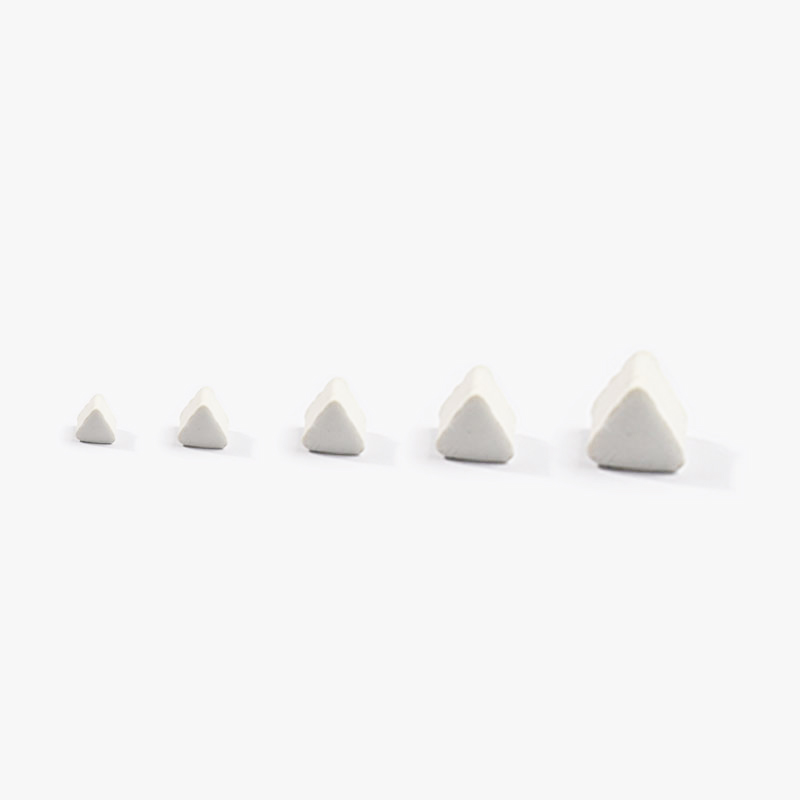
| Media | Best fit | Watch out for |
|---|---|---|
| Plastic media, polyester and urea based | Gentle deburring of delicate or thin stainless parts and of softer metals in mixed production, where edge loss must be minimised. | Low cutting power on stainless, can load with metal particles, and is generally the wrong tool for generating a stainless appearance finish. |
| Alumina-based ceramic triangles and angle-cut forms | Heavy deburring, edge blending and machine-mark removal on stainless brackets, flanges and housings where corners and recesses must be reached. | Wears down in size and sharpness, so cutting rate falls without any setting change; broken pieces and fines can lodge in small features and must be screened out. |
| Porcelain and fine high-density ceramic media | Pre-polish refining stages on austenitic stainless appearance parts before a brightening stage, where a finer texture is the objective. | Limited cutting power on hard or work-hardened surfaces, and wear changes the charge gradually, so finish can drift between batches. |
| Magnetic stainless pins and fine needles for magnetic finishing | Deburring and brightening of intricate small stainless features, slots, gear teeth and blind holes where media cannot be allowed to lodge. | Suits small part envelopes only, and the route needs testing on magnetic grades before it is assumed to apply to a given part. |
Stainless parts that emerge with speckled rust, a brown bloom or a grey smut have usually picked up foreign metal, and the source is often the shop rather than the alloy. Free iron can arrive from carbon steel parts run in the same machine or media, from worn steel components in the chamber, from steel racks and containers, from a wire brush used elsewhere, or from airborne grinding dust settling on a wet part. A ferroxyl-type test at agreed locations detects free iron, and a comparison against an untouched control part from the same batch makes the result interpretable. Because the visible bloom may take days to appear, agree an evaluation window and keep sample parts in defined conditions before judging. Prevention is segregation: dedicated media and machines for stainless, non-metallic or stainless handling, covered storage, and a check on incoming media for metallic debris.
| Failure mode | Likely cause | How to catch it |
|---|---|---|
| Dimensional drift, including bores opening slightly and thin walls thinning | Sustained media contact removing material from every accessible surface, with cycle time or media size class beyond what the feature tolerances can absorb. | Measure critical dimensions with micrometers, bore gages or a CMM before and after on a fixed sample size, and track a maximum stock removal per cycle for each feature at risk. |
| Edge rounding beyond the specified radius on a functional edge | Cycle energy, time or media size class chosen for appearance rather than for the tightest edge callout on the drawing. | Measure edge radius at marked locations with an optical comparator or a cast impression before and after, and record the result against a written allowable band rather than judging it visually. |
| Impingement marks, nicks or gouges on thin stainless panels and webs | Part-on-part contact in an under-filled chamber, excessive amplitude, or free parts striking each other where no compartment or fixture controls them. | Inspect the suspect feature under magnification and raking light before and after processing, and compare its location across several parts from the same load to confirm the defect is random rather than systematic. |
| Uneven finish, with one region bright and another dull on the same part | Positional effects in the media mass, dead zones in the chamber, shielding by neighbouring parts, or a poor fill ratio in the load. | Mark reference locations, photograph under fixed raking light, and measure the same feature at multiple points on the part and across parts in the load to separate positional variation from process variation. |
Winnipeg's manufacturing base is aerospace and defence plus food processing and packaging, and federal investment is actively expanding it. Prairies Economic Development Canada announced CAD 19.5 million through the Regional Defence Investment Initiative for three Winnipeg-based projects: Magellan Aerospace's establishment of an advanced machining centre in Winnipeg for aircraft components used in military aircraft, StandardAero's expansion of its Winnipeg campus for dual-use aerospace maintenance, repair and overhaul capacity including new equipment and advanced digital technologies, and Win-Shield Devices' establishment of a manufacturing facility for personal protective equipment. The city is also a defence geography in its own right: it is home to the operational headquarters of the Royal Canadian Air Force and the Canadian NORAD region, and Manitoba hosts CFB Winnipeg (17 Wing) and CFB Shilo. Investment in the airside industrial base continues, with CAD 10 million federal and CAD 5 million provincial funding announced in February 2026 toward the Winnipeg Airports Authority's development of 127 acres of direct-access runway lands at Winnipeg Richardson International Airport, intended to support growth in aerospace, defence and advanced manufacturing including aircraft maintenance and repair operations.
The nearest part of that base to this brief is medical: Win-Shield Devices received CAD 3.5 million through the same federal programme to establish a Winnipeg manufacturing facility for personal protection equipment for military and civilian applications, including inclusive respirators.
Winnipeg's aerospace machining and MRO base is the dominant finishing driver: engine components and aircraft structures produced or repaired in the city carry edge-condition, surface-integrity and cleanliness requirements that trace back to airworthiness, and MRO work on in-service hardware often requires re-finishing parts whose original surface condition has degraded. Magellan's new advanced machining centre and StandardAero's expanded engine MRO campus both increase the volume of machined and reworked parts flowing through the city, and both sit inside quality systems that require the finishing process to be specified, controlled and recorded. Personal protective equipment manufacturing at Win-Shield adds a different requirement set, where moulded and formed components need clean, burr-free edges that will not damage the sealing surfaces of respirators.
A Winnipeg buyer should settle whether the finishing operation is inside a quality system that requires approved process specifications and records, because in aerospace MRO and component manufacturing it usually is, and a machine that cannot be tied to a controlled specification will not be usable on flight hardware. The second question is how reworked and in-service parts differ from new parts in their finishing requirement, since MRO work brings in parts with unknown prior surface history that may need inspection and re-finishing rather than a standard pass through the same process.
Freight context: Winnipeg Richardson International Airport (YWG), CentrePort Canada inland port, CN and CPKC rail corridors, Arctic Gateway Group trade alliance routes. Winnipeg is a rail and air hub rather than a seaport. The federal and provincial governments are funding preparation of 127 acres of direct-access runway lands at YWG to create space for businesses that need immediate runway access, in support of aerospace, defence and advanced manufacturing including aircraft maintenance and repair operations. Separately, the Winnipeg Airports Authority, CentrePort Canada and Arctic Gateway Group announced a trade alliance in January 2026 to diversify trade routes and improve access to global markets, which matters for a manufacturer importing equipment and exporting finished parts.
Canada's national standards system is coordinated by the Standards Council of Canada (SCC), which accredits standards-development organizations, certification bodies and testing laboratories; the SCC and CSA Group websites could not be retrieved for citation during this research, so this entry rests on the accessible Government of Canada and CCOHS material below. The Canadian Centre for Occupational Health and Safety describes standards as documents that "establish specifications and procedures to ensure the reliability of the products, methods, and services people use every day on the job", and Innovation, Science and Economic Development Canada (ISED) maintains the federal entry point for "[t]he different types of standards and certifying bodies that can be used by your business". In practice a Canadian buyer of finishing equipment references (a) the Canadian electrical safety certification of the machine and its control panel, (b) provincial occupational health and safety regulation for machine guarding, lockout and dust/ventilation control, which in Canada is enforced by the provinces rather than by a single federal inspectorate, and (c) the buyer's own customer-specific surface finish, edge-condition and cleanliness specifications, which are contractual rather than national standards. Finishing-process standards in the ISO 25.080 machine-tool and ISO 8500-series surface-preparation families are the usual technical reference points, but product-level standards sold by CSA Group were not retrievable for verification here.
The customs authority is the Canada Border Services Agency (CBSA), and importers of commercial goods must work through the CBSA Assessment and Revenue Management (CARM) system, which is where registration, the duties-and-taxes calculator, advance rulings and national customs rulings, and the commercial accounting declaration (CAD) are handled. Documentation expectations are explicit: "You must provide proof of country of origin when you import goods into Canada and, in some cases, your goods must also be clearly marked", the invoice or sales receipt must carry "a complete description of the goods", "the selling price" and "any conditions and terms of the sale", and the value for duty must be declared in Canadian currency only. Duties and taxes are layered rather than single: customs duty on the tariff item, the Goods and Services Tax calculated on the duty-paid value, and potentially excise duty, excise tax, surtax or safeguard measures. Importers must also clear non-tariff gates: goods must be admissible, some goods need permits, certificates or inspections from other federal departments that the CBSA applies on their behalf, controlled goods under the Defence Production Act require consultation with the CBSA and Global Affairs Canada before import, and "Goods manufactured or produced wholly or in part by forced or prison labour are prohibited from entering Canada", with due diligence resting on the importer. For electrical machinery, the practical conformity route in Canada is certification of the product to Canadian electrical safety standards by an accredited certification body rather than a self-declared CE-style mark; buyers should confirm the specific certification body and mark required before shipment. For a first shipment of a finishing machine or a media/compound sample lot, the fastest way to remove classification and valuation uncertainty is to use the CARM portal to request an advance ruling for tariff classification and origin.
SurfacePolish supplies from Xiamen, China. The buyer's own destination rules, conformity marking, tariff classification and documentation responsibilities stay with the buyer; confirm them against the authorities named above before ordering.
Ask for a record that lets a finished part be traced to what produced it: material certificates and heat numbers, the batch identification used during processing, media specification and size class, compound family and concentration, cycle parameters, and the measured results with locations. The distinction worth insisting on is between observations and acceptance, because a supplier reports what it saw while the buyer decides what is acceptable. First-article discipline is the practical form of this. For each part family, alloy and finish, process one article and inspect it fully against the drawing before any batch is released, retain it as a physical reference, and write down the settings that produced it. Then treat any change to media, compound, machine parameters or sources as a trigger to repeat the first-article inspection, because that is where a stable process is usually lost.
Parts returned from a trial are only half the deliverable; the record of what was done is the other half. A usable trial report describes the machine route, media specification and size class including its condition, compound family and concentration, water source, cycle duration, load fill ratio, and the measured results at the marked locations. Read it against your own before-and-after record, and check that the settings are described completely enough to be repeated by a different operator on a different day. Where a result is strong but the mechanism is unexplained, ask what changed rather than accepting the outcome, because an unexplained good result is hard to reproduce. Where a trial produced a good appearance and a poor edge measurement, treat the edge measurement as the governing result for a functional automotive part.
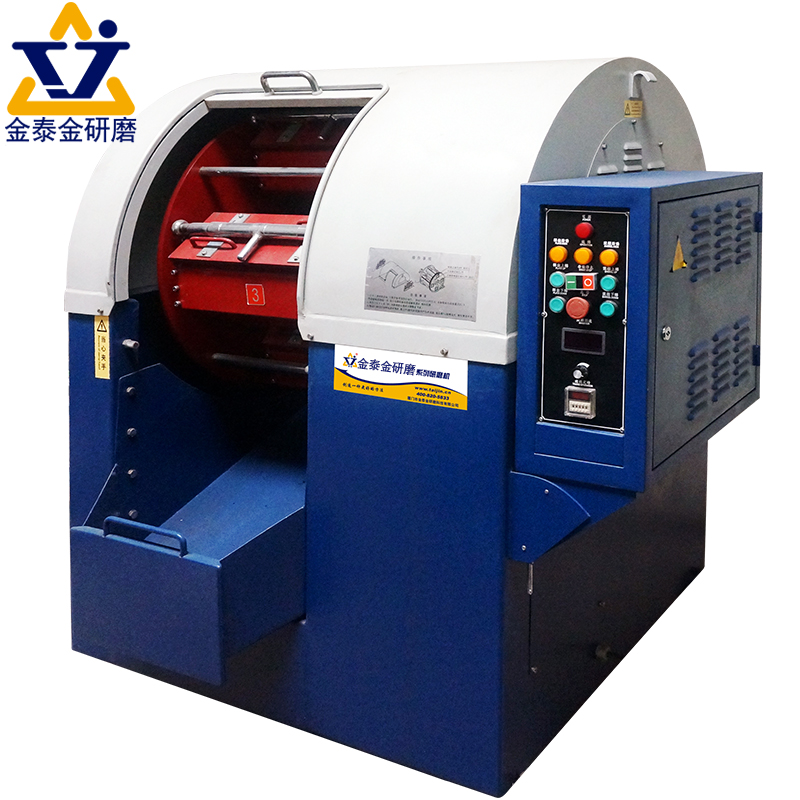

Uneven finish comes from position in the load, dead zones in the media mass, shielding by neighbouring parts and part-on-part contact, so evenness is a loading and handling question as much as a machine question. Mark reference locations on the part, photograph under fixed raking light, and measure the same feature at both ends and in the middle rather than at one convenient spot. If the variation is positional, rotating parts between cycles, changing the load pattern, or shortening cycles with repositioning usually helps more than adding time. Tubs suit long parts but need evenness verified along the length.
Control direction, texture depth and coverage, not only a roughness number. Mechanical finishing tends to create directionality, so agree with the customer whether the grain runs in one direction across the whole part order and how visible variation may be. Keep a physical master for the satin finish and view parts under the same lighting, distance and angle as the master, because lighting changes appearance judgements more than small process changes do. Fix media shape, size class and cycle settings in a work instruction, and re-verify the finish whenever the media charge is replaced or a new supplier batch of compound is introduced.
A trial produces observations on the parts tested under the settings used, and nothing more. It cannot guarantee a surface value, appearance grade, cycle time, capacity or cost in production, and it does not certify or qualify a process for any regulated application. What it can do is narrow the field: compare two media, two compound families or two cycle lengths under controlled conditions, expose edge and lodging risks, and give your engineering team measured before-and-after data to work from. Read the trial record, check that the settings are described fully enough to repeat, and keep the acceptance decision and any qualification work inside your own quality system.
Use Winnipeg, Canada as the destination on the enquiry and state whether the deliverable is equipment, media and compound, a representative sample review or a line concept. A destination does not imply local stock, a local service point or a local delivery time.
A Winnipeg buyer in aerospace works to the applicable transport-aircraft maintenance and manufacturing requirements and the customer's approved process specifications, with the finished part's edge condition and cleanliness treated as part of airworthiness rather than appearance. On the plant side, Manitoba occupational health and safety regulation and Canadian electrical certification of the equipment apply. Where the product is protective equipment, the relevant product standard and certification regime for that device governs.
Sources were retrieved on 2026-09-29 and describe the local industrial and trade context only. They do not evidence any SurfacePolish project, shipment, installation or service in Winnipeg.
The buyer needs rivet-hole burrs removed and the visible face refreshed while keeping the latch edges sharp enough to engage.
Send the material, dimensions, approximate weight, batch quantity, the incoming condition and photographs of the difficult features. Mark which features must not be contacted by media and state how the result will be inspected. This form carries source reference PSEO-0182; quote it if you prefer an additional manual reference.
Open the SurfacePolish enquiry form Email a prepared enquiry
No price, lead time, certification or result is promised here. Confirm whether a sample trial is available for the specific part and what the trial can and cannot show.
Page PSEO-0182 · revised 2026-09-29 · cross-border equipment, media and scoped sample review. City context is sourced and cited above.
Use this local checker to identify missing part and inspection information. It prepares a technical-review brief; it does not approve a machine, process recipe or production result.
Complete the part details to prepare a review brief.
Email : info@surface-polish.com


 IPv6 network supported


 +86-592-2381506