A gripper and tooling maker in Calgary, Canada working in robotics and automation has a recurring batch of small machined jaws where the edge break has to be consistent without losing the pivot hole or the serrated face. SurfacePolish supplies finishing machines, media and compounds across borders and runs a free sample trial, returning a representative batch with observations and a proposed media, compound and cycle direction for the buyer to compare. This brief is written for a buyer in Calgary working on robotics and automation; it describes equipment, media and a scoped sample review, not a local polishing service.
What is the size and mass spread inside one part family, and does one machine have to cover both a heavy casting and a small gripper jaw?
Which alloys and tempers run through the shop, and how will media, machines and compounds be purged between aluminium, stainless and steel work?
How much of the incoming contamination, cutting oil, machining chip and handling damage is expected to be removed by finishing rather than by an earlier operation?
Begin with a marked-up drawing rather than a part family name. On a robot joint housing, an actuator body or a gripper base plate, the surfaces that carry function form a short and severe list: bearing bores and their shoulders, dowel and pin holes that set position, seal grooves, ground mounting lands, clamp faces and threaded holes. Every one of those needs a decision before a medium is chosen, whether it is masked, plugged, finished to a stated limit or deliberately left as machined. The cosmetic list is usually longer, covering external webs, covers, ribs and visible faces that only have to look even. Separating the two lists prevents the most common error in this work, which is selecting a charge by part size and then discovering that it has been working a bearing seat that had to stay round.
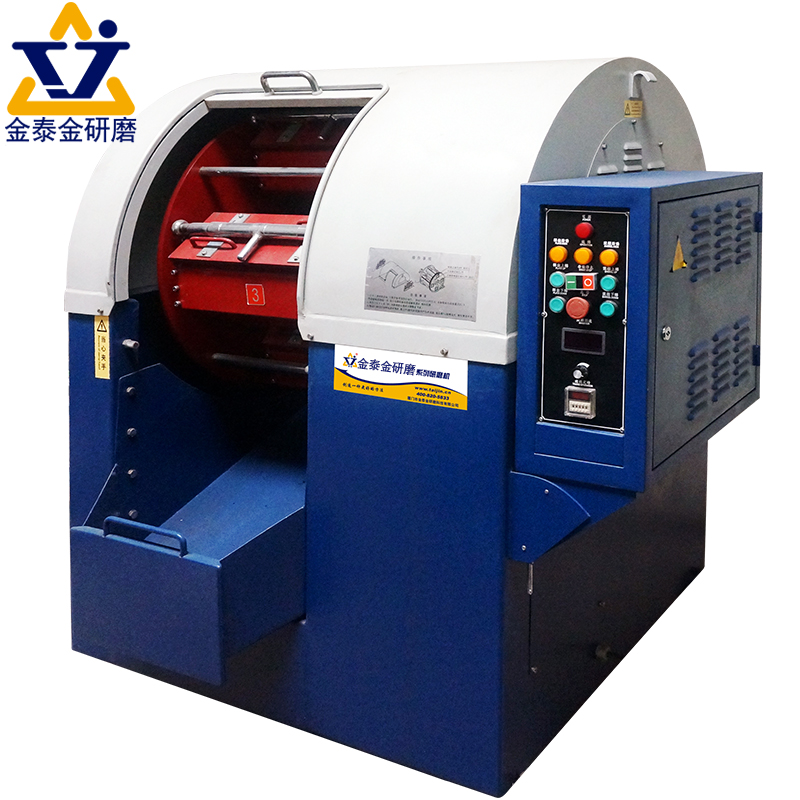
Long parts and heavy parts both fall outside a round bowl. A tub vibrator uses a rectangular chamber, so the working length extends along one axis while the bed stays shallow, which suits linear-axis beams, long manifolds and welded frames that cannot tumble end over end. The part is immersed or supported rather than turned, which removes bending risk from a divider, but energy per unit area is lower and a heavy burr takes longer. A grinding finishing machine works the other way, using higher removal energy to take off a defined layer or a heavy machining burr before refinement. That route cuts functional edges quickly and needs a tighter assessment of what may be removed. The deciding questions are part length, mass, how the part can be supported, and whether the critical face can be presented to the media at all.
| Machine route | Where it fits | What it will not do |
|---|---|---|
| Grinding finishing machine | Taking off a heavy machining burr, dross or a defined stock layer before a refinement pass on robust steel and stainless work | High removal energy cuts functional edges fast and demands a tighter assessment of what may be removed and how much |
| Barrel finishing machine, rotary barrel tumbling | Gentle deburring of small fragile parts and mixed batches of screw-machine components with a generous compound flow | Long cycles, no visibility while running, and internal features can collect media and compound that must be retrieved at unload |
| Disc finishing machine | Fast, high-energy edge breaking and surface refinement on small robust parts and uniform batches of gripper jaws, blocks and fittings | High impingement and edge-loss risk on thin, soft or aluminium parts, and the geometry must suit the disc working gap |
| Tub vibrator | Long parts such as linear-axis beams, manifolds and welded frames that cannot rotate in a bowl | Lower energy per unit area so heavy burrs take longer, and large tubs need floor space and a reliable part support method |
Shape decides what the marks look like, often more than the material label does. Spheres and rounded shapes leave overlapping craters, which suits a general deburred or satin appearance but reads as a peened, dimpled surface. Angle-cut triangles, cylinders and cones strike along their axis and leave a linear pattern, which suits visible covers, panels and brackets where a direction is wanted. The mass of the media then sets the cutting power, so a heavy ceramic charge removes a milled burr faster and also reaches edges sooner. On aluminium, a coarse angular charge can fold or smear the surface instead of cutting it cleanly. Choose the shape against the appearance the part must carry and the edges that must keep their radius, then keep the shape class stable, because a charge that has worn into rounded forms behaves differently from a fresh one.
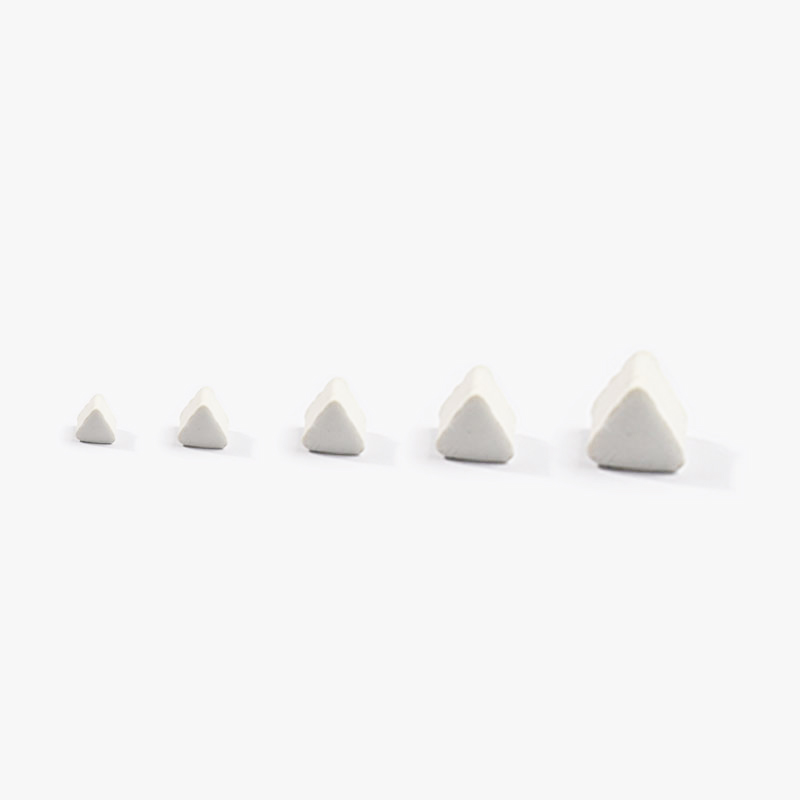
| Media | Best fit | Watch out for |
|---|---|---|
| Fine ceramic or porcelain shapes in a small size class | Edge blending and surface refinement after a cutting stage, and reaching tighter external geometry on machined housings and brackets | Small sizes enter and retain in tapped holes and fine slots, and media wear shrinks the charge so the finish drifts over its life |
| Steel media, including balls and shaped pins | Bright finishing and edge blending on stainless automation components where appearance and a burnished surface matter | Transfers iron to aluminium and carbon steel, needs a corrosion-inhibiting compound, and must be separated magnetically or by screen at unload |
| Plastic cylinders and cones in a harder, denser grade | Longer cycles on mixed batches of small fittings and screw-machine parts where a repeatable light edge break is wanted without ceramic impact | Can float or segregate by shape in a bowl, and cylindrical forms can wedge in slots, keyways and cross-drillings |
| Dry media such as walnut shell and corn cob | Drying assistance and light surface polish after a wet cycle, particularly on parts with pockets and threads that must not stay wet | Does not deburr or refine metal significantly, generates dust, and must not be treated as a cleanliness step |
Too much energy does not leave a smooth surface; it deforms one. Impingement shows as bright impact marks, dents on thin cover plates, flattened corners and a rippled or peened appearance on aluminium faces that should be flat. It comes from a heavy or dense charge, a high load ratio, a part that is too large a fraction of the load, or light parts left loose among heavy neighbours. A soft aluminium housing run in the same charge as steel brackets will show the marks first. Checking means looking for repeating mark patterns on exposed faces, comparing a part run loose with the same part compartmentalised, and reviewing the batch record for the mix and load that produced the lot. The practical fixes are separation, a lighter route, a shorter cycle and a charge sized to the part rather than to the chamber.
| Failure mode | Likely cause | How to catch it |
|---|---|---|
| Compound film, smut or tenacious residue left on a face or in a bore | A film-forming or silicate-bearing compound, insufficient rinse volume, or drying a part before it is genuinely clean | Magnify the suspect surface, wipe a defined area with solvent against a clean reference, and confirm with the buyer's own cleanliness method |
| A ceramic, plastic or steel medium lodged in a tapped hole, keyway, cross-drilling or seal groove | Media size class too close to the opening, a charge that has worn or fractured into smaller pieces, or a retention feature that was never mapped | Count the charge in and out where practical, pin or thread gauge every hole, borescope the smallest passages at an agreed angle, and rinse through a filter for a visual check |
| Uneven finish with unrefined pockets, internal corners or the shielded side of a flange | Media cannot reach the feature at the chosen size or orientation, charge circulation is blocked, or the part was never repositioned during the cycle | Inspect at defined locations rather than judging the whole part, photograph the same feature before and after, and measure roughness only at the surfaces the drawing controls |
| Rust spotting on stainless parts appearing hours or days after finishing | Ferrous transfer from steel media, a machine or tooling that has held carbon steel, or insufficient corrosion inhibition and drying | Inspect after a defined dwell time rather than immediately, look for pinpoint spots on and near edges, and trace the media and machine history for the lot |
Calgary is Canada's energy head-office city and has been building aerospace, life sciences and logistics depth on top of that base. Calgary Economic Development reports that more than 70 major energy companies have head offices in the city and that 462 of Alberta's 940 cleantech companies are headquartered there. The aerospace sector is real but narrower than Montreal's: the region's aerospace ecosystem is anchored by applied research and development, aerospace components and parts manufacturing, maintenance, repair and overhaul (MRO), and unmanned systems, with CAD 3 billion contributed to Alberta's GDP in 2024 and over 100 direct global routes from Calgary International Airport. Life sciences has grown to more than 140 companies in human and animal health, with medical device manufacturing and diagnostics among the growth subsectors. Logistics is a genuine industrial cluster in its own right, with both CPKC and CN headquartered in Calgary and the proposed Prairie Economic Gateway inland port positioned to add manufacturing, processing and distribution capacity.
For this brief the relevant part of that base is automation: Calgary Economic Development lists digital supply chain and logistics automation and intelligent transportation among the subsectors driving growth in the city's transportation and logistics sector.
Calgary's energy and oilfield service base generates a continuous flow of valve bodies, fittings, pump components, tubular connections and machined parts where burrs at sealing faces and threads are a leak-path and galling risk, and where surface finish on sealing surfaces is a functional specification. Aerospace components and MRO work in the same city adds edge-condition and cleanliness requirements on machined aluminium and steel parts, and the emerging medical device and diagnostics manufacturing base adds small, high-value parts where hand deburring variability is the main quality problem. Because both the energy and aerospace customers operate under formal quality systems, the finishing step usually has to be documented and repeatable rather than operator-dependent.
A Calgary buyer should settle which surface is actually functional before choosing a process: on valve, pump and tubular components the acceptance criterion is usually a specific sealing-face finish and a burr-free thread or edge, and that determines whether vibratory, centrifugal or spindle finishing is even applicable, and whether edge radius rather than surface roughness is the real specification. The second question is repeatability across shifts, because energy and aerospace customers increasingly require documented, repeatable surface condition rather than a finish that depends on which operator ran the part.
Freight context: YYC Calgary International Airport and YYC Global Logistics Park, CPKC headquarters and intermodal terminals, CN intermodal terminals, Prairie Economic Gateway inland port (proposed). Calgary handles 75 per cent of Alberta's air cargo shipments through YYC and has over 100 direct routes into Europe and the Americas, and both Class 1 railways are headquartered in the city, giving access to West Coast ports and to centres in Canada, the United States and Mexico. The proposed Prairie Economic Gateway inland port, a City of Calgary and Rocky View County partnership, is projected to generate over CAD 7 billion in economic activity and more than 30,000 jobs over 10 to 12 years, and is explicitly targeted at manufacturing, logistics, processing and distribution.
Canada's national standards system is coordinated by the Standards Council of Canada (SCC), which accredits standards-development organizations, certification bodies and testing laboratories; the SCC and CSA Group websites could not be retrieved for citation during this research, so this entry rests on the accessible Government of Canada and CCOHS material below. The Canadian Centre for Occupational Health and Safety describes standards as documents that "establish specifications and procedures to ensure the reliability of the products, methods, and services people use every day on the job", and Innovation, Science and Economic Development Canada (ISED) maintains the federal entry point for "[t]he different types of standards and certifying bodies that can be used by your business". In practice a Canadian buyer of finishing equipment references (a) the Canadian electrical safety certification of the machine and its control panel, (b) provincial occupational health and safety regulation for machine guarding, lockout and dust/ventilation control, which in Canada is enforced by the provinces rather than by a single federal inspectorate, and (c) the buyer's own customer-specific surface finish, edge-condition and cleanliness specifications, which are contractual rather than national standards. Finishing-process standards in the ISO 25.080 machine-tool and ISO 8500-series surface-preparation families are the usual technical reference points, but product-level standards sold by CSA Group were not retrievable for verification here.
China is one of Canada's ten principal merchandise trading partners and the second-largest single-country source of Canadian imports after the United States: Statistics Canada reported CAD 5,369 million of balance-of-payments imports from China in January 2025, against a CAD 2,299 million bilateral merchandise deficit that month. Canada has no free trade agreement with China, so Chinese-origin industrial machinery enters under the Most-Favoured-Nation (MFN) tariff column of the Canadian Customs Tariff; the preferential treatments listed in the tariff (CUSMA/UST and MXT, CETA/CEUT, CPTPP/CPTPT, UKT, KRT and others) do not include China, and preferential rates require proof of origin plus the applicable shipping rules, so a China-origin machine cannot claim them. Tariff classification is mandatory work, not a formality: vibratory, barrel, centrifugal and disc finishing machines are classified in Chapter 84 ("Nuclear reactors, boilers, machinery and mechanical appliances; parts thereof") according to the function of the machine, and the ten-digit Canadian tariff item drives both the duty rate and the statistics. A further landed-cost risk sits outside the tariff schedule: under the Special Import Measures Act (SIMA), the CBSA and the Canadian International Trade Tribunal may apply anti-dumping and countervailing duties to named goods, so a buyer should check the measures-in-force list for the specific product before assuming the MFN rate is the final duty.
SurfacePolish supplies from Xiamen, China. The buyer's own destination rules, conformity marking, tariff classification and documentation responsibilities stay with the buyer; confirm them against the authorities named above before ordering.
Some failures never show on a surface. Measure the features that can move: bore diameters and roundness with a bore gauge or CMM, dowel hole position, flatness of a mounting face on a surface plate or CMM, wall thickness on a thin housing, and thread condition with go and no-go gauges, since edge finishing can open or gall a thread crest. Where the part carries a pneumatic or hydraulic passage, a flow or pressure check against a reference part catches a lodged medium or a burr that visual inspection misses. Where a seal or gasket seats, the buyer's own leak or assembly check is the only test that sees a rounded land or a residue film. These checks belong to the buyer's quality function against the buyer's own limits; a finishing report is supporting evidence rather than a release.
Send parts that represent the real range rather than one convenient sample. Include the part with the tightest hole, slot or cross-drilling, the thinnest unsupported section, the functional surface that must not be touched, and at least one part in its normal as-received condition with the usual burr, chips and cutting oil. Cover every alloy and temper in the family, because aluminium and stainless behave differently under the same charge. Add a coupon of the same material with a known starting roughness so a measurement can be compared before and after. Supply a marked-up drawing naming the controlled surfaces, edge limits and any cleanliness requirement, and a short note on what the part does in service. Several pieces let more than one stop point be examined; one part answers one question.
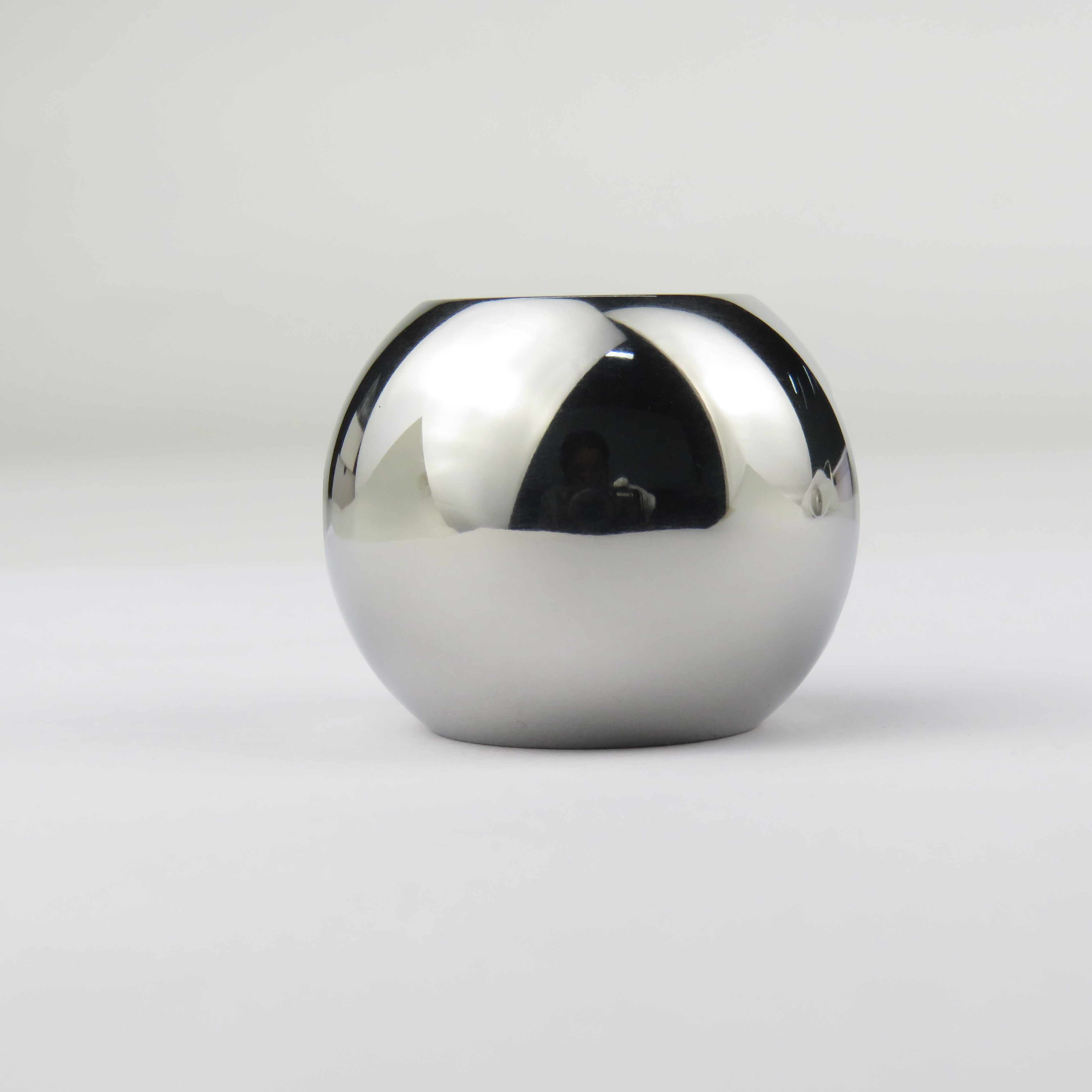
SurfacePolish does not coat, anodise or paint parts, and no finishing cycle here should be treated as a coating preparation specification. A coating or anodising step usually makes residue, smut and embedded debris more visible rather than less, and a compound film left in a bore becomes your problem at the next operation. Define what your own coating process requires and how you will verify it, then ask for the parts to be checked against that requirement. A trial can report what was observed on the tested surfaces and the settings used, but the fitness of a surface for a downstream coating step is your own process decision.
A trial shows what a given machine, charge and setting did to the parts tested, which is useful evidence but not a sizing study. Machine size depends on the largest envelope and mass in the family, the smallest part that must meet the same appearance, the load ratio you intend to run, and how many stages the part needs. Those are planning questions that belong in a line-concept discussion alongside the trial result. A part tested on a small machine may behave differently in a larger chamber, and a part run in a full production load may come out differently from one run in a light trial batch. Record both the settings and the load.
There is no single best medium, because aluminium is soft and the trade-off is between cut rate and surface damage. Plastic media is often the safer starting point where a machined face, a thin wall or a bore lip must be preserved, while a fine ceramic cuts faster if the edges tolerate more energy. The deciding variables are the smallest opening a medium could enter, the smallest radius that must not be rounded, and the surface condition the next operation needs. Media size class usually matters more than the broad material name. Send a marked-up part with its tightest feature and one controlled face, and let the trial compare two size classes.
Use Calgary, Canada as the destination on the enquiry and state whether the deliverable is equipment, media and compound, a representative sample review or a line concept. A destination does not imply local stock, a local service point or a local delivery time.
A Calgary buyer in the energy supply chain normally works to the end-user's material and inspection specification for sealing faces, threads and surface finish, plus the requirements of the applicable pressure-equipment or pipeline standard their customer names. On the plant side, Alberta occupational health and safety rules for guarding and lockout apply, along with Canadian electrical safety certification for the equipment.
Sources were retrieved on 2026-09-29 and describe the local industrial and trade context only. They do not evidence any SurfacePolish project, shipment, installation or service in Calgary.
The buyer needs a consistent light edge break across the batch without rounding the pivot hole or blunting the serrations.
Send the material, dimensions, approximate weight, batch quantity, the incoming condition and photographs of the difficult features. Mark which features must not be contacted by media and state how the result will be inspected. This form carries source reference PSEO-0140; quote it if you prefer an additional manual reference.
Open the SurfacePolish enquiry form Email a prepared enquiry
No price, lead time, certification or result is promised here. Confirm whether a sample trial is available for the specific part and what the trial can and cannot show.
Page PSEO-0140 · revised 2026-09-29 · cross-border equipment, media and scoped sample review. City context is sourced and cited above.
Use this local checker to identify missing part and inspection information. It prepares a technical-review brief; it does not approve a machine, process recipe or production result.
Complete the part details to prepare a review brief.
Email : info@surface-polish.com


 IPv6 network supported


 +86-592-2381506