A precision turned parts supplier in Coventry, United Kingdom in robotics and automation has a mixed batch of small stainless bushings and pins that need a consistent edge break without media trapped in the cross-holes. SurfacePolish supplies finishing machines, media and compounds across borders and offers a free sample trial: a representative batch travels to Xiamen and returns with observations and a proposed media, compound and cycle direction for the buyer to compare. This brief is written for a buyer in Coventry working on robotics and automation; it describes equipment, media and a scoped sample review, not a local polishing service.
Which alloys and tempers run through the shop, and how will media, machines and compounds be purged between aluminium, stainless and steel work?
What does the finishing step actually have to deliver before the next operation, whether that is assembly, anodising, painting or a functional test, and who defines that requirement?
What is the smallest hole, slot, keyway or cross-drilling the charge must not enter or plug, and how will a lodged medium be detected and removed?
Automation work mixes scales in a way that catches buyers out. The same shop may finish a 40 kg robot base casting and a 30 g gripper jaw, and a machine sized for the casting will over-work the jaw. Load ratio, the mass of parts against the mass of the charge, is the variable that usually decides whether small parts come out even or rounded. Screen the family on its extremes: the heaviest part, the largest envelope, the thinnest unsupported wall and the smallest part that must meet the same appearance. Long linear-axis beams and thin cover plates distort under their own weight in a deep bed, while heavy castings need a chamber large enough to keep them moving. A shortlist built on the average part will miss both ends of the range.
Rotary barrel finishing is the gentle end of the range. Parts tumble in a closed drum, usually with plastic or light ceramic media and a generous compound flow, so direct impact is limited and small fragile components such as spools, pins, bushings and screw-machine parts survive. Cycles are long and the drum hides the work while it runs. Magnetic finishing works differently: a small charge of pin-shaped or fine media is driven by a moving field into narrow gaps, small bores and fine internal radii that tumbling media cannot enter, which suits precise items such as orifice plates, small valve spools and fine slot arrays. Its working envelope is small, the pins are a lodging risk in the features they are chosen to reach, and the surface signature differs from tumbling, so a roughness value from one route does not transfer to the other.
| Machine route | Where it fits | What it will not do |
|---|---|---|
| Disc finishing machine | Fast, high-energy edge breaking and surface refinement on small robust parts and uniform batches of gripper jaws, blocks and fittings | High impingement and edge-loss risk on thin, soft or aluminium parts, and the geometry must suit the disc working gap |
| Dry polishing machine and dryer | Removing residual moisture after a wet cycle and reducing water spotting on aluminium and stainless surfaces with pockets and threads | A finishing step only; a dry part can still carry compound film, fines and media dust, so it is not a cleanliness release |
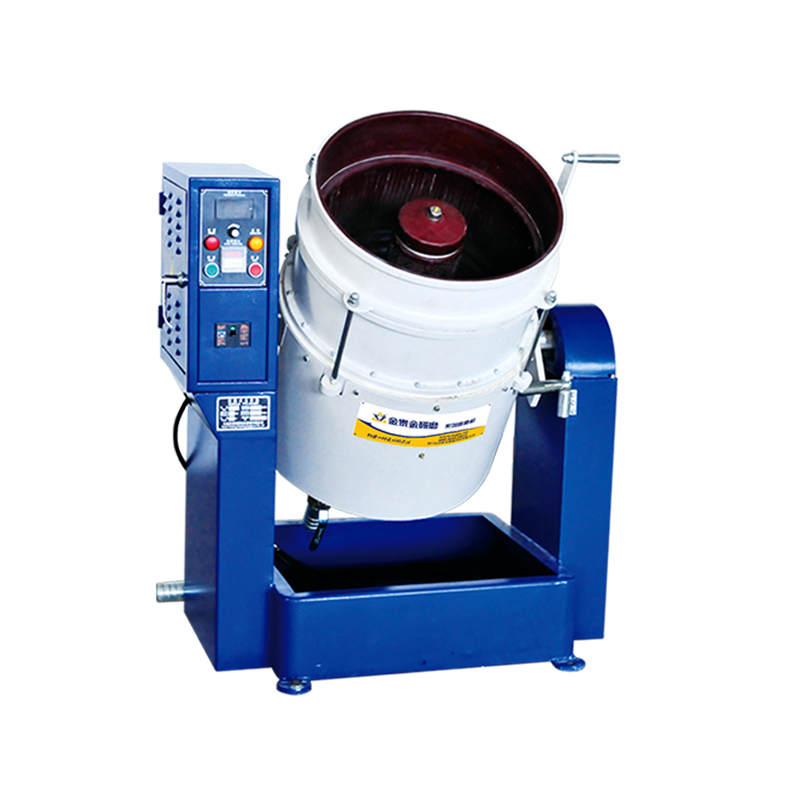
| Magnetic finishing machine | Fine deburring and light refinement of small precise features such as small bores, narrow slots and fine internal radii | Small working envelope that excludes housings and long parts, with pin media that can lodge in the fine features it reaches |
| Vibratory finishing machine, bowl type | General deburring and refinement of machined housings, plates and brackets that fit and can tumble without racking, with easy mid-cycle inspection | Continuous part-on-part contact and no access to deep internal passages; thin plates and finished mounting faces need separation |
Media has to be small enough to enter the pocket or passage that must be finished and large enough not to lodge in a tapped hole, a cross-drilling, a keyway or a seal groove. Those two conditions conflict on almost every automation part, and the usual resolution is to plug or mask the openings rather than to compromise the charge. Measure the narrowest opening a medium could enter, and the depth behind it, and compare that against the smallest medium in the proposed charge. Threads are the classic retention point: a medium that enters a tapped hole is difficult to see and easy to leave behind. Where a passage genuinely needs work, plan a defined retrieval and check step rather than assuming parts come out clear. Media wear shrinks the charge over its life, so a size class that is safe when new can become a lodging risk later.
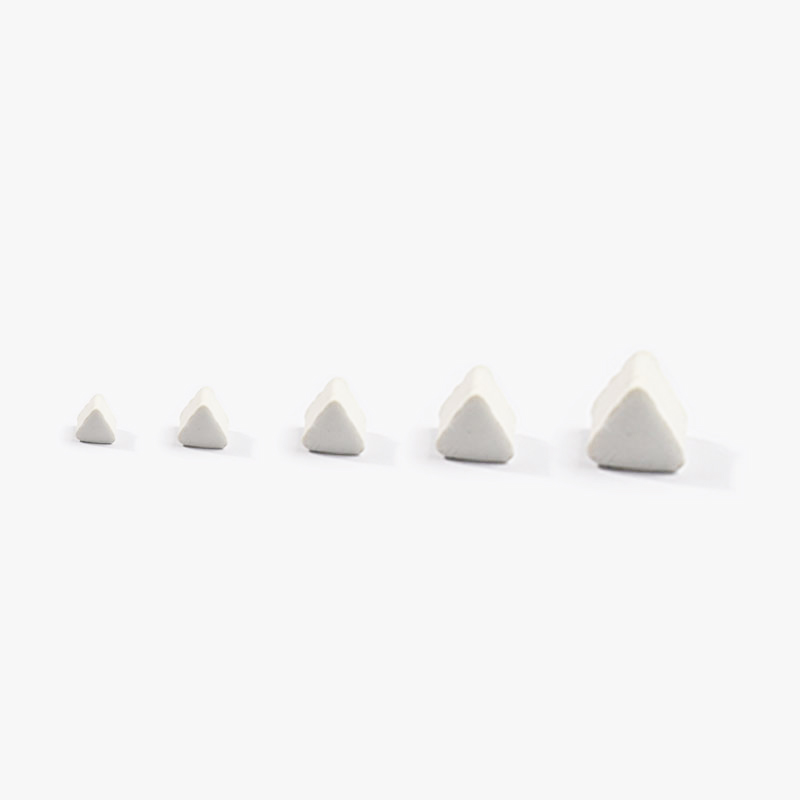
| Media | Best fit | Watch out for |
|---|---|---|
| Fine ceramic or porcelain shapes in a small size class | Edge blending and surface refinement after a cutting stage, and reaching tighter external geometry on machined housings and brackets | Small sizes enter and retain in tapped holes and fine slots, and media wear shrinks the charge so the finish drifts over its life |
| Plastic triangles, cones and pyramids in a soft to medium grade | Deburring aluminium housings, gripper plates and other soft alloy parts where surface marking and edge rounding must be kept to a minimum | Slow cut rate, media deforms and wears, and a worn charge behaves noticeably differently from a fresh one |
| Heavy-cut ceramic, angle-cut triangles in a coarse size class | Removing a substantial milled or turned burr from open external edges and pockets on steel and stainless automation parts before a refinement stage | Cuts functional edges and corners aggressively, leaves a coarse surface on aluminium, and lodges in slots whose width approaches the media section |
| Aluminium oxide grinding media in a dense ceramic bond | Heavier stock removal or a more consistent cut on robust steel and stainless parts with thick edges and a defined layer to remove | High removal energy rounds functional edges quickly and is a poor match for thin aluminium plates, cast housings and bore lips |
Too much energy does not leave a smooth surface; it deforms one. Impingement shows as bright impact marks, dents on thin cover plates, flattened corners and a rippled or peened appearance on aluminium faces that should be flat. It comes from a heavy or dense charge, a high load ratio, a part that is too large a fraction of the load, or light parts left loose among heavy neighbours. A soft aluminium housing run in the same charge as steel brackets will show the marks first. Checking means looking for repeating mark patterns on exposed faces, comparing a part run loose with the same part compartmentalised, and reviewing the batch record for the mix and load that produced the lot. The practical fixes are separation, a lighter route, a shorter cycle and a charge sized to the part rather than to the chamber.
| Failure mode | Likely cause | How to catch it |
|---|---|---|
| Grey aluminium smear transferred onto stainless parts in a shared batch | Aluminium fines retained in media, compound or the machine sump after an aluminium lot, with no purge before the stainless lot | Check stainless surfaces under angled light for a dull grey film, review the changeover record, and inspect the charge and sump for retained fines |
| Uneven finish with unrefined pockets, internal corners or the shielded side of a flange | Media cannot reach the feature at the chosen size or orientation, charge circulation is blocked, or the part was never repositioned during the cycle | Inspect at defined locations rather than judging the whole part, photograph the same feature before and after, and measure roughness only at the surfaces the drawing controls |
| Bearing bore, bore lip or dowel hole edge rounded past the drawing limit | High-energy route, over-long cycle, dense or coarse media, or a functional edge run without masking or a shielding fixture | Measure the defined edge feature before and after with an optical comparator, radius gauge or moulded replica, and compare it with the maximum radius on the drawing |
| Burr remaining inside a cross-drilled intersection or an internal corner | Media too large to enter the intersection, part orientation that shields the feature, or a cycle stopped before that feature was reached | Borescope the intersection at a fixed angle, compare with a first-article reference, and use a pin or probe to feel for a lip on sampled parts |
Coventry is one of the local authority areas inside the West Midlands Combined Authority, whose region-wide economic and skills activity includes a skills hub opened at Coventry city centre South. The city's dedicated business support route changed on 1 April 2026, when the Coventry & Warwickshire Growth Hub transitioned to a new regional model that centralises programmes, events and funding information through Business Growth West Midlands, with local advisory support remaining available through Coventry City Council. Coventry sits inside the West Midlands production base that Make UK studied with the West Midlands Combined Authority and the West Midlands RAS Cluster, surveying over 100 manufacturers of all sizes.
For this brief the relevant part of that base is automation: The regional business support route for Coventry moved to Business Growth West Midlands on 1 April 2026, centralising programmes, events and funding for the area's firms.
Coventry sits inside the West Midlands production base that Make UK and the West Midlands Combined Authority surveyed on robotics and autonomous systems adoption - a programme aimed at lifting productivity in an industrial base where deburring and edge finishing sit between machining and assembly and are a candidate for the same automation programme. Because no Coventry-specific industrial source could be verified in this research, process specifics should be drawn from the customer's drawing and specification rather than from regional averages.
A Coventry buyer should confirm who in the supply chain owns the finishing specification - the OEM, the tier-one or the machining supplier - before selecting equipment, because the edge and cleanliness requirement is normally flowed down contractually rather than agreed locally.
Freight context: Hams Hall Rail Freight Terminal (ABP-owned, near Birmingham) as the nearest inland container terminal to Coventry, West Midlands motorway network (M6, M69, A45) for road freight. ABP's 11ha Hams Hall terminal, located eight miles outside Birmingham, handles deep-sea and short-sea traffic to and from ports such as Southampton, Tilbury and Felixstowe along with Channel Tunnel and Scottish domestic traffic, making it the practical inland container gateway for Coventry consignments.
Importers need a GB-prefixed Economic Operators Registration and Identification (EORI) number, an import declaration carrying the correct commodity code, and retained commercial invoices plus the Import VAT Certificate (C79) so import VAT can be reclaimed. Machinery placed on the Great Britain market must be marked UKCA or CE: the manufacturer must draw up and retain technical documentation including a Declaration of Conformity, apply the correct marking with identification details, and cooperate with market surveillance; an authorised representative must be established in the UK. Under the Product Safety and Metrology (Amendment) Regulations 2024 the UK continues to recognise CE marking alongside or in place of UKCA for the Great Britain market, so either route can be used for most product types. Duty and import VAT are calculated from the customs value declared, and the commodity code also determines whether an import licence is needed.
English is the working language of contracts, drawings and conformity paperwork, so quotations, technical files and Declarations of Conformity should be supplied in English. UK manufacturers have now recovered above 2019 output levels in every English region and devolved nation except Northern Ireland, and the sector is concentrated in food and drink and transport equipment, with the North West the largest manufacturing region by total output. Buyers typically expect the UKCA/CE route, a Declaration of Conformity and a UK-established economic operator to be identified before order, and they need commercial invoices, customs declarations and the C79 retained in a form their finance team can use for import VAT recovery. No source verified in this research establishes a mandated payment instrument, so payment structure should be treated as commercial negotiation rather than a regulatory requirement.
SurfacePolish supplies from Xiamen, China. The buyer's own destination rules, conformity marking, tariff classification and documentation responsibilities stay with the buyer; confirm them against the authorities named above before ordering.
Ask for a record that says what was actually done, rather than one that asserts a result. A useful batch record lists the part numbers and quantities in the lot, the machine used, the media type and size class, the charge mass and its age since the last screen or top-up, the compound product and dose, the rinse water source, the cycle time and any interruption, plus the inspection results and the lot disposition. Request the media and compound data sheets offered by the supplier. Where aluminium and stainless run in the same shop, ask for the changeover note covering media purge, machine cleaning and compound replacement. This is process documentation from a finishing operation, not a certificate of compliance with any standard, and it supports the buyer's own traceability.
Change one variable at a time. If the question is media shape, hold the machine, load, compound, cycle time and part mix constant and change only the medium. If the question is cycle time, hold the charge and settings constant and stop at two or three defined intervals. Use adjacent coupons or parts from the same production lot so the only difference is the variable under test. Label the pieces before they run and have the returned parts judged in one session under the same light, rather than one at a time as they arrive. Where several people judge appearance, ask each to rank the parts before discussion so the strongest opinion does not set the answer. Running two changes at once produces a result that cannot be attributed to either.

Ask for a record that identifies what was done rather than one that asserts a result. A useful record lists the part numbers and quantities in the lot, the machine used, the media type and size class, the charge mass and its age since the last screen or top-up, the compound and dose, the rinse water source, the cycle time, any interruption, the inspection results and the lot disposition. Request the media and compound data sheets. Where aluminium and stainless are processed on the same site, ask for the changeover note covering media purge, machine cleaning and compound replacement. This is finishing process documentation, not a certificate of compliance.
SurfacePolish does not coat, anodise or paint parts, and no finishing cycle here should be treated as a coating preparation specification. A coating or anodising step usually makes residue, smut and embedded debris more visible rather than less, and a compound film left in a bore becomes your problem at the next operation. Define what your own coating process requires and how you will verify it, then ask for the parts to be checked against that requirement. A trial can report what was observed on the tested surfaces and the settings used, but the fitness of a surface for a downstream coating step is your own process decision.
Yes. The offer is cross-border supply of finishing machines, media and compounds, together with a free sample trial and a scoped discussion of a finishing line concept. That means machine class, media and compound are considered as one question rather than three purchases, since a charge that suits one chamber may not suit another. The buyer keeps ownership of the part, the drawing and the acceptance criteria, and we do not verify the material, the upstream machining or the heat treatment. Bring the part family, the alloys, the size range and the features that must be protected into the discussion, along with the condition the parts arrive in.
Use Coventry, United Kingdom as the destination on the enquiry and state whether the deliverable is equipment, media and compound, a representative sample review or a line concept. A destination does not imply local stock, a local service point or a local delivery time.
Machinery placed on the Great Britain market needs UKCA or CE marking with a Declaration of Conformity, and HSE's work equipment and machinery and COSHH regimes govern safe operation and the media, compounds and dust involved. In a multi-tier supply chain, the surface, edge and cleanliness requirement is normally flowed down from the OEM or tier-one rather than set by the finishing shop.
Sources were retrieved on 2026-09-29 and describe the local industrial and trade context only. They do not evidence any SurfacePolish project, shipment, installation or service in Coventry.
The buyer needs a repeatable edge break and a uniform appearance across the mixed batch without media lodging in the cross-holes.
Send the material, dimensions, approximate weight, batch quantity, the incoming condition and photographs of the difficult features. Mark which features must not be contacted by media and state how the result will be inspected. This form carries source reference PSEO-0290; quote it if you prefer an additional manual reference.
Open the SurfacePolish enquiry form Email a prepared enquiry
No price, lead time, certification or result is promised here. Confirm whether a sample trial is available for the specific part and what the trial can and cannot show.
Page PSEO-0290 · revised 2026-09-29 · cross-border equipment, media and scoped sample review. City context is sourced and cited above.
Use this local checker to identify missing part and inspection information. It prepares a technical-review brief; it does not approve a machine, process recipe or production result.
Complete the part details to prepare a review brief.
Email : info@surface-polish.com


 IPv6 network supported


 +86-592-2381506