A precision turned parts supplier in Fukuoka, Japan in robotics and automation has a mixed batch of small stainless bushings and pins that need a consistent edge break without media trapped in the cross-holes. SurfacePolish supplies finishing machines, media and compounds across borders and offers a free sample trial: a representative batch travels to Xiamen and returns with observations and a proposed media, compound and cycle direction for the buyer to compare. This brief is written for a buyer in Fukuoka working on robotics and automation; it describes equipment, media and a scoped sample review, not a local polishing service.
What is the smallest hole, slot, keyway or cross-drilling the charge must not enter or plug, and how will a lodged medium be detected and removed?
Which alloys and tempers run through the shop, and how will media, machines and compounds be purged between aluminium, stainless and steel work?
Which surfaces on the part are functional, such as bearing bores, dowel holes, seal lands, ground mounting faces and threads, and which are only cosmetic?
Automation work mixes scales in a way that catches buyers out. The same shop may finish a 40 kg robot base casting and a 30 g gripper jaw, and a machine sized for the casting will over-work the jaw. Load ratio, the mass of parts against the mass of the charge, is the variable that usually decides whether small parts come out even or rounded. Screen the family on its extremes: the heaviest part, the largest envelope, the thinnest unsupported wall and the smallest part that must meet the same appearance. Long linear-axis beams and thin cover plates distort under their own weight in a deep bed, while heavy castings need a chamber large enough to keep them moving. A shortlist built on the average part will miss both ends of the range.
Inside any machine, the way parts are carried decides whether the finish is even and the geometry survives. Parts left loose together nibble each other along contact lines and produce bright impact marks on visible faces. Cradles that follow a casting, compartments, dividers and clip-on carriers present the same face to the media on every part and protect machined lands. Load ratio matters as much: too many parts in the charge reduces circulation and leaves shielded pockets unworked, while too few allows parts to be thrown against the chamber wall. Build the arrangement around the most delicate and the heaviest part in the family rather than an average one. Where a buyer plans automated loading or transfer between operations, the fixture interface, the orientation and the pick points belong to the buyer's own engineering scope and are defined and verified on that side.
| Machine route | Where it fits | What it will not do |
|---|---|---|
| Magnetic finishing machine | Fine deburring and light refinement of small precise features such as small bores, narrow slots and fine internal radii | Small working envelope that excludes housings and long parts, with pin media that can lodge in the fine features it reaches |
| Tub vibrator | Long parts such as linear-axis beams, manifolds and welded frames that cannot rotate in a bowl | Lower energy per unit area so heavy burrs take longer, and large tubs need floor space and a reliable part support method |
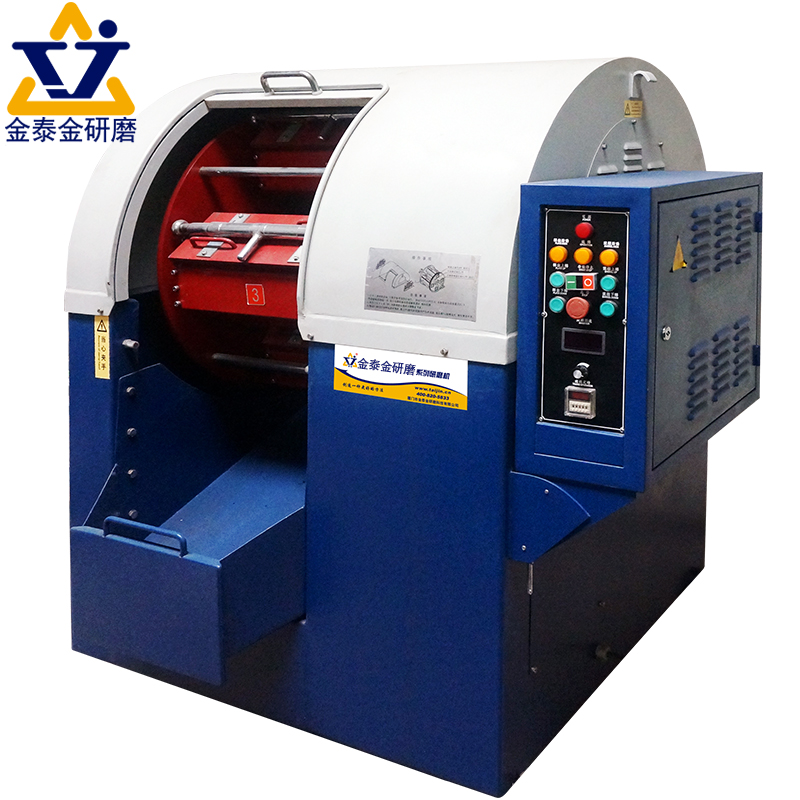
| Grinding finishing machine | Taking off a heavy machining burr, dross or a defined stock layer before a refinement pass on robust steel and stainless work | High removal energy cuts functional edges fast and demands a tighter assessment of what may be removed and how much |
| Disc finishing machine | Fast, high-energy edge breaking and surface refinement on small robust parts and uniform batches of gripper jaws, blocks and fittings | High impingement and edge-loss risk on thin, soft or aluminium parts, and the geometry must suit the disc working gap |
The material family of the media sets how much energy reaches the part. Plastic media is lighter and is the conservative choice for aluminium housings, thin cover plates and machined faces that must not be peened, at the cost of a slower cut and a shorter media life. Ceramic cuts harder and holds its shape longer, which suits removing a machining burr from steel and stainless parts and blending edges, but it marks soft aluminium and rounds functional edges faster. Steel media burnishes to a bright appearance and works well on stainless, and it is the wrong starting point for aluminium because it transfers iron and can leave spotting that appears later. Wear behaviour differs across all three: ceramic shrinks and generates sludge, plastic deforms and floats differently, and steel can fracture into slivers.
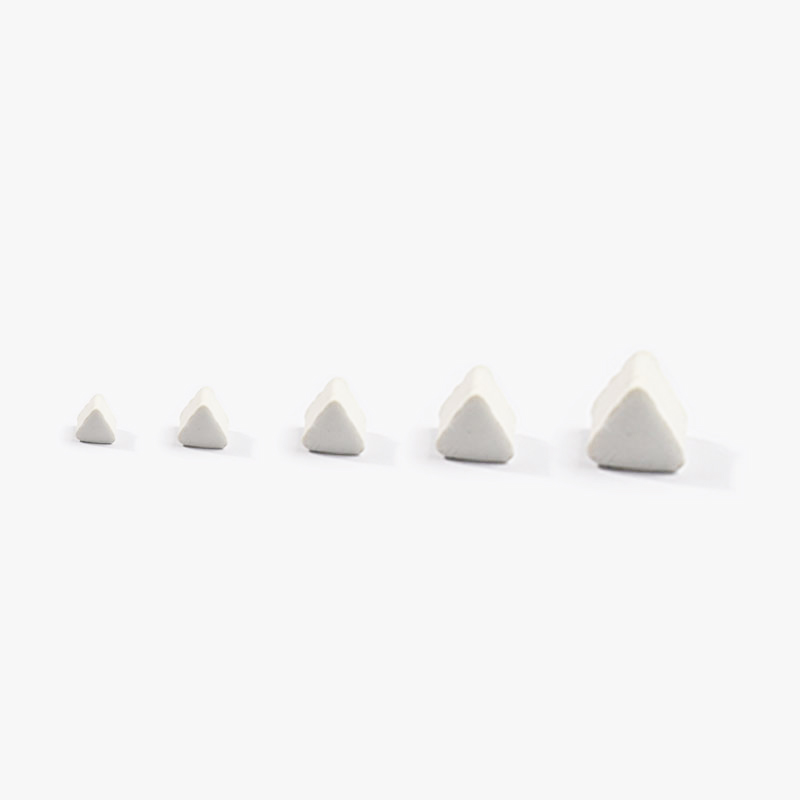
| Media | Best fit | Watch out for |
|---|---|---|
| Plastic triangles, cones and pyramids in a soft to medium grade | Deburring aluminium housings, gripper plates and other soft alloy parts where surface marking and edge rounding must be kept to a minimum | Slow cut rate, media deforms and wears, and a worn charge behaves noticeably differently from a fresh one |
| Magnetic finishing pins and fine magnetic media | Small precise items such as spools, orifice plates, small valve parts and fine slot arrays where tumbling media cannot reach the feature | Limited working envelope, pins lodge in the same fine features they are chosen to reach, and the surface signature differs from tumbling |
| Steel media, including balls and shaped pins | Bright finishing and edge blending on stainless automation components where appearance and a burnished surface matter | Transfers iron to aluminium and carbon steel, needs a corrosion-inhibiting compound, and must be separated magnetically or by screen at unload |
| Aluminium oxide grinding media in a dense ceramic bond | Heavier stock removal or a more consistent cut on robust steel and stainless parts with thick edges and a defined layer to remove | High removal energy rounds functional edges quickly and is a poor match for thin aluminium plates, cast housings and bore lips |
Parts can pass a finish check and still fail because something moved. Thin machined webs, long beams and unsupported walls relax or distort under tumbling loads, so a housing that measured flat before the cycle fails a flatness or position check afterwards, and a soft aluminium part can pick up a bow that only shows on a surface plate. At the same time, media that cannot reach deep pockets, internal corners or the shielded side of a flange leave the original machining marks intact while the exposed faces are fully refined, and the difference becomes obvious once the part is assembled against a mating surface. Both outcomes are caught by measurement rather than by looking harder at the finish: record flatness, wall thickness and critical dimensions at the same points before and after, inspect at defined locations, and treat the batch record as the first place to look for the cause.
| Failure mode | Likely cause | How to catch it |
|---|---|---|
| Grey aluminium smear transferred onto stainless parts in a shared batch | Aluminium fines retained in media, compound or the machine sump after an aluminium lot, with no purge before the stainless lot | Check stainless surfaces under angled light for a dull grey film, review the changeover record, and inspect the charge and sump for retained fines |
| Uneven finish with unrefined pockets, internal corners or the shielded side of a flange | Media cannot reach the feature at the chosen size or orientation, charge circulation is blocked, or the part was never repositioned during the cycle | Inspect at defined locations rather than judging the whole part, photograph the same feature before and after, and measure roughness only at the surfaces the drawing controls |
| Threads rounded, galled or opened out by edge finishing | Media working the thread crest during a long or high-energy cycle, with no plugging or masking on the hole | Run go and no-go thread gauges on every sampled hole, inspect the crest at magnification, and confirm that plugs or masks were fitted and removed |
| Burr remaining inside a cross-drilled intersection or an internal corner | Media too large to enter the intersection, part orientation that shields the feature, or a cycle stopped before that feature was reached | Borescope the intersection at a fixed angle, compare with a first-article reference, and use a pin or probe to feel for a lip on sampled parts |
Fukuoka City is the economic core of Fukuoka Prefecture on Kyushu's north coast, and the prefecture's industrial policy is organised around two formally designated clusters: it has published regional industrial cluster plans for the semiconductor field and the advanced-mobility field under the national Regional Future Strategy, presented as promoting a total of JPY 600 billion of investment, and it maintains an annual map and database of automotive and car-electronics suppliers that listed 1,251 companies across Kyushu in December 2025, 647 of them in Fukuoka Prefecture. The city promotes hydrogen-related industry through its Hydrogen Leader City Project, and states that it opened a hydrogen station producing hydrogen from municipal sewage biogas for fuel-cell vehicles in 2015, which it describes as a world first.
The nearest part of that base to this brief is semiconductor: Fukuoka Prefecture has drawn up a regional industrial cluster plan for the semiconductor field under the national Regional Future Strategy, announced together with a plan for the advanced-mobility field.
Automotive and car-electronics suppliers in the prefecture machine metal parts and housings where burrs and edge condition affect fit, electrical contact and coating adhesion, so deburring and edge control sit on the normal production route rather than in rework. Semiconductor-related equipment work adds a cleanliness requirement, and the city's hydrogen and environmental-equipment activity adds valve, manifold and plate components whose sealing faces depend on surface finish.
For a Fukuoka-area semiconductor-equipment or automotive supplier the first question is which specification governs the feature in question - a JIS or customer-drawing callout for edge condition and surface roughness on a sealing face, an electrical contact or a cosmetic surface - because that decides whether a vibratory or centrifugal barrel process, a disc finishing machine, or a scoped media-and-compound sample trial is the right starting point.
Freight context: 博多港 (Port of Hakata), including the Island City container terminal, 博多港 中央ふ頭 (Chuo Pier). The city's port pages state that Hakata Port is the sea gateway for Kyushu and western Japan and that about 910,000 TEU of international maritime containers were handled in 2025 (Reiwa 7), with Island City and Chuo Pier serving as logistics gateways. Hakata Port is therefore the practical point of entry for incoming finishing machines and for outbound sample parts.
Chinese industrial machinery entering Japan is classified under the Customs Tariff Law, whose harmonised schedule sets the classification and the General Rate; the Temporary Tariff Measures Law sets a Temporary Rate for certain products, and where the WTO rate or an EPA rate for the goods is lower, that lower rate is applied. The applied rate therefore depends on the exact commodity code, and on whether an economic partnership agreement covers the goods and their origin, so a landed-cost figure has to be confirmed against the specific machine before it is quoted. Japan Customs' monthly country table for August 2026 records exports to China of 1,809,133 million yen and imports from China of 2,361,239 million yen, the largest single-country line in the Asian table, with imports from China up 22.5 per cent year on year.
The customs authority is Japan Customs, the Customs and Tariff Bureau of the Ministry of Finance, with regional customs at Tokyo, Yokohama, Nagoya, Osaka and Kobe. Any person importing goods must declare them to the Director-General of Customs and obtain an import permit after examination and payment of customs duty and consumption tax. The declaration is normally filed by the importer or by a customs broker acting as proxy, on a triplicate import (customs duty payment) declaration form (Customs form C-5020) supported by the invoice, the bill of lading or air waybill, a certificate of origin where a WTO rate applies, certificates of origin for preferential rates, packing lists and freight and insurance documents where required, plus any licence or certificate demanded by laws other than the Customs Law. More than 90 per cent of import procedures are computerised. A JIS Mark certificate is a separate, voluntary third-party scheme; foreign exporters are eligible to apply, and certification bodies must comply with ISO/IEC 17065.
SurfacePolish supplies from Xiamen, China. The buyer's own destination rules, conformity marking, tariff classification and documentation responsibilities stay with the buyer; confirm them against the authorities named above before ordering.
Some failures never show on a surface. Measure the features that can move: bore diameters and roundness with a bore gauge or CMM, dowel hole position, flatness of a mounting face on a surface plate or CMM, wall thickness on a thin housing, and thread condition with go and no-go gauges, since edge finishing can open or gall a thread crest. Where the part carries a pneumatic or hydraulic passage, a flow or pressure check against a reference part catches a lodged medium or a burr that visual inspection misses. Where a seal or gasket seats, the buyer's own leak or assembly check is the only test that sees a rounded land or a residue film. These checks belong to the buyer's quality function against the buyer's own limits; a finishing report is supporting evidence rather than a release.
A sample trial answers a narrow question: what happened to these parts under these settings on this equipment. It does not prove that a production lot will be uniform, because load ratio, media age and operator practice all shift the outcome, and it does not transfer a result from a coupon to a complex housing. It cannot establish a particle count, a cleanliness level or fitness for any regulated application, and it does not show whether a machine or medium is approved or qualified for a buyer's process. It cannot establish a cycle time, a cost per part, a capacity or a delivery schedule, and it says nothing about how the surrounding handling or automation should be arranged. Treat the returned parts and the settings record as evidence for the buyer's own engineering and quality decision, and plan the production route with its own first-article and sampling discipline.

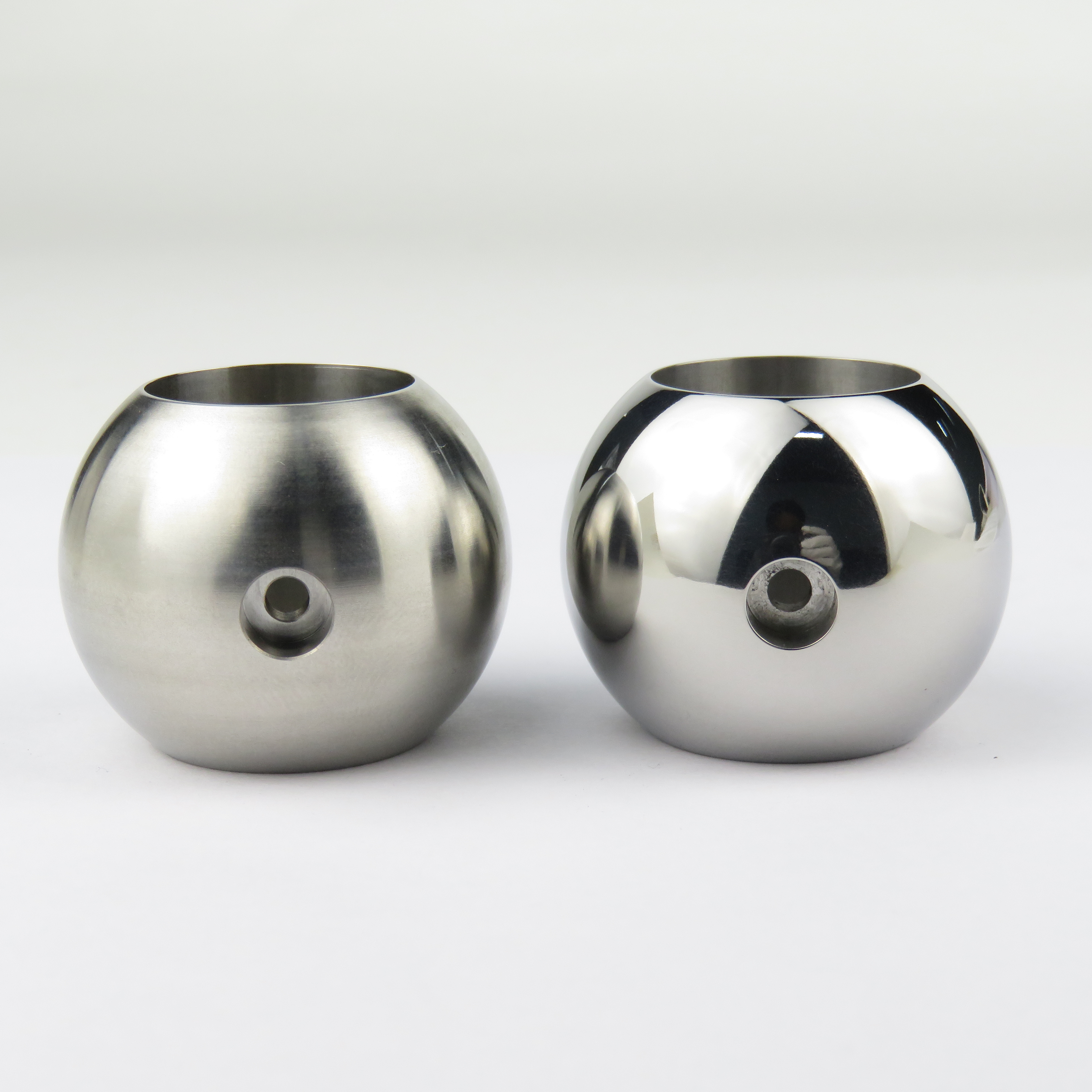
Size the medium well below the smallest opening the charge could enter, and treat every passage as a retrieval point rather than assuming it stays clear. Map the tightest tapped hole, keyway or cross-drilling first, then choose a size class against that geometry instead of an average part. Add a defined check such as a pin or thread gauge on holes, a borescope at an agreed angle and a rinse collected through a filter. For a trial, send the part with the smallest opening so the media choice is tested on the real feature. SurfacePolish reports what was observed on the tested parts; the release decision remains with your own quality function in Japan.
They can, but not without a changeover discipline, because the failure is contamination rather than damage. Aluminium fines retained in media, compound or a machine sump transfer onto stainless as a dull grey smear, and iron from steel media or carbon steel work shows up on stainless as rust spotting that appears hours or days later. Practical controls are dedicated or segregated media charges, a purging routine for the machine and sump, a compound change where needed, and a record of when the changeover happened. Where the volumes justify it, separate machines or separate charges are simpler than a cleaning procedure. Only you can decide which arrangement is acceptable for your own contamination control.
Change one variable at a time. Hold the machine, load, compound, cycle time and part mix constant and change only the medium. Use parts from the same production lot so the only difference is the variable under test. Label the pieces before they run and have the returned parts judged in one session, under the same light and at the same marked measurement points, rather than one at a time. Where several people judge appearance, ask each to rank the pieces before discussion. Where a cut stage is followed by a refinement stage, score the stages separately, because a good final result can hide an unremoved burr or an over-coarse first stage.
Use Fukuoka, Japan as the destination on the enquiry and state whether the deliverable is equipment, media and compound, a representative sample review or a line concept. A destination does not imply local stock, a local service point or a local delivery time.
Japanese buyers work to JIS (Japanese Industrial Standards), enacted and revised under the Industrial Standardization Act and administered through the Japanese Industrial Standards Committee (JISC) at METI; the JISC site publishes JIS enactments and revisions while allowing JIS documents to be read but not printed. Surface-finish and material requirements are normally cited on drawings as JIS or as customer-specific specifications, and management-system certification to ISO 9001 is commonly requested as general industry practice.
Sources were retrieved on 2026-09-29 and describe the local industrial and trade context only. They do not evidence any SurfacePolish project, shipment, installation or service in Fukuoka.
The buyer needs a repeatable edge break and a uniform appearance across the mixed batch without media lodging in the cross-holes.
Send the material, dimensions, approximate weight, batch quantity, the incoming condition and photographs of the difficult features. Mark which features must not be contacted by media and state how the result will be inspected. This form carries source reference PSEO-0880; quote it if you prefer an additional manual reference.
Open the SurfacePolish enquiry form Email a prepared enquiry
No price, lead time, certification or result is promised here. Confirm whether a sample trial is available for the specific part and what the trial can and cannot show.
Page PSEO-0880 · revised 2026-09-29 · cross-border equipment, media and scoped sample review. City context is sourced and cited above.
Use this local checker to identify missing part and inspection information. It prepares a technical-review brief; it does not approve a machine, process recipe or production result.
Complete the part details to prepare a review brief.
Email : info@surface-polish.com


 IPv6 network supported


 +86-592-2381506